
HSE-332 · Lesson 10 of 12 · 27 min
Pipeline right-of-way and ground disturbance
Damage by people digging, boring, ploughing and driving over pipelines is one of the leading causes of pipeline failures in both countries. The pipe itself may be in excellent condition, well coated and cathodically protected, and still be holed in seconds by an excavator bucket or an auger. Most of these strikes happen on the right-of-way, the strip of land over the pipeline where the operator has the legal right to build, operate and maintain it. HSE-330 introduced ground disturbance on leases: locating buried facilities, the zones around them, hand exposure and hydrovac, and what to do if a line is hit. This lesson looks at the pipeline right-of-way from the operator's side and from the side of anyone working near it: what the right-of-way is, the rules that protect it, how crossings and third-party work are managed, the hazards that pipeline crews face while working on rights-of-way and how a strike becomes an emergency.
What a right-of-way is
Pipeline companies rarely own the land their lines cross. Instead they hold easements or right-of-way agreements with landowners, who keep ownership and most uses of the land, such as farming and grazing, but agree not to build on or disturb the strip over the pipe without the company's permission. Rights-of-way are usually marked where they cross roads, railways, fences and watercourses with signs that name the operator, the product and an emergency telephone number. Markers show the approximate route, not the exact position or depth of the pipe, and several pipelines may share one corridor.
A right-of-way needs to stay clear. Trees and buildings on it block patrols and access for repairs, and roots and foundations can damage coatings and pipe. Encroachments, such as sheds, fences, dugouts, stockpiles or new roads built without permission, are found on patrols and resolved with the landowner. Changes in land use, such as a farm field turning into a subdivision, may also change the pipeline's class location, as Lesson 9 explained.
The legal framework for work near pipelines
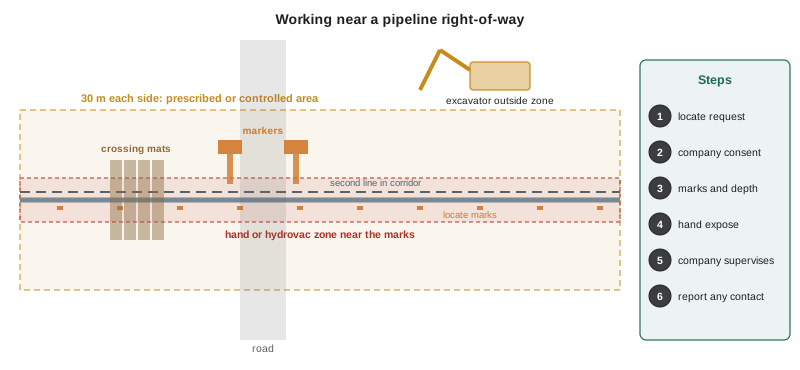
In Canada, rules for work near pipelines depend on who regulates the line. For federally regulated pipelines, the CER's Pipeline Damage Prevention Regulations create a prescribed area extending 30 m (100 ft) on each side of the pipeline centreline. Anyone planning ground disturbance in that area must make a locate request through the provincial one-call centre, such as Utility Safety Partners' Click Before You Dig service in Alberta, a few working days before work starts, and must have the pipeline company's consent and follow its conditions. Constructing a facility across, on, along or under a pipeline needs the company's permission, and vehicles and mobile equipment may cross a pipeline only on travelled roads or with the company's consent. Alberta's provincial rules set a similar controlled area of 30 m (100 ft) on each side of provincially regulated pipelines, and the licensee must be involved in ground disturbance within it. Other provinces have their own one-call centres and rules, and CSA Z247 sets out damage prevention practices for buried infrastructure.
Damage statistics show why these rules exist. PHMSA's April 2026 advisory bulletin on excavation damage reported that since 2005, excavation damage to regulated pipelines had caused more than 875 incidents, 40 deaths and 166 serious injuries. For gas distribution systems in 2025 alone, operators reported 85,606 damages from about 35.8 million locate tickets, with excavator practices, notification failures and locating errors as the leading root causes. Canadian one-call centres and the CER publish similar data showing that most strikes involve work done without a locate request or without hand exposure near the marks.
Crossings and third-party work
Pipelines are crossed constantly: by roads, other pipelines, power and communication cables, drainage tile, fences and, most often, by vehicles and farm equipment. Each crossing is a chance for damage, so operators manage them through crossing agreements and procedures. A typical crossing request includes the location, the type of work, the equipment and its weight, the depth of the pipeline and the protection proposed, such as minimum clearances between the pipeline and a new cable, minimum cover over the line, or mats and ramps to spread a heavy load.
Heavy loads crossing a shallow pipeline can overstress it, especially if the soil cover is thin or wet, the pipe is old or thin-walled, or the load passes repeatedly. Operators use engineering methods to check crossings. The program below uses a classic simple estimate, Boussinesq's equation for a point load on the surface, to show how the vertical stress reaching the top of a pipe depends on the wheel load and the depth of cover, and how a crane mat that spreads the load over a larger area helps. It is a teaching calculation; real crossing assessments follow industry methods and the operator's standards.
# Vertical soil stress at the top of a pipe from a wheel load (Boussinesq point load, teaching only).
import math

def stress_kpa(load_kn, depth_m):
    return 3 * load_kn / (2 * math.pi * depth_m ** 2)    # directly under the load

wheel_kn = 90.0        # one heavy wheel, invented
for cover in (0.6, 0.9, 1.2, 1.5):
    print(f"Cover {cover:.1f} m: about {stress_kpa(wheel_kn, cover):6.1f} kPa at the pipe")

# A mat spreads the wheel load: approximate it as four smaller loads 0.6 m apart.
cover = 0.9
spread = sum(3 * (wheel_kn / 4) * cover ** 3 / (2 * math.pi * (cover ** 2 + r ** 2) ** 2.5)
             for r in (0.3, 0.3, 0.3, 0.3))
print(f"With a mat at {cover} m cover: about {spread:5.1f} kPa (vs {stress_kpa(wheel_kn, cover):.1f} kPa)")Cover 0.6 m: about 119.4 kPa at the pipe Cover 0.9 m: about 53.1 kPa at the pipe Cover 1.2 m: about 29.8 kPa at the pipe Cover 1.5 m: about 19.1 kPa at the pipe With a mat at 0.9 m cover: about 40.8 kPa (vs 53.1 kPa)
Halving the depth of cover roughly quadruples the stress at the pipe, which is why shallow lines need special care and why operators measure depth of cover before approving heavy crossings. Spreading the load with mats reduces the peak stress noticeably. Cover can also change over time: erosion, ploughing, levelling and river scour can leave a pipeline far shallower than it was built, which is one reason operators run depth-of-cover surveys.
Third-party work, such as road building, utility installation, farm drainage or a neighbour's oilfield construction, is supervised by the pipeline operator when it is close to the line. A pipeline company representative may be required on site to confirm the pipe's location, watch excavation within the controlled zone, check that the pipe is exposed by hand or hydrovac where required, and inspect the pipe and coating if they are exposed. The representative has the authority to stop work that threatens the line.
Hazards for pipeline crews on the right-of-way
Pipeline technicians, patrol crews and contractors who work on rights-of-way face hazards of their own, often far from help.
| Hazard | Where it arises | Controls |
|---|---|---|
| Remote travel and working alone | Patrols, valve site visits, cathodic protection surveys | Journey management, check-in schedules, satellite communication |
| ATV and UTV rollovers | Rough or wet rights-of-way, slopes, river banks | Training, helmets, avoiding slopes beyond limits, rollover protection |
| Induced AC voltage | Pipelines running parallel to high-voltage power lines | Test before touching test posts and appurtenances, gradient mats, grounding |
| Excavation and trench collapse | Digs to examine or repair pipe | Sloping, shoring, protective systems, competent person |
| Gas or liquid release during a dig | Exposing a damaged or leaking line | Gas monitoring, ignition control, emergency plan |
| Unstable ground and water | Slopes, river crossings, washouts, muskeg and swamps | Geotechnical assessment, access planning, no entry to unstable banks |
| Weather and wildlife | Cold, heat, storms, wildfire smoke, bears, insects | Clothing, monitoring, bear awareness, insect protection |
| Vegetation management | Brushing, mowing, herbicide application | Equipment guarding, chemical training, care around markers and test posts |
Induced voltage deserves a closer look because it surprises people. A long metal pipeline running beside a high-voltage power line for kilometres can pick up an alternating voltage through electromagnetic induction, high enough in some cases to give a dangerous shock to someone touching a test post, valve or exposed pipe while standing on the ground. Fault currents during a power line failure can raise the voltage much higher for a short time. Operators install AC mitigation, such as grounding cables and gradient control mats, and technicians measure AC voltage before touching pipeline appurtenances in shared corridors. Workers should never assume a buried pipeline is electrically dead.
When a pipeline is struck
A strike on a pipeline can range from a scrape on the coating to a full rupture. HSE-330 described the immediate response to a line strike on a lease. On a pipeline right-of-way the response follows the same principles with some additions.
- If gas or liquid is escaping, stop work, shut down equipment where it is safe to do so without creating sparks, leave the equipment and move upwind and uphill, and keep others away.
- Call the emergency number on the pipeline marker and 911, and give the location, what was hit and what is escaping. Do not try to stop the leak or bury the line.
- If nothing is escaping, stop work and still call the pipeline company. A scrape, dent or gouge that does not leak today can fail later, and the coating damage must be repaired.
- Do not backfill a damaged line. The operator will inspect it, which may mean reducing the line's pressure first.
- Expect the operator to isolate and depressure the line, control the area and notify regulators.
Many jurisdictions treat failure to report a strike as a serious offence, because the hidden damage from an unreported contact is exactly what leads to later ruptures. A strike reported at once can be repaired for the cost of a dig; one hidden under backfill can become a fatal failure years later.
Worked problem
A farmer's drainage project on the Spruce Ridge line
A farmer plans to install drainage tile across a field crossed by Larchwood's provincially regulated 323.9 mm (12 in) sour gas line to Spruce Ridge. His contractor wants to start trenching next week and has not contacted anyone. What should happen?
Show solution
- The contractor submits a locate request through the one-call centre and contacts Larchwood, because the trench will cross the 30 m controlled area.
- Larchwood locates and marks the line, measures depth of cover and sets conditions for the crossing, such as minimum clearance below or above the pipe and hand or hydrovac exposure at the crossing.
- A Larchwood representative attends to supervise the crossing and has the authority to stop work.
- The contractor exposes the pipe by hand or hydrovac where required before trenching across it, and uses no mechanical excavation within the hand-exposure zone.
- If the pipe or coating is touched, work stops and Larchwood inspects and repairs it before backfill.
Answer: Drainage work is a common cause of strikes. A locate request, the operator's conditions and supervision, and hand exposure at the crossing protect both the contractor and a sour gas line.
Patrols and what they look for
Operators patrol rights-of-way on a schedule set by regulation and their integrity programs, using ground crews on foot or in vehicles, aircraft and, increasingly, drones and satellite imagery. A patrol is not a sightseeing trip; patrollers look for specific signs that the pipeline or its cover is threatened. These include excavation, construction or survey stakes on or near the right-of-way that nobody has told the operator about; exposed pipe or loss of cover at creek crossings and in cultivated fields; erosion, washouts, slumping, tension cracks and leaning trees on slopes; dead or discoloured vegetation, frost patches, bubbling water or stains that may indicate a leak; damaged or missing markers, test posts and fences; and new buildings, dugouts or roads that could change the class location or block access. Each observation is recorded with a location and photographs and passed to the integrity or damage prevention team for follow-up.
Landowners, farmers and nearby residents are often the first to notice a problem, because they are on the land every day. Pipeline companies maintain contact with landowners through land agents and public awareness mailings, and many publish their emergency and inquiry numbers on every marker. A landowner who calls about a wet spot, a new contractor or a strange smell is part of the damage prevention system, and every such call should be answered and followed up. Under federal and provincial rules, landowners also have obligations, such as obtaining consent before ground disturbance in the prescribed or controlled area, and pipeline companies explain these obligations as part of their outreach.
Common mistakes
MistakeAssuming a pipeline marker shows the exact location and depth of the pipe.
InsteadTreat markers as approximate and rely on locates and hand exposure.
MistakeDriving heavy equipment across a right-of-way wherever it is convenient.
InsteadCross only at approved crossings or with the operator's permission and protection.
MistakeBackfilling over a scrape on the coating.
InsteadStop and report every contact so the operator can inspect and repair it.
MistakeTouching a test post in a power line corridor without testing.
InsteadMeasure AC voltage first; pipelines can carry induced voltage.
MistakeStarting work because the locate marks are faded but probably still right.
InsteadRequest a re-mark when marks are unclear or expired.
Summary and key terms
- Excavation and third-party damage are leading causes of pipeline failures.
- Rights-of-way are easements over land the operator does not own; markers show approximate routes only.
- Federally regulated pipelines have a 30 m prescribed area and Alberta has a 30 m controlled area in which ground disturbance needs locates and operator involvement or consent.
- Crossings are managed by agreements that check load, depth of cover and clearances; shallow cover greatly increases stress on the pipe.
- Pipeline crews face remote travel, ATV, induced voltage, excavation, unstable ground, weather and wildlife hazards.
- Induced AC voltage on pipelines near power lines can shock workers who touch appurtenances without testing.
- Every strike, even a scrape, must be reported and inspected before backfill.
- Right-of-way
- The strip of land over a pipeline where the operator has the legal right to build, operate and maintain it.
- Easement
- A legal right to use part of another person's land for a specific purpose.
- Prescribed area
- The 30 m zone on each side of a federally regulated pipeline in Canada.
- One-call centre
- The service that receives locate requests and notifies owners of buried facilities.
- Tolerance zone
- The area on each side of locate marks where only hand or vacuum excavation is allowed.
- Encroachment
- An unauthorized structure or activity on a right-of-way.
- Depth of cover
- The thickness of soil over the top of a buried pipeline.
- Induced voltage
- Voltage on a pipeline caused by nearby high-voltage power lines.
Practice problems
Work each problem on paper first, then reveal the answer to check.
Who usually owns the land over a pipeline right-of-way?
Show answer
The landowner; the operator holds an easement or agreement.
Do pipeline markers show the exact position of the pipe?
Show answer
No, they show only the approximate route.
How wide is the CER prescribed area on each side of a pipeline?
Show answer
30 m from the centreline.
What did PHMSA's 2026 bulletin report about excavation damage since 2005?
Show answer
More than 875 incidents, 40 deaths and 166 serious injuries.
In the program, how does halving depth of cover change the stress at the pipe?
Show answer
It roughly quadruples it.
Why do operators run depth-of-cover surveys?
Show answer
Erosion, ploughing and scour can reduce cover over time.
What authority does a pipeline company representative have at a crossing?
Show answer
To stop work that threatens the line.
Why must technicians test before touching test posts in power line corridors?
Show answer
Pipelines can carry dangerous induced AC voltage.
What should be done if an excavator scrapes a pipe but nothing leaks?
Show answer
Stop, report it and leave it exposed for the operator to inspect and repair.
Why is failure to report a strike treated seriously?
Show answer
Hidden damage can lead to later ruptures.
Lesson quiz · 5 questions
Score 60% or more to complete this lesson.
Create a free account to save your progress, take quizzes and earn a certificate.