
HSE-332 · Lesson 2 of 12 · 28 min
Law, regulators and standards for facilities and pipelines
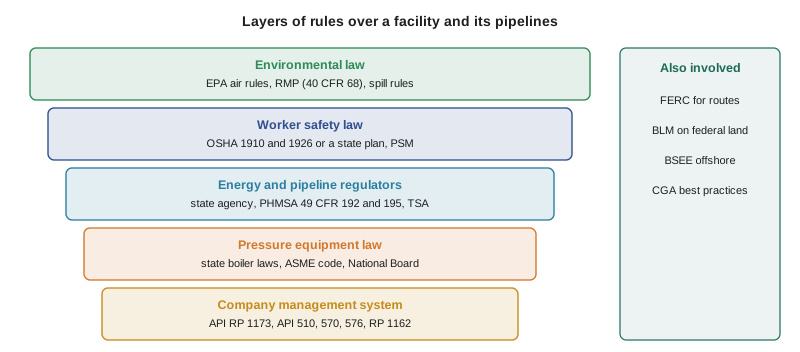
Facilities and pipelines sit under more layers of rules than almost any other workplace. A worker at a gas plant is protected by occupational health and safety law like any other worker. The plant itself is licensed and inspected by an energy regulator. Its pressure vessels and piping are registered under pressure equipment law. Its emissions are regulated by environmental agencies, and the pipelines that leave it may be regulated by a different agency again, depending on where they go. On top of the law sit codes and standards, most written by industry and standards bodies, that the law often adopts by reference. This lesson maps those layers so that you know whose rules apply to the job in front of you.
HSE-330 introduced the two kinds of regulator in oil and gas: the worker safety regulator, who protects people at work, and the energy regulator, who licenses and oversees wells, facilities and pipelines. This lesson builds on that map with the rules that matter most for facilities and pipelines: pressure equipment law, process safety rules, pipeline regulation and the standards that sit behind them. It does not cite clause numbers, because these change; your employer's procedures should point you to the current requirements.
Worker safety law
Federal OSHA covers private-sector facility and pipeline workers in most states, while about half the states run their own OSHA-approved state plans, which must be at least as effective as federal OSHA. Facilities fall under the general industry standards in 29 CFR 1910, including those on hazard communication, respiratory protection, permit-required confined spaces, lockout/tagout, walking-working surfaces and process safety management, and construction work at facilities falls under 29 CFR 1926. Where no specific standard applies, the general duty clause requires employers to keep the workplace free of recognized hazards likely to cause death or serious harm. Workers have the right to a safe workplace, to information and training, to file complaints and to be protected from retaliation.
Energy regulators
Energy regulation in the US is split between states and federal agencies. State oil and gas agencies, such as the North Dakota Industrial Commission's Department of Mineral Resources or the Railroad Commission of Texas, regulate wells, facilities, flaring and, in many states, intrastate pipelines. The Pipeline and Hazardous Materials Safety Administration (PHMSA) sets federal pipeline safety rules in 49 CFR Part 192 for gas and Part 195 for hazardous liquids, enforced directly for interstate lines and through certified state partners for most intrastate lines. The Federal Energy Regulatory Commission approves interstate gas pipelines and their routes but does not set safety rules. The Environmental Protection Agency regulates air emissions, spills and chemical accident prevention, and the Bureau of Land Management and the Bureau of Safety and Environmental Enforcement oversee operations on federal onshore land and offshore.
Pressure equipment law
The ASME Boiler and Pressure Vessel Code and the B31 piping codes are the technical basis for pressure equipment in the US. Most states have boiler and pressure vessel laws that adopt the ASME code, require registration with the National Board of Boiler and Pressure Vessel Inspectors and require periodic inspection by commissioned inspectors, although coverage of unfired vessels at oil and gas facilities varies widely from state to state. OSHA's process safety management standard, where it applies, requires mechanical integrity programs for pressure vessels, piping, relief systems and controls, and API standards such as API 510 for vessel inspection, API 570 for piping and API 576 for relief devices describe how to do it. For workers this means that vessels carry nameplates with their maximum allowable working pressure, that only qualified people should repair or alter pressure equipment, and that relief devices must be tested and maintained on schedule.
Process safety rules
OSHA's process safety management standard, 29 CFR 1910.119, applies to processes containing more than threshold quantities of listed highly hazardous chemicals or more than 10,000 lb of flammable liquid or gas. Many gas plants, fractionators and large storage facilities fall under it, but the standard exempts oil and gas well drilling and servicing and normally unoccupied remote facilities, and its application to field facilities is often debated. EPA's Risk Management Program rule, 40 CFR Part 68, has similar prevention requirements and adds offsite consequence analysis and emergency planning. The RMP rule has changed repeatedly: EPA strengthened it in 2024, announced in March 2025 that it would reconsider those changes, and published a proposal to roll many of them back in February 2026; as of October 2026 that proposal had not been finalized. Lesson 7 explains what process safety management means for a facility worker, and HSE-311 covers it in depth.
Pipeline regulation
PHMSA's 49 CFR Part 192 covers gas pipelines, including gathering lines in categories defined by diameter, pressure and location, and Part 195 covers crude oil, products and other hazardous liquids. The rules set design factors by class location, maximum allowable operating pressure, testing, corrosion control, operator qualification, control room management, public awareness programs (which incorporate API RP 1162), damage prevention and integrity management in high consequence areas. Many smaller rural gathering lines were outside federal rules until PHMSA's 2021 gas gathering rule brought large-diameter, high-pressure gathering lines into reporting and some safety requirements. The Transportation Security Administration issues pipeline security directives, first after the 2021 Colonial Pipeline ransomware attack and reissued several times since. API RP 1173 sets out pipeline safety management systems.
Codes and standards
Behind the law sit codes and standards written by technical committees. They tell engineers how to design and test equipment and tell operators how to inspect and maintain it. Some are adopted into law; others become mandatory because a company's own management system or a contract requires them. Workers rarely read them directly, but they shape almost every procedure in a facility.
| Topic | Common US references | What they cover for workers |
|---|---|---|
| Pressure vessels and piping | ASME BPVC Section VIII, ASME B31.3, API 510, API 570 | Design pressure, nameplates, repair rules, inspection |
| Pipelines | ASME B31.8, ASME B31.4, 49 CFR 192 and 195, API RP 1173 | Design, operation, integrity, safety management |
| Process safety | 29 CFR 1910.119, 40 CFR 68, CCPS guidelines | Management system elements for hazardous processes |
| Relief and flares | API 520, 521, 526 and 576 | Relief sizing, flare design, radiation limits, relief device inspection |
| Sour service materials | NACE MR0175/ISO 15156 | Materials resistant to sulfide stress cracking |
| Industry practices | API recommended practices, GPA Midstream guidance | Agreed practices for sour gas, flaring, isolation and more |
Inspections, enforcement and reporting
Different regulators inspect for different things. A worker safety inspector may look at gas detection, confined space permits, guarding, training records and hazard assessments. An energy regulator inspector may look at flare logs, emergency response plans, pipeline patrol records, relief valve test dates and the integrity of buried lines. A pressure equipment inspector looks at vessels, piping and relief devices. All of them can issue orders, and serious non-compliance can lead to shutdowns, prosecutions and fines.
Reporting rules also overlap. A single event, such as a pipeline rupture that injures a worker and releases sour gas, may have to be reported to the worker safety regulator, the energy regulator, the environmental regulator and local authorities, each with its own timeline. Facility emergency response plans should list who calls whom and how quickly. The program below checks an invented incident against a simple reporting matrix to show how quickly the obligations pile up; the triggers and times are illustrative.
# Illustrative reporting checklist for an invented incident.
incident = {"worker_hospitalized": True, "sour_gas_release": True,
            "pipeline_rupture": True, "liquid_to_water": False}

matrix = [
    ("OSHA", "worker_hospitalized", "within 24 hours"),
    ("PHMSA via the National Response Center", "pipeline_rupture", "at the earliest practicable moment"),
    ("State oil and gas agency", "sour_gas_release", "per state rule"),
    ("National Response Center", "liquid_to_water", "immediately"),
    ("State environmental agency", "liquid_to_water", "per state rule"),
]
calls = [(who, when) for who, trigger, when in matrix if incident[trigger]]
for who, when in dict.fromkeys(calls):
    print(f"Notify {who:40s} {when}")
print(f"{len(set(w for w, _ in calls))} agencies to notify; check the site ERP for exact rules")Notify OSHA within 24 hours Notify PHMSA via the National Response Center at the earliest practicable moment Notify State oil and gas agency per state rule 3 agencies to notify; check the site ERP for exact rules
Even with only three triggers, the crew must notify three agencies with different timelines, while also managing the emergency itself. That is why reporting is assigned to specific roles in the emergency response plan, and why the people on the scene should focus on safety and leave notifications to those roles.
Who holds which duty
Duties overlap, and it helps to be clear about who is responsible for what. The licensee or operator of a facility or pipeline holds the energy regulator's license and is responsible for its design, operation and integrity. The employer of each worker is responsible for that worker's safety, training and equipment. Where several employers work on one site, a prime contractor or controlling employer coordinates them, as HSE-330 explained. Engineers who design or approve equipment hold professional duties. Supervisors must know the hazards and direct work safely. Workers must follow procedures, use their equipment, report hazards and refuse work they believe is dangerous. When an incident happens, investigators will ask what each party knew and what each did; doing your own part well is the best protection for you and for those around you.
Worked problem
Whose rules apply at Kettle Creek?
A contractor crew is replacing a relief valve on the discharge scrubber at Larchwood's Kettle Creek compressor station in North Dakota. The station is permitted by the state, the scrubber was built to the ASME code and the station connects to a regulated gathering line. Which rules apply to the job?
Show solution
- Worker safety: OSHA's general industry standards apply to both the contractor's and Larchwood's workers, including hazard communication, lockout/tagout and respiratory protection, and the general duty clause covers hazards with no specific standard.
- Coordination: under OSHA's multi-employer policy, Larchwood as controlling employer and the contractor as exposing and correcting employer each have duties.
- Pressure equipment: the replacement valve must suit the service, be set and tested by a qualified shop and be installed under Larchwood's mechanical integrity program, following API 576 practice.
- State and federal agencies: the state permit applies to flaring during the blowdown, and PHMSA rules apply to the connected gathering line if it falls in a regulated category.
- Company rules: Larchwood's permit to work, isolation and management of change procedures apply, covered in HSE-333 and Lesson 7.
Answer: Several layers apply at once. The crew does not need to memorize every rule, but it must follow the permit and procedures that turn those rules into practice, and stop if the job does not match them.
How standards change and why it matters to you
Codes and standards are revised every few years, usually after incidents, research or new technology show that the old rules were not good enough. A revision may tighten inspection intervals, change the materials allowed in sour service, add requirements for leak detection or change how relief systems must be sized. Regulators then adopt the new edition, sometimes with a transition period, and companies update their procedures. Workers feel these changes indirectly: a new inspection task appears on the work order system, a valve type is no longer allowed, a form gains a new field. When a procedure changes, ask why. The answer is often an incident somewhere else that nobody wants to repeat.
Industry practices fill gaps between formal standards. Energy Safety Canada's industry recommended practices, CAPP guides, API recommended practices and GPA Midstream guidance capture what experienced operators have learned about tasks such as sour gas handling, flaring, isolation and fatigue. They are not law unless a regulator or contract makes them so, but inspectors and courts often treat them as evidence of what a reasonable operator would do. A company that ignores a widely used practice will have to explain why its own approach is at least as safe.
What the rules mean on a work day
For a field operator or maintenance worker, all of these layers come down to a handful of practical questions before any task. Is the equipment I am about to touch registered and within its rated pressure and temperature? Is there a permit, and does it match what I see? Has the hazard assessment identified the gas, pressure, temperature and chemical hazards, and are the controls in place? Do I have the training and authorization this task requires? Who do I call if something unexpected happens, and is anyone else working nearby whose work could affect mine? If the answer to any of these is unclear, the rules give you the right, and the duty, to stop and ask.
Workers also have a role in improving the rules. Safety committees, worker representatives and OSHA's complaint process give workers a voice, and OSHA protects workers from retaliation for raising safety concerns. Near-miss reports from the field are one of the main sources of the lessons that later become company procedures and industry practices. A report that a relief valve tag was missing, or that a line was found pressurized after it was signed off as isolated, may prevent a serious incident at another site.
Common mistakes
MistakeAssuming only one regulator oversees a facility.
InsteadExpect worker safety, energy, pressure equipment and environmental regulators to have a say.
MistakeRepairing or altering a pressure vessel because the fix looks simple.
InsteadLeave pressure equipment repairs to qualified, authorized people under the integrity program.
MistakeTreating standards as optional reading for engineers only.
InsteadRecognize that procedures are built on standards that the law or the company makes mandatory.
MistakeCalling every agency yourself during an emergency.
InsteadFocus on safety and let the roles named in the emergency response plan make the notifications.
MistakeBelieving a pipeline right-of-way is just a strip of grass.
InsteadRemember that ground disturbance near a pipeline requires locates and the operator's involvement or consent.
Summary and key terms
- Facilities and pipelines are covered by worker safety law, energy regulation, pressure equipment law, environmental law and company standards at once.
- OSHA or a state plan protects workers; state agencies, PHMSA, EPA and others regulate facilities and pipelines.
- Pressure equipment is built to the ASME code, with state boiler laws and mechanical integrity programs governing inspection.
- OSHA PSM and EPA RMP set process safety rules for covered processes; the RMP rule has changed several times since 2017.
- 49 CFR 192 and 195 govern gas and liquid pipelines, with integrity management in high consequence areas and TSA security directives.
- One incident may trigger reports to several agencies, which emergency plans assign to specific roles.
- Licensees, employers, coordinators, supervisors and workers each hold distinct duties.
- Licensee
- The company that holds the energy regulator's license for a well, facility or pipeline.
- Pressure equipment
- Boilers, pressure vessels, pressure piping and fittings that hold fluids above atmospheric pressure.
- Maximum allowable working pressure
- The highest pressure at which a vessel may operate at a stated temperature, shown on its nameplate.
- Registration
- Acceptance of a pressure equipment design or item by the authority in a jurisdiction.
- Process safety management
- A management system for preventing fires, explosions and toxic releases from hazardous processes.
- Prescribed area
- The zone on each side of a federally regulated pipeline in which ground disturbance requires consent.
- Integrity management
- A program to identify, assess and reduce threats to pipelines and equipment.
- Adopted by reference
- Made legally binding because a regulation names a standard.
Practice problems
Work each problem on paper first, then reveal the answer to check.
Name two kinds of regulator that may inspect the same gas plant.
Show answer
Any two of: worker safety, energy, pressure equipment and environmental regulators.
Which code is the technical basis for pressure vessels in the US?
Show answer
The ASME Boiler and Pressure Vessel Code.
Which parts of 49 CFR cover gas and hazardous liquid pipelines?
Show answer
Part 192 for gas and Part 195 for hazardous liquids.
Which agency sets federal pipeline safety rules?
Show answer
PHMSA, the Pipeline and Hazardous Materials Safety Administration.
What is shown on a vessel nameplate that limits how it can be operated?
Show answer
Its maximum allowable working pressure at a stated temperature.
What does EPA's RMP rule add to OSHA PSM?
Show answer
Offsite consequence analysis and emergency planning, among other requirements.
What did PHMSA's 2021 gas gathering rule do?
Show answer
It brought large-diameter, high-pressure gathering lines into reporting and some safety requirements.
Why does the emergency plan assign notifications to specific roles?
Show answer
So people on scene can focus on safety while required reports are made on time.
Who holds the energy regulator's license for a facility?
Show answer
The licensee or operator.
What should a crew do if the job does not match the permit or procedure?
Show answer
Stop and check before continuing.
Lesson quiz · 5 questions
Score 60% or more to complete this lesson.
Create a free account to save your progress, take quizzes and earn a certificate.