
HSE-332 · Lesson 12 of 12 · 29 min
Capstone: emergency response, case studies and a facility hazard review
This final lesson brings the course together in three parts. First, it looks at how facilities and pipelines respond to emergencies: the automatic systems that shut them down, the roles of field workers and the plans that protect the public. Second, it studies major facility and pipeline failures to see how the hazards and safeguards in Lessons 1 to 11 played out in real events. Third, it applies everything to a hazard review of the invented Spruce Ridge gas plant and its incoming line, ranking findings so that the most serious get fixed first. HSE-330 covered emergency response plans in general, including incident command and sour gas planning; this lesson focuses on what is specific to facilities and pipelines.
Emergency shutdown and blowdown
Facilities and pipelines are designed to make themselves safe automatically in an emergency. An emergency shutdown (ESD) system closes valves to isolate inventories, stops compressors and pumps, shuts off fuel to fired equipment and, at many compressor stations and gas plants, opens blowdown valves to send gas to the flare. ESDs can be triggered by fire and gas detectors, process trips, loss of power or instrument air, or a person pressing an ESD button. Pipelines have remotely operated or automatic shutoff valves at intervals that limit how much product can escape from a ruptured segment; recent rules in both countries have pushed for more of them, especially on large lines in populated areas.
Field workers need to know where the ESD stations are, what each one shuts down and how to reach them safely. They also need to know what an ESD does to the plant around them: a blowdown fills the air with noise, may cover the flare area with intense radiation and cold, and stops equipment that people may have been working on. Drills that include activating ESDs, at least in simulation, help crews respond without hesitation.
Field roles in an emergency
When a facility or pipeline emergency starts, the people on site are usually few and the plant is large. The emergency response plan assigns roles, and everyone should know theirs before the alarm sounds. In general:
- The first person to notice a release, fire or injury raises the alarm by the fastest route, often an ESD station, a manual pull station or a radio call to the control room.
- People not assigned to response go to the designated muster point, choosing an upwind route and an alternate muster point if the primary is downwind of the release.
- The control room or the senior person on site takes charge as incident commander under the incident command system until relieved.
- Operators isolate and depressure from safe locations if it is safe to do so, and never walk into a vapour cloud or a sour release to close a valve by hand.
- Trained responders handle rescue only with the right breathing apparatus and backup, because untrained rescue attempts in H2S and nitrogen atmospheres have killed many would-be rescuers.
- Designated people make notifications to regulators, local authorities and the public, as Lesson 2 described.
Protecting the public
Facilities and pipelines often sit near homes, roads, farms and towns, so their emergency plans must protect the public as well as workers. In Alberta, AER Directive 071 requires licensees to have emergency response plans, including sour gas plans with emergency planning zones for facilities and pipelines that could release enough H2S to harm the public, as HSE-330 explained. The CER requires federally regulated pipeline companies to maintain emergency management programs, consult with emergency responders and communities, and run exercises. Operators run continuing public awareness programs so that residents, landowners, excavators and local emergency services know where pipelines are, how to recognize a leak, what to do and whom to call.
Signs of a pipeline leak that the public, and workers, should recognize include a hissing or roaring sound, dead or discoloured vegetation over the right-of-way, bubbling in water, a rotten egg or petroleum odour, a dust cloud or mist, frozen ground in warm weather and liquid on the ground. The advice is the same for everyone: leave the area on foot in an upwind direction, do not use anything that could make a spark, including phones and vehicle ignitions near the leak, warn others to stay away and call the emergency number on the pipeline marker and 911 from a safe distance.
Case studies
Major failures teach lessons that procedures alone cannot. The cases below involved facilities and pipelines similar to those in this course. Each shows several barriers failing together, which is typical of major accidents.
| Event | What happened | Key lessons |
|---|---|---|
| Carlsbad, New Mexico, 2000 | A 30-inch (762 mm) natural gas transmission line ruptured from severe internal corrosion and the gas ignited, killing 12 members of an extended family camping nearby. | Internal corrosion from water and contaminants in gas lines; need for liquid removal, monitoring and integrity programs. |
| San Bruno, California, 2010 | A 30-inch (762 mm) gas transmission line ruptured in a residential area, killing eight people, hospitalizing 51 and destroying 38 homes. Records did not match the pipe in the ground, and manually operated valves took about 95 minutes to close. | Accurate records, pressure testing and verified pressure ratings; remotely controlled shutoff valves. |
| Marshall, Michigan, 2010 | A 30-inch crude oil line ruptured from corrosion fatigue cracks that had been detected but not repaired. Controllers misread alarms and restarted the line; more than 3,180 m³ (840,000 gal) reached a creek and river over about 17 hours before a utility worker reported it. | Crack management, control room training and procedures, and the authority to shut down. |
| Long Lake, Alberta, 2015 | A new emulsion pipeline at an oil sands facility ruptured; about 5,000 m³ (31,000 bbl) of bitumen, sand and water spread over about 21,900 m². The leak detection system did not catch it, and a contractor walking the line found it. | Designing pipe for ground conditions and temperature cycles; leak detection that works; patrols. |
| North Saskatchewan River, 2016 | A heavy oil pipeline leaked about 225,000 L of blended crude after ground movement on a slope stressed the line; about 90,000 L reached the river, and three cities shut their water intakes for nearly two months. | Geotechnical monitoring of slopes and river crossings; quick detection and response. |
| Longford, Australia, 1998 | A heat exchanger at a gas plant chilled to about −48 °C after a loss of warm oil flow and fractured when warm oil was restarted, killing two workers and cutting gas supply to Victoria for about two weeks. | Brittle fracture, operator training in abnormal conditions, hazard analysis and management of change. |
The Canadian cases led to prosecutions and fines under environmental and fisheries law. Nexen pleaded guilty in 2018 to an Alberta Environmental Protection and Enhancement Act charge and federal Fisheries Act charges and was ordered to pay 460,000 dollars, most of it directed to environmental education and a pipeline learning centre. Husky pleaded guilty in 2019 and was fined about 3.8 million dollars under federal and Saskatchewan law, having spent more than 140 million dollars on cleanup. Beyond the penalties, both events changed how Alberta and Saskatchewan regulators oversee pipeline design for ground conditions, leak detection and response.
Common threads run through all of these. Integrity threats such as corrosion, cracking and ground movement were present for a long time before failure. Detection failed or was not believed. Records, procedures or training did not match the reality in the field. And the consequences depended heavily on how quickly the release was isolated and how close people, water supplies and homes were. Each of the course's lessons addresses one or more of these threads.
A hazard review of Spruce Ridge
A hazard review, sometimes called a site hazard walkdown, is a structured look at a facility to find hazards and weaknesses in safeguards. It is not a substitute for a full process hazard analysis, but supervisors, safety advisors and experienced operators use it regularly to keep a fresh eye on the plant. The review team walks the site with checklists drawn from the facility's hazards, notes findings with photographs and locations, and ranks them by likelihood and severity so that the most serious are fixed first.
Suppose a team from Larchwood walks the Spruce Ridge plant and the receiving end of the Kettle Creek line during a quiet day shift. Their findings are shown in the figure and ranked in the program below, using a simple five-by-five risk matrix. The findings and ratings are invented for teaching.
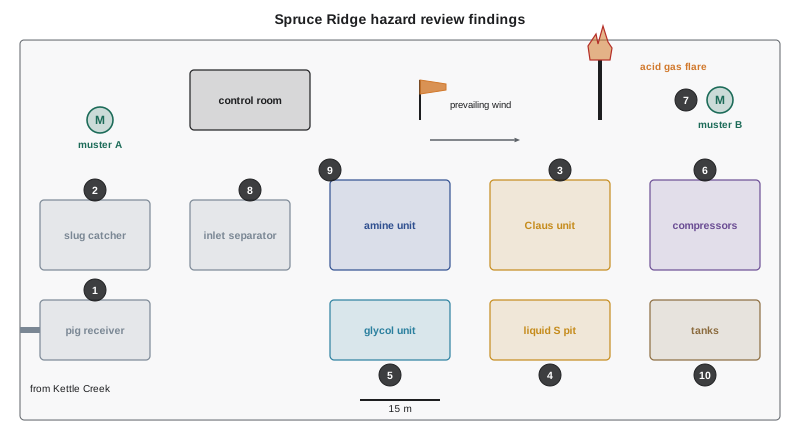
# Ranking invented hazard review findings at the Spruce Ridge plant (5 x 5 matrix).
findings = [
    (1, "Pig receiver has only a high-range gauge; no low-range gauge for zero checks", 3, 5),
    (2, "Slug catcher high-high level shutdown in bypass for 9 days, no permit", 4, 5),
    (3, "Block valve under acid gas KO drum relief valve found closed, no car seal", 3, 5),
    (4, "Molten S pit sweep air fan tripped; local alarm not wired to control room", 3, 4),
    (5, "Glycol still vent condenser bypassed; benzene smell at reboiler", 3, 3),
    (6, "Vibrating small-bore tubing on compressor 2 discharge, loose support", 4, 4),
    (7, "Wind-dependent muster point B downwind of acid gas flare in prevailing wind", 2, 5),
    (8, "Sweet-service ball valve installed on sour fuel gas line during repair", 2, 5),
    (9, "Spent amine filters stored dry in open bin", 3, 3),
    (10, "Temporary hose on condensate transfer, no MOC record, 4 months old", 3, 4),
]
ranked = sorted(findings, key=lambda f: (f[2] * f[3], f[3]), reverse=True)
print("Rank  Score  L x S  Finding")
for i, (n, text, L, S) in enumerate(ranked, 1):
    level = "HIGH" if L * S >= 15 else "MEDIUM" if L * S >= 8 else "LOW"
    print(f"{i:>4}  {L*S:>5}  {L} x {S}  #{n} {text}  [{level}]")
print(f"High-risk findings needing immediate action: {sum(1 for f in findings if f[2]*f[3] >= 15)}")Rank Score L x S Finding 1 20 4 x 5 #2 Slug catcher high-high level shutdown in bypass for 9 days, no permit [HIGH] 2 16 4 x 4 #6 Vibrating small-bore tubing on compressor 2 discharge, loose support [HIGH] 3 15 3 x 5 #1 Pig receiver has only a high-range gauge; no low-range gauge for zero checks [HIGH] 4 15 3 x 5 #3 Block valve under acid gas KO drum relief valve found closed, no car seal [HIGH] 5 12 3 x 4 #4 Molten S pit sweep air fan tripped; local alarm not wired to control room [MEDIUM] 6 12 3 x 4 #10 Temporary hose on condensate transfer, no MOC record, 4 months old [MEDIUM] 7 10 2 x 5 #7 Wind-dependent muster point B downwind of acid gas flare in prevailing wind [MEDIUM] 8 10 2 x 5 #8 Sweet-service ball valve installed on sour fuel gas line during repair [MEDIUM] 9 9 3 x 3 #5 Glycol still vent condenser bypassed; benzene smell at reboiler [MEDIUM] 10 9 3 x 3 #9 Spent amine filters stored dry in open bin [MEDIUM] High-risk findings needing immediate action: 4
The ranking puts the bypassed slug catcher shutdown at the top, followed by the vibrating tubing, the receiver gauge and the closed relief valve block valve. Several findings share a pattern that this course has stressed: safeguards defeated or degraded without control. A shutdown in bypass for nine days without a permit, a relief valve blocked in, a sweet valve in sour service and a temporary hose that became permanent are all failures of management of change and bypass control, not of equipment design. The muster point downwind of the acid gas flare is rated lower in likelihood but still high in severity, and fixing it costs almost nothing.
Turning findings into action
A hazard review is only useful if its findings are acted on. For each finding, the team records an action, an owner and a due date, and high-risk findings get immediate interim measures. For Spruce Ridge, the actions might look like this:
| Finding | Immediate measure | Lasting fix |
|---|---|---|
| Slug catcher shutdown in bypass | Remove bypass or authorize with permit and continuous monitoring | Find why the shutdown was bypassed; fix instrument; review pigging schedule |
| Relief valve block valve closed | Open and car-seal it after checking the system | Audit all relief valve block valves; investigate who closed it and why |
| Receiver gauge range | Use a calibrated low-range test gauge for zero checks | Install a low-range gauge and closure pressure-warning device |
| Vibrating tubing | Support the tubing; check fittings for cracks | Vibration survey of small-bore connections on all compressors |
| Sweet valve in sour service | Replace with a sour-rated valve | Review the parts control and MOC process for repairs |
| Temporary hose | Take it through MOC or remove it | Set up a temporary equipment register with expiry dates |
| Muster point B | Mark it as a secondary point used only in specific winds | Update the emergency plan and orientation |
The review team also looks for patterns behind the findings. Here, four findings involve uncontrolled changes or bypasses, which suggests a weakness in the plant's management of change and bypass culture rather than four unrelated mistakes. Addressing that weakness, through training, supervision, simpler MOC for small changes and leadership attention, will prevent findings that the walkdown did not catch.
Carrying the course forward
This course has followed oil and gas from the battery through compressor stations, a gas plant and pipelines. The same habits apply everywhere: know what is in the equipment and how much energy it holds; respect relief and shutdown systems; watch for corrosion, hydrates, cracks and movement; never assume a line is isolated until you have verified it; treat tanks, flares and pig traps as the high-risk equipment they are; protect pipelines on the right-of-way; and speak up when something does not match what you expect. HSE-333 completes the track with permits to work, isolation planning, simultaneous operations and handover, the systems that hold these habits together on a busy site.
Worked problem
A release during a walkdown
During the Spruce Ridge walkdown, the team hears a loud hiss near the amine regenerator and the fixed H2S detectors in that area go into high alarm. The wind is from the west, carrying gas towards the control room, and the primary muster point is east of the plant. What should the team do?
Show solution
- Move immediately away from the release, crosswind and then upwind, checking personal monitors and not walking towards the hiss.
- Raise the alarm by radio to the control room and, if an ESD station is on the escape route and safe to reach, use it as the plan directs.
- Go to the alternate muster point to the west, upwind, because the primary muster point to the east is downwind of the release.
- Account for everyone at the muster point and report anyone missing to the incident commander; do not attempt a rescue without breathing apparatus and backup.
- Let the incident commander and trained responders manage isolation, blowdown, public protection and notifications under the emergency response plan.
Answer: With acid gas H2S, a few breaths can be fatal. Moving out of the plume, raising the alarm, choosing the upwind muster point and leaving rescue to equipped responders follow the core emergency principles of the course.
Common mistakes
MistakeWalking towards a release to identify or close the source.
InsteadMove away crosswind and upwind and isolate only from safe locations.
MistakeGoing to the primary muster point even when it is downwind.
InsteadCheck the wind and use the alternate upwind muster point.
MistakeAttempting a rescue in H2S without breathing apparatus.
InsteadRaise the alarm and leave rescue to equipped, trained responders.
MistakeListing hazard review findings without owners or dates.
InsteadGive every finding an action, an owner, a due date and interim measures if needed.
MistakeTreating each finding as an isolated mistake.
InsteadLook for patterns that point to weaknesses in the management system.
Summary and key terms
- Emergency shutdown and blowdown systems make facilities and pipelines safe automatically; workers must know where ESD stations are and what they do.
- In an emergency, raise the alarm, move upwind to the correct muster point, isolate only from safe places and leave rescue to equipped responders.
- Directive 071 sour gas plans, CER emergency management programs and public awareness protect the public near facilities and pipelines.
- Carlsbad, San Bruno, Marshall, Long Lake, the North Saskatchewan River leak and Longford show integrity threats, detection failures and records gaps combining.
- Hazard reviews find and rank weaknesses so that the most serious are fixed first.
- At Spruce Ridge, the highest-ranked findings were defeated safeguards and uncontrolled changes.
- Patterns across findings point to management system weaknesses that need lasting fixes.
- Emergency shutdown system
- A system that isolates, stops and often depressures equipment automatically or on demand.
- ESD station
- A manual push button or switch that triggers an emergency shutdown.
- Muster point
- A designated assembly area where people gather and are counted in an emergency.
- Public awareness program
- An operator program that informs people along a pipeline about its presence, hazards and emergency response.
- Hazard review
- A structured walkdown of a site to find hazards and weaknesses in safeguards.
- Risk matrix
- A grid that ranks hazards by likelihood and severity.
- Interim measure
- A temporary control that reduces risk until a lasting fix is in place.
- Incident commander
- The person in overall charge of an emergency response.
Practice problems
Work each problem on paper first, then reveal the answer to check.
Name three things an ESD system can do.
Show answer
Any three of: close isolation valves, stop compressors and pumps, cut fuel to fired equipment, open blowdown valves.
What should workers know about ESD stations?
Show answer
Where they are, what each shuts down and how to reach them safely.
Why might the primary muster point be the wrong choice?
Show answer
It may be downwind of the release.
Why should untrained workers not attempt rescues in H2S atmospheres?
Show answer
Untrained rescuers often become additional victims.
Name four signs of a pipeline leak.
Show answer
Any four of: hissing or roaring, dead vegetation, bubbling water, odour, dust cloud or mist, frozen ground, liquid on the ground.
What caused the Carlsbad rupture?
Show answer
Severe internal corrosion in a gas transmission line.
What records lesson came from San Bruno?
Show answer
Records must match the pipe in the ground, and pressure ratings must be verified.
What did Long Lake show about leak detection?
Show answer
The system missed the rupture and a contractor walking the line found it.
Which Spruce Ridge finding ranked highest and why?
Show answer
The bypassed slug catcher shutdown, because it combined a likely event with a severe consequence.
What pattern did the Spruce Ridge findings reveal?
Show answer
Repeated uncontrolled changes and bypasses, pointing to a management of change weakness.
Lesson quiz · 5 questions
Score 60% or more to complete this lesson.
Create a free account to save your progress, take quizzes and earn a certificate.