
HSE-332 · Lesson 1 of 12 · 28 min
Facility types and how they work
Wells produce a mixture, not a product. What comes out of a Montney or Bakken well is a hot, pressurized blend of oil or condensate, natural gas, produced water, sand and sometimes hydrogen sulphide and carbon dioxide. Before any of it can be sold, it has to be separated, treated, measured, compressed, stored and moved. That work happens in facilities and pipelines: batteries, compressor stations, gas plants, terminals and the thousands of kilometres of pipe that connect them. Facilities are where most oil and gas workers spend their careers, and they are where many of the industry's most serious incidents happen, because they concentrate large inventories of flammable and toxic fluids under pressure in one place.
This course is the third in the oil and gas sites track. HSE-330 gave the orientation every worker needs: the life cycle, the regulators, gas detection, hydrogen sulphide basics, pressure and stored energy, ground disturbance and emergency response plans. HSE-331 covered drilling rigs, service rigs and completion pads. This course follows the fluids downstream, from the wellhead into the battery, through compressor stations and a sour gas plant and along gathering and transmission pipelines. HSE-333 follows with permits to work, isolation planning and simultaneous operations. Where another course already teaches a topic in depth, this course points to it rather than repeating it: HSE-311 for process safety management, HSE-210 for lockout, HSE-211 for confined spaces, HSE-216 for hot work, HSE-244 for hydrogen sulphide, HSE-251 for spills and HSE-312 for chemical storage.
This first lesson is a tour. You do not need to be a process engineer to work safely in a facility, but you do need to know what each vessel and line does, what is inside it, how much pressure it holds and how it can fail. An operator who understands why a separator has a high-level shutdown, or why a gas plant has a sulphur pit, makes better decisions than one who simply follows the rounds sheet.
The running example: Larchwood's Pinecrest system
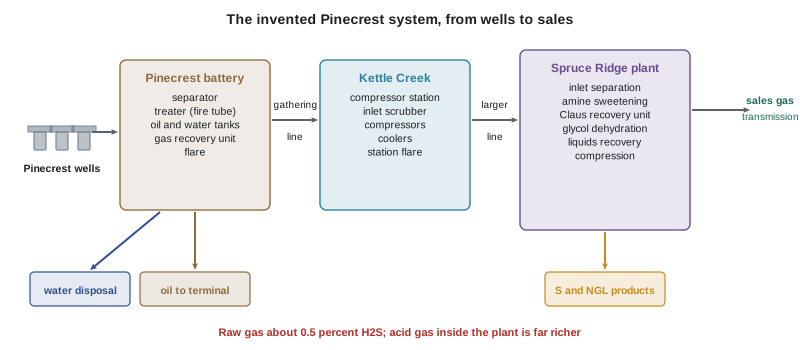
The course follows the invented company Larchwood Resources, whose Pinecrest pad of eight Montney wells, about 60 km south of Grande Prairie, Alberta, was the setting for HSE-330 and HSE-331. Raw gas from the wells carries about 0.5 percent hydrogen sulphide. In this course we follow the production from the Pinecrest battery through a 9 km, 168.3 mm (6 in) sour gathering line to Larchwood's Kettle Creek compressor station, and then through a 22 km, 323.9 mm (12 in) line to the invented Spruce Ridge sour gas plant, which sweetens the gas, recovers sulphur and liquids and delivers sales gas into a third-party transmission pipeline. Every company, facility and number in the example is invented for teaching.
The battery
The first facility downstream of most wells is a battery: a group of vessels and tanks that separates, measures and stores production from one or more wells. A single-well battery may sit on the lease beside the wellhead; a multi-well or central battery, like Pinecrest, takes production from a whole pad. The core equipment is simple in principle:
- Inlet manifold and test separator, so that each well can be routed alone through measurement to test its rates.
- Production separator, a pressure vessel in which gas rises, oil or condensate settles in the middle and water drops to the bottom. Two-phase separators split gas from liquid; three-phase separators also split oil from water.
- Treater, a heated vessel that breaks emulsions so that oil meets the buyer's water specification. Treaters have fire tubes with burners inside, which brings combustion hazards into a hydrocarbon vessel.
- Line heater, a bath of heated water and glycol that warms gas to prevent hydrates.
- Storage tanks for oil or condensate and for produced water, usually atmospheric or low-pressure tanks with thief hatches, vents and connections to vapour recovery or a flare.
- Vapour recovery unit, a small compressor that captures tank vapours.
- Flare or combustor, which burns gas that cannot be conserved or that must be released in an upset.
- Measurement: meters, sample points and, for gas, orifice or Coriolis meters with electronic flow measurement.
- Pumps, loading arms or a pipeline connection to move liquids off site.
The battery is controlled by a programmable logic controller and monitored remotely. Many batteries are unstaffed most of the time; operators visit on rounds, often alone, which is why working alone procedures and gas detection, covered in HSE-330, matter so much here. A visiting operator may be the only person within many kilometres when something goes wrong.
Compressor stations
Gas leaving a battery is usually at modest pressure. To push it through gathering and transmission lines it must be compressed, sometimes several times. A compressor station typically includes an inlet separator or scrubber to remove liquids that would damage the compressor, one or more compressors with their drivers, interstage and discharge coolers, a station flare or vent, emergency shutdown valves on the inlet and outlet, and a control building. Field compressors are often reciprocating machines driven by natural gas engines; large transmission stations often use centrifugal compressors driven by gas turbines or electric motors.
Compressor stations bring together several hazards: high-pressure gas in many small-bore connections that vibrate constantly, rotating and reciprocating machinery, hot surfaces and exhaust, high noise levels, engine exhaust containing carbon monoxide, lube oil systems that can feed a fire, and inside a compressor building, the possibility of a gas build-up that could explode. Buildings have gas detection, ventilation and, often, fire and gas systems that shut the station down and blow it down automatically.
Gas plants
A gas plant turns raw gas into a product that meets pipeline specifications for water, hydrogen sulphide, carbon dioxide, heating value and hydrocarbon dew point. A sour gas plant like Spruce Ridge has several process units, each with its own hazards:
| Unit | What it does | Key hazards |
|---|---|---|
| Inlet separation and slug catcher | Removes liquids and solids arriving with the gas | High pressure, liquid slugs, NORM in sludge, H2S |
| Amine sweetening | Absorbs H2S and CO2 into an amine solution, which is then regenerated by heating | Very high H2S in acid gas, hot amine, chemical exposure, corrosion |
| Sulphur recovery (Claus unit) | Converts H2S in acid gas into elemental sulphur | H2S and SO2, molten sulphur near 130 to 150 °C, sulphur fires, sulphur pit atmospheres |
| Tail gas treating and incineration | Removes or burns remaining sulphur compounds | SO2, high temperatures, burner management |
| Glycol dehydration | Removes water using triethylene glycol | Hot glycol, benzene and BTEX emissions from the still vent, fire |
| Liquids recovery and fractionation | Chills gas to recover ethane, propane, butane and condensate | Cryogenic temperatures, NGL fire and BLEVE, brittle fracture |
| Compression and utilities | Inlet and sales compression, steam, power, instrument air, flare | Rotating equipment, noise, high pressure, flare radiation |
Gas plants are large, continuously staffed facilities with control rooms, shift operators, maintenance crews and frequent contractor work. They are also the facilities most likely to fall under formal process safety management rules, discussed in Lesson 7. A sour plant handles acid gas streams that may contain tens of percent hydrogen sulphide, far higher than the raw gas at the wellhead, which is why the amine regenerator overhead, the sulphur recovery unit and the acid gas flare are among the most dangerous places on site.
Pipelines
Pipelines connect every facility in the chain. In this course we use four broad categories:
- Flowlines carry production from a wellhead to a battery. They are short and often run at well pressure.
- Gathering lines carry gas, oil or water from batteries to compressor stations, plants or terminals. Many are small-diameter lines in rural areas, and many carry sour or wet gas.
- Transmission lines carry processed gas, crude oil or refined products long distances at high pressure, often across provincial, state or national borders.
- Distribution lines carry gas at lower pressure to homes and businesses. They are outside the scope of this course except where they share rights-of-way with oil and gas lines.
Pipelines are, mile for mile, a very safe way to move large volumes of hydrocarbons. But a pipeline is a long, thin pressure vessel, often buried and out of sight, crossing farmland, rivers, roads and towns. When it fails it can release large volumes before anyone notices, and gas transmission ruptures can produce fires that destroy everything within hundreds of metres. Lessons 9 to 11 cover pipeline design, operation, rights-of-way and maintenance.
Other facilities
The same principles apply to facilities that this course mentions only briefly. Oil sands and heavy oil operations use steam, large tank farms and high-temperature equipment. Saltwater disposal facilities inject produced water into deep formations under high pressure. Terminals and tank farms store crude oil and products in large atmospheric tanks. Liquefied natural gas plants cool gas to about −162 °C (−260 °F). Offshore platforms combine all of these in a small space surrounded by sea. If you move to one of these facilities, the hazard thinking in this course carries over, but you will need site-specific training.
How much energy is in a facility
One way to understand why facilities need so many safeguards is to estimate the energy they contain. The program below adds up the inventories of a few invented Spruce Ridge vessels and expresses the combustion energy of each as an equivalent mass of TNT. The comparison is crude, because a fire or vapour cloud explosion releases energy very differently from a high explosive, but it shows the scale of what operators manage every day.
# Rough combustion energy of hydrocarbon inventories at an invented gas plant.
# Heats of combustion (MJ/kg, approximate): methane 50, propane 46, condensate 44.
TNT_MJ_PER_KG = 4.6

inventories = [
    # name, mass of hydrocarbon (kg), heat of combustion (MJ/kg)
    ("Inlet separator gas", 1_800, 50),
    ("Slug catcher liquids", 25_000, 44),
    ("Propane storage bullet", 60_000, 46),
    ("Condensate tank", 400_000, 44),
]
total = 0.0
for name, kg, hc in inventories:
    mj = kg * hc
    total += mj
    print(f"{name:24s} {kg:>9,} kg  {mj/1000:>9,.0f} GJ  = {mj/TNT_MJ_PER_KG/1000:>7,.0f} t TNT equivalent")
print(f"{'Total':24s} {'':>12s}  {total/1000:>9,.0f} GJ")
print("Only a small fraction of this energy is released in a typical explosion,")
print("but even 1 percent of the propane bullet would be about", round(60_000*46*0.01/TNT_MJ_PER_KG/1000, 1), "t TNT.")Inlet separator gas 1,800 kg 90 GJ = 20 t TNT equivalent Slug catcher liquids 25,000 kg 1,100 GJ = 239 t TNT equivalent Propane storage bullet 60,000 kg 2,760 GJ = 600 t TNT equivalent Condensate tank 400,000 kg 17,600 GJ = 3,826 t TNT equivalent Total 21,550 GJ Only a small fraction of this energy is released in a typical explosion, but even 1 percent of the propane bullet would be about 6.0 t TNT.
The numbers are large because hydrocarbons carry far more energy per kilogram than explosives do. The safeguards in the following lessons, from relief valves and emergency shutdown systems to spacing, gas detection and permits, exist to keep that energy in the pipe or, if it escapes, to keep it away from ignition and from people.
Who works in facilities
Facility work involves many roles. Field operators make rounds, read gauges, take samples, drain liquids, switch wells and respond to alarms. Plant operators run process units from the control room and the field. Instrument and electrical technicians maintain transmitters, controllers, shutdown systems and power. Millwrights and mechanics maintain compressors and pumps. Pipeline technicians patrol lines, run pigs, read cathodic protection and supervise crossings. Contractors arrive for turnarounds, inspection, welding, vacuum truck work, scaffolding and construction. Each group sees a different slice of the hazards, and incidents often happen where their work meets, for example when a contractor opens a line that an operator thought was isolated.
That is why this course keeps returning to the same habits: know what is in the equipment, know what pressure and energy it holds, confirm isolation before opening anything, monitor the atmosphere, and stop and ask when something does not match what you expected.
Worked problem
First rounds at the Pinecrest battery
A new field operator arrives at the Pinecrest battery for her first solo round. The site has a three-phase separator, a treater with its burner lit, four oil tanks, two water tanks, a vapour recovery unit and a flare. What should she look for and do before and during the round?
Show solution
- Check in by the working alone procedure, confirm the wind direction from the windsock and park upwind and facing out.
- Put on and bump test her four-gas monitor and confirm that the site's fixed H2S and LEL detectors show normal readings on the panel at the gate.
- Walk the site upwind first, listening and looking for leaks, unusual noises, flame-outs on the flare or treater, and liquid on the ground.
- Read separator and treater pressures, levels and temperatures and compare them with the normal ranges on the rounds sheet.
- Stay off tank roofs and away from thief hatches unless the job and procedure require it, and use remote gauging where installed.
- Report anything abnormal to the control centre before acting on it, and do not open, drain or adjust equipment that she has not been trained and authorized to operate.
Answer: A round is a hazard check as much as a production check. Knowing what each vessel does and what normal looks like lets the operator spot problems early and avoid the most dangerous tasks, such as opening tank hatches, without the right controls.
Common mistakes
MistakeThinking an unstaffed battery is low risk because nobody works there.
InsteadTreat every visit as high risk: you are alone with pressurized, flammable and toxic inventory.
MistakeAssuming every facility handles gas of the same H2S content as the wells.
InsteadCheck the H2S content of each stream; acid gas at a plant can be far richer than raw gas.
MistakeTreating a treater as just another vessel.
InsteadRemember it contains a fire tube and burner inside a hydrocarbon vessel and needs burner management.
MistakeSeeing pipelines as passive pipe that needs no attention.
InsteadRemember pipelines are long pressure vessels that need patrol, inspection and integrity management.
MistakeLearning only your own equipment.
InsteadUnderstand how your facility connects upstream and downstream, because upsets travel along the pipe.
Summary and key terms
- Production must be separated, treated, measured, compressed, stored and moved before sale, which is done in facilities and pipelines.
- Batteries separate and store production; key equipment includes separators, treaters, heaters, tanks, vapour recovery and flares.
- Compressor stations raise gas pressure and combine high-pressure gas, rotating machinery, noise, heat and exhaust hazards.
- Gas plants remove water, H2S, CO2 and liquids; amine, sulphur recovery, dehydration and NGL units each have distinctive hazards.
- Flowlines, gathering, transmission and distribution lines connect facilities and can release large volumes when they fail.
- Hydrocarbon inventories contain enormous energy, which is why facilities need layered safeguards.
- Incidents often happen where different crews and contractors meet, so communication and isolation discipline are essential.
- Battery
- A facility that separates, measures and stores production from one or more wells.
- Separator
- A pressure vessel that separates gas, oil or condensate and water by gravity.
- Treater
- A heated vessel, usually with an internal fire tube, that breaks oil and water emulsions.
- Compressor station
- A facility that raises gas pressure so it can move through pipelines.
- Sour gas
- Natural gas containing hydrogen sulphide.
- Acid gas
- The H2S and CO2 stream removed from sour gas in an amine unit.
- Gathering line
- A pipeline that carries production from batteries to compressor stations, plants or terminals.
- Transmission line
- A large, high-pressure pipeline that carries processed products long distances.
Practice problems
Work each problem on paper first, then reveal the answer to check.
What three main fluids does a three-phase separator split?
Show answer
Gas, oil or condensate, and water.
Why does a treater bring combustion hazards into a hydrocarbon vessel?
Show answer
It has a burner and fire tube inside the vessel to heat the emulsion.
What is the purpose of a vapour recovery unit?
Show answer
To capture and compress vapours from tanks instead of venting or flaring them.
Why do compressor stations have inlet scrubbers?
Show answer
To remove liquids that would damage the compressors.
Which gas plant unit handles the richest H2S stream?
Show answer
The amine regenerator overhead and the sulphur recovery unit, which handle acid gas.
What hazard does molten sulphur add?
Show answer
Burns from material at about 130 to 150 °C, sulphur fires and toxic gases in sulphur pits.
Name the four broad categories of pipeline used in this course.
Show answer
Flowlines, gathering lines, transmission lines and distribution lines.
Why is working alone a particular concern at batteries?
Show answer
Many are unstaffed and remote, so a visiting operator may be the only person nearby.
Why is the TNT comparison in the program only a rough guide?
Show answer
Fires and vapour cloud explosions release energy differently from high explosives, and only a fraction is released.
Where do many facility incidents happen?
Show answer
Where the work of different crews or contractors meets, such as at handovers and line openings.
Lesson quiz · 5 questions
Score 60% or more to complete this lesson.
Create a free account to save your progress, take quizzes and earn a certificate.