
HSE-246 · Lesson 9 of 12 · 25 min
Respiratory protection and protective clothing for asbestos
Respirators and protective clothing are the last line of defence in asbestos work, but they are essential in most removal and repair tasks because source controls rarely bring concentrations inside the work area down to safe levels. This lesson explains how asbestos rules specify respirators, how assigned protection factors and maximum use concentrations apply to asbestos, what protective clothing is needed, and how to avoid the common failures that turn good equipment into poor protection. The general principles of respirator programs, selection, medical evaluation, fit testing and maintenance are covered in HSE-240 and are not repeated here.
Why respirators are needed in asbestos work
Even with wetting and careful methods, fibre concentrations close to asbestos removal can far exceed the 0.1 f/cc limit. Dry removal of sprayed fireproofing has been measured at tens to hundreds of fibres per cubic centimetre; wet removal reduces this greatly but often not below the limit. Because asbestos has no known safe level and because concentrations change minute by minute as material is disturbed, asbestos rules require respirators for most work that disturbs asbestos, often regardless of measured concentration.
How Ontario specifies respirators
Ontario's O. Reg. 278/05 specifies respirators by operation type rather than leaving the choice to a calculation. Section 13 sets general requirements (effective face seal, assignment to one worker where practicable, cleaning and inspection after each shift, clean storage), and Table 2 lists the respirators required for each type of work.
| Operation | Minimum respirator under Table 2 (simplified) |
|---|---|
| Type 1 | Half-mask air-purifying respirator with N-100, R-100 or P-100 filter, if the worker requests one |
| Type 2, removing a false ceiling where ACM is likely above | Full-facepiece air-purifying respirator with N-100, R-100 or P-100 filter, a powered air-purifying respirator with a high-efficiency filter, or a supplied-air respirator with a tight-fitting facepiece |
| Other Type 2 operations | Half-mask air-purifying respirator with N-100, R-100 or P-100 filter |
| Type 3, depending on the task, whether material is wetted, whether it was sprayed and whether only chrysotile is present | Full-facepiece air-purifying respirator, powered air-purifying respirator, or supplied-air respirator in demand, continuous-flow or pressure-demand mode, as Table 2 specifies |
BC, Alberta and other provinces specify respirators through their regulations and guidelines, often tied to the risk level and the expected concentration. The common thread is that filtering facepieces (disposable dust masks) are not acceptable for most asbestos work, that 100-series (HEPA-equivalent) filters are the minimum, and that higher-risk work needs full-facepiece, powered or supplied-air respirators.
Protection factors and maximum use concentration
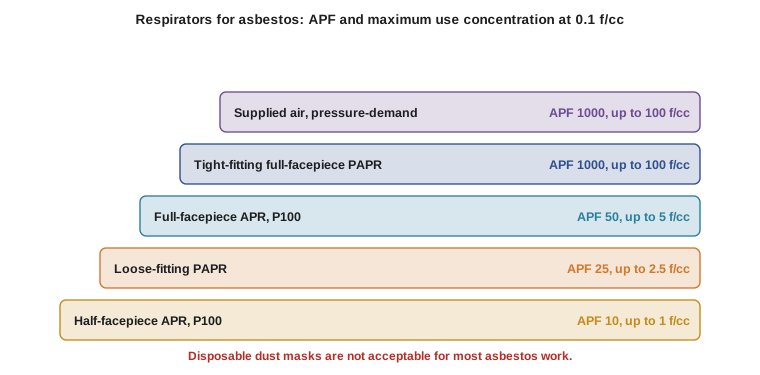
An assigned protection factor (APF) is the level of protection a properly used respirator is expected to provide. The maximum use concentration (MUC) is the highest concentration in which the respirator may be used: the APF multiplied by the exposure limit. For asbestos, with a limit of 0.1 f/cc, the MUC is easy to compute.
LIMIT = 0.1   # f/cc, 8-hour exposure limit

respirators = [
    ("half-facepiece APR, P100",                 10),
    ("loose-fitting PAPR (hood or helmet)",      25),
    ("full-facepiece APR, P100",                 50),
    ("tight-fitting full-facepiece PAPR",      1000),
    ("full-facepiece supplied air, pressure-demand", 1000),
]
for name, apf in respirators:
    print(f"{name:45s} APF {apf:5d}  MUC {apf * LIMIT:6.1f} f/cc")

# Which respirators are adequate for an expected task concentration?
expected = 3.5   # f/cc, illustrative wet removal of sprayed fireproofing
print(f"\nexpected concentration {expected} f/cc needs APF of at least {expected / LIMIT:.0f}")
for name, apf in respirators:
    ok = "adequate" if apf * LIMIT >= expected else "not adequate"
print(f" {name:45s} {ok}")half-facepiece APR, P100 APF 10 MUC 1.0 f/cc loose-fitting PAPR (hood or helmet) APF 25 MUC 2.5 f/cc full-facepiece APR, P100 APF 50 MUC 5.0 f/cc tight-fitting full-facepiece PAPR APF 1000 MUC 100.0 f/cc full-facepiece supplied air, pressure-demand APF 1000 MUC 100.0 f/cc expected concentration 3.5 f/cc needs APF of at least 35 half-facepiece APR, P100 not adequate loose-fitting PAPR (hood or helmet) not adequate full-facepiece APR, P100 adequate tight-fitting full-facepiece PAPR adequate full-facepiece supplied air, pressure-demand adequate
The APFs in the script are those commonly used in North America, including OSHA's Table 1 in 1910.134 and the values in CSA Z94.4; check the values your program uses. The calculation shows why half-facepiece respirators, with an MUC of 1 f/cc, are not enough for high-risk removal, and why full-facepiece powered or supplied-air respirators are specified for it. Remember that APFs assume the respirator is fit tested, worn correctly the whole time, and maintained. A full-facepiece respirator worn with a beard or with the straps loose gives far less protection than its APF suggests.
Filters for asbestos
Asbestos fibres are particles, so the filter, not a gas or vapour cartridge, provides the protection. Asbestos work needs the highest efficiency filters: N-100, R-100 or P-100 for air-purifying respirators, which remove at least 99.97 per cent of the most penetrating particle size, or high-efficiency filters on PAPRs. Filters are changed when breathing resistance increases, when they are damaged or wet, and in any case as the respirator program specifies; filters used in asbestos work are disposed of as asbestos waste.
Common failures
Respirators fail more often from how they are used than from how they are made. The most common failures in asbestos work are:
- Facial hair. Any beard, stubble or sideburns under the seal of a tight-fitting respirator breaks the seal. Workers using tight-fitting respirators must be clean-shaven where the seal meets the face; workers who cannot shave for religious or medical reasons need a loose-fitting PAPR or another solution, discussed in HSE-240.
- No fit test or the wrong size. A respirator that has not been fit tested on the wearer cannot be relied on.
- Removing the respirator inside the work area to talk, wipe sweat or take a break.
- Wearing the respirator under the coverall hood strap, so the hood pulls the facepiece off the face when the worker bends.
- Dirty or damaged respirators, with cracked valves or worn straps.
- Removing the respirator before decontamination, taking it off in the dirty room instead of the shower.
Protective clothing
Fibres settle on clothing, skin and hair, and then travel with the worker. Protective clothing keeps fibres off street clothes and the body, and it is removed in a controlled way during decontamination so that fibres stay in the work area.
| Item | Purpose | Notes |
|---|---|---|
| Disposable coveralls with hood | Keep fibres off clothing, skin and hair | Made of material that resists dust penetration; sized to allow movement without tearing; hood over the respirator straps |
| Footwear covers or washable boots | Keep fibres off footwear and prevent tracking | Slip-resistant covers on polyethylene floors; boots stay in the work area or are decontaminated |
| Gloves | Protect hands and keep fibres off skin | Disposable gloves under or over work gloves as the task requires |
| Eye and head protection | Protect against impact and splashes | Full-facepiece respirators provide eye protection; hard hats where overhead hazards exist |
| Underclothing | Worn under coveralls in the work area | Disposable or laundered as contaminated, never worn home |
Ontario's regulation requires protective clothing for workers in Type 2 and Type 3 work areas, made of material that resists penetration by asbestos fibres, covering the body and fitting snugly at the neck, wrists and ankles, with head covering and suitable footwear. Protective clothing must be decontaminated or disposed of as asbestos waste and must not be taken home. Clothing that will be laundered must be handled so that fibres are not released, in sealed and labelled bags, by a laundry that knows the clothing is contaminated.
Heat stress
Disposable coveralls, respirators and enclosures that block air movement make heat stress a serious hazard in asbestos work, especially in summer, in boiler rooms and in attics. Heat stress can impair judgement, leading to respirator removal and other unsafe acts, and it can cause heat exhaustion and heat stroke. Plan for heat: schedule hot work for cooler times, provide cool drinking water in the clean area, set work and rest cycles, consider cooling vests and PAPRs, which move air across the face, and train workers and supervisors to recognize symptoms. Heat stress is covered in more detail in the safety course on heat and cold stress.
Hygiene and personal practices
Personal practices complete the protection provided by equipment:
- No eating, drinking, smoking or chewing in the work area or the dirty room.
- Wash hands and face before eating, drinking or smoking, even after Type 1 or Class III work.
- Shower and change before leaving the site after high-risk work.
- Keep personal items such as phones out of the work area, or seal them in clear bags.
- Never take contaminated clothing, tools or equipment home, or into vehicles used by others.
Worked problem
Checking respirator selection
Air monitoring from similar jobs shows that wet removal of pipe insulation in a boiler room produces about 2 f/cc inside the enclosure. The crew has half-facepiece respirators with P100 filters. Is this adequate, and what should the supervisor require?
Show solution
- The required protection factor is 2 ÷ 0.1 = 20.
- A half-facepiece APR has an APF of 10, so its MUC is 1 f/cc, below the expected concentration. It is not adequate.
- A loose-fitting PAPR (APF 25, MUC 2.5 f/cc) would barely meet the requirement with little margin.
- A full-facepiece APR (APF 50, MUC 5 f/cc) or a tight-fitting full-facepiece PAPR (APF 1000) gives adequate protection with margin.
- The supervisor must also check what Table 2 of O. Reg. 278/05 requires for this Type 3 task, which may set a higher minimum regardless of the calculation.
Answer: Half-facepiece respirators are not adequate. The crew needs at least full-facepiece or powered respirators, and the specific legal requirement for the task may require more.
Pre-entry respirator checks
Before entering an asbestos work area, each worker should check their respirator and the supervisor should confirm the checks are done. A simple routine catches most problems: inspect the facepiece, straps and valves for cracks, tears or distortion; confirm that the filters are the right type, correctly fitted and not damaged; for PAPRs, check the battery charge and the airflow with the manufacturer's indicator; for supplied air, confirm the air source, hose connections and alarms; perform a user seal check on tight-fitting facepieces; and put the coverall hood over the straps. Any respirator that fails a check is removed from service. These checks take a minute and prevent the most common causes of poor protection.
Common mistakes
MistakeUsing disposable dust masks for asbestos removal.
InsteadUse at least a half-mask with 100-series filters, and higher protection as the task requires.
MistakeChoosing a respirator by APF alone without checking the regulation.
InsteadCheck the respirator the regulation specifies for the task; it may require more than the calculation.
MistakeWearing a tight-fitting respirator with stubble.
InsteadBe clean-shaven where the seal meets the face, or use a loose-fitting PAPR.
MistakeTaking coveralls home to wash.
InsteadDispose of coveralls as asbestos waste or launder them through an informed laundry in sealed, labelled bags.
MistakeIgnoring heat stress in enclosures.
InsteadPlan work and rest cycles, water and cooling, and train people to recognize symptoms.
Summary and key terms
- Respirators are required for most asbestos work because concentrations near disturbance often exceed the limit.
- Ontario specifies respirators by operation type in Table 2 of O. Reg. 278/05.
- Disposable dust masks are not acceptable for most asbestos work; 100-series filters are the minimum.
- The maximum use concentration is the APF times the 0.1 f/cc limit: 1 f/cc for a half-mask, 5 f/cc for a full-facepiece APR.
- Facial hair, poor fit, removal in the work area and early removal during decontamination are common failures.
- Protective clothing keeps fibres off clothes, skin and hair and must never go home.
- Plan for heat stress, and follow hygiene practices such as washing before eating and showering before leaving.
- Assigned protection factor (APF)
- The expected workplace level of protection of a properly used respirator.
- Maximum use concentration (MUC)
- The highest concentration in which a respirator may be used, equal to APF times the exposure limit.
- P-100 filter
- A particulate filter at least 99.97 per cent efficient, resistant to oil, used for asbestos.
- Powered air-purifying respirator (PAPR)
- A respirator that uses a blower to push filtered air into a facepiece, hood or helmet.
- Supplied-air respirator
- A respirator that delivers breathing air from a compressor or cylinders through a hose.
- Pressure-demand mode
- A supplied-air mode that keeps the facepiece at positive pressure during inhalation.
- Fit test
- A test confirming that a tight-fitting respirator seals on the wearer's face.
- Disposable coverall
- A single-use suit that keeps fibres off clothing and skin.
- Heat stress
- The total heat load on the body from work, environment and clothing.
- Informed laundry
- A laundry told in writing that clothing is contaminated with asbestos and handling it accordingly.
Practice problems
Work each problem on paper first, then reveal the answer to check.
Why are respirators required for most asbestos work even with wet methods?
Show answer
Concentrations near the work often still exceed the limit, and asbestos has no known safe level.
What is the MUC of a full-facepiece APR with an APF of 50 at a limit of 0.1 f/cc?
Show answer
5 f/cc.
An expected concentration is 0.6 f/cc. What minimum APF is needed?
Show answer
6, so a half-facepiece (APF 10) meets the calculation, subject to the regulation's requirements.
Are disposable filtering facepieces acceptable for asbestos removal?
Show answer
No, not for most asbestos work; the minimum is a half-mask with 100-series filters.
What filter class is used for asbestos?
Show answer
N-100, R-100 or P-100 (HEPA-equivalent) filters.
Why does facial hair matter?
Show answer
It breaks the seal of tight-fitting respirators, greatly reducing protection.
Where should the coverall hood go relative to the respirator straps?
Show answer
Over the straps, so the hood cannot pull the facepiece off.
How should contaminated clothing that will be laundered be handled?
Show answer
In sealed, labelled bags, sent to a laundry informed of the hazard.
Give three ways to manage heat stress in enclosures.
Show answer
Cooler scheduling, work and rest cycles, cool water, cooling vests, PAPRs, training (any three).
When should a worker wash hands and face during asbestos work?
Show answer
Before eating, drinking or smoking, and before leaving the site.
Lesson quiz · 5 questions
Score 60% or more to complete this lesson.
Create a free account to save your progress, take quizzes and earn a certificate.