
HSE-246 · Lesson 3 of 12 · 25 min
Where asbestos hides
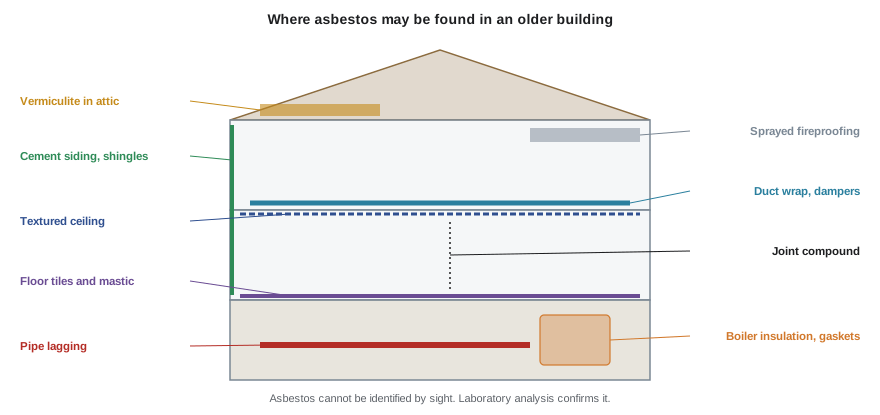
Asbestos was used in so many products that it can turn up almost anywhere in an older building. Some uses are obvious, such as the white lagging on old steam pipes. Many are not: the adhesive under a floor tile, the joint compound in a drywall seam, the texture on a ceiling, the cement board behind a shower, the gasket in a valve. This lesson surveys where asbestos-containing material is found, explains the difference between friable and non-friable material, shows how building age guides suspicion, and describes why visual identification is never enough.
Friable and non-friable material
The most important property of an asbestos-containing material, from a safety point of view, is how easily it releases fibres. Ontario's regulation defines friable material as material that, when dry, can be crumbled, pulverized or powdered by hand pressure, or that is already crumbled, pulverized or powdered. Non-friable material binds the fibres in a matrix such as cement, vinyl, asphalt or resin, so it releases few fibres unless it is broken, cut, sanded, drilled or ground. Most provinces use similar terms.
Friability is not fixed. Non-friable material becomes friable when it is damaged, weathered, burned or mechanically worked. A cement sheet that is intact releases little; the same sheet broken with a hammer or cut with a power saw releases large amounts. Damage, water and age can turn sound material into crumbling material, so the condition of the material matters as much as its type.
Common asbestos-containing materials
| Material | Typical locations | Friability | Notes |
|---|---|---|---|
| Sprayed fireproofing and insulation | Structural steel, decks, ceilings of commercial and institutional buildings | Highly friable | Some of the highest fibre releases when disturbed |
| Thermal system insulation | Pipe lagging, boiler and tank insulation, elbows and fittings, duct wrap | Often friable | Fittings may contain asbestos even when straight runs do not |
| Acoustic and textured coatings | Popcorn and stipple ceilings, textured walls, acoustic plaster | Friable when disturbed | Common in houses and apartments |
| Drywall joint compound | Seams, corners and patches of gypsum board walls and ceilings | Non-friable until sanded or broken | Sanding creates high exposures |
| Vinyl and asphalt floor tiles | Floors, often 9 in square tiles in older buildings | Non-friable | Mastic adhesive underneath may also contain asbestos |
| Sheet vinyl backing | Kitchen and bathroom floors | Friable backing | The paper-like backing is often the asbestos layer |
| Asbestos-cement products | Siding, roofing shingles, soffits, wall boards, pipe, ducts, laboratory benches | Non-friable | Dangerous when cut, drilled or broken |
| Ceiling tiles | Suspended ceilings in commercial buildings | Varies | Some older tiles contained asbestos |
| Plaster and stucco | Walls and ceilings, older finishes | Varies | Some plasters and stuccos contained asbestos |
| Vermiculite insulation | Attics and wall cavities of houses | Loose and dusty | Assume it may be contaminated |
| Roofing felts, mastics and flashing | Built-up roofs, sealants | Non-friable | Grinding or cutting can release fibres |
| Gaskets, packing and rope | Valves, flanges, boilers, ovens, furnace doors | Varies | Common in mechanical rooms and industrial plants |
| Electrical materials | Wire insulation, panel boards, arc chutes, lighting fixture backing | Varies | Found in older electrical equipment |
| Fire doors and fire-rated products | Cores of fire doors, fire blankets, curtains | Varies | Labels or records may identify them |
| Brake and clutch parts | Older vehicles and equipment | Dust is friable | Never use compressed air to clean brake assemblies |
Building age as a guide
Building age is the first clue. Asbestos use in Canadian construction was widespread from the 1920s to the late 1970s and continued in many products into the 1980s and 1990s, ending only with the 2018 ban. Sprayed asbestos fireproofing and insulation were restricted in the 1970s, but asbestos remained in floor tiles, cement products, joint compounds and other materials for years afterwards. As a practical rule, any building or addition built or renovated before about 1990 may contain asbestos, and older materials remain in newer buildings when they are reused or left in place during renovations.
Age alone is not reliable for several reasons. Buildings are renovated in stages, so a 1995 building may contain a 1970s boiler or reused materials. Some products were made with asbestos for longer than others. Imported products have occasionally contained asbestos long after domestic use ended. And records are often incomplete. Age tells you how suspicious to be, not whether asbestos is present.
Residential versus commercial and industrial buildings
Houses and small apartment buildings most often contain asbestos in textured ceilings, drywall joint compound, vinyl flooring and its backing, vermiculite insulation, cement siding and roofing, furnace and boiler insulation, duct tape and wrap, and old plaster. Commercial, institutional and industrial buildings are more likely to contain sprayed fireproofing, extensive pipe and boiler insulation, acoustic plaster, ceiling tiles, asbestos-cement panels, roofing felts and industrial gaskets and packings. Industrial plants, refineries, mills, power stations and ships may contain large quantities of thermal insulation, refractory materials in furnaces and kilns, and asbestos textiles.
Why you cannot identify asbestos by looking
Asbestos-containing materials usually look identical to materials without asbestos. A white pipe covering may be asbestos, fibreglass, calcium silicate or mineral wool. A floor tile may or may not contain asbestos, and its adhesive may contain asbestos when the tile does not. Colour, texture and the presence of visible fibres are not reliable guides. Only laboratory analysis of a sample, or reliable documentation from the manufacturer or a previous survey, can confirm whether a material contains asbestos.
Some clues raise suspicion: date of installation, product labels, manufacturer names known to have used asbestos, the fibrous appearance of certain insulations, and records from earlier surveys. Clues are reasons to test, not substitutes for testing. A competent person who suspects asbestos and cannot confirm otherwise should treat the material as asbestos-containing.
Hidden and unexpected locations
Many exposures happen because asbestos was hidden from view. Common surprises include:
- Insulation inside wall cavities, above suspended ceilings and in pipe chases, revealed only when the wall is opened.
- Multiple layers of flooring, with asbestos tiles and mastic buried under newer floor coverings.
- Asbestos-cement board behind tile in bathrooms, around fireplaces or behind wood stoves.
- Duct insulation, vibration dampers (the fabric joints in ductwork) and duct sealants.
- Debris left on top of ceiling tiles or in plenums from earlier removals or from deteriorating fireproofing.
- Old pipe insulation buried in crawl spaces or under slabs, and asbestos-cement pipe in the ground.
- Fire-rated doors, electrical panels and older appliances such as ovens and heaters.
This is why surveys must be thorough and why workers should stop when they uncover a suspect material that was not identified in the survey. Lesson 5 covers surveys, and Lesson 12 covers what to do when asbestos is discovered unexpectedly.
Condition assessment
Once asbestos-containing material is found, its condition determines how urgently it must be dealt with. Material in good condition that will not be disturbed can often be safely left in place and managed. Material that is damaged, deteriorating, exposed to vibration, water or physical contact, or located where work will disturb it, needs action: repair, enclosure, encapsulation or removal.
| Condition | Description | Typical response |
|---|---|---|
| Good | Intact, no visible damage, unlikely to be disturbed | Leave in place, record and inspect periodically |
| Fair | Minor damage, small areas of exposed fibres or delamination | Repair or encapsulate; increase inspection |
| Poor | Widespread damage, crumbling, water damaged, debris present | Restrict access, clean up debris under controlled conditions and plan removal or repair |
Using an inventory score
Building owners managing many materials often rank them by combining friability, condition and the likelihood of disturbance into a simple priority score. The scoring scheme below is illustrative; real programs use the method set by the owner's consultant or management plan.
# Illustrative priority scoring for asbestos materials in a building
FRIABILITY = {"non-friable": 1, "friable": 3}
CONDITION = {"good": 1, "fair": 2, "poor": 3}
DISTURBANCE = {"unlikely": 1, "possible": 2, "planned work": 3}

materials = [
    ("boiler room pipe lagging",   "friable",     "fair", "possible"),
    ("corridor floor tiles",       "non-friable", "good", "unlikely"),
    ("gym sprayed fireproofing",   "friable",     "poor", "possible"),
    ("washroom cement board",      "non-friable", "good", "planned work"),
]
ranked = []
for name, f, c, d in materials:
    score = FRIABILITY[f] * CONDITION[c] * DISTURBANCE[d]
    ranked.append((score, name))
for score, name in sorted(ranked, reverse=True):
    action = "act now" if score >= 12 else "plan" if score >= 3 else "manage in place"
print(f"{name:28s} score {score:2d} {action}")gym sprayed fireproofing score 18 act now boiler room pipe lagging score 12 act now washroom cement board score 3 plan corridor floor tiles score 1 manage in place
Even a non-friable material in good condition rises in priority when planned work will disturb it, because that is exactly when fibres are released. The score is a planning tool; it does not replace legal requirements to identify and control asbestos before work begins.
Worked problem
Planning a renovation walk-through
A supervisor is preparing for a renovation of the second floor of a 1972 office building: new ceilings, new flooring, new washrooms and rerouted ductwork. Which materials should be on the list for checking against the asbestos survey?
Show solution
- Ceilings: suspended ceiling tiles, any sprayed fireproofing on the steel deck above, textured or acoustic plaster, and debris on top of the tiles.
- Floors: all layers of flooring and adhesive, including tiles hidden under carpet.
- Walls: drywall joint compound, plaster, and cement board behind washroom tile.
- Mechanical: duct wrap, vibration dampers, duct sealants and pipe insulation including fittings.
- Washrooms: cement board, old pipe lagging in chases and any gaskets that will be disturbed.
Answer: Every material that the work will disturb must be checked against the survey, and anything not covered must be sampled or treated as asbestos-containing.
Industrial, marine and transportation settings
Industrial sites contain asbestos in places that rarely appear in building surveys. Refineries, pulp mills, smelters and power stations may have asbestos in high-temperature insulation on vessels, turbines and steam lines, in refractory linings of furnaces, kilns and boilers, in gaskets and rope packing on flanges and doors, in friction materials on cranes and hoists, and in old electrical equipment such as arc chutes and switchgear panels. Ships built before the 1990s often contain large amounts of insulation, deck coverings, gaskets and fire barriers. Rail cars, locomotives, buses and older heavy equipment may have asbestos in brakes, clutches, gaskets and insulation.
Maintenance on this equipment is often done by mechanics, millwrights, boilermakers and electricians who may not think of themselves as working with asbestos. Plants with older equipment should include equipment, not only buildings, in their asbestos inventory, label known asbestos components, and include asbestos checks in work permits and maintenance planning, so that a gasket change or a furnace repair is done with the right controls.
Common mistakes
MistakeDeciding a material is not asbestos because it looks like fibreglass.
InsteadOnly laboratory analysis or reliable records can confirm whether a material contains asbestos.
MistakeTesting the floor tile but not the mastic underneath.
InsteadSample each distinct layer; adhesives and backings often contain asbestos when the top layer does not.
MistakeAssuming non-friable material is always safe to cut or drill.
InsteadMechanical work makes non-friable material release fibres; it needs controls.
MistakeRelying on building age alone.
InsteadUse age to guide suspicion, but confirm by survey and sampling.
MistakeIgnoring debris above ceilings or in plenums.
InsteadTreat debris as asbestos-containing until tested and clean it up under controlled conditions.
Summary and key terms
- Asbestos was used in hundreds of building and industrial products, many of which look like non-asbestos materials.
- Friable material releases fibres easily; non-friable material releases them when broken, cut, sanded or ground.
- Friability can change with damage, weathering and mechanical work.
- Buildings built or renovated before about 1990 may contain asbestos, but age only guides suspicion.
- Common hiding places include wall cavities, buried flooring layers, cement board behind tile, ductwork, plenums and older equipment.
- Visual identification is never enough; laboratory analysis or reliable records are required.
- Material in good condition that will not be disturbed may be managed in place; damaged material or material to be disturbed needs action.
- Friable material
- Material that, when dry, can be crumbled, pulverized or powdered by hand pressure.
- Non-friable material
- Material in which asbestos is bound in a matrix such as cement, vinyl or asphalt.
- Thermal system insulation (TSI)
- Asbestos-containing insulation on pipes, fittings, boilers, tanks and ducts.
- Surfacing material
- Material sprayed, troweled or otherwise applied to surfaces, such as fireproofing and acoustic plaster.
- Mastic
- An adhesive used to fix flooring, roofing or insulation, which may contain asbestos.
- Asbestos-cement
- A product made of cement reinforced with asbestos fibres, used for siding, roofing, panels and pipe.
- Vermiculite
- A mineral expanded into lightweight insulation; some sources were contaminated with amphibole asbestos.
- Presumed asbestos-containing material (PACM)
- An OSHA term for materials presumed to contain asbestos; Canadian rules similarly require suspect material to be treated as asbestos-containing unless tested.
- Condition assessment
- An evaluation of whether asbestos-containing material is intact, damaged or deteriorating.
- Plenum
- The space above a suspended ceiling or below a raised floor used for air movement or services.
Practice problems
Work each problem on paper first, then reveal the answer to check.
Define friable material.
Show answer
Material that can be crumbled, pulverized or powdered by hand pressure when dry, or is already in that state.
Give two examples of friable asbestos-containing material.
Show answer
Sprayed fireproofing, pipe lagging, textured ceiling coatings or vermiculite insulation.
Give two examples of non-friable asbestos-containing material.
Show answer
Asbestos-cement siding, vinyl floor tiles, roofing felts or gaskets.
Why can a floor tile be asbestos-free while the floor still contains asbestos?
Show answer
The mastic adhesive or a buried lower layer may contain asbestos.
What turns non-friable material into a high-exposure hazard?
Show answer
Breaking, cutting, sanding, drilling, grinding, weathering or burning it.
Up to about what construction date should buildings be suspected of containing asbestos in Canada?
Show answer
Buildings built or renovated before about 1990, and older materials in newer buildings.
Why is visual identification unreliable?
Show answer
Asbestos-containing materials usually look the same as materials without asbestos.
Name three hidden places where asbestos is often found during renovation.
Show answer
Wall cavities, under newer flooring, behind washroom tile, in ductwork, on top of ceiling tiles or in plenums.
What should happen to a material that is damaged and crumbling?
Show answer
Restrict access, clean up debris under controlled conditions and plan removal or repair.
Why does planned work raise the priority of non-friable material in good condition?
Show answer
Disturbing it during the work is what releases fibres.
Lesson quiz · 5 questions
Score 60% or more to complete this lesson.
Create a free account to save your progress, take quizzes and earn a certificate.