
HSE-246 · Lesson 4 of 12 · 25 min
Law and responsibilities
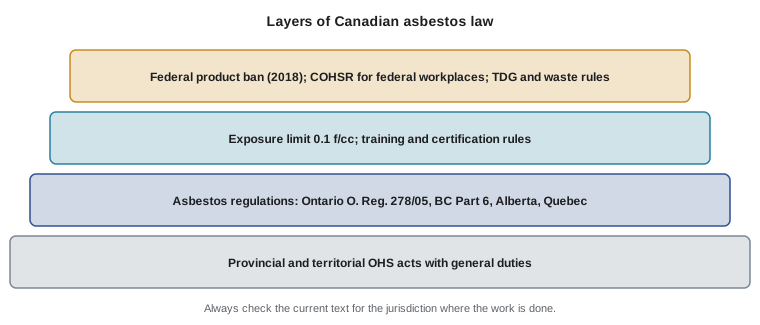
Asbestos work in Canada is controlled by provincial and territorial occupational health and safety law, by federal law for federally regulated workplaces, and by environmental rules on waste and the federal ban on new products. The rules differ in detail from one jurisdiction to another, but they share a structure: building owners must find and disclose asbestos, employers must classify the work and apply the precautions for each level, workers must be trained, and waste must be handled so that fibres do not escape. This lesson outlines the main laws, compares several provinces, and explains who is responsible for what.
Provincial and territorial OHS law
Every province and territory has an occupational health and safety act with a general duty for employers to protect workers and take every precaution reasonable in the circumstances. Asbestos is then covered by specific regulations, codes or guidelines that set exposure limits, require identification, classify work and prescribe precautions. Most Canadian jurisdictions now use an 8-hour exposure limit of 0.1 fibre per cubic centimetre (f/cc) for all forms of asbestos, the same value as the ACGIH threshold limit value, but check the limit and any excursion or ceiling limit that applies where you work.
| Jurisdiction | Main asbestos rules | Key features |
|---|---|---|
| Ontario | O. Reg. 278/05 (construction projects, buildings and repair operations); O. Reg. 490/09 and exposure limits for other workplaces | Owner records and reports; Type 1, 2 and 3 operations; Ministry notice for Type 3 and larger glove bag removals; 253W and 253S certification for Type 3 |
| British Columbia | OHS Regulation Part 6 (asbestos sections); Workers Compensation Act licensing and certification provisions | Exposure control plans; inventory before work; qualified persons; licensed abatement contractors and certified workers since 1 January 2024 |
| Alberta | OHS Code (asbestos provisions) with the Alberta Asbestos Abatement Manual as guidance | Restricted areas; asbestos worker training and certificates; prescribed work practices |
| Quebec | Regulation respecting occupational health and safety and the Safety Code for the construction industry | Owners must locate friable flocking and heat insulation in buildings; low, moderate and high-risk construction work |
| Federal | Canada Occupational Health and Safety Regulations (COHSR) for federally regulated workplaces; Prohibition of Asbestos and Products Containing Asbestos Regulations | Asbestos exposure management programs in federal workplaces; ban on new asbestos products since 2018 |
Ontario in more detail
Because Ontario's regulation is detailed and widely referenced, it is a useful model. O. Reg. 278/05 defines asbestos-containing material as material containing 0.5 per cent or more asbestos by dry weight. Owners of buildings must keep a record of friable and non-friable asbestos-containing material, update it at least every 12 months, and tell occupiers about material in the parts they occupy. Before tendering or arranging demolition, alteration or repair work, the owner must prepare a report on asbestos-containing material that may be disturbed and give it to prospective constructors, who pass it to contractors and subcontractors. The regulation classifies work as Type 1, Type 2 or Type 3 operations, sets the precautions, respirators and training for each type, and requires written and oral notice to a Ministry inspector before a Type 3 operation or a Type 2 glove bag removal of one square metre or more of insulation. Lesson 6 explains the three types.
Elsewhere, the details differ. BC requires a qualified person to prepare an inventory of asbestos-containing materials before work that may disturb them, and employers must have a written exposure control plan. Since 1 January 2024, asbestos abatement contractors in BC must hold a licence and workers doing abatement must complete approved training and be certified. Alberta's OHS Code sets requirements for restricted areas, work practices and worker training, supported by the Alberta Asbestos Abatement Manual. Quebec requires building owners to locate friable flocking and heat insulation that may contain asbestos and to keep a register. Workers moving between provinces should never assume the rules are the same.
Who is responsible for what
Asbestos safety depends on several parties doing their part. A failure by one, such as an owner who does not disclose a known material, can expose workers who did everything else right.
| Party | Main responsibilities |
|---|---|
| Building owner | Identify asbestos-containing material, keep records, disclose it to occupiers and to constructors before tendering work |
| Constructor or general contractor | Make sure the asbestos report reaches every contractor, coordinate trades so others are not exposed, and give required notices |
| Employer | Classify the operation, apply the required precautions, provide respirators and training, and ensure certification where required |
| Supervisor | Know where asbestos is, plan the work to avoid disturbing it, enforce controls, stop work when suspect material is found |
| Worker | Follow the procedures and training, use controls and respirators properly, report suspect materials and damaged controls, never take contamination home |
| Consultant or inspector | Carry out surveys and sampling, write specifications, inspect enclosures and conduct air monitoring and clearance testing |
| Joint committee or representative | Receive reports and air test results, take part in inspections and raise concerns |
Federal and environmental rules
The federal Prohibition of Asbestos and Products Containing Asbestos Regulations, in force since 30 December 2018, ban the import, sale, use, manufacture and export of asbestos and products containing it, with limited exclusions such as asbestos integrated into existing buildings and some military, nuclear and museum uses. They do not require removal of asbestos already in buildings, and they allow the management and removal of asbestos during renovation and demolition. Federally regulated workplaces, such as banks, airlines, rail, telecommunications and federal government buildings, follow the COHSR, which require an asbestos exposure management program where asbestos may be present. Waste rules are provincial and municipal, and transport of asbestos waste is covered by the federal Transportation of Dangerous Goods Regulations, discussed in Lesson 11.
Exposure limits are not safe levels
An exposure limit is a legal ceiling, not a line between safe and unsafe. Asbestos is a carcinogen with no known threshold, so the aim is always to keep exposure as low as reasonably achievable, not merely below the limit. Limits are also hard to measure at low levels, because standard phase contrast microscopy counts fibres down to about 0.01 f/cc only with large sample volumes. This is why asbestos regulations rely heavily on prescribed work methods by risk level or class, rather than on measured exposure alone.
# Comparing a measured exposure with an 8-hour limit and a 30-minute excursion limit
TWA_LIMIT = 0.1        # f/cc, 8-hour
EXCURSION_LIMIT = 1.0  # f/cc, 30-minute (OSHA; Canadian rules vary)

samples = [  # (duration in minutes, concentration in f/cc)
    (30, 0.9),   # dry scraping before controls were fixed
    (210, 0.06),
    (240, 0.02),
]
total_min = sum(d for d, _ in samples)
twa = sum(d * c for d, c in samples) / 480
print(f"time sampled: {total_min} min")
print(f"8-hour TWA: {twa:.3f} f/cc -> {'above' if twa > TWA_LIMIT else 'below'} the 0.1 limit")
peak = max(c for d, c in samples if d >= 30)
print(f"highest 30-minute result: {peak} f/cc -> {'above' if peak > EXCURSION_LIMIT else 'below'} the 1.0 excursion limit")time sampled: 480 min 8-hour TWA: 0.092 f/cc -> below the 0.1 limit highest 30-minute result: 0.9 f/cc -> below the 1.0 excursion limit
In this illustrative case, the shift average is under the 8-hour limit, but the 30-minute result during dry scraping was close to the excursion limit. The fix is not to celebrate the average but to correct the method that caused the peak, because asbestos risk depends on total dose and peaks contribute to it.
Worked problem
Who should have acted?
A drywall contractor is hired to renovate a 1974 office suite. The building owner has an asbestos survey showing asbestos in the joint compound but does not provide it. The crew sands the joints dry. Who failed, and how?
Show solution
- The owner failed to give the asbestos report to the constructor before tendering the work, as Ontario's regulation and similar rules require.
- The constructor or general contractor should have asked for the asbestos report and made sure it reached the drywall contractor.
- The drywall contractor's supervisor should have asked about asbestos in a 1974 building before allowing sanding, and should have had the joint compound tested or treated as asbestos-containing.
- The crew should have been trained to recognize suspect materials and to stop and ask.
Answer: Several parties failed. Asbestos law assigns duties to owners, constructors, employers, supervisors and workers so that one failure does not lead to exposure, but here every safeguard was missed.
Enforcement and due diligence
Asbestos rules are actively enforced. Ministry and WorkSafe inspectors visit renovation and demolition sites, review asbestos reports and notices, and issue orders to stop work where asbestos is being disturbed without the required precautions. Convictions for asbestos offences have led to substantial fines for corporations and, in some cases, for directors and supervisors personally, and environmental regulators prosecute illegal dumping of asbestos waste. In BC, the 2024 licensing regime gives WorkSafeBC the power to suspend or cancel the licences of contractors who do not comply.
When something goes wrong, employers and supervisors may defend themselves by showing due diligence: that they took every precaution reasonable in the circumstances to prevent the harm. For asbestos, due diligence is shown by documents and actions, not good intentions. Useful evidence includes the asbestos report obtained before work, records of task classification, the written procedures and exposure control plan, training and certification records for every worker, inspection checklists, air monitoring and clearance results, waste receipts, and records of how discoveries and incidents were handled.
Due diligence also covers the choice of contractors. Owners and general contractors should check that asbestos subcontractors are qualified, licensed or certified where required, experienced with the type of work, and insured, and should review their written procedures before awarding the work. A low bid that leaves out enclosures, monitoring or proper disposal is a warning sign, not a saving: the cost of an uncontrolled release, including clean-up of a contaminated building, stopped work, orders and prosecution, is far higher than the cost of doing the work properly.
Finally, due diligence is continuous. Supervisors should check controls during the work, not only at the start, and should record what they find and what they correct. A record showing that a torn barrier was found and repaired within minutes is evidence of a working system, not of failure.
Common mistakes
MistakeAssuming asbestos rules are the same in every jurisdiction.
InsteadCheck the specific regulation, limits, training and notification rules where the work is done.
MistakeTreating the exposure limit as a safe level.
InsteadKeep exposure as low as reasonably achievable; asbestos has no known safe level.
MistakeThinking the ban means existing asbestos must be removed.
InsteadBans cover new products; existing material is managed or removed under OHS and environmental rules.
MistakeLeaving disclosure to the trades to sort out.
InsteadOwners and constructors must provide asbestos information to everyone who may disturb it.
MistakeIgnoring short peaks because the shift average is low.
InsteadCorrect the methods that cause peaks; they add to cumulative dose.
Summary and key terms
- Provincial and territorial OHS laws, with asbestos-specific regulations, govern most asbestos work in Canada.
- Most Canadian jurisdictions use an 8-hour limit of 0.1 f/cc for all forms of asbestos.
- Ontario's O. Reg. 278/05 defines ACM at 0.5 per cent, requires owner records and reports, and classifies Type 1, 2 and 3 operations.
- BC requires inventories, exposure control plans, licensed contractors and certified workers since 2024.
- The federal ban has prohibited new asbestos products since 30 December 2018; federal workplaces follow the COHSR.
- Owners, constructors, employers, supervisors, workers and consultants each have defined duties.
- Exposure limits are legal ceilings, not safe levels; asbestos rules rely heavily on prescribed work methods.
- Designated substance
- A substance, such as asbestos, for which Ontario has specific regulations on assessment and control.
- Owner's asbestos report
- A report the owner must prepare under Ontario's regulation, before tendering work, listing asbestos-containing material that may be disturbed.
- Exposure limit
- The maximum legally permitted airborne concentration, usually as an 8-hour time-weighted average.
- Excursion limit
- A short-term limit, such as OSHA's 1.0 f/cc averaged over 30 minutes.
- Competent person
- A person qualified by training and experience to identify hazards and take corrective action, required by many asbestos rules.
- NESHAP
- EPA's National Emission Standards for Hazardous Air Pollutants, which include asbestos rules for demolition, renovation and waste.
- AHERA
- The Asbestos Hazard Emergency Response Act, which governs asbestos in US schools.
- Model Accreditation Plan (MAP)
- EPA's plan setting training and accreditation requirements for asbestos professionals.
- Exposure control plan
- A written plan required in BC describing how asbestos exposure will be controlled.
- COHSR
- The Canada Occupational Health and Safety Regulations, which apply to federally regulated workplaces.
Practice problems
Work each problem on paper first, then reveal the answer to check.
What does O. Reg. 278/05 cover?
Show answer
Asbestos on construction projects and in buildings and repair operations in Ontario.
What is the common 8-hour exposure limit for asbestos?
Show answer
0.1 fibre per cubic centimetre.
What percentage of asbestos defines ACM in Ontario?
Show answer
0.5 per cent or more by dry weight.
Before which operations must an Ontario inspector be notified?
Show answer
Type 3 operations and Type 2 glove bag removal of one square metre or more of insulation.
What changed for asbestos abatement in BC on 1 January 2024?
Show answer
Contractors must be licensed and abatement workers must be trained and certified.
Name two duties of a building owner.
Show answer
Identify asbestos-containing material and disclose it to occupiers and to those who will do work; keep records.
Why are exposure limits not safe levels for asbestos?
Show answer
Asbestos is a carcinogen with no known threshold, so exposure should be kept as low as reasonably achievable.
A worker had 30 min at 0.5 f/cc and 450 min at 0.02 f/cc. What is the 8-hour TWA?
Show answer
(15 + 9) ÷ 480 = 0.05 f/cc.
Do Canada's federal asbestos regulations require removal of existing asbestos?
Show answer
No; they ban new products and exclude asbestos already integrated into buildings.
What should a supervisor do when a suspect material is found that is not in the survey?
Show answer
Stop the work, keep people away and have the material assessed before continuing.
Lesson quiz · 5 questions
Score 60% or more to complete this lesson.
Create a free account to save your progress, take quizzes and earn a certificate.