
HSE-246 · Lesson 1 of 12 · 26 min
What asbestos is and why it is still here
Asbestos was banned in Canada at the end of 2018, yet it remains one of the most important hazards on construction and maintenance sites in the country. It is still in place in hundreds of thousands of buildings, ships, plants and pipelines, and every renovation, repair or demolition of an older structure can release it. Most of the people who die from asbestos disease today were exposed decades ago, but new exposures are still happening wherever workers disturb materials without knowing what they contain.
This course is awareness and supervisor training. It explains what asbestos is, where it is found, how it harms people, how the law classifies asbestos work and what precautions each level requires. It does not qualify anyone to do high-risk abatement. In Ontario, workers and supervisors in Type 3 operations need the asbestos abatement worker (253W) and supervisor (253S) training and certification under section 20 of O. Reg. 278/05, and British Columbia has required certification of abatement workers and licensing of abatement contractors since 1 January 2024. Other provinces set their own training rules. Respirator selection and fit testing are covered in HSE-240, and the hygiene and decontamination ideas shared with silica and lead are introduced in HSE-242.
What asbestos is
Asbestos is not one mineral. It is a commercial name for a group of naturally occurring silicate minerals that crystallize as long, thin, flexible fibres. Six minerals are regulated as asbestos. They fall into two families that differ in shape and in how long they persist in the lungs.
| Mineral | Family | Common name or use | Notes |
|---|---|---|---|
| Chrysotile | Serpentine | White asbestos | Curly fibres; about 95 per cent of all asbestos ever used; mined in Quebec until 2011 |
| Amosite | Amphibole | Brown asbestos | Straight, needle-like fibres; used in insulation board and pipe insulation |
| Crocidolite | Amphibole | Blue asbestos | Very fine straight fibres; considered the most potent for mesothelioma |
| Tremolite | Amphibole | Contaminant | Found as a contaminant of talc, vermiculite and some chrysotile |
| Actinolite | Amphibole | Contaminant | Rarely used commercially; found in some rock and vermiculite |
| Anthophyllite | Amphibole | Contaminant | Rarely used commercially; found in some talc |
All six forms cause cancer in humans, and the International Agency for Research on Cancer classifies all forms of asbestos as Group 1 carcinogens. Amphiboles are more durable in lung tissue than chrysotile, and they are generally considered more potent for mesothelioma, but chrysotile also causes mesothelioma, lung cancer and asbestosis. For workplace purposes, the law treats every form as hazardous, and workers should too.
Why asbestos was used so widely
Asbestos was called a miracle mineral for good reasons. It does not burn, it resists heat, chemicals and electricity, it is strong for its weight, and its fibres can be spun, woven, pressed into boards or mixed into cement, plaster, plastics and asphalt. It was also cheap. By the middle of the twentieth century, it appeared in thousands of products: pipe and boiler insulation, sprayed fireproofing, ceiling tiles, floor tiles and their adhesives, drywall joint compound, cement pipe and siding, roofing felts, brake pads and clutch facings, gaskets, textured paints and many more.
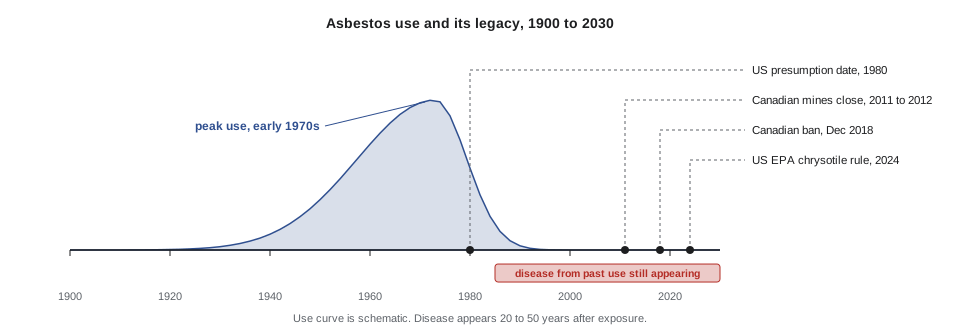
Canada was one of the world's largest producers. The town of Asbestos, Quebec (renamed Val-des-Sources in 2020) was home to the Jeffrey Mine, once the largest chrysotile mine in the world, and the Thetford Mines area had several more. Canadian chrysotile was exported around the world for decades. The last mines closed in 2011 and 2012, and the federal Prohibition of Asbestos and Products Containing Asbestos Regulations took effect on 30 December 2018, banning the import, sale, use, manufacture and export of asbestos and most asbestos products, with limited exclusions.
Why it is still here
Banning new asbestos products does not remove the asbestos already installed. Buildings last for generations. A school built in 1965, an office tower built in 1975 or a house renovated in 1985 may still contain the original insulation, ceiling texture, flooring and cement products. Asbestos also remains in industrial plants, refineries, power stations, ships, rail cars, older vehicles and underground cement pipe. As these structures age, they are repaired, renovated and eventually demolished, and each of those activities can disturb asbestos.
There is no single public inventory of every asbestos-containing material. Some provinces require building owners to keep records: Ontario's O. Reg. 278/05 requires owners of buildings with friable or non-friable asbestos-containing material to keep a record of its location and to update it, and BC requires an inventory of asbestos-containing material before work that may disturb it. Saskatchewan maintains a public registry of asbestos in public buildings. In many homes and small commercial buildings, however, nobody knows what is in the walls until someone tests it.
Asbestos outside buildings
Buildings are the main source of exposure for most workers, but they are not the only one. Asbestos occurs naturally in some rock formations, particularly serpentinite and some ultramafic rocks, and road building, quarrying, tunnelling and excavation in these formations can release fibres. Older vehicles and equipment may still have asbestos brake linings, clutch facings and gaskets, and imported replacement parts have occasionally been found to contain asbestos. Ships, locomotives, boilers, kilns and industrial furnaces built before the 1990s often contain asbestos insulation, refractory products, gaskets and rope packing. Underground asbestos-cement water and sewer pipe remains in service in many municipalities, and cutting or tapping it for repairs can release fibres if it is done dry.
Contaminated vermiculite is another special case. Much of the loose-fill vermiculite insulation sold in North America, often under the Zonolite brand, came from the mine at Libby, Montana, where the ore was contaminated with amphibole asbestos. Health Canada advises homeowners who have vermiculite insulation to assume it may contain asbestos, leave it undisturbed and hire a qualified professional if it must be removed.
Who is exposed today
CAREX Canada estimates that about 152,000 Canadians are exposed to asbestos at work, almost all of them in construction and maintenance. Carpenters, construction labourers, electricians, plumbers and pipefitters, drywall installers, insulators, demolition workers, HVAC technicians, flooring installers, building maintenance staff and automotive mechanics working on older vehicles are among the most exposed. Many of them are not asbestos workers; they are tradespeople whose work happens to disturb asbestos.
This is why awareness training matters so much. A trained abatement crew working under a proper plan is well protected. The highest risks today are often faced by an electrician drilling through a ceiling, a plumber cutting old pipe lagging, a homeowner's contractor sanding a textured ceiling, or a maintenance worker replacing floor tiles, none of whom stopped to ask whether the material contained asbestos.
The burden of disease
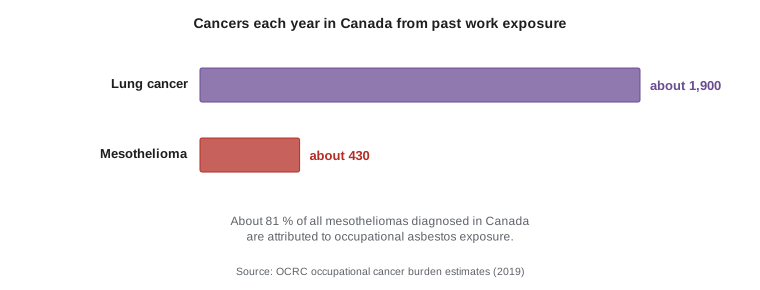
Asbestos is the leading cause of accepted workplace death claims in Canada. Analyses of compensation data have found that asbestos-related diseases account for more than a third of all accepted workplace death claims since 1996, and the Occupational Cancer Research Centre estimates that past workplace exposure causes about 430 mesotheliomas and 1,900 lung cancers a year in Canada, around 81 per cent of all mesotheliomas diagnosed. These figures do not include asbestosis or the many cases that are never compensated.
Thinking about dose
Asbestos disease depends on how many fibres a person breathes over time. Researchers describe cumulative exposure in fibre-years: the average concentration in fibres per cubic centimetre multiplied by the number of years of exposure. One fibre-year is, for example, one year of work at an average of 1 fibre/cc, or ten years at 0.1 fibre/cc. Risk of lung cancer and asbestosis rises with cumulative dose. Mesothelioma has occurred after relatively low and brief exposures, which is one reason there is no level of exposure known to be safe.
# Cumulative exposure (f/cc-years) for three illustrative careers
careers = {
    "insulator before 1975":            [(0.8, 1972 - 1960)],          # (f/cc, years)
    "maintenance electrician":          [(0.05, 20), (0.01, 10)],
    "carpenter, one uncontrolled job":  [(5.0, 0.1)],                   # about five weeks
}
for name, periods in careers.items():
    total = sum(conc * years for conc, years in periods)
    print(f"{name:34s} {total:5.2f} f/cc-years")

# Same total dose, very different patterns
print(f"0.1 f/cc for 10 years = {0.1 * 10:.1f} f/cc-year")
print(f"10 f/cc for 0.1 year = {10 * 0.1:.1f} f/cc-year")insulator before 1975 9.60 f/cc-years maintenance electrician 1.10 f/cc-years carpenter, one uncontrolled job 0.50 f/cc-years 0.1 f/cc for 10 years = 1.0 f/cc-year 10 f/cc for 0.1 year = 1.0 f/cc-year
The script writes fibre-years as f/cc-years. Its numbers are illustrative, not measurements, but they show two things. First, a few weeks of uncontrolled work can give a dose comparable to decades of low-level exposure. Second, the same cumulative dose can come from very different patterns. This is why a single dusty job without precautions matters, and why controls must be used every time rather than only on large projects.
The basic rule: identify before you disturb
Almost every asbestos exposure on a modern site can be traced to one failure: someone disturbed a material without knowing whether it contained asbestos. The rest of this course builds on one rule. Before you cut, drill, sand, scrape, break, remove or demolish any material in a building or structure that may contain asbestos, find out whether it does. If you cannot find out, treat it as asbestos until testing shows otherwise.
Worked problem
Recognizing a hidden risk
A small contractor is hired to open a wall in a 1968 bungalow to move a bathroom. The homeowner says there is no asbestos because the house has drywall, not plaster. What should the contractor think about before starting?
Show solution
- The house was built well before asbestos use ended, so asbestos-containing materials are possible.
- Drywall joint compound, textured ceiling finishes and some vinyl flooring from this era commonly contained asbestos, even though drywall itself is gypsum board.
- Pipe insulation, vermiculite in the attic or walls, and cement board around the bathtub are also possible.
- The contractor should arrange sampling of the materials to be disturbed, or treat them as asbestos-containing, before starting.
Answer: A modern-looking material is not proof of no asbestos. The contractor should have the materials tested or treat them as asbestos-containing until results come back.
How the limits came down
The hazards of asbestos were recognized long before its use peaked. Asbestosis was described in British textile workers in the 1920s, and links to lung cancer and mesothelioma were established through the 1950s and 1960s, including Irving Selikoff's landmark studies of insulation workers in the 1960s. Exposure limits followed slowly. In the early 1970s, limits in North America were around 5 to 12 fibres per cubic centimetre; they were cut to 2 f/cc, then to 0.2 f/cc in the 1980s, and to 0.1 f/cc in the 1990s and 2000s as evidence accumulated that much lower exposures cause disease. Each reduction reflected the same lesson: what was considered safe turned out not to be.
Canadian provinces lowered their limits at different times, and Quebec, where asbestos was mined, kept higher limits for chrysotile longer than other jurisdictions before lowering them. Today most Canadian jurisdictions use 0.1 f/cc for all forms. The history matters for workers because older documents, safety data sheets and habits may still reflect outdated limits and practices.
Common mistakes
MistakeAssuming that because asbestos is banned, it is no longer a hazard.
InsteadBans stop new uses; asbestos installed before the bans remains in older buildings and equipment.
MistakeBelieving white chrysotile asbestos is harmless.
InsteadAll six forms of asbestos are Group 1 carcinogens and are regulated as hazardous.
MistakeThinking only asbestos removal workers are at risk.
InsteadTradespeople who unknowingly disturb asbestos during renovation and maintenance face some of the highest risks today.
MistakeTreating one short dusty job as unimportant.
InsteadA brief uncontrolled exposure can deliver a large dose; precautions are needed every time.
MistakeStarting work and testing materials later if dust appears.
InsteadIdentify asbestos before disturbing materials, or treat them as asbestos-containing.
Summary and key terms
- Asbestos is a commercial name for six fibrous minerals: chrysotile (serpentine) and five amphiboles.
- All forms cause cancer; amphiboles are more durable in the lungs and generally more potent for mesothelioma.
- Asbestos was used in thousands of building and industrial products because it was cheap, strong and heat resistant.
- Canada banned asbestos from 30 December 2018, but installed material remains in older buildings and equipment.
- Most exposure today happens during renovation, repair, maintenance and demolition, often to tradespeople who do not know the material contains asbestos.
- Disease risk rises with cumulative dose, measured in fibre-years, but no safe level is known.
- The basic rule is to identify asbestos before disturbing materials, or treat them as asbestos-containing.
- Asbestos
- A commercial name for six naturally fibrous silicate minerals regulated as hazardous.
- Chrysotile
- The serpentine form of asbestos, with curly fibres, that made up most asbestos used.
- Amphibole
- A family of asbestos minerals with straight, needle-like fibres, including amosite and crocidolite.
- Fibre
- For counting purposes, a particle longer than 5 micrometres with a length at least three times its width.
- Asbestos-containing material (ACM)
- Material containing 0.5 per cent or more asbestos by dry weight under Ontario's regulation; other jurisdictions use similar definitions.
- Fibre-year
- A measure of cumulative exposure: average concentration in fibres per cubic centimetre multiplied by years of exposure.
- Latency
- The time between first exposure and the appearance of disease, often decades for asbestos.
- Group 1 carcinogen
- An agent classified by IARC as carcinogenic to humans.
- Legacy material
- Asbestos-containing material installed before bans and still in place.
- Abatement
- The removal, enclosure or encapsulation of asbestos-containing material.
Practice problems
Work each problem on paper first, then reveal the answer to check.
Name the six regulated forms of asbestos.
Show answer
Chrysotile, amosite, crocidolite, tremolite, actinolite and anthophyllite.
Which form of asbestos made up most commercial use?
Show answer
Chrysotile, about 95 per cent.
Why are amphiboles generally considered more potent for mesothelioma?
Show answer
Their straight fibres are more durable in lung tissue and persist longer.
Give three properties that made asbestos attractive to manufacturers.
Show answer
Heat and fire resistance, chemical resistance, strength and low cost (any three).
When did the Canadian asbestos ban take effect?
Show answer
30 December 2018.
Why does asbestos remain a hazard after a ban?
Show answer
Installed material stays in buildings and equipment and is disturbed during renovation, repair and demolition.
Calculate the cumulative exposure for 8 years at 0.05 f/cc.
Show answer
0.4 fibre-years.
Which trades are commonly exposed today?
Show answer
Carpenters, labourers, electricians, plumbers, drywall installers, insulators, HVAC technicians and maintenance staff, among others.
Does this course qualify you to remove asbestos?
Show answer
No. Type 3 work in Ontario needs 253W or 253S certification, and other provinces have their own requirements.
What is the basic rule for any material that may contain asbestos?
Show answer
Identify it before disturbing it, or treat it as asbestos-containing.
Lesson quiz · 5 questions
Score 60% or more to complete this lesson.
Create a free account to save your progress, take quizzes and earn a certificate.