
HSE-241 · Lesson 3 of 12 · 26 min
Exposure limits and the law
An exposure limit turns the biology of Lesson 1 and the physics of Lesson 2 into a rule a workplace can follow. It says how much noise a worker may receive in a day before the employer must act. The limit itself is only part of the law. Regulations also say how exposure is measured, which controls come first, when hearing protectors may be used, when hearing tests are needed and what training and records are required. This lesson explains how limits are built, compares the approaches used in Canada and the United States, and sets out the legal framework in your jurisdiction.
Exposure limits are not a line between safe and harmful. Even at 85 dBA over a working lifetime, a small percentage of workers will develop a measurable hearing loss. The limits reflect a judgement about acceptable risk, and good programs aim well below them.
The parts of a noise exposure limit
Every occupational noise limit has three parts.
| Part | What it means | Common values |
|---|---|---|
| Criterion level | The steady A-weighted level allowed for a full 8-hour day | 85 dBA in most of Canada; 87 dBA federally in Canada; 90 dBA for OSHA and MSHA; 85 dBA recommended by NIOSH |
| Exchange rate | The change in level that doubles or halves the allowed time | 3 dB in Canada and in NIOSH and ACGIH recommendations; 5 dB for OSHA and MSHA |
| Peak limit | A ceiling for impulse noise that no exposure should exceed | 140 dB peak (usually C-weighted) in many jurisdictions |
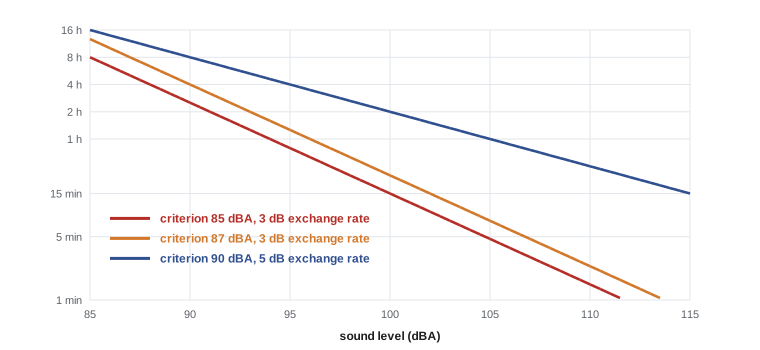
The criterion level and the exchange rate together define the allowable time at any level. With an 85 dBA criterion and a 3 dB exchange rate, a worker may be exposed to 85 dBA for 8 hours, 88 dBA for 4 hours, 91 dBA for 2 hours, 94 dBA for 1 hour and 100 dBA for only 15 minutes. With a 90 dBA criterion and a 5 dB exchange rate, the times are 8 hours at 90, 4 hours at 95, 2 hours at 100, 1 hour at 105 and 15 minutes at 115.
In the formula, T is the allowable time, L is the A-weighted level, Lc is the criterion level and E is the exchange rate.
Why the exchange rate matters so much
The 3 dB exchange rate follows the equal-energy principle: a doubling of acoustic energy, which is a 3 dB increase, halves the allowable time, so the total energy received is the same. Most scientific bodies, including NIOSH, ACGIH and the International Organization for Standardization, support the 3 dB rule. The 5 dB rule dates from the 1960s and assumed that intermittent noise, with quiet breaks, allows the ear to recover. It is more permissive at high levels. At 100 dBA, a 3 dB rule with an 85 dBA criterion allows 15 minutes; a 5 dB rule with a 90 dBA criterion allows 2 hours, eight times longer.
def allowable_hours(level, criterion, exchange):
    return 8 / 2 ** ((level - criterion) / exchange)

def fmt(h):
    return f"{h:5.2f} h" if h >= 1 else f"{h * 60:5.1f} min"

rules = {"85 dBA / 3 dB": (85, 3), "87 dBA / 3 dB": (87, 3), "90 dBA / 5 dB": (90, 5)}
print("Level   " + "".join(f"{name:>16}" for name in rules))
for level in range(85, 116, 3):
    row = "".join(f"{fmt(allowable_hours(level, c, e)):>16}" for c, e in rules.values())
print(f"{level} dBA" + row)Level 85 dBA / 3 dB 87 dBA / 3 dB 90 dBA / 5 dB 85 dBA 8.00 h 12.70 h 16.00 h 88 dBA 4.00 h 6.35 h 10.56 h 91 dBA 2.00 h 3.17 h 6.96 h 94 dBA 1.00 h 1.59 h 4.59 h 97 dBA 30.0 min 47.6 min 3.03 h 100 dBA 15.0 min 23.8 min 2.00 h 103 dBA 7.5 min 11.9 min 1.32 h 106 dBA 3.8 min 6.0 min 52.2 min 109 dBA 1.9 min 3.0 min 34.5 min 112 dBA 0.9 min 1.5 min 22.7 min 115 dBA 0.5 min 0.7 min 15.0 min
The table shows how quickly the rules diverge. At 85 dBA the differences hardly matter. At 103 dBA, a common level for grinding or cutting, a Canadian provincial worker reaches the limit in under 8 minutes, while the OSHA limit allows over an hour.
The law in Canada
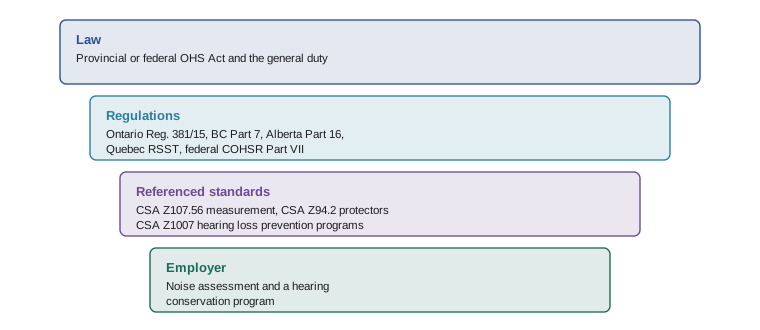
Occupational health and safety in Canada is mainly provincial and territorial. About 90 per cent of workers fall under the law of the province or territory where they work. Federally regulated workplaces, such as banks, airlines, interprovincial trucking and rail, telecommunications, ports and federal government departments, fall under the Canada Labour Code, Part II, and the Canada Occupational Health and Safety Regulations. Each jurisdiction sets its own noise rules, although they are now broadly similar.
| Jurisdiction | Criterion and exchange rate | Other key points |
|---|---|---|
| Federal (Canada Labour Code, Part II; COHSR Part VII) | 87 dBA, 3 dB | Hearing protectors must meet CSA Z94.2; investigation required where exposure may approach the limit |
| Ontario (O. Reg. 381/15) | 85 dBA Lex,8, 3 dB | Applies to all workplaces under the OHSA since 2016; engineering controls and work practices first; protectors only in listed situations |
| British Columbia (OHS Regulation Part 7) | 85 dBA Lex, 3 dB; 140 dBC peak | Written noise control and hearing conservation program above the limits; baseline and annual hearing tests |
| Alberta (OHS Code Part 16) | 85 dBA, 3 dB | Noise exposure assessment and written noise management program; audiometric tests within 6 months, after 12 months and then at least every 2 years |
| Quebec (Regulation respecting occupational health and safety) | 85 dBA, 3 dB since June 2023 | Exposure assessment by a qualified person, reassessed at least every 5 years where limits are exceeded |
| Other provinces and territories | 85 dBA in all; 3 dB in most | Several set a 140 dB peak limit; program and audiometric requirements vary |
A closer look at Ontario
Ontario's noise regulation, O. Reg. 381/15, came into force on July 1, 2016 and extended noise protection to all workplaces covered by the Occupational Health and Safety Act, including construction, health care, schools, farms and mines, which had previously been covered unevenly. Its main requirements are short but strict.
| Section | Requirement |
|---|---|
| s. 2(1) | The employer must take all measures reasonably necessary in the circumstances to protect workers from exposure to hazardous sound levels |
| s. 2(2) and (5) | Engineering controls and work practices come first; workers above the limit must be protected without relying on hearing protection where possible |
| s. 2(3) | Exposure is measured without taking hearing protectors into account |
| s. 2(4) | No worker may be exposed above 85 dBA Lex,8 |
| s. 2(6) | Hearing protection may be used only where engineering controls are not in existence or not obtainable, not reasonable or practical because of the duration or frequency of exposure or the nature of the process, ineffective because of a temporary breakdown, or ineffective because of an emergency |
| s. 2(7) | Where practicable, signs must warn at each approach to an area where sound levels regularly exceed 85 dBA |
| s. 3 | Workers who must use hearing protectors must be trained in their care and use, including limitations, fitting, inspection and maintenance |
| s. 4 | Protectors must be selected considering the sound level, the protector's attenuation and the manufacturer's information |
Ontario does not mandate audiometric testing or a formal hearing conservation program in the regulation, but the general duty in section 25(2)(h) of the Occupational Health and Safety Act, to take every precaution reasonable in the circumstances, and good practice under CSA Z1007, Hearing loss prevention program management, mean that most well-run workplaces with noise above the limit have both. Inspectors may ask how the employer knows that its controls and protectors are working, and audiometric results are the most direct answer.
Program requirements beyond the limit
The exposure limit is only the trigger. What really protects workers is the set of program elements that apply once noise is above certain levels. These typically include an exposure assessment, controls, signs or posting of noisy areas, provision and selection of protectors, training, audiometric testing and records.
| Element | Typical Canadian requirement |
|---|---|
| Assessment | Required where exposure may exceed the limit; several provinces specify CSA Z107.56 methods and reassessment after changes |
| Controls | Engineering controls first; administrative controls and protectors when controls are not practicable or not enough |
| Posting | Signs at approaches to areas above the limit in Ontario, British Columbia and other provinces |
| Protectors | Meeting CSA Z94.2 and selected for the exposure, in many provinces using the CSA class or grade tables |
| Training | Effects of noise, use and care of protectors, results of assessments |
| Audiometric testing | Required in British Columbia, Alberta, Manitoba, Saskatchewan, Newfoundland and Labrador, PEI, Yukon and others; not mandated by regulation in Ontario or federally |
| Program | Written noise management or hearing conservation program in several provinces, often guided by CSA Z1007 |
Worked problem
Applying the limit to a mixed day
A sheet metal worker in Ontario spends 2 hours at 91 dBA and the rest of an 8-hour shift at 80 dBA. Is the worker over the limit, and may the employer simply issue earplugs?
Show solution
- With an 85 dBA criterion and 3 dB exchange rate, 91 dBA is allowed for 2 hours, so those 2 hours alone use 100 per cent of the daily dose.
- The 6 hours at 80 dBA add a further 6 ÷ 25.4 ≈ 24 per cent, because 80 dBA is allowed for about 25.4 hours.
- Total dose is about 124 per cent, so Lex,8 is about 85 + 10 log10(1.24) ≈ 85.9 dBA, above the limit.
- Under O. Reg. 381/15 the employer must first look at engineering controls and work practices for the 91 dBA task. Earplugs alone are acceptable only if one of the section 2(6) situations applies, and the worker must then be trained and the protectors properly selected.
Answer: About 124 per cent of the daily dose, or 85.9 dBA Lex,8, which is over the limit. Engineering controls and work practices must be considered first; earplugs alone are acceptable only in the listed situations.
The general duty and due diligence
Even where a regulation is silent, such as on audiometric testing in Ontario, employers in every Canadian jurisdiction have a general duty to take every precaution reasonable in the circumstances. Supervisors have their own duties, including ensuring that workers use the protective devices the employer requires and advising workers of hazards. In a prosecution, an employer's defence is due diligence: showing that it took all reasonable steps. For noise, that means an up-to-date assessment, a documented consideration of engineering controls, properly selected protectors, training, and a way of checking that the program works.
Limits are minimums
Because current limits still leave a measurable risk of hearing loss, many employers set internal targets below the legal limit. Common choices are to use 85 dBA with a 3 dB exchange rate even where the law allows 90 dBA and 5 dB, to aim for protected exposures between 70 and 80 dBA rather than just under the limit, and to start audiometric testing and training at 80 or 82 dBA for workers whose exposures fluctuate. Buy-quiet purchasing policies, covered in Lesson 6, aim to keep new equipment below 80 or 85 dBA at the operator position.
Common mistakes
MistakeTreating the exposure limit as a safe level.
InsteadRecognize that limits still leave a measurable risk and aim for exposures well below them.
MistakeApplying the wrong exchange rate, for example using 5 dB in a province that uses 3 dB.
InsteadUse the criterion level and exchange rate of the jurisdiction that governs the workplace.
MistakeCounting the attenuation of hearing protectors when deciding whether exposure exceeds the limit.
InsteadAssess exposure without protectors, then use protectors only as allowed after controls are considered.
MistakeReaching straight for earplugs because they are cheap.
InsteadDocument why engineering controls and work practices are or are not practicable before relying on protectors.
MistakeAssuming no audiometric testing is needed because the regulation does not mention it.
InsteadUse audiometric testing as the main check that the program works, as recommended in program standards.
Summary and key terms
- A noise limit has a criterion level, an exchange rate and often a peak limit.
- Canada uses 85 dBA with a 3 dB exchange rate in every province and territory, and 87 dBA federally; OSHA and MSHA use 90 dBA with a 5 dB exchange rate and an 85 dBA action level.
- The 3 dB exchange rate follows the equal-energy principle and is far stricter than the 5 dB rule at high levels.
- Regulations put engineering controls and work practices before hearing protectors, and exposure is assessed without protectors.
- Program elements such as assessment, posting, protectors, training, audiometric testing and records apply once noise exceeds set levels, and they vary by jurisdiction.
- The general duty and due diligence apply even where a regulation is silent.
- Limits are minimums; many employers set stricter internal targets.
- Criterion level
- The steady A-weighted level allowed for an 8-hour day.
- Exchange rate
- The increase in level that halves the allowable exposure time.
- Equal-energy principle
- The idea that equal amounts of acoustic energy cause equal hearing risk, which leads to the 3 dB exchange rate.
- Lex,8
- The A-weighted noise exposure level normalized to an 8-hour day.
- Permissible exposure limit (PEL)
- OSHA's enforceable limit, 90 dBA as an 8-hour TWA with a 5 dB exchange rate.
- Action level
- The exposure, 85 dBA TWA in OSHA and MSHA rules, at which a hearing conservation program is required.
- Recommended exposure limit (REL)
- NIOSH's recommended limit of 85 dBA with a 3 dB exchange rate.
- Peak limit
- The maximum instantaneous level allowed for impulse noise, commonly 140 dB.
- General duty
- The broad legal obligation to protect workers, which applies even where specific regulations are silent.
- Due diligence
- Taking all reasonable precautions in the circumstances; the main defence to a charge under Canadian OHS law.
Practice problems
Work each problem on paper first, then reveal the answer to check.
With an 85 dBA criterion and 3 dB exchange rate, how long may a worker be exposed to 97 dBA?
Show answer
8 ÷ 2^4 = 0.5 hours, or 30 minutes.
With a 90 dBA criterion and 5 dB exchange rate, how long is allowed at 100 dBA?
Show answer
2 hours.
What exchange rate does the equal-energy principle produce?
Show answer
3 dB.
What is the federal Canadian criterion level?
Show answer
87 dBA with a 3 dB exchange rate.
At what exposure must OSHA general industry employers start a hearing conservation program?
Show answer
At or above an 8-hour TWA of 85 dBA, the action level.
Why is exposure assessed without counting hearing protectors?
Show answer
So that the need for controls is judged on the real noise hazard, and protectors are treated as a last resort.
Name four of the grounds in O. Reg. 381/15 for relying on hearing protectors.
Show answer
Controls not in existence or obtainable; not reasonable or practical; temporary breakdown; emergency.
Which Canadian jurisdictions mentioned require audiometric testing by regulation?
Show answer
Examples include British Columbia, Alberta, Manitoba, Saskatchewan, Newfoundland and Labrador, PEI and Yukon.
How long must OSHA audiometric records be kept?
Show answer
For the duration of the affected employee's employment.
Why do many employers set internal limits below the legal limit?
Show answer
Because legal limits still leave a measurable risk of hearing loss.
Lesson quiz · 5 questions
Score 60% or more to complete this lesson.
Create a free account to save your progress, take quizzes and earn a certificate.