
HSE-241 · Lesson 6 of 12 · 27 min
Engineering noise control
Engineering controls reduce noise at its source or along its path, so they protect everyone in the area, all the time, without depending on anyone remembering to put on a protector. They are first in the hierarchy of controls for that reason, and the law in both Canada and the United States expects them to be considered before hearing protectors. Engineering noise control is sometimes seen as expensive and specialized. Some solutions are, but many effective measures are simple: maintenance, a quieter air nozzle, a rubber lining in a chute, a gap sealed in a guard, a machine moved away from a wall. This lesson covers the principles, the main techniques and how to make the business case.
Source, path and receiver
Every noise problem can be broken into three parts. The source is the machine or process that generates the sound. The path is the route by which sound travels to the worker, through the air directly, by reflection from walls and ceilings, or as vibration through the structure. The receiver is the worker. Controls can act on any of the three, and they are generally most effective and cheapest at the source.
Before choosing a control, find out which source, which part of it and which path matter most, using the measurements and source-ranking approach from Lessons 2 and 4. Treating the wrong source or path is the most common reason noise control projects disappoint.
Controls at the source
Source controls change the way sound is generated. Many are part of good engineering and maintenance practice rather than special projects.
| Mechanism | Examples of source controls | Typical result (illustrative) |
|---|---|---|
| Poor maintenance | Lubricate bearings, replace worn gears and belts, balance fans, tighten loose guards and panels, fix air leaks | Several dB, often at no capital cost |
| Compressed air | Engineered low-noise nozzles, exhaust silencers on valves, lower supply pressure where possible, turn off air when not needed | 5 to 15 dB at blow-off points, with energy savings |
| Impacts | Reduce drop heights, line chutes and bins with rubber or plastic, use soft-faced hammers, cushion stops | 5 to 20 dB for parts handling |
| Vibrating panels | Add damping material, stiffen or perforate guards, use mesh where safe | 5 to 10 dB from radiating surfaces |
| Speed and flow | Slower, larger fans; reduced turbulence in ducts; lower cutting speeds with sharper tools | Several dB; fan noise rises steeply with tip speed |
| Process change | Press fitting instead of hammering, welding instead of riveting, water-jet or laser instead of sawing, electric instead of pneumatic tools | Often 10 dB or more |
Compressed air deserves special mention because it is everywhere and wasteful. An open pipe used to blow off parts or clean a bench can exceed 100 dBA at the operator's ear. Engineered nozzles entrain surrounding air, giving the same cleaning force with less compressed air and much less turbulence, typically reducing noise by around 10 dB. Because compressed air is one of the most expensive forms of energy in a plant, the nozzles often pay for themselves through energy savings alone.
Controls along the path
Path controls block, absorb or redirect sound between the source and the worker. The main tools are enclosures, barriers, sound-absorbing treatment, silencers and vibration isolation.
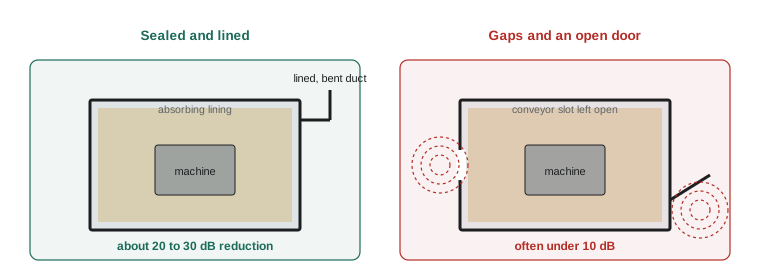
An enclosure surrounds the source with a solid, sealed box lined with absorbing material. The heavier and more airtight the walls, the more sound they block; this is described by the mass law, under which the sound transmission loss of a single wall increases by about 6 dB for each doubling of its mass per unit area or each doubling of frequency. Enclosures can achieve reductions of 20 dB or more, but only if they are well sealed. Openings for material flow, ventilation, cables and access are the weak points, as the code example below shows.
import math

def enclosure_reduction(wall_tl, open_fraction):
    """Effective transmission loss of an enclosure wall with openings.
    wall_tl: transmission loss of the solid panel (dB)
    open_fraction: fraction of the total area that is open (TL of openings = 0)."""
    tau_wall = 10 ** (-wall_tl / 10)
    tau = (1 - open_fraction) * tau_wall + open_fraction * 1.0
    return -10 * math.log10(tau)

print("Panel TL 30 dB:")
for pct in [0, 0.1, 0.5, 1, 2, 5, 10]:
print(f" {pct:>4}% open -> effective TL {enclosure_reduction(30, pct / 100):5.1f} dB")Panel TL 30 dB:
0% open -> effective TL 30.0 dB
0.1% open -> effective TL 27.0 dB
0.5% open -> effective TL 22.2 dB
1% open -> effective TL 19.6 dB
2% open -> effective TL 16.8 dB
5% open -> effective TL 12.9 dB
10% open -> effective TL 10.0 dBA panel capable of 30 dB loses 3 dB, letting twice as much sound energy through, with just 0.1 per cent of its area open, and with 1 per cent open it can do no better than 20 dB. With 10 per cent open, the enclosure is little more than a partial barrier. That is why enclosure design pays so much attention to seals, gaskets, lined ventilation ducts and baffled openings for conveyors, and why enclosures that are left open for convenience lose most of their benefit.
A barrier is a solid screen between the source and the worker. It blocks the direct path and creates a sound shadow behind it, but sound bends, or diffracts, around the edges. Barriers work best when they are tall, close to either the source or the worker, and used against high-frequency noise; they do little for low-frequency noise and little in a reverberant room unless the ceiling and walls are also treated. A typical indoor barrier gives 5 to 10 dB for a worker close behind it.
Sound-absorbing treatment, such as acoustic panels, baffles hung from the ceiling or perforated metal panels with mineral wool behind them, reduces reflected sound. It does nothing for a worker right next to a machine, where direct sound dominates, but it reduces the reverberant level throughout the room, helping workers who are farther from the source. The improvement depends on how much absorption is added compared with what is already there:
where A is the total sound absorption in the room. Doubling the absorption gives 3 dB; increasing it fourfold gives 6 dB. In a hard concrete and steel building with very little absorption, treatment can deliver 5 to 10 dB in the reverberant field. In a room that already has some absorption, the gains are smaller.
import math

# Room 30 m x 20 m x 8 m with hard surfaces (illustrative absorption coefficients)
floor = ceiling = 30 * 20
walls = 2 * (30 * 8) + 2 * (20 * 8)
alpha_hard = 0.03
A_before = (floor + ceiling + walls) * alpha_hard

# Option 1: absorbing ceiling panels (alpha 0.85) over 70 % of the ceiling
A_ceiling = A_before - 0.7 * ceiling * alpha_hard + 0.7 * ceiling * 0.85
# Option 2: ceiling panels plus wall panels on half of the walls (alpha 0.8)
A_both = A_ceiling - 0.5 * walls * alpha_hard + 0.5 * walls * 0.8

for name, A in [("ceiling panels", A_ceiling), ("ceiling and walls", A_both)]:
    print(f"{name:<18} absorption {A_before:5.0f} -> {A:5.0f} m2 Sabine, "
f"reverberant level down {10 * math.log10(A / A_before):4.1f} dB")ceiling panels absorption 60 -> 404 m2 Sabine, reverberant level down 8.3 dB ceiling and walls absorption 60 -> 712 m2 Sabine, reverberant level down 10.7 dB
This simple calculation ignores the absorption already provided by machines, stored materials and people, so real-world gains are usually a few decibels smaller. Even so, it shows why treating a bare, hard building can make a noticeable difference to workers who are not right beside a machine.
Silencers, also called mufflers, reduce noise from air and gas flows: fan inlets and outlets, ventilation ducts, engine exhausts, pneumatic valve exhausts and vacuum pumps. Absorptive silencers line the flow path with sound-absorbing material and work best at middle and high frequencies; reactive silencers use chambers and tubes to reflect sound and target low frequencies.
Vibration isolation stops machines from shaking the floor and the building structure, which would otherwise radiate sound far from the machine. Resilient mounts, springs and flexible connectors on pipes and ducts break the structure-borne path. Isolation is especially important for compressors, pumps, fans and presses on upper floors or on light structures.
Controls at the receiver
When the source and path cannot be treated enough, the worker can be placed in a quieter space. Control rooms, operator booths and acoustic shelters with windows let operators monitor equipment while working in 70 to 80 dBA instead of 95. Booths need the same attention to sealing and ventilation as enclosures, and they work only if the operator can do the job from inside. Reducing the time spent in noisy areas, for example by remote monitoring or relocating paperwork to a quiet office, also reduces exposure, though it is usually classed as an administrative control.
Buy quiet
The cheapest noise to control is noise that never enters the workplace. A buy-quiet policy builds noise limits into purchasing for new and replacement equipment, tools and facilities. The policy specifies a maximum sound level at the operator position, such as 80 or 85 dBA, asks suppliers for declared noise emission data measured to recognized standards, compares products on noise as well as price and performance, and verifies the level after installation.
In Canada, there is no general federal requirement for machinery suppliers to declare noise emissions, but many products sold internationally carry noise data prepared for the European Union's machinery rules, and purchasers can require it in their specifications. Several provinces' guidance documents and CSA Z1007 encourage noise to be considered at the design and purchasing stage, and Alberta's OHS Code includes a section on noise control design for new and modified workplaces.
Worked problem
Making the business case for a quieter process
A plant uses 12 open copper tubes to blow parts off conveyors. Each operates about 4,000 hours a year. Replacing them with engineered nozzles costs $85 each installed. The tubes produce 98 dBA at the operator; the nozzles are rated about 10 dB quieter and use roughly half the compressed air. Compressed air for each open tube costs an estimated $310 a year. What is the payback?
Show solution
- Cost of nozzles: 12 × $85 = $1,020.
- Annual air saving: half of 12 × $310 = $1,860 a year.
- Simple payback: $1,020 ÷ $1,860 ≈ 0.55 years, or about 7 months.
- The 10 dB reduction may bring several operators below the limit, which also reduces the cost of protectors, audiometric testing and potential hearing loss claims.
Answer: Payback is about 7 months on energy savings alone, before counting the hearing conservation benefits. All costs here are illustrative; use local figures.
Engineering control programs
In plants with many noise sources, a structured noise control program works better than isolated fixes. Typical steps are to rank sources by their contribution to worker exposures, list feasible controls for each with estimated costs and reductions, prioritize by exposure reduction per dollar and by the number of workers affected, set targets, implement in phases and remeasure after each phase to confirm the benefit. A simple spreadsheet with source contributions, using the decibel arithmetic of Lesson 2, is often enough to show which projects matter most.
import math

def combine(levels):
    return 10 * math.log10(sum(10 ** (L / 10) for L in levels))

# Contributions to the level at an operator position (illustrative)
sources = {"air blow-off": 94, "parts chute": 92, "gearbox": 87, "fan": 84, "motor": 80}
options = {  # source: (reduction dB, cost $)
    "air blow-off": (10, 1000),
    "parts chute": (12, 2500),
    "gearbox": (6, 9000),
    "fan": (8, 6000),
}
before = combine(sources.values())
print(f"Before: {before:.1f} dBA")
ranked = []
for name, (red, cost) in options.items():
    after = combine([L - red if n == name else L for n, L in sources.items()])
    ranked.append((before - after, cost, name))
for gain, cost, name in sorted(ranked, reverse=True):
    print(f"  treat {name:<13} gain {gain:4.1f} dB  cost ${cost:>5}")

levels = dict(sources)
for name in ["air blow-off", "parts chute"]:
    levels[name] -= options[name][0]
print(f"After blow-off and chute: {combine(levels.values()):.1f} dBA")Before: 96.9 dBA treat air blow-off gain 2.7 dB cost $ 1000 treat parts chute gain 1.5 dB cost $ 2500 treat gearbox gain 0.3 dB cost $ 9000 treat fan gain 0.2 dB cost $ 6000 After blow-off and chute: 90.8 dBA
Treating only the gearbox, the most expensive project, would hardly change the operator's level, because the air blow-off and parts chute dominate. Treating those two first brings the level down by several decibels for a fraction of the cost.
When engineering controls are judged not practicable
Ontario's noise regulation and similar rules elsewhere allow hearing protectors to be relied on only in specified situations, such as when controls do not exist or are not reasonable or practical. The decision should be documented: what controls were considered, what reduction each would achieve, the cost and practical barriers, and when the decision will be reviewed. Cost alone is not a listed ground in Ontario. A short written assessment of this kind is evidence of due diligence and helps prevent the default assumption that earplugs are the answer.
Common mistakes
MistakeStarting with the quietest or cheapest sources.
InsteadRank sources by their contribution to worker exposure and treat the dominant ones first.
MistakeBuilding an enclosure with unsealed openings or leaving its doors open.
InsteadSeal gaps, use gaskets and lined ducts, and design access so the enclosure stays closed in normal use.
MistakeExpecting a barrier or absorption panels to protect a worker standing right at the machine.
InsteadUse source controls or enclosures for workers close to the source; absorption helps mainly in the reverberant field.
MistakeIgnoring maintenance as a noise control.
InsteadInclude lubrication, balancing, worn part replacement and air leak repair in the noise program.
MistakeBuying new equipment without asking about noise.
InsteadAdopt a buy-quiet policy with noise limits and declared emission data in purchase specifications.
Summary and key terms
- Engineering controls protect everyone continuously and come before hearing protectors in the hierarchy of controls.
- Noise problems have a source, a path and a receiver; controls at the source are usually the most effective and economical.
- Source controls include maintenance, quieter air nozzles, reduced impacts, damping and process changes.
- Enclosures can give 20 dB or more but lose much of their benefit through small openings.
- Barriers work best for high frequencies and close positions; absorption reduces the reverberant level, with about 3 dB for each doubling of absorption.
- Silencers, vibration isolation and operator booths complete the toolkit, and buy-quiet purchasing prevents new problems.
- Ranking sources, estimating gains and costs and documenting decisions turn noise control into a manageable program.
- Engineering control
- A physical change to equipment, processes or the workplace that reduces noise at the source or along its path.
- Source control
- A measure that reduces the noise a machine or process generates.
- Enclosure
- A sealed, usually lined housing around a noise source that blocks sound transmission.
- Transmission loss
- The reduction in sound energy, in decibels, as sound passes through a wall or panel.
- Mass law
- The rule that transmission loss of a single wall rises about 6 dB per doubling of its mass per unit area or of frequency.
- Barrier
- A solid screen that blocks the direct sound path between a source and a worker.
- Sound absorption
- Treatment that converts sound energy to heat and reduces reflections in a room.
- Silencer
- A device that reduces noise carried by air or gas flowing through ducts, exhausts or vents.
- Vibration isolation
- Resilient mounts and connectors that stop vibration from passing into the building structure.
- Buy quiet
- A purchasing policy that sets noise limits for new equipment and tools.
Practice problems
Work each problem on paper first, then reveal the answer to check.
Why are source controls usually preferred over path controls?
Show answer
They reduce noise for everyone everywhere and are often simpler and cheaper.
Give three source controls for a parts-handling operation.
Show answer
Reduce drop heights, line chutes and bins with rubber or plastic, cushion stops.
What happens to a 30 dB enclosure panel with 1 per cent of its area open?
Show answer
Its effective transmission loss falls to about 20 dB.
When is a barrier most effective?
Show answer
When it is tall, close to the source or worker, and the noise is high frequency.
A room's absorption is increased fourfold. What reduction in reverberant level is expected?
Show answer
About 6 dB.
Why does absorption do little for a worker standing at the machine?
Show answer
Direct sound dominates close to the source, and absorption reduces only reflected sound.
What is the purpose of vibration isolation?
Show answer
To stop machine vibration passing into the floor and structure, where it radiates as noise.
Name two benefits of engineered compressed air nozzles.
Show answer
Lower noise and lower compressed air use, which saves energy.
What should a buy-quiet specification ask suppliers for?
Show answer
Declared noise emission data measured to recognized standards and a maximum level at the operator position.
What should a written decision that controls are not practicable include?
Show answer
Controls considered, expected reductions, costs and barriers, and a review date.
Lesson quiz · 5 questions
Score 60% or more to complete this lesson.
Create a free account to save your progress, take quizzes and earn a certificate.