
HSE-241 · Lesson 2 of 12 · 30 min
Sound basics for noise control
Every decision in a hearing conservation program rests on a few numbers: the sound level at a workstation, the daily exposure of a worker, the attenuation of a protector, the reduction an enclosure provides. Those numbers are all decibels, and decibels behave in ways that surprise people who are used to ordinary arithmetic. Two machines at 90 dBA do not make 180 dBA. Halving the distance to a source does not double the level. A reduction of 3 dB sounds small but halves the acoustic energy. This lesson gives you the working knowledge of sound you need to read noise surveys, check calculations and avoid the common mistakes. It deliberately stays practical; FILM-310 Sound for Film, lesson 2, covers acoustics in more depth.
What sound is
Sound is a pressure wave travelling through air, or through another medium such as water or steel. A vibrating surface, such as a saw blade, a loudspeaker cone or the panel of a machine, pushes and pulls on the air next to it, creating tiny alternating regions of higher and lower pressure that spread outward. In air at room temperature these waves travel at about 343 metres per second.
Two properties describe a simple sound. Its amplitude, the size of the pressure fluctuation, determines how loud it is. Its frequency, the number of pressure cycles per second, measured in hertz (Hz), determines its pitch. Young, healthy ears can hear roughly 20 Hz to 20,000 Hz. Most real noises contain a broad mix of frequencies at once, and noise control engineers break them down into frequency bands to understand them.
The pressure fluctuations involved are tiny compared with atmospheric pressure, which is about 101,000 pascals. The quietest sound a young person can hear at 1,000 Hz is a fluctuation of about 20 micropascals, or 0.00002 Pa. A sound loud enough to cause pain is about 20 Pa, a million times larger. That enormous range is the reason we use a logarithmic scale.
The decibel
The sound pressure level, in decibels, compares a sound pressure with the reference pressure of 20 micropascals:
On this scale the threshold of hearing is 0 dB and the threshold of pain is about 120 dB. The logarithm compresses a range of a million to one into a range of 0 to 120, which is easier to work with and closer to the way loudness is perceived. It also changes the rules of arithmetic. A few landmarks are worth memorizing.
| Change in level | Change in acoustic energy | Typical perception |
|---|---|---|
| +3 dB | Doubled | Just noticeable to most people |
| +6 dB | Four times | Clearly louder |
| +10 dB | Ten times | About twice as loud |
| +20 dB | One hundred times | About four times as loud |
| −3 dB | Halved | Just noticeably quieter |
| −10 dB | One tenth | About half as loud |
The first row explains a theme that runs through this course. Hearing damage depends on acoustic energy, not perceived loudness. A 3 dB increase doubles the energy reaching the ear, even though most people can barely hear the difference. That is why Canadian jurisdictions halve the allowable exposure time for every 3 dB increase in level, as Lesson 3 explains.
Adding and subtracting levels
Because decibels are logarithmic, levels from separate sources cannot be added directly. Instead, each level is converted back to a relative energy, the energies are added, and the total is converted back to decibels:
This formula applies to sources that are independent, such as two different machines, which is the usual case in workplaces. Several useful rules follow from it.
| Difference between two levels | Add this to the higher level |
|---|---|
| 0 dB (equal levels) | 3 dB |
| 1 dB | 2.5 dB |
| 2 dB | 2.1 dB |
| 3 dB | 1.8 dB |
| 4 dB | 1.5 dB |
| 6 dB | 1.0 dB |
| 10 dB | 0.4 dB |
| More than 10 dB | Negligible |
Two machines at 90 dBA together produce 93 dBA, not 180. Ten identical machines produce 10 dB more than one. A quiet machine next to a loud one barely changes the total: a 92 dBA press beside an 80 dBA conveyor gives 92.3 dBA. The practical lesson is powerful. Noise control effort should go to the loudest sources first, because quietening the smaller ones does almost nothing to the total.
The same logic works in reverse. If the total level with all machines running is 95 dBA and it drops to 92 dBA when one machine is switched off, that machine was contributing about 92 dBA on its own, because removing it halved the energy. This kind of switch-off test is a simple way to rank sources during a survey.
import math

def add_levels(levels):
    """Combine independent sound levels in dB."""
    return 10 * math.log10(sum(10 ** (L / 10) for L in levels))

def subtract_level(total, background):
    """Level of one source, given the total and the level without it."""
    return 10 * math.log10(10 ** (total / 10) - 10 ** (background / 10))

print("Two machines at 90 dBA:", round(add_levels([90, 90]), 1), "dBA")
print("Ten machines at 90 dBA:", round(add_levels([90] * 10), 1), "dBA")
print("Press 92 + conveyor 80:", round(add_levels([92, 80]), 1), "dBA")

shop = {"press": 94, "grinder": 91, "compressor": 88, "fans": 82, "conveyor": 79}
total = add_levels(shop.values())
print(f"Shop total: {total:.1f} dBA")
for name, L in sorted(shop.items(), key=lambda kv: -kv[1]):
    others = add_levels([v for k, v in shop.items() if k != name])
    print(f"  without {name:<10} {others:5.1f} dBA  (reduction {total - others:4.1f} dB)")

print("Source level from a switch-off test:", round(subtract_level(95, 92), 1), "dBA")Two machines at 90 dBA: 93.0 dBA Ten machines at 90 dBA: 100.0 dBA Press 92 + conveyor 80: 92.3 dBA Shop total: 96.7 dBA without press 93.3 dBA (reduction 3.4 dB) without grinder 95.3 dBA (reduction 1.4 dB) without compressor 96.0 dBA (reduction 0.6 dB) without fans 96.5 dBA (reduction 0.2 dB) without conveyor 96.6 dBA (reduction 0.1 dB) Source level from a switch-off test: 92.0 dBA
The output shows the ranking clearly. Removing the press would lower the shop level by more than any other single change, while removing the conveyor would make almost no difference. Even silencing everything except the press would leave the level above 94 dBA.
Distance and the inverse square law
Outdoors, or in a very large room with sound-absorbing surfaces, sound from a small source spreads over an ever larger sphere. The sound intensity falls with the square of distance, so each doubling of distance reduces the level by about 6 dB. A compressor measuring 96 dBA at 1 metre would measure about 90 dBA at 2 metres, 84 dBA at 4 metres and 78 dBA at 8 metres in these free-field conditions.
Indoors, things are different. Sound reflects from walls, floors, ceilings and machines, building up a reverberant field that does not fall off with distance. Close to a source, the direct sound dominates and the 6 dB rule roughly applies. Farther away, the reverberant sound dominates and the level levels off. In a hard-walled factory, moving a worker from 2 to 8 metres from a machine may reduce the level by only 3 or 4 dB instead of 12. A long line of machines, such as a conveyor or a busy road, behaves more like a line source and falls off by about 3 dB per doubling of distance.
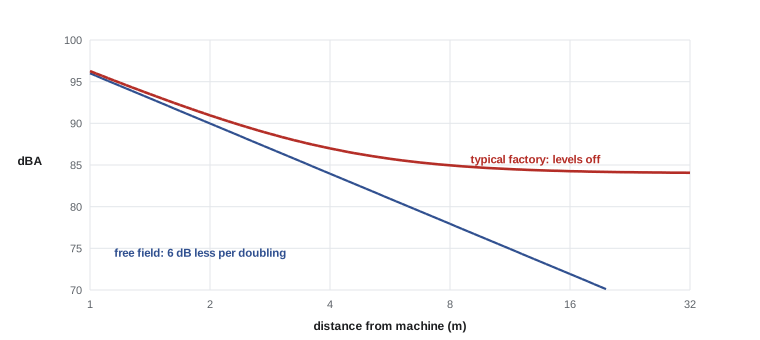
This is why simply moving workers away from a machine is often less effective indoors than people expect, and why sound-absorbing treatment of the room, discussed in Lesson 6, can help workers who are not right next to the source.
Worked problem
Using distance to plan a workstation
A portable generator measures 98 dBA at 1 metre on an outdoor site. Ignoring reflections, at what distance would the level fall to 85 dBA?
Show solution
- The level must fall by 98 − 85 = 13 dB.
- Using the free-field formula, 13 = 20 log10(r ÷ 1), so log10(r) = 0.65 and r = 10^0.65 ≈ 4.5 metres.
- Hard surfaces such as nearby walls, trucks or a building face will reflect sound back and raise the level, so the real distance may need to be greater.
- Measure at the planned location before relying on the calculation.
Answer: About 4.5 metres in ideal free-field conditions, and more in practice where reflecting surfaces are nearby.
Frequency and octave bands
Real noises contain many frequencies. To describe and control them, acousticians divide the audible range into octave bands, each spanning a doubling of frequency, identified by their centre frequency: 31.5, 63, 125, 250, 500, 1,000, 2,000, 4,000, 8,000 and 16,000 Hz. Finer one-third octave bands are used for detailed work. An octave band analysis shows where a noise's energy lies, which matters for two reasons. First, low-frequency noise is much harder to block with barriers and protectors than high-frequency noise. Second, the ear is more sensitive to some frequencies than others, so the same sound pressure at different frequencies carries different risk.
| Noise character | Typical sources | Control implications |
|---|---|---|
| Low frequency rumble, below about 250 Hz | Large engines, fans, compressors, vibrating floors and ducts | Hard to block; needs mass, vibration isolation and careful protector choice |
| Mid frequency, 500 to 2,000 Hz | Many motors, gearboxes, general machinery | Responds well to enclosures and absorption |
| High frequency, above about 2,000 Hz | Compressed air leaks and nozzles, cutting, grinding, high-speed saws | Easiest to block and absorb; protectors very effective; most damaging to hearing |
| Tonal noise | Fans, gears, transformers, pumps with a dominant pitch | Identify and treat the specific frequency |
Frequency weighting
The ear is less sensitive to low frequencies at moderate levels. To produce a single number that reflects hearing risk, sound level meters apply a frequency weighting, an electronic filter that reduces some bands before combining them. Three are common in occupational work.
| Weighting | What it does | Main use |
|---|---|---|
| A-weighting (dBA) | Strongly reduces low frequencies and slightly boosts 2,000 to 4,000 Hz, approximating the ear at moderate levels | Occupational exposure limits and almost all noise assessments |
| C-weighting (dBC) | Nearly flat, reducing only the extremes of the range | Peak levels of impulse noise; comparing with dBA to detect low-frequency noise; some protector selection methods |
| Z-weighting (dBZ) | No weighting, flat from 10 Hz to 20,000 Hz | Octave band analysis and engineering studies |
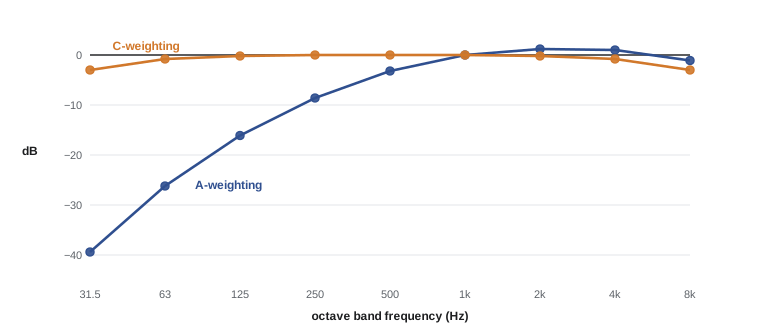
Comparing dBC and dBA readings gives a quick clue about low-frequency content. If the C-weighted level is much higher than the A-weighted level, say by more than about 10 dB, the noise has a lot of low-frequency energy. That matters when choosing hearing protectors, because many protectors give less attenuation at low frequencies, and when designing barriers and enclosures.
Applying the weighting to octave band data is straightforward: add the correction for each band, then combine the corrected bands with the decibel addition formula.
import math

bands = [63, 125, 250, 500, 1000, 2000, 4000, 8000]
a_corr = [-26.2, -16.1, -8.6, -3.2, 0.0, 1.2, 1.0, -1.1]
c_corr = [-0.8, -0.2, 0.0, 0.0, 0.0, -0.2, -0.8, -3.0]

def combine(levels):
    return 10 * math.log10(sum(10 ** (L / 10) for L in levels))

# Unweighted octave band levels measured beside a large fan (illustrative)
fan = [101, 99, 95, 90, 86, 82, 78, 72]

a_bands = [L + c for L, c in zip(fan, a_corr)]
c_bands = [L + c for L, c in zip(fan, c_corr)]
print("Band (Hz)  dBZ   dBA band")
for f, L, La in zip(bands, fan, a_bands):
    print(f"{f:>8}  {L:5.1f}  {La:6.1f}")
LA, LC = combine(a_bands), combine(c_bands)
print(f"Overall: {LA:.1f} dBA, {LC:.1f} dBC, difference {LC - LA:.1f} dB")Band (Hz) dBZ dBA band
63 101.0 74.8
125 99.0 82.9
250 95.0 86.4
500 90.0 86.8
1000 86.0 86.0
2000 82.0 83.2
4000 78.0 79.0
8000 72.0 70.9
Overall: 92.6 dBA, 103.6 dBC, difference 10.9 dBThe fan's overall A-weighted level is far below its C-weighted level because most of its energy sits in the low-frequency bands that A-weighting discounts. The large difference tells the program to check protector performance at low frequencies and to expect that barriers will be less effective than for a high-pitched source.
Time weighting and averaging
Sound levels fluctuate constantly, so instruments also need rules for time. Sound level meters offer slow (one second) and fast (one-eighth second) time weightings, which smooth the reading. For exposure assessment, though, the key quantity is the equivalent continuous level, written Leq or LAeq when A-weighted. It is the steady level that would deliver the same acoustic energy as the fluctuating noise over the measurement period. Lesson 5 shows how equivalent levels are combined into a daily exposure.
Impulse noise, such as hammering, nail guns and gunfire, rises and falls too fast for slow or fast weightings to follow. Peak levels are measured with a separate peak detector, usually C-weighted, and many jurisdictions set a separate ceiling of 140 dB peak. Lesson 11 covers impulse noise in detail.
Worked problem
Spotting a calculation error in a contractor report
A contractor's report says that a bottling line has four filling machines at 88 dBA each and a labeller at 85 dBA, so the area level is 88 + 88 + 88 + 88 + 85 = 437 dBA, which it describes as an obvious typing error and corrects to an average of 87.4 dBA. What is the correct combined level?
Show solution
- Neither adding nor averaging decibels is correct for combining independent sources.
- Four machines at 88 dBA combine to 88 + 10 log10(4) = 88 + 6.0 = 94.0 dBA.
- Adding the labeller at 85 dBA: the difference is 9 dB, which adds about 0.5 dB, giving about 94.5 dBA.
- The area level is roughly 7 dB higher than the report suggests, which means about five times the acoustic energy and a very different conclusion about hearing protection.
Answer: About 94.5 dBA. Arithmetic averaging understated the level by about 7 dB. Reports that add or average decibels directly should be sent back for correction.
Common mistakes
MistakeAdding decibel values directly, so that two 90 dBA machines make 180 dBA.
InsteadCombine levels by converting to energy: two equal sources add 3 dB, ten equal sources add 10 dB.
MistakeAveraging decibel readings arithmetically.
InsteadAverage on an energy basis, which gives more weight to the louder readings.
MistakeSpending noise control effort on the quieter sources first.
InsteadRank sources and control the loudest first, because quieter sources contribute little to the total.
MistakeAssuming every doubling of distance gives 6 dB indoors.
InsteadExpect less reduction in reverberant rooms; measure at the planned position.
MistakeIgnoring the difference between dBC and dBA readings.
InsteadUse a large dBC minus dBA difference as a sign of low-frequency noise that affects protector and barrier choice.
Summary and key terms
- Sound is a pressure wave; amplitude sets loudness and frequency sets pitch, with a hearing range of roughly 20 to 20,000 Hz.
- The decibel scale compresses a million-to-one pressure range into about 0 to 120 dB, referenced to 20 micropascals.
- Each 3 dB increase doubles acoustic energy; each 10 dB increase is ten times the energy and sounds about twice as loud.
- Independent sources combine on an energy basis: two equal sources add 3 dB, and a source 10 dB quieter adds almost nothing.
- In a free field the level falls about 6 dB per doubling of distance, but indoors the reverberant field limits the benefit of distance.
- Octave band analysis shows where noise energy lies; low frequencies are hardest to block.
- A-weighting is used for exposure limits, C-weighting for peaks and low-frequency checks, and Leq describes the energy average of fluctuating noise.
- Sound pressure level
- The level of a sound in decibels relative to the reference pressure of 20 micropascals.
- Decibel (dB)
- A logarithmic unit expressing the ratio of a quantity to a reference value.
- Frequency
- The number of pressure cycles per second, measured in hertz, perceived as pitch.
- Octave band
- A frequency range spanning a doubling of frequency, identified by its centre frequency.
- A-weighting
- A frequency filter that approximates the ear at moderate levels, used for exposure limits (dBA).
- C-weighting
- A nearly flat frequency filter used for peak measurements and low-frequency checks (dBC).
- Free field
- Conditions with no reflecting surfaces, where sound falls by about 6 dB per doubling of distance from a small source.
- Reverberant field
- The build-up of reflected sound in a room, which does not decrease with distance from the source.
- Equivalent continuous level (Leq)
- The steady level that delivers the same acoustic energy as a fluctuating noise over a stated period.
- Peak level
- The highest instantaneous sound pressure, usually C-weighted, used to assess impulse noise.
Practice problems
Work each problem on paper first, then reveal the answer to check.
What is the combined level of three machines at 87, 87 and 87 dBA?
Show answer
87 + 10 log10(3) ≈ 91.8 dBA.
A press is 95 dBA and a fan is 85 dBA. What is the combined level?
Show answer
The difference is 10 dB, which adds about 0.4 dB, giving about 95.4 dBA.
The total level is 96 dBA with all machines on and 90 dBA with one machine off. What is that machine's level?
Show answer
10 log10(10^9.6 − 10^9.0) ≈ 94.7 dBA.
How much energy change does a 3 dB reduction represent?
Show answer
It halves the acoustic energy.
A source is 92 dBA at 2 metres in a free field. What is it at 8 metres?
Show answer
Two doublings of distance, so about 92 − 12 = 80 dBA.
Why does moving away from a machine often help less indoors than outdoors?
Show answer
Reflected sound builds up a reverberant field that does not fall off with distance.
Which weighting is used for occupational exposure limits?
Show answer
A-weighting.
A reading is 98 dBC and 84 dBA. What does the difference suggest?
Show answer
Strong low-frequency content, which is harder to block and may reduce protector performance.
Why is high-frequency noise easier to control?
Show answer
It is more easily blocked and absorbed by barriers, enclosures and protectors.
What does Leq mean?
Show answer
The steady level that would deliver the same acoustic energy as the fluctuating noise over the period.
Lesson quiz · 5 questions
Score 60% or more to complete this lesson.
Create a free account to save your progress, take quizzes and earn a certificate.