
HSE-241 · Lesson 7 of 12 · 26 min
Administrative controls and hearing conservation programs
Engineering controls are the best answer to noise, but in many workplaces they cannot bring every exposure below the limit, at least not right away. What remains has to be managed through administrative controls, hearing protectors and the systematic checks that make sure protection is working. These pieces come together in a hearing conservation program, also called a hearing loss prevention program. This lesson covers administrative controls, the elements of a sound program, the roles involved and how to tell whether the program is actually preventing hearing loss.
Administrative controls
Administrative controls change the way work is organized to reduce the time workers spend in noise or the number of workers exposed. They depend on planning and supervision, so they rank below engineering controls, but they are often quick to introduce.
| Control | How it reduces exposure | Cautions |
|---|---|---|
| Scheduling | Run the noisiest operations when fewest people are present, such as a night shift with a small crew or a weekend | Make sure the smaller crew is still protected and supervised |
| Restricted access | Keep people who do not need to be there out of noisy areas, with marked boundaries and signs | Signs must be maintained and respected |
| Quiet refuges | Provide quiet break rooms, lunch areas, offices and control rooms | Workers must actually use them; noisy break areas undermine the program |
| Remote operation | Monitor and operate equipment from a quieter location | Often overlaps with engineering controls |
| Maintenance scheduling | Plan repairs so they are done when nearby noisy machines are stopped | Requires coordination between departments |
| Job rotation | Split time at a noisy station among several workers | Spreads the dose but exposes more people; total noise energy is unchanged |
Job rotation deserves a careful look, because it is often proposed as a cheap fix. With a 3 dB exchange rate, rotation can bring each worker under the limit, but it does so by sharing the dose, not reducing it, and the numbers can be disappointing at high levels.
import math

def lex8(segments):
    """segments: list of (hours, dBA) for one worker in an 8-hour day."""
    return 10 * math.log10(sum(h * 10 ** (L / 10) for h, L in segments) / 8)

station, elsewhere = 97, 80
print(f"One worker at the {station} dBA station all day: {lex8([(8, station)]):.1f} dBA")
for n in [2, 4, 8]:
    h = 8 / n
    L = lex8([(h, station), (8 - h, elsewhere)])
print(f"Rotate among {n} workers ({h:.1f} h each at the station): {L:.1f} dBA each")One worker at the 97 dBA station all day: 97.0 dBA Rotate among 2 workers (4.0 h each at the station): 94.1 dBA each Rotate among 4 workers (2.0 h each at the station): 91.2 dBA each Rotate among 8 workers (1.0 h each at the station): 88.5 dBA each
Even with eight workers sharing the station, each spends an hour at 97 dBA and receives a Lex,8 of about 88 dBA, still over the limit. Rotation helps only when the noisy station is moderately loud. It also brings more people into the hearing conservation program, and if the noise is above about 100 dBA, minutes of unprotected exposure can be enough to exceed the daily allowance. Rotation is a supplement to engineering controls and protectors, not a substitute.
What a hearing conservation program is
A hearing conservation program is the set of activities that keep workers' hearing from being damaged where noise cannot be fully controlled. The terms used vary, but the core elements are the same everywhere.
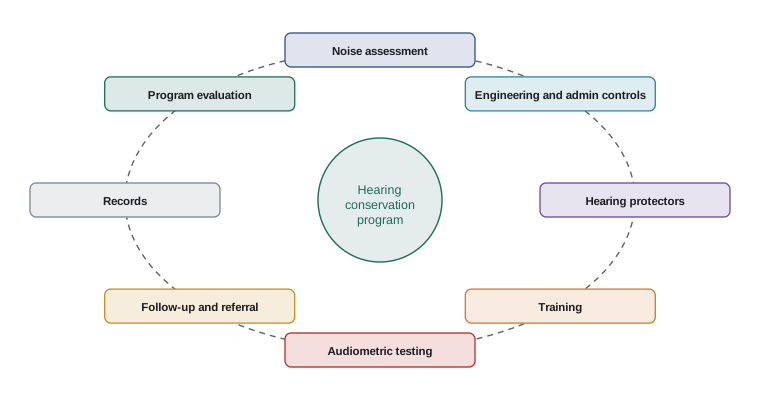
| Element | What it involves |
|---|---|
| Management commitment and responsibility | A written policy, a named program coordinator, resources and clear roles; CSA Z1007 emphasizes management system principles |
| Noise assessment | Identifying noisy areas and exposed workers, using CSA Z107.56 methods where the regulation references it, and reassessing after changes |
| Noise control | An engineering and administrative control plan with priorities and timelines |
| Hearing protection | Selection to CSA Z94.2 and the exposure, a choice of models, fitting and fit checks, availability at no cost |
| Training and education | Effects of noise, results of assessments, controls, protector use and care, audiometric testing, off-the-job noise |
| Audiometric testing | Baseline and periodic testing where required or adopted as good practice, with professional review |
| Follow-up | Notifying workers of changes, refitting protectors, reviewing exposures, referral to an audiologist or physician |
| Records | Assessments, training, protector issue and audiometric results, kept confidential where medical |
| Program evaluation | Regular review of whether hearing is being preserved, using audiometric trends, audits and worker feedback |
Roles and responsibilities
Programs fail most often because nobody owns them. Purchasing buys earplugs, a contractor runs the mobile hearing test van once a year, and nobody looks at whether the results are getting worse. A strong program assigns clear responsibilities.
| Role | Main responsibilities |
|---|---|
| Senior management | Set the policy, provide resources, include noise in capital and purchasing decisions, review results |
| Program coordinator | Run the program day to day, keep it current, coordinate assessments, testing, training and evaluation |
| Supervisors | Enforce protector use in marked areas, model good practice, report changes in equipment or noise, follow up on workers with hearing changes |
| Workers | Use controls and protectors correctly, attend training and tests, report problems, faulty equipment and symptoms such as tinnitus |
| Occupational hygienist or noise specialist | Plan and carry out noise assessments, advise on controls and protector selection |
| Audiometric technicians and audiologists or physicians | Conduct and review hearing tests, decide on referrals and work-relatedness, advise on individual protection |
| Joint health and safety committee or representative | Review assessments and audiometric trends in aggregate, inspect noisy areas, recommend improvements |
| Maintenance and engineering | Maintain quiet equipment, carry out noise control projects, apply buy-quiet specifications |
Signs and noise zones
Ontario requires signs at each approach to areas where noise regularly exceeds 85 dBA where practicable, and other provinces have similar rules. Signs should state clearly that hearing protection is required, ideally with a pictogram, and should be placed at the boundary of the zone shown on the noise map from Lesson 4. Many employers also mark noisy machines individually, especially where a machine is loud only when a particular operation is running.
Zone rules need to be simple and consistent: everyone entering the marked area wears hearing protection, including managers, visitors and contractors, even for a short time. Inconsistent rules, such as protectors being required only when a certain machine is running, are hard to follow and easy to ignore. Where levels change a lot, consider electronic signs that light up when a machine runs.
Training that changes behaviour
Training is required in both countries, but the quality of training varies enormously. Lectures about decibels followed by a signature on a form do little. Training that changes behaviour tends to share some features.
| Feature | Why it works |
|---|---|
| Personal relevance | Showing workers their own noise exposure and, privately, their own audiogram trend makes the risk concrete |
| Hands-on fitting | Each worker practises inserting earplugs or adjusting earmuffs, with feedback, ideally with a fit check |
| Demonstrations | Simulations of hearing loss and tinnitus help workers understand what is at stake |
| Short and frequent | Brief toolbox talks and reminders throughout the year reinforce the annual session |
| Supervisor involvement | Supervisors who wear protectors and correct poor use set the norm |
| Off-the-job noise | Covering hunting, music, tools and motorsports shows that the program cares about workers' whole lives |
| Two-way discussion | Asking why workers remove protectors uncovers fixable problems such as discomfort, heat or communication |
Hearing protection policy
The program should state which protectors are approved for which areas and tasks, how workers obtain replacements, and how special needs are handled: workers with existing hearing loss, workers who need to hear alarms or radio communication, workers who wear safety glasses or other headgear, and workers with ear conditions. It should offer a choice of at least a few types and sizes, because comfort strongly predicts consistent use. Lessons 8 and 9 cover selection and fitting in detail.
Program evaluation
A hearing conservation program exists to prevent hearing loss, so the ultimate measure of success is whether workers' hearing stays stable. Program evaluation looks at both processes and outcomes.
| Type of check | Examples of indicators |
|---|---|
| Process | Percentage of exposed workers assessed, trained, tested on schedule and fitted with protectors; protector use observed during walk-throughs; noise control projects completed |
| Outcome | Rate of standard threshold shifts or other significant shifts per year; trends in average hearing levels for exposed groups; recordable hearing loss cases; tinnitus reports |
| Data quality | Variability in repeated audiograms, which signals testing problems; percentage of baselines missing; follow-up tests completed |
Audiometric database analysis compares groups of workers over time. If exposed workers show significantly more threshold shifts than would be expected from ageing, or more than a comparison group with low exposure, the program is not working. A practical approach is to calculate the percentage of tested workers with a significant shift each year, by department or job group, and investigate groups that stand out. Guidance from NIOSH and the American National Standards Institute describes formal methods based on how much hearing levels vary between successive tests.
# Annual audiometric results by department: (workers tested, workers with a
# significant threshold shift). Illustrative data for program evaluation.
depts = {
    "Press shop": (64, 7),
    "Assembly": (110, 3),
    "Maintenance": (28, 4),
    "Shipping": (45, 1),
    "Office (comparison)": (40, 0),
}
total_t = sum(t for t, _ in depts.values())
total_s = sum(s for _, s in depts.values())
print(f"Plant-wide shift rate: {100 * total_s / total_t:.1f} %")
for name, (tested, shifts) in depts.items():
    rate = 100 * shifts / tested
    flag = "  <- investigate" if rate > 5 else ""
print(f" {name:<20} {shifts:>2}/{tested:<3} {rate:5.1f} %{flag}")Plant-wide shift rate: 5.2 % Press shop 7/64 10.9 % <- investigate Assembly 3/110 2.7 % Maintenance 4/28 14.3 % <- investigate Shipping 1/45 2.2 % Office (comparison) 0/40 0.0 %
Here the plant-wide figure hides large differences: the press shop and maintenance stand out. Those departments should be investigated: are exposures higher than assessed, are protectors suitable and worn, are workers trained, or is something else, such as leisure noise or testing quality, involved? The threshold used to flag groups, 5 per cent in this example, is a program choice, not a legal limit.
Worked problem
Diagnosing a failing program
A plant has had a hearing conservation program for ten years. Every worker has an annual audiogram and signs a training record, and earplugs are available at every entrance. Yet the rate of standard threshold shifts in the fabrication department has been 9 to 12 per cent a year for three years. Walk-throughs show many workers with earplugs hanging around their necks. What should the coordinator investigate?
Show solution
- Whether the noise assessment is current: production rates and equipment may have changed.
- Whether protectors are suitable and comfortable for the work, including heat, communication needs and compatibility with welding helmets.
- Whether workers are trained to fit protectors properly, with hands-on practice and fit checks, rather than only signing forms.
- Whether supervisors enforce use in marked zones and wear protectors themselves.
- Whether engineering controls for the loudest tasks have been considered or deferred indefinitely.
- Whether audiometric results are being followed up with individual counselling and refitting.
Answer: The program exists on paper but is not preventing hearing loss. The coordinator should look at exposures, protector suitability and fit, training quality, supervision, engineering controls and follow-up, starting with fabrication.
Records and confidentiality
Programs generate several kinds of records: noise assessments and maps, control plans, protector issue and selection records, training records, audiometric results and follow-up actions, and program evaluations. Audiometric results are personal health information. They should be held by the testing provider or a health professional, shared with the worker, and shared with the employer only to the extent needed for the program, usually as summaries and notices of significant shifts. Committees should see aggregate data, not individual audiograms.
Common mistakes
MistakeUsing job rotation as the main control at very high noise levels.
InsteadTreat rotation as a supplement; at high levels even short periods exceed the allowance and more workers are exposed.
MistakeRunning a program on paper with signatures but no checks on whether hearing is preserved.
InsteadEvaluate outcomes such as threshold shift rates by group, and act on what the data show.
MistakeLeaving the program without a named owner.
InsteadAppoint a coordinator with time, authority and resources, and define the roles of supervisors and workers.
MistakeMaking zone rules complicated or exempting managers and visitors.
InsteadUse simple, consistent rules that apply to everyone entering a marked area.
MistakeSharing individual audiograms with supervisors or the committee.
InsteadKeep audiometric results confidential and share aggregate data or necessary notices only.
Summary and key terms
- Administrative controls such as scheduling, restricted access, quiet refuges and remote operation reduce time in noise or the number exposed.
- Job rotation shares the dose rather than reducing it and is ineffective at very high levels.
- A hearing conservation program includes management commitment, assessment, controls, protectors, training, audiometric testing, follow-up, records and evaluation.
- Clear roles for management, the coordinator, supervisors, workers and specialists prevent programs from drifting.
- Simple, consistently enforced noise zones and practical, personal training improve protector use.
- Program evaluation compares threshold shift rates and trends by group and investigates groups that stand out.
- Audiometric results are confidential health information; committees review aggregate data.
- Administrative control
- A change in work organization that reduces exposure time or the number of workers exposed.
- Job rotation
- Moving workers between noisy and quieter tasks to share the noise dose.
- Quiet refuge
- A quiet area such as a break room or control room where workers can recover from noise.
- Hearing conservation program
- The organized set of activities that prevent occupational hearing loss where noise cannot be fully controlled.
- Hearing loss prevention program
- Another name for a hearing conservation program, used in CSA Z1007 and NIOSH guidance.
- Program coordinator
- The person responsible for running and evaluating the hearing conservation program.
- Noise zone
- A marked area where hearing protection is required.
- Program evaluation
- Regular review of whether the program is preserving hearing and running as planned.
- Threshold shift rate
- The percentage of tested workers who show a significant hearing change in a period.
- Aggregate data
- Summary results for groups that do not identify individuals.
Practice problems
Work each problem on paper first, then reveal the answer to check.
Why does job rotation not reduce the total noise energy?
Show answer
It shares the same noisy time among more workers instead of making the noise quieter.
Four workers share 8 hours at a 97 dBA station, each spending the rest of the day at 80 dBA. Are they under 85 dBA Lex,8?
Show answer
No; each gets about 2 hours at 97 dBA, which is well over the limit.
Name three administrative controls other than rotation.
Show answer
Any three of scheduling, restricted access, quiet refuges, remote operation and maintenance scheduling.
List six elements of a hearing conservation program.
Show answer
Any six of management commitment, assessment, controls, protectors, training, audiometric testing, follow-up, records and evaluation.
What is one supervisor responsibility in the program?
Show answer
Enforcing protector use in marked areas, modelling good practice, or reporting equipment changes.
Why should zone rules apply to managers and visitors?
Show answer
Consistency makes rules easier to follow and avoids undermining them.
Give two features of effective training.
Show answer
Any two of personal relevance, hands-on fitting, demonstrations, short frequent reminders, supervisor involvement and two-way discussion.
What is an outcome indicator for a hearing conservation program?
Show answer
The rate of significant threshold shifts per year by group, or trends in hearing levels.
A department has a threshold shift rate twice the plant average. What should happen?
Show answer
Investigate exposures, protectors, training, supervision, controls and testing quality in that department.
Who should see individual audiograms?
Show answer
The worker and the health professionals running the testing; others see only aggregate data or necessary notices.
Lesson quiz · 5 questions
Score 60% or more to complete this lesson.
Create a free account to save your progress, take quizzes and earn a certificate.