
HSE-241 · Lesson 9 of 12 · 26 min
Fitting, fit testing and wearing hearing protection
A hearing protector is only as good as its fit and the time it is worn. Lesson 8 showed that laboratory ratings overstate real-world protection, mainly because of poor fit. This lesson is about closing that gap: how to fit each type of protector, how individual fit testing measures the protection a worker actually gets, why wearing time matters so much, and how to deal with the practical problems, such as communication, heat, other equipment and comfort, that lead workers to remove protectors.
Fitting foam earplugs
Slow-recovery foam earplugs are the most common protector and the most sensitive to technique. Inserted correctly, deep in the canal, they can give some of the highest attenuation of any protector. Inserted shallowly, with most of the plug sticking out, they may give only a few decibels.
| Step | What to do | Why |
|---|---|---|
| 1. Clean hands | Wash or wipe hands before handling plugs | Dirt and chemicals on plugs can irritate or infect the ear canal |
| 2. Roll | Roll the plug slowly between fingers into a thin, tight cylinder with no creases | A narrow, crease-free plug slides deep into the canal |
| 3. Open the canal | Reach over the head with the opposite hand and pull the top of the ear up and back | Straightens the S-shaped ear canal |
| 4. Insert | Slide the rolled plug well into the canal so that little of it shows from the front | Deep insertion gives the seal and attenuation |
| 5. Hold | Hold the plug in place with a fingertip for 20 to 30 seconds while it expands | Prevents the plug from backing out as it expands |
| 6. Check | Cup the hands over the ears: the sound should change very little if the plugs fit well; your own voice should sound louder and deeper | A simple field check of the seal |
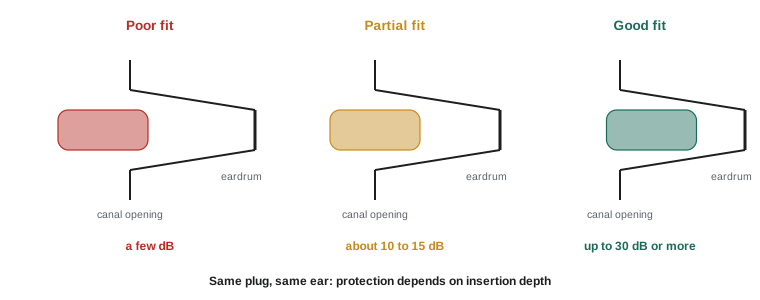
Premoulded plugs must be the right size. Most come in two or three sizes, and many people need a different size in each ear. They are inserted with the same pull-up-and-back technique and should feel snug, with a slight sense of pressure. Custom-moulded plugs are inserted with a twisting motion until they sit fully in the canal; their fit should be verified when they are new and periodically, because ear canals change with age and weight. Banded protectors are pressed into or against the canal entrance; leaving the band resting on clothing or allowing the pods to sit loosely gives very poor attenuation.
Fitting earmuffs
Earmuffs are easier to fit consistently because the user can see and feel the position. The cups must completely enclose the ears, the cushions must seal against the head all the way round, and the headband must provide enough force. The main enemies of an earmuff seal are safety glasses, long hair, hoods and caps, and worn or hardened cushions. Wearing safety glasses with thick temple arms under earmuff cushions can reduce attenuation by several decibels; thin-armed glasses, glasses designed for use with earmuffs, or gel cushions reduce the loss. Cushions and foam liners should be replaced according to the manufacturer's schedule, often every six months with heavy use, or sooner if they are cracked, hard or flattened.
Why individual fit testing matters
Because individuals vary so much, the only way to know how much protection a particular worker gets from a particular protector is to measure it. Field attenuation estimation systems, commonly called hearing protector fit testing, do exactly that. They produce a personal attenuation rating, or PAR, for the worker with the protector fitted as they normally fit it. The PAR replaces the population rating on the package with a measurement for that person.
| Method | How it works | Notes |
|---|---|---|
| Real-ear attenuation at threshold (REAT) | The worker listens to test tones with and without the protector, often using headphones or loudspeakers; the difference in hearing thresholds is the attenuation | Works with any protector; needs a quiet room; takes a few minutes per ear |
| Microphone in real ear (MIRE) | A probe microphone measures sound inside the ear canal behind the protector and compares it with the sound outside | Objective and fast; needs special earplugs or probes |
| Loudness balance | The worker matches the loudness of tones in each ear with and without protectors | Quick and portable; less precise |
CSA Z94.2 recognizes the value of fit testing in protector programs, and several provinces' guidance recommends it, especially for workers with high exposures or hearing shifts. It is not yet a general regulatory requirement in Canadian jurisdictions. ANSI/ASA S12.71, published in 2018, sets performance requirements for fit testing systems and is used by Canadian programs too.
Fit testing has value beyond the number. Many workers discover during their first test that they have been inserting their plugs far too shallowly, and the test becomes a training session: the technician coaches the worker, they try again and see their PAR improve. Testing also identifies workers who need a different size or type of protector.
import random, statistics

random.seed(9)
# Personal attenuation ratings (dB) for 40 workers with the same foam plug,
# before and after hands-on training (illustrative).
before = [max(0, round(random.gauss(14, 8))) for _ in range(40)]
after = [min(36, b + max(0, round(random.gauss(9, 4)))) for b in before]

needed = 15   # attenuation needed to bring a 98 dBA exposure to 83 dBA
for label, data in [("before training", before), ("after training", after)]:
    ok = sum(p >= needed for p in data)
    print(f"{label:<16} median PAR {statistics.median(data):4.1f} dB, "
f"range {min(data)}-{max(data)} dB, adequate {ok}/{len(data)}")before training median PAR 13.5 dB, range 0-30 dB, adequate 18/40 after training median PAR 22.0 dB, range 5-36 dB, adequate 33/40
Before training, many workers in this illustrative group get too little protection from a plug rated far higher. Training improves the median and lifts most workers above the needed attenuation, but a few still fall short and need a different protector. This is the pattern often reported in workplace studies.
Worked problem
Using a personal attenuation rating
A grinder operator's Lex,8 is 97 dBA. Her fit test with foam earplugs gives a PAR of 18 dB in the left ear and 25 dB in the right. What is her estimated protected exposure, and what should happen?
Show solution
- Many systems report a combined PAR that is limited by the poorer ear; here, take 18 dB as the conservative value.
- Some fit testing systems apply a further adjustment for uncertainty; assume the 18 dB has already been adjusted by the system.
- Protected exposure is about 97 − 18 = 79 dBA, within the 70 to 80 dBA target range.
- The difference between ears suggests her left plug is not as deep or not the right size. The technician should coach her on the left ear, retest and record the result.
Answer: About 79 dBA, which is acceptable. Coaching on the left ear should improve the margin, and the PAR should be rechecked at her next audiometric test or sooner if her hearing changes.
Wearing time: the most important factor
Protectors protect only while they are worn. Because the decibel scale is logarithmic and allowable time halves with every 3 dB, even short periods without protection in high noise destroy most of the benefit. The effective protection over a shift depends on the fraction of time the protector is worn:
where A is the attenuation while worn and f is the fraction of noisy time the protector is worn.
import math

def effective(atten_db, fraction_worn):
    return -10 * math.log10(fraction_worn * 10 ** (-atten_db / 10) + (1 - fraction_worn))

shift_min = 480
print("Attenuation while worn: 30 dB")
for removed in [0, 5, 15, 30, 60, 120]:
    f = 1 - removed / shift_min
print(f" removed {removed:>3} min of {shift_min}: effective protection {effective(30, f):5.1f} dB")Attenuation while worn: 30 dB removed 0 min of 480: effective protection 30.0 dB removed 5 min of 480: effective protection 19.4 dB removed 15 min of 480: effective protection 14.9 dB removed 30 min of 480: effective protection 12.0 dB removed 60 min of 480: effective protection 9.0 dB removed 120 min of 480: effective protection 6.0 dB
A protector giving 30 dB while worn delivers only about 20 dB if it is removed for 5 minutes of an 8-hour noisy shift, and about 12 dB if removed for 30 minutes. Removing it for an hour reduces effective protection to about 9 dB. No protector rating, however high, makes up for intermittent wear.
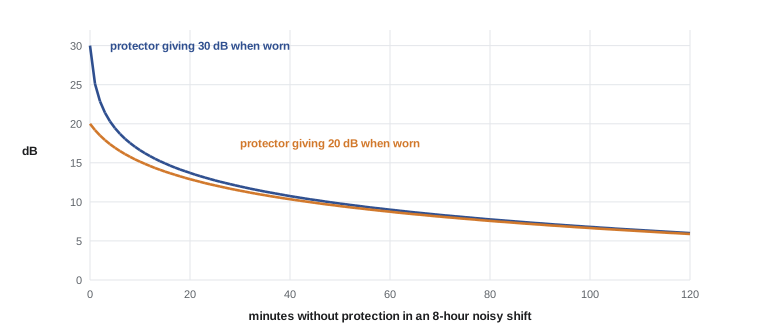
This is why supervisors must insist on protectors being worn for the whole time a worker is in a noise zone, why protectors should be comfortable enough to wear all day, and why practical problems that lead to removal must be solved rather than tolerated.
Why workers remove protectors
| Reason | Practical solutions |
|---|---|
| Discomfort or pressure | Offer several types and sizes; try custom plugs; replace hard cushions; allow short breaks in quiet areas |
| Heat and sweating | Use earplugs instead of earmuffs in hot conditions; use cushion covers; provide cool rest areas |
| Need to communicate | Use flat-attenuation plugs, level-dependent or communication earmuffs; move conversations to quiet areas; use hand signals |
| Need to hear machines and warnings | Avoid over-protection; use flat-attenuation or level-dependent protectors; add visual alarms |
| Conflict with other equipment | Choose earmuffs compatible with hard hats, glasses, respirators and welding helmets; consider earplugs |
| Belief that short exposures do not matter | Explain the wear-time effect with examples; supervisors model wearing protectors at all times in zones |
| Existing hearing loss | Fit test; use level-dependent or amplifying protectors designed for hearing loss; consult an audiologist |
Communication and hearing warning signals
Workers often fear that protectors will stop them hearing speech and warnings. In fact, for people with normal hearing, speech in loud noise can be as intelligible or more intelligible with moderate protection, because protectors reduce both the speech and the noise and bring the sound to a level where the ear is not overloaded. The problem arises with over-protection, with workers who already have hearing loss, and with low-level signals. Selection should aim for the 70 to 80 dBA protected range, warning signals should be designed to be audible to protected workers (often 10 to 15 dB above the masked threshold) or supplemented by flashing lights, and workers with hearing loss should have individual assessments.
Workers who must hear radio communications or work near mobile equipment may benefit from communication headsets or level-dependent earmuffs. These devices must themselves be selected so that the sound they deliver to the ear does not add to the worker's noise exposure; some products limit their output to a safe level.
Care, hygiene and replacement
Disposable foam plugs should be used once or for a single shift and discarded if they become dirty, hard or misshapen. Reusable plugs should be washed with mild soap and water, dried and stored in a clean case. Earmuffs should be wiped clean, inspected for cracked cups, worn cushions and loose headbands, and stored where they will not be crushed or distorted. Bending the headband to make it more comfortable reduces clamping force and attenuation. Workers with ear infections, discharge or pain should not use earplugs until cleared by a health professional, and should use earmuffs instead.
Supervising protector use
Supervisors are the key to consistent wear. They can make protectors easy to get by placing dispensers at zone entrances, model correct use themselves, check fit visually during walk-throughs (for foam plugs, only a small part of the plug should be visible from the front), correct poor use promptly and respectfully, and pass worker complaints about comfort or communication to the program coordinator. Many programs use short observations during regular walk-throughs, recording the percentage of workers in a zone wearing protectors correctly, as a leading indicator.
Common mistakes
MistakeInserting foam plugs without rolling them or opening the ear canal.
InsteadRoll the plug into a thin cylinder, pull the ear up and back, insert deeply and hold it while it expands.
MistakeAssuming every worker gets the labelled rating from the same protector.
InsteadUse individual fit testing to measure each worker's personal attenuation rating.
MistakeAllowing protectors to be removed briefly in noise zones.
InsteadRequire protectors for the whole time in a zone; a few minutes of non-wear destroys most of the protection.
MistakeWearing earmuffs over thick-armed safety glasses or hoods without checking the seal.
InsteadChoose compatible glasses and headwear or use earplugs, and check the seal.
MistakeIgnoring complaints about discomfort or communication.
InsteadTreat complaints as program problems and solve them with different protectors, communication devices or work arrangements.
Summary and key terms
- Foam earplugs must be rolled, inserted deeply with the ear pulled up and back, and held while they expand; shallow insertion gives little protection.
- Premoulded plugs must be sized for each ear, and earmuff seals are broken by glasses, hair, hoods and worn cushions.
- Individual fit testing measures a personal attenuation rating and doubles as effective training.
- Effective protection falls sharply with even short periods of non-wear: a 30 dB protector removed for 5 minutes of a shift gives about 20 dB.
- Workers remove protectors because of discomfort, heat, communication needs, conflicts with other equipment and misconceptions, all of which can be addressed.
- Moderate protection often improves speech understanding in loud noise, but over-protection and existing hearing loss create problems.
- Care, hygiene, replacement and active supervision keep protectors working.
- Fit testing
- Measuring the attenuation an individual receives from a hearing protector as they normally fit it.
- Field attenuation estimation system
- Equipment and procedures used to carry out hearing protector fit testing in the workplace.
- Personal attenuation rating (PAR)
- The attenuation measured for an individual worker with a particular protector.
- REAT
- Real-ear attenuation at threshold: the difference in hearing thresholds with and without the protector.
- MIRE
- Microphone in real ear: measuring sound inside the ear canal behind the protector.
- Wear time
- The fraction of noisy time during which a protector is actually worn.
- Effective attenuation
- The protection averaged over a shift, taking into account time without the protector.
- Flat-attenuation earplug
- A plug that reduces all frequencies roughly equally, keeping speech and music natural.
- Communication headset
- An earmuff with a built-in radio or intercom for communication in noise.
- Masked threshold
- The level at which a signal can just be heard in the presence of noise.
Practice problems
Work each problem on paper first, then reveal the answer to check.
Why is the ear pulled up and back when inserting an earplug?
Show answer
To straighten the ear canal so the plug can go in deeply.
How long should a foam plug be held after insertion?
Show answer
About 20 to 30 seconds while it expands.
What is a simple field check of earplug fit?
Show answer
Cupping hands over the ears should change the sound very little, and your own voice sounds louder and deeper.
Name two things that break an earmuff seal.
Show answer
Any two of thick-armed safety glasses, long hair, hoods or caps and worn cushions.
What is a personal attenuation rating?
Show answer
The measured attenuation for an individual worker with a particular protector.
A 30 dB protector is removed for 30 minutes of an 8-hour noisy shift. About what effective protection results?
Show answer
About 12 dB.
Why can moderate protection improve speech understanding in loud noise?
Show answer
It reduces both speech and noise to levels where the ear is not overloaded.
What protector type suits a hot environment?
Show answer
Earplugs, which are cooler than earmuffs.
What should a worker with an ear infection use?
Show answer
Earmuffs instead of earplugs, until cleared by a health professional.
What leading indicator can supervisors record during walk-throughs?
Show answer
The percentage of workers in noise zones wearing protectors correctly.
Lesson quiz · 5 questions
Score 60% or more to complete this lesson.
Create a free account to save your progress, take quizzes and earn a certificate.