
HSE-241 · Lesson 11 of 12 · 26 min
Impulse noise, ototoxic substances and special settings
Most of this course deals with continuous and fluctuating noise from machinery. Some hazards do not fit that pattern neatly. Impulse noise from gunfire, explosives, nail guns and impacts can damage hearing in an instant. Some chemicals damage the ear on their own or make it more vulnerable to noise. And some workplaces, such as construction sites, music venues, call centres and firing ranges, have noise problems that need special approaches. This lesson covers these situations and shows how the general principles from earlier lessons apply to them.
What impulse noise is
Impulse noise is a sudden burst of sound lasting less than about one second, often only a few milliseconds, with a rapid rise to a very high peak. Impact noise, from one object striking another, such as a hammer on steel or a press closing, is closely related. Examples include gunshots, explosions, nail guns, powder-actuated tools, forging hammers, pile drivers, metal stamping and dropping steel plates.
| Source | Typical peak level, dB (illustrative) |
|---|---|
| Hammer on steel at the ear | 120 to 135 |
| Pneumatic nail gun | 125 to 140 |
| Powder-actuated fastening tool | 140 to 155 |
| Forging hammer or drop forge | 130 to 145 |
| Rifle or handgun at the shooter's ear | 150 to 170 |
| Explosive blasting close by | Above 170 |
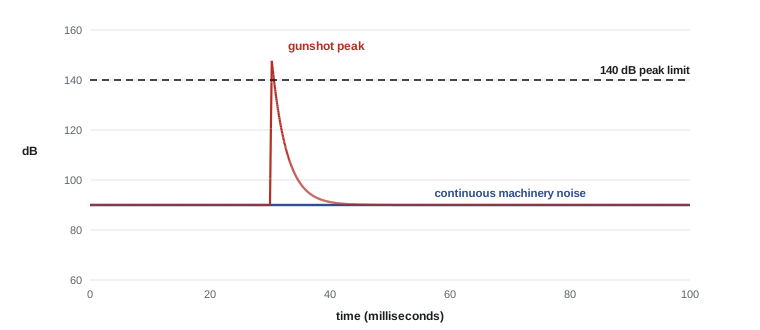
Impulse noise is especially damaging for two reasons. First, the rise time is faster than the acoustic reflex described in Lesson 1, so the middle ear muscles offer no protection. Second, very high peaks can cause direct mechanical damage to the hair cells and supporting structures, the acoustic trauma described in Lesson 1, rather than the slower metabolic damage of continuous noise. Above roughly 140 dB peak, a single exposure can cause permanent loss. That is the basis for the 140 dB peak limit used in many jurisdictions and in OSHA's guidance that impulse exposure should not exceed 140 dB peak.
Measuring impulse noise
Ordinary sound level meter readings with slow or fast time weighting greatly underestimate impulse peaks. Impulse assessment uses the peak sound pressure level, usually C-weighted, measured by a peak detector that responds in microseconds. For very high peaks, such as gunfire, special microphones and instruments with a high upper measurement range are needed, because ordinary dosimeters may saturate.
With a 3 dB exchange rate, the energy of impulses is included in the Leq and Lex,8, because an integrating instrument adds up all the acoustic energy. With a 5 dB exchange rate and slow time weighting, as in OSHA's rule, impulses are underweighted, which is one reason NIOSH recommends the 3 dB rule. The energy of a single impulse can be described by its sound exposure level, SEL, the level of a one-second steady sound with the same energy. The contribution of many impulses to the daily exposure is then:
where N is the number of impulses in the day and 28,800 is the number of seconds in 8 hours.
import math

def lex8_from_impulses(sel, n):
    """Daily exposure from n identical impulses with sound exposure level sel (dB)."""
    return sel + 10 * math.log10(n) - 10 * math.log10(8 * 3600)

def combine(levels):
    return 10 * math.log10(sum(10 ** (L / 10) for L in levels))

sel_nail = 108          # SEL of one nail-gun shot at the operator's ear (illustrative)
background = 82         # Lex,8 from the other noise of the day
for nails in [200, 1000, 3000]:
    imp = lex8_from_impulses(sel_nail, nails)
print(f"{nails:>5} nails: impulses alone {imp:5.1f} dBA, with background {combine([imp, background]):5.1f} dBA")200 nails: impulses alone 86.4 dBA, with background 87.8 dBA 1000 nails: impulses alone 93.4 dBA, with background 93.7 dBA 3000 nails: impulses alone 98.2 dBA, with background 98.3 dBA
A framer driving a few thousand nails a day can exceed the daily limit from the nail gun alone, even though each shot lasts only milliseconds. Quieter tools, exhaust deflectors pointing away from the ear, and protectors suited to impulses help.
Protecting against impulse noise
The hierarchy of controls still applies. Engineering options include quieter tools, such as electric or cordless fastening tools in place of powder-actuated ones, padding and damping to reduce impact noise, enclosures for presses and forges, and baffles and absorption on indoor ranges. Administrative controls include limiting the number of rounds or impacts, keeping non-essential people away and scheduling blasting when few workers are present.
Hearing protectors work against impulses, but selection is different. Peaks above about 150 dB often call for dual protection. Electronic level-dependent earmuffs and earplugs are popular with shooters and blasters because they let the wearer hear speech and range commands between shots while limiting the peaks. Passive non-linear earplugs, with a small filter that attenuates more at high levels, offer a simpler option for intermittent impulses. Laboratory ratings for impulse attenuation, such as impulse peak insertion loss, are increasingly published.
Ototoxic substances
Some chemicals damage hearing directly, by harming the hair cells or the auditory nerve, or make the ear more susceptible to noise damage. These ototoxic substances matter in noise programs for three reasons: they can cause hearing loss at noise levels below the limit, the combination of noise and an ototoxicant can cause more damage than either alone, and audiometric results may be misinterpreted if chemical exposure is not considered.
| Group | Examples | Where found |
|---|---|---|
| Solvents | Toluene, styrene, xylene, ethylbenzene, trichloroethylene, carbon disulphide | Painting, printing, boat and fibreglass manufacturing, adhesives, fuels, degreasing |
| Metals and compounds | Lead, mercury, organic tin compounds | Battery recycling, demolition, smelting, firing ranges |
| Asphyxiants | Carbon monoxide, hydrogen cyanide | Combustion, firefighting, metal plating, fumigation |
| Some medications | Certain antibiotics, chemotherapy drugs and high-dose aspirin | Medical treatment rather than workplace exposure, but relevant to audiogram interpretation |
No Canadian jurisdiction yet sets a specific occupational rule for ototoxicants, but ACGIH's documentation for noise recommends audiometric testing for workers exposed to ototoxic chemicals even below the noise limit, and several provincial guides mention the issue. Because ACGIH limits are adopted in many provinces, programs should identify ototoxicants in their chemical inventories and safety data sheets, control them through the hierarchy of controls, and include exposed workers in audiometric testing.
Skin contact matters for solvents, which can be absorbed through the skin, so gloves and skin protection are part of preventing ototoxic effects. Respiratory protection, covered in HSE-240, may be needed where airborne levels cannot be controlled. Audiometric results for workers exposed to ototoxicants may show shifts across a broader range of frequencies, and the reviewing professional should be told about the chemical exposure.
Hand-arm and whole-body vibration
Many noisy tools also vibrate: grinders, chipping hammers, rock drills, chainsaws and impact wrenches. Hand-arm vibration can cause vibration white finger, a form of Raynaud's phenomenon, along with nerve and muscle damage, and some research suggests that workers with vibration white finger have more hearing loss than similarly exposed workers without it. Vibration is a separate hazard with its own assessment methods and limits and is beyond the scope of this course, but noise and vibration controls often overlap: a quieter, better-balanced tool with vibration-damped handles reduces both.
Special settings
Some workplaces present noise problems that call for adapted approaches.
| Setting | Special features | Approaches |
|---|---|---|
| Construction | Short, very loud tasks; moving work locations; many employers on site; equipment shared and rented | Task-based exposure estimates; quieter tools and buy quiet in rental contracts; zones around loud work; constructor coordination; protectors suited to intermittent use |
| Music and entertainment | Musicians and staff exposed to amplified and acoustic music for long periods; artistic needs to hear accurately | Sound level management and monitoring at venues; stage layout and risers; in-ear monitors with limiters; musicians' flat-attenuation earplugs; rest periods |
| Call centres and headset users | Moderate average exposure but risk of acoustic shock from sudden loud signals | Headsets with output limiters; equipment that filters loud tones; quiet background; training to report incidents |
| Firing ranges | Very high peaks, reverberant indoor ranges, lead exposure | Baffles and absorption; dual protection; electronic protectors for instructors; lead controls and hygiene; audiometric testing |
| Agriculture | Older tractors without cabs, grain dryers, hog barns at feeding time, chainsaws; family workers and youth | Cabs and maintained mufflers; protectors kept on equipment; education for families |
| Health care and laboratories | Equipment such as MRI scanners, surgical bone saws, sterilization areas, animal facilities | Assessment of specific tasks; protectors for patients and staff near MRI scanners; quieter equipment |
Construction in more detail
Construction workers often face the highest noise exposures of any sector, yet their exposures are among the hardest to manage. A worker may run a concrete saw for 20 minutes, then carry materials, then work next to another trade's jackhammer. Since 2016, Ontario's noise regulation has applied to construction projects, so constructors and employers on Ontario sites must meet the same 85 dBA Lex,8 limit and the same priority for engineering controls as factories. Practical tools include task-based exposure tables for common tools, quieter equipment specified in rental and purchase agreements, water-fed and shrouded cutting tools that reduce both dust and noise, scheduling loud work to limit how many people are nearby, and simple rules such as hearing protection required within a set distance of named tools.
Worked problem
A construction task-based estimate
A concrete finisher's typical day includes 45 minutes of cutting with a walk-behind saw at 103 dBA, 2 hours of power trowelling at 91 dBA and 5 hours of hand work at 78 dBA. Using an 85 dBA, 3 dB rule, what is the Lex,8, and where should controls focus?
Show solution
- Allowable time at 103 dBA: 8 ÷ 2^6 = 0.125 hours, so 0.75 hours uses 600 per cent.
- Allowable time at 91 dBA: 2 hours, so 2 hours uses 100 per cent.
- Allowable time at 78 dBA: 8 × 2^(7/3) ≈ 40.3 hours, so 5 hours uses about 12 per cent.
- Total dose about 712 per cent, so Lex,8 ≈ 85 + 10 log10(7.12) ≈ 93.5 dBA.
- The saw contributes about 84 per cent of the dose. A quieter saw, water feed with a better blade, or reduced cutting time would have the biggest effect, with protectors rated for at least about 15 to 20 dB of real-world attenuation in the meantime.
Answer: About 93.5 dBA Lex,8. Controls should focus on the saw, which contributes most of the dose.
Young and new workers
Young workers are often given the noisiest, least skilled tasks, have the least experience of using protectors and may already be exposed to loud music and recreational noise. Their hearing has decades of potential exposure ahead of it. Programs should make sure that new and young workers receive training and properly fitted protectors before their first noisy task, are enrolled in audiometric testing with a good baseline, and are supervised closely in their first months.
Common mistakes
MistakeMeasuring impulse noise with an ordinary slow or fast sound level reading.
InsteadUse a peak detector, usually C-weighted, with an instrument rated for the expected peak level.
MistakeAssuming that brief impulses cannot add much to the daily exposure.
InsteadCalculate the contribution from the number of impulses and their energy; thousands of impulses can exceed the limit.
MistakeIgnoring chemical exposures when interpreting audiometric shifts.
InsteadIdentify ototoxicants, control them and tell the reviewing professional about them.
MistakeApplying a factory-style program unchanged to construction or entertainment.
InsteadAdapt the program with task-based estimates, rental and purchasing controls, and protectors suited to the work.
MistakePutting new or young workers on the noisiest tasks without training or fitted protectors.
InsteadTrain, fit and test new workers before their first noisy task and supervise them closely.
Summary and key terms
- Impulse noise rises to very high peaks in milliseconds, faster than the acoustic reflex, and can cause immediate mechanical damage.
- Impulse noise is assessed with peak measurements, commonly against a 140 dB peak limit, and its energy is included in Lex,8 with a 3 dB exchange rate.
- Many impulses, such as nail gun shots, can exceed the daily limit even though each lasts milliseconds.
- Ototoxic solvents, metals and asphyxiants can damage hearing alone or together with noise; exposed workers should be identified and tested.
- Vibration is a separate hazard, but quieter, better-balanced tools reduce both noise and vibration.
- Construction, music, call centres, firing ranges, agriculture and health care need adapted approaches.
- Young and new workers need training, fitted protectors and a good baseline before their first noisy task.
- Impulse noise
- A sudden burst of sound lasting less than about one second, with a rapid rise to a high peak.
- Impact noise
- Impulse noise produced by objects striking each other.
- Peak sound pressure level
- The highest instantaneous sound pressure, measured with a fast peak detector.
- Sound exposure level (SEL)
- The level of a one-second steady sound with the same energy as a sound event.
- Acoustic trauma
- Immediate mechanical damage to the ear from very intense sound.
- Ototoxic substance
- A chemical that can damage the inner ear or auditory nerve.
- Level-dependent protector
- A protector that allows normal sounds through but limits loud sounds such as impulses.
- Non-linear earplug
- A passive earplug with a filter that attenuates more at high levels.
- Acoustic shock
- Symptoms such as pain, tinnitus and hypersensitivity following a sudden loud sound through a headset.
- Vibration white finger
- A disorder caused by hand-arm vibration in which fingers turn white and numb.
Practice problems
Work each problem on paper first, then reveal the answer to check.
Why does the acoustic reflex fail to protect against impulses?
Show answer
Impulses rise faster than the tens of milliseconds the reflex needs to engage.
What peak limit is commonly used for impulse noise?
Show answer
140 dB peak, usually C-weighted.
What does SEL stand for, and what does it describe?
Show answer
Sound exposure level: the level of a one-second steady sound with the same energy as the event.
Calculate the Lex,8 from 1,000 impulses each with an SEL of 105 dB.
Show answer
105 + 30 − 44.6 ≈ 90.4 dBA.
Name two solvents that are ototoxic.
Show answer
Any two of toluene, styrene, xylene, ethylbenzene, trichloroethylene and carbon disulphide.
Why should workers exposed to ototoxicants be included in audiometric testing even below the noise limit?
Show answer
The chemicals can cause hearing loss alone or in combination with lower noise levels.
What is acoustic shock, and how is it prevented?
Show answer
Symptoms after a sudden loud sound in a headset; prevented by output limiters and filtering equipment.
Why are indoor firing ranges especially hazardous?
Show answer
Very high peaks are reflected in a reverberant space, and there is also lead exposure.
Give two construction-specific noise control approaches.
Show answer
Any two of task-based estimates, quieter rental equipment, water-fed and shrouded tools, scheduling loud work and distance-based protector rules.
Why do young workers need special attention?
Show answer
They often get the noisiest tasks, have little experience with protectors and have decades of potential exposure ahead.
Lesson quiz · 5 questions
Score 60% or more to complete this lesson.
Create a free account to save your progress, take quizzes and earn a certificate.