
HSE-222 · Lesson 2 of 12 · 25 min
Fire safety plans, codes and warden duties in Canada
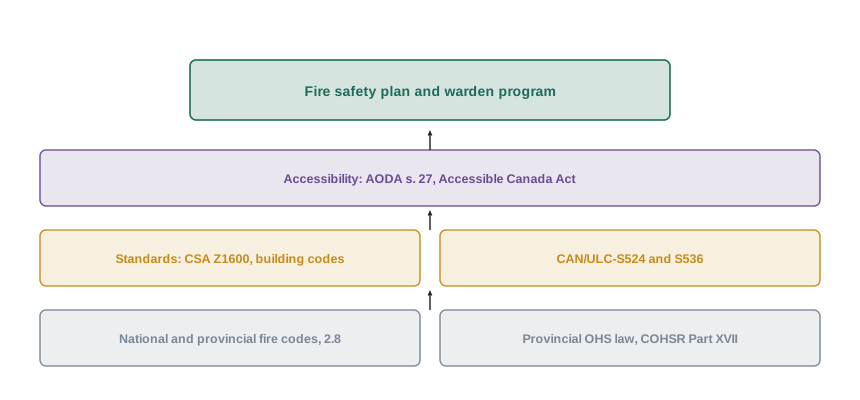
Warden programs in Canada rest on two overlapping sets of rules. Fire codes, adopted by each province and territory and based on the National Fire Code of Canada, require building owners to prepare fire safety plans and to appoint and train supervisory staff. Occupational health and safety law requires employers to plan for emergencies that affect their workers. In federally regulated workplaces, the Canada Occupational Health and Safety Regulations set specific rules for emergency wardens. Accessibility law adds duties for people with disabilities. This lesson maps those sources so that you understand why your building's plan looks the way it does. Section numbers change when codes and regulations are amended, so always check the current edition that applies where you work.
Fire codes: the fire safety plan
The National Fire Code of Canada, Division B, Section 2.8, Emergency Planning, applies to many buildings, including those with a fire alarm system, assembly and care occupancies, and buildings where flammable or combustible materials are handled in quantity. Provinces adopt the National Fire Code with amendments in their own fire codes, for example the Ontario Fire Code (O. Reg. 213/07), the British Columbia Fire Code and the Alberta Fire Code. Where Section 2.8 applies, the owner must prepare a fire safety plan in cooperation with the fire department and other authorities. The plan must cover the emergency procedures to follow in a fire, including sounding the alarm, notifying the fire department, instructing occupants, evacuating occupants including those who need special assistance, and confining, controlling and extinguishing the fire. It must also cover the appointment and organization of designated supervisory staff, their training and that of other occupants, documents and diagrams showing the building's fire emergency systems, fire drills, the control of fire hazards and the inspection and maintenance of fire safety facilities.
The code calls the people with fire safety duties supervisory staff. Article 2.8.1.2 requires supervisory staff to be trained in the fire emergency procedures in the fire safety plan before they are given any responsibility for fire safety. In care, treatment and detention occupancies, enough supervisory staff must be on duty at all times to carry out the plan. In high buildings, the plan must also cover training in the use of the voice communication system and the procedures for using elevators. Fire wardens, floor wardens and searchers are supervisory staff in this sense.
Fire drills under the fire code
Article 2.8.3.2 of the National Fire Code sets the minimum frequency of fire drills for supervisory staff. In general, drills must be held at intervals not greater than 12 months. In day-care centres and in Group B occupancies, such as hospitals, care homes and detention facilities, drills must be held at intervals not greater than one month. In high buildings, drills must be held at intervals not greater than 2 months. Provincial codes follow this pattern with their own variations, for example for schools, where provinces often require several drills each school year, and some provinces set detailed rules for care occupancies. Drills test the supervisory staff and the procedures; they do not always require a full evacuation of every occupant, but many buildings evacuate at least once a year to test the whole plan.
Occupational health and safety law
Provincial OHS laws require employers to take every precaution reasonable in the circumstances to protect workers, and most provinces have specific emergency preparedness rules. For example, Alberta's OHS Code requires an emergency response plan that covers potential emergencies, procedures, evacuation, designated workers and training. British Columbia's OHS Regulation requires written emergency procedures and drills. Ontario relies on the Occupational Health and Safety Act general duties and on the Ontario Fire Code for building fire safety. Where a workplace is in a building with a fire safety plan, the employer's emergency procedures must fit with the building owner's plan, and tenant employers usually supply floor wardens to the building program.
Federal workplaces: COHSR Part XVII
Workplaces under federal jurisdiction, such as banks, interprovincial transport, telecommunications and federal government offices, follow Part XVII of the Canada Occupational Health and Safety Regulations, Safe Occupancy of the Work Place. Section 17.4 requires an emergency evacuation plan for any building in which more than 50 employees work at any time; the plan must describe the evacuation procedures and list the names, room numbers and telephone numbers of the chief emergency warden and deputy. Section 17.7 requires the employer to appoint a chief emergency warden and a deputy for the building, an emergency warden and a deputy for each floor occupied by its employees, and monitors for employees who need special assistance. These people must normally work in the building or on that floor. Section 17.10 requires meetings of the emergency wardens and evacuation drills at least once every year and after any change to the plan, with the local fire department notified at least 24 hours before a drill.
Accessibility law
Ontario's Integrated Accessibility Standards Regulation (O. Reg. 191/11), made under the Accessibility for Ontarians with Disabilities Act, section 27, requires every employer to provide individualized workplace emergency response information to employees with a disability, if the disability is such that the information is necessary and the employer is aware of the need for accommodation. With the employee's consent, the employer must give the information to anyone designated to provide assistance, and must review it when the employee moves to a different location, when the employee's overall accommodation needs or plans are reviewed, and when the employer reviews its general emergency response policies. The Accessible Canada Act covers federally regulated organizations and requires accessibility plans, and other provinces, such as Manitoba and Nova Scotia, have their own accessibility laws. Human rights codes in every province require employers to accommodate employees with disabilities to the point of undue hardship, which includes emergency planning.
Standards
CSA Z1600, Emergency and continuity management program, sets out a management system for emergency preparedness and is widely used by large organizations, municipalities and critical infrastructure. Building codes, based on the National Building Code of Canada, set the physical features wardens depend on: exits, fire separations, alarm systems, voice communication in high buildings, and protected areas for people who need assistance. CAN/ULC-S524 governs fire alarm installation, including audibility, and CAN/ULC-S536 governs inspection and testing.
| Source | What it requires of a warden program |
|---|---|
| National Fire Code, Section 2.8, and provincial fire codes | Fire safety plan, supervisory staff appointed and trained before taking duties, drills at set intervals |
| Provincial OHS law | Employer emergency procedures, training and drills; fit with the building plan |
| COHSR Part XVII (federal) | Evacuation plan over 50 employees, chief and floor emergency wardens and deputies, monitors, drills at least yearly |
| AODA IASR s. 27 (Ontario) | Individualized workplace emergency response information for employees with disabilities |
| CSA Z1600, NBC, CAN/ULC-S524 | Program management, building features and alarm requirements |
Worked problem
A drill calendar for a mixed-use building
A 14-storey office and retail building in a province that follows the National Fire Code has a fire alarm system and a voice communication system. On the ground floor is a day-care centre. What is the minimum supervisory staff drill frequency for the office building and for the day-care, and how many drills does that mean in a year?
Show solution
- A 14-storey building is a high building, so supervisory staff drills are required at intervals not greater than 2 months: at least 6 per year.
- The day-care centre must hold drills at intervals not greater than one month: at least 12 per year.
- The building owner coordinates both in the fire safety plan, and many owners also run one full evacuation of all occupants each year.
- The plan should record each drill, the time taken and the problems found (Lesson 12).
Answer: Supervisory staff drills at least every 2 months for the building (6 a year) and at least monthly for the day-care (12 a year).
Putting the sources together
In practice, a warden program serves several masters at once. The building owner or property manager runs the overall plan required by the fire code. Each tenant employer appoints wardens for its own floors, meets its own workplace safety duties, and provides individualized plans for its employees who need assistance. The fire department reviews the plan, may attend drills and responds to real alarms. The best programs write all of this into a single coordinated plan with clear roles, so that wardens do not have to work out who is in charge on the day.
What the rules mean for a floor warden
For an individual floor warden, the legal framework comes down to a few practical points. You act under the fire safety plan for your building, which the owner prepared and the fire department may have reviewed. Your employer, whether it owns the building or is a tenant, appointed you and must train you before you take on any fire safety duty. Your duties are those written in the plan and in your employer's emergency procedures, not whatever someone asks of you on the day. If the plan is out of date, unclear or does not match what happens in drills, you have a duty to say so, and the owner has a duty to fix it at the next review, which the National Fire Code requires at intervals not greater than 12 months.
Wardens are also workers, and their own safety is protected by provincial OHS law and, in federally regulated workplaces, by the Canada Labour Code. A warden is never required to enter smoke, fight a fire beyond their training, or stay behind in danger. The right to refuse dangerous work exists in every Canadian jurisdiction, and the fire safety plan should make it clear that wardens leave when conditions become unsafe. Many jurisdictions also protect workers from reprisal for raising safety concerns, which includes a warden who reports that the plan or equipment does not work.
Where a building has several tenants, the owner's plan and each tenant's procedures must fit together. In practice, the property manager usually chairs a building emergency committee or warden meeting, sets building-wide signals, routes and assembly areas, and runs drills, while each tenant names its floor wardens, keeps its own lists of employees and people who need assistance, and trains its staff. Wardens should know both their tenant contact and the property manager's fire safety contact.
Finally, remember that requirements differ across the country. Each province and territory adopts its own fire code and OHS rules, municipalities may add bylaws, and federally regulated workplaces follow the Canada Labour Code. When in doubt, ask the building owner, your employer's safety contact or the local fire department which rules apply to your building.
Common mistakes
MistakeAssuming the fire code applies only to the building owner and not to tenants.
InsteadTenant employers supply wardens and must fit their emergency procedures to the owner's fire safety plan.
MistakeGiving warden responsibilities before training.
InsteadSupervisory staff must be trained before taking any fire safety responsibility.
MistakeRunning one drill a year in every building regardless of occupancy.
InsteadCheck the frequency for the occupancy: monthly for day-care and care occupancies, every 2 months in high buildings.
MistakeKeeping no record of employees who need help to evacuate.
InsteadProvide individualized emergency response information where needed, with consent, as AODA section 27 requires in Ontario.
MistakeRelying on an old code edition.
InsteadCheck the edition in force where you work; requirements and section numbers change.
Summary and key terms
- The National Fire Code Section 2.8 and provincial fire codes require fire safety plans for many buildings.
- Supervisory staff must be trained in the plan before taking fire safety duties.
- Drills are required at least every 12 months, monthly in day-care and Group B, and every 2 months in high buildings.
- Federal workplaces need chief and floor emergency wardens, monitors and yearly drills under COHSR Part XVII.
- AODA section 27 requires individualized workplace emergency response information in Ontario.
- CSA Z1600, the building code and CAN/ULC-S524 support program design and alarms.
- Owners, tenants and the fire department should be brought together in one coordinated plan.
- Fire safety plan
- The Canadian fire code document setting out fire emergency procedures, supervisory staff and drills.
- Emergency action plan
- The OSHA-required plan for reporting emergencies, evacuating and accounting for employees.
- Fire prevention plan
- The OSHA-required plan listing fire hazards and their controls.
- Supervisory staff
- People designated under a Canadian fire safety plan to carry out fire safety duties.
- High building
- A tall building, as defined in the building code, that needs extra fire safety measures such as voice communication.
- Emergency warden
- The title used for wardens in federal Canadian workplaces under COHSR Part XVII.
- Monitor
- A person appointed to help an employee who needs special assistance to evacuate.
- Individualized emergency response information
- A personal plan for an employee with a disability, required in Ontario where necessary.
- Life Safety Code
- NFPA 101, a code setting minimum requirements for egress and life safety, including drills.
- Fire and Life Safety Director
- A certified person required in many New York City high-rise buildings to run the fire and emergency plan.
Practice problems
Work each problem on paper first, then reveal the answer to check.
Which section of the National Fire Code covers emergency planning?
Show answer
Division B, Section 2.8.
When must supervisory staff be trained?
Show answer
Before they are given any responsibility for fire safety.
What is the drill interval for a high building?
Show answer
Not greater than 2 months.
What is the drill interval for a day-care centre?
Show answer
Not greater than one month.
Above how many employees does COHSR require an emergency evacuation plan?
Show answer
More than 50 employees working in the building at any time.
How often must federal emergency wardens meet and drill?
Show answer
At least once a year and after any change to the plan.
What does AODA IASR section 27 require?
Show answer
Individualized workplace emergency response information for employees with disabilities where necessary.
Which CSA standard covers emergency and continuity management?
Show answer
CSA Z1600.
Why should owners and tenants share one coordinated plan?
Show answer
So wardens know who is in charge and procedures do not conflict on the day.
Name a provincial fire code.
Show answer
The Ontario Fire Code (O. Reg. 213/07), the BC Fire Code or the Alberta Fire Code.
Lesson quiz · 5 questions
Score 60% or more to complete this lesson.
Create a free account to save your progress, take quizzes and earn a certificate.