
HSE-222 · Lesson 10 of 12 · 27 min
Assembly areas, headcounts and accounting for everyone
Getting people out of the building is only half the job. The fire service arriving at a burning building needs to know one thing above all: is anyone still inside? If wardens can say confidently that everyone is accounted for, firefighters can concentrate on the fire. If they cannot, firefighters must search, which takes time and puts them at risk, and they may search for people who are actually standing across the street. This lesson covers how to choose and run assembly areas, how to account for people, and how to reconcile a headcount quickly and honestly.
Choosing assembly areas
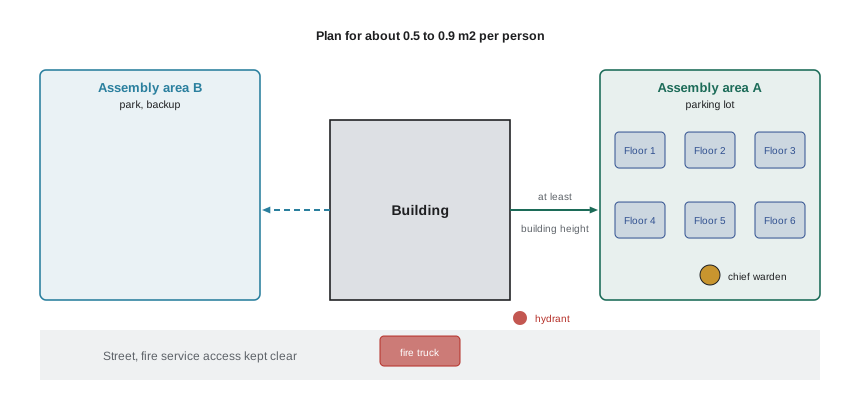
An assembly area, also called a muster point or meeting point, is a place where evacuated people gather so that they can be accounted for and kept safe. It should be far enough from the building to be clear of falling glass, smoke and fire, and out of the way of fire trucks, hydrants and the fire department connection. It should be reachable without crossing busy roads if possible, large enough for everyone expected, and accessible for people with mobility impairments. It should have a backup in case the first is unusable because of wind direction, the location of the fire, or another hazard.
| Factor | What to look for |
|---|---|
| Distance from building | Clear of falling debris, smoke and radiant heat; a common rule of thumb is at least the building height away, or further for tall buildings |
| Fire service access | Not blocking roads, hydrants, fire department connections or the main entrance |
| Route | Reachable from exits without crossing busy roads or passing hazards |
| Size | Room for everyone expected, with space to form groups |
| Accessibility | Level, firm ground reachable by wheelchair users |
| Shelter | Somewhere to go in bad weather if the wait is long |
| Backup | A second area in a different direction |
| Signage | Clearly marked and shown on evacuation diagrams |
The distance rule of thumb is only a starting point. Wind can carry smoke much further, and a building with large glass facades can shed glass well beyond its height. In dense downtown areas, it may be impossible to find space that meets every factor; the plan may then use a nearby park, a plaza, a parking lot or an agreed space in a neighbouring building, and should arrange this with the owner in advance.
Sizing an assembly area
How much space is needed? Guidance varies, and no single number is set in Canadian codes for workplace assembly areas. Planning figures in common use range from about 0.5 m² per person for people standing close together to about 0.9 m² per person for people standing in groups with room to move and for wardens to work. Allow more for people using wheelchairs or mobility aids, for strollers, and for circulation between groups. Treat these as planning figures, not legal requirements.
Worked problem
Is the parking lot big enough?
A building holds up to 640 people at peak, including about 40 visitors. The proposed assembly area is part of a parking lot measuring 30 m by 16 m. About 10 % of the area is taken by light poles, islands and a lane that must be kept clear for the fire department. Using 0.5 to 0.9 m² per person, check whether the area is big enough.
Show solution
- Gross area: 30 × 16 = 480 m².
- Usable area: 480 × 0.9 = 432 m².
- Space needed at 0.5 m² per person: 640 × 0.5 = 320 m². At 0.9 m² per person: 640 × 0.9 = 576 m².
- The usable 432 m² holds everyone packed closely, but not with room to form groups and work (it would need 576 m²). At 432 m², the density is about 0.68 m² per person.
- Options: split the population between two assembly areas by floor or by tenant, extend into an adjacent area, or arrange with the neighbouring property. Splitting by floor also makes headcounts faster, because each area has fewer groups.
Answer: Tight: about 0.68 m² per person; use two assembly areas or extend the space.
Running the assembly area
Assembly areas work best when people know where to stand. Many buildings mark positions for each floor, department or tenant with signs or numbered posts, so that floor wardens can see quickly who is missing. An assembly area warden, or the chief warden, takes position at a known point, often marked by a flag or a high-visibility vest of a particular colour, where floor wardens report. People should be told to stay at the assembly area until released, not to leave in cars or go for coffee, because anyone who leaves unannounced becomes a person who might still be inside.
In bad weather or long events, people may need shelter. The plan can arrange for a nearby building, a transit shelter or a covered area to receive people, but accounting must be finished first, and the move must be organized so that nobody is lost from the count.
Methods of accounting for people
There are several ways to account for people, and most buildings use a combination. Each has strengths and weaknesses.
| Method | Strengths | Weaknesses |
|---|---|---|
| Floor warden sweep report ("floor clear") | Quick, based on direct checks | Does not catch people elsewhere in the building |
| Roll call from staff list | Names each person | Lists out of date; absences, hybrid work and visitors complicate it |
| Sign-in sheets for visitors and contractors | Captures non-employees | Only works if everyone signs in and out |
| Access control or badge data | Shows who badged in | Misses tailgaters and people who badged out; system may be inside the building |
| Mobile app check-in | Fast, works for dispersed people | Needs a phone and signal; some people will not check in |
| Buddy or team check | People notice when a colleague is missing | Informal and incomplete on its own |
The fire safety plan required by Canadian fire codes must cover evacuation procedures, and provincial OHS rules require employers to have emergency procedures for workers. Accounting for workers and visitors after evacuation is a normal part of both.
Reconciling the headcount
Reconciliation means comparing the people known to have been in the building with the people known to be safe, and resolving the differences. It must be fast, because the fire service is waiting, and it must be honest: "probably everyone" is not good enough. A missing person is either outside and not yet counted, away from the building for a reason nobody knew, or still inside. Only the third possibility matters to firefighters, and the job of reconciliation is to narrow the list of names as fast as possible.
Worked problem
Reconciling the count
The day's access records and visitor log show 412 people in the building at the time of the alarm: 386 employees and 26 visitors and contractors. Twelve minutes after the alarm, floor wardens report 401 people at the assembly areas. Of the 11 not counted, the warden team learns that 4 employees badged in but left by a side door for a meeting off site an hour ago, 2 contractors are standing at the wrong assembly area across the street, 1 visitor signed out at reception just before the alarm but the log was not updated, and 1 employee is reported by their buddy to be in the refuge at the east stair on floor 5. What should the chief warden tell the fire service?
Show solution
- Start with the gap: 412 − 401 = 11 not accounted for.
- Remove the people found to be safe elsewhere: 4 off-site employees, 2 contractors at the wrong area, and 1 visitor who left: 11 − 7 = 4.
- One of the 4 is known to be in the east stair refuge on floor 5. This is critical information for the fire service and must be given first.
- That leaves 3 people unaccounted for. The chief warden has their names and normal work locations from the lists.
- Report to the fire service: "One person needing assistance is in the east stair refuge on floor 5 with no buddy. Three people are unaccounted for: names and usual locations as follows. Everyone else is accounted for." Wardens keep checking the crowd and phones for the three while firefighters act.
Answer: One person in the floor 5 east stair refuge, plus three named people unaccounted for; everyone else accounted for.
Hybrid work, shifts and visitors
Modern workplaces make headcounts harder. With hybrid work, the staff list says nothing about who is in today. Desk booking systems, access control data and team check-ins help, but none is perfect. Shift work means the population changes during the day. Visitors and contractors may not know the assembly area, may not have signed in, and may leave without telling anyone. Good plans recognize these gaps: visitors are escorted by their hosts, contractors report to their site contact, and wardens carry or can access a current list for their area, which may be electronic but must also work if the building's systems are down.
Reporting to the fire service
When the fire service arrives, the chief warden, or designated person, meets the officer in charge at an agreed point, often the main entrance or the fire alarm annunciator, and hands over information. The most important items are: the location of the fire if known, the alarm zone, anyone still inside or unaccounted for and where they might be, people waiting in refuges, any hazards such as gas or chemicals, and the status of building systems. Keys, floor plans and the fire safety plan or emergency action plan box are often kept at the entrance for this purpose.
| Item | Example |
|---|---|
| Fire location | "Smoke reported in the kitchen on floor 3." |
| Alarm zone | "Panel shows smoke detector, floor 3 east." |
| People needing rescue | "One person in the east stair refuge, floor 5." |
| Unaccounted for | "Three names, usual locations floors 2, 4 and 7." |
| Hazards | "Lithium battery charging room on floor 3." |
| Systems | "Elevators recalled, sprinklers on, stair pressurization running." |
Releasing people and returning
Only the fire service or the person in charge, when the fire service is not involved, can declare the building safe to re-enter. The chief warden then tells floor wardens, who release their groups and manage the return, making sure that people do not crowd the elevators and that anyone who needed help is supported. If the building will not reopen, the plan should say how people are released, how they get their belongings later, and how the organization will communicate with them.
Common mistakes
MistakeChoosing an assembly area in front of the main entrance where fire trucks arrive.
InsteadKeep assembly areas clear of fire service access, hydrants and connections.
MistakeReporting "everyone is out" without a proper count.
InsteadReport only what is confirmed, and name anyone unaccounted for.
MistakeLetting people leave the assembly area before accounting is complete.
InsteadTell people to stay until released; anyone who leaves may be counted as missing.
MistakeRelying only on access control data stored on a server inside the building.
InsteadHave a backup list that works if building systems are unavailable.
MistakeBurying the most critical information in a long report.
InsteadGive people needing rescue and anyone unaccounted for first.
Summary and key terms
- Assembly areas should be clear of debris, smoke and fire service access, accessible, large enough and backed up.
- Planning figures of about 0.5 to 0.9 m² per person are common; treat them as guidance.
- Mark positions for floors or groups so missing people are noticed quickly.
- Combine methods of accounting: sweep reports, lists, sign-ins, access data, apps and buddies.
- Reconcile the count by removing people found safe elsewhere and naming those still missing.
- Hybrid work, shifts and visitors make counts harder; plan backups that work without building systems.
- Hand over to the fire service with the most critical information first; only they declare the building safe.
- Assembly area
- A place where evacuated people gather to be accounted for.
- Muster point
- Another name for an assembly area.
- Assembly area warden
- The person who runs the assembly area and receives floor reports.
- Accounting
- Confirming that every person who was in the building is safe or located.
- Headcount
- A count of people present at the assembly area.
- Roll call
- Calling or checking names against a list.
- Reconciliation
- Comparing who was inside with who is safe and resolving differences.
- Unaccounted for
- A person whose location after evacuation is not known.
- Handover
- Passing key information to the fire service on arrival.
- Re-entry
- Returning to the building once it is declared safe.
Practice problems
Work each problem on paper first, then reveal the answer to check.
Why is accounting for people so important to the fire service?
Show answer
It tells them whether to search for people or concentrate on the fire.
Give four factors in choosing an assembly area.
Show answer
Any four: distance, fire service access, route, size, accessibility, shelter, backup, signage.
What is a common rule of thumb for distance?
Show answer
At least the building height away, more for tall or glass-clad buildings.
How much space do 300 people need at 0.9 m² each?
Show answer
270 m².
Why mark positions for each floor in the assembly area?
Show answer
So wardens can see quickly who is missing.
What is the weakness of access control data for headcounts?
Show answer
It misses tailgaters and badge-outs, and the system may be inside the building.
Records show 250 in, 241 counted, and 6 found safe elsewhere. How many are unaccounted for?
Show answer
3.
What should be given first in the handover?
Show answer
People needing rescue and anyone unaccounted for, with locations.
Who may declare the building safe to re-enter?
Show answer
The fire service, or the person in charge when the fire service is not involved.
Why must people not leave the assembly area early?
Show answer
They may be counted as missing and searched for.
Lesson quiz · 5 questions
Score 60% or more to complete this lesson.
Create a free account to save your progress, take quizzes and earn a certificate.