
HSE-222 · Lesson 3 of 12 · 25 min
Organizing a warden team: structure, coverage and competence
A warden program is only as strong as the team behind it on the day of an alarm. A plan that names one warden per floor looks fine on paper, but if that person is on holiday, working from home or in a meeting on another floor, the floor has no leader. This lesson covers how to design the team: the roles, the numbers, the coverage across shifts and hybrid schedules, the selection and training of wardens, and how to keep the team current as people come and go.
The roles in a typical team
Every building is different, but most warden teams use a similar set of roles. Smaller buildings combine them; very large buildings split them further.
- Chief warden. Coordinates the whole building response. Usually stationed at the fire alarm panel, the fire command centre or the main entrance, depending on the plan. Receives reports from floor wardens, makes decisions within the plan, and briefs the fire service on arrival. In Canadian high buildings, the chief warden often works alongside building staff who operate the voice communication system.
- Deputy chief warden. Replaces the chief warden when absent, and in large buildings may run the assembly area while the chief warden stays at the command point.
- Floor or area wardens. Lead the evacuation of a floor or a defined zone, direct occupants to exits, make sure the area is swept, and report to the chief warden.
- Deputy floor wardens. Replace floor wardens when absent and share the work on large floors.
- Searchers or sweepers. Check enclosed spaces such as washrooms, meeting rooms, storage rooms and quiet rooms, close doors, and report to the floor warden.
- Evacuation helpers, buddies or monitors. Assist specific occupants who need help to evacuate, following each person's individual plan (Lesson 9).
- Stairwell and exit monitors. In some buildings, keep stair doors closed, stop people from re-entering, and report crowding.
- Assembly area coordinator. Runs the assembly point, takes reports and headcounts, and keeps people away from the building and fire department access routes (Lesson 10).
In federally regulated Canadian workplaces, these roles map onto the COHSR terms: chief emergency warden, deputy chief emergency warden, floor emergency warden and deputy, and monitors for employees who need special assistance.
How many wardens?
There is no single correct number, but three factors drive it: the number of occupants, the layout of the space and the number of exits, and the needs of occupants who require assistance. A useful starting point is the guidance used in many programs of roughly one warden or helper for every 20 occupants, adjusted for layout. An open-plan floor with two stairs and 80 people needs fewer people than a floor of 80 divided into dozens of small offices, laboratories and storage rooms, where searching takes longer.
Canadian fire codes do not set a fixed ratio for most buildings; they require enough supervisory staff to carry out the fire safety plan, and in care, treatment and detention occupancies, enough on duty at all times. Federal workplaces need at least a warden and deputy per occupied floor. Many organizations also use the US figure of one per 20 as a planning guide.
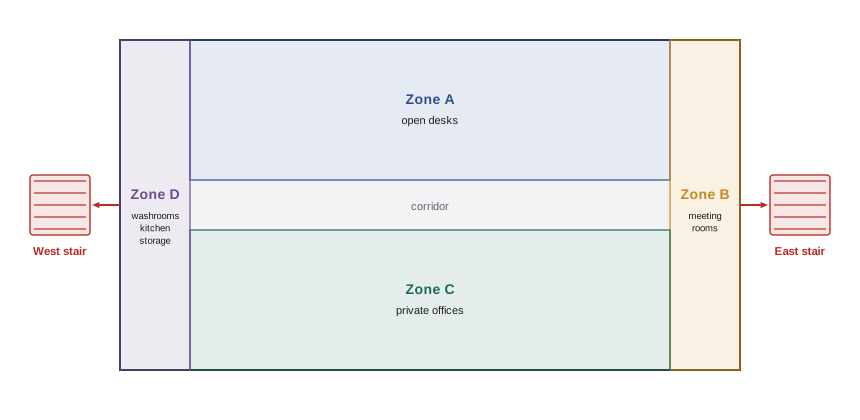
Zones and coverage
Large or complex floors should be divided into zones, each with an assigned warden or searcher and a defined route to an exit. Zone boundaries should follow natural lines such as corridors, fire separations or departments, and each zone should be small enough to sweep in about one to two minutes. The zone map belongs in the plan and should be posted in the warden's kit and on the floor.
Worked problem
Sizing a warden team for one floor
A floor has 140 workstations, but on a typical day about 95 people are present. It has four zones. Zone C has 18 small offices and three storage rooms. Two employees need help to evacuate: one uses a wheelchair and one has a hearing impairment. The plan uses one warden or helper per 20 people present as a minimum, at least one person per zone, and one buddy per person who needs help. How many trained people should be on duty, and how many should the team include to allow for absences of about 40 %?
Show solution
- Ratio: 95 ÷ 20 = 4.75, round up to 5.
- Zones: 4 zones need at least 4 people, which the ratio already covers. Zone C's many small rooms justify a second searcher, so 6.
- Buddies: 2 occupants need help, so 2 buddies, giving 6 + 2 = 8 on duty.
- Allow for absence: 8 ÷ (1 − 0.40) = 13.3, so the team should include about 14 trained people.
- Each zone and each buddy should therefore have a named primary and at least one named alternate.
Answer: About 8 trained people on duty, from a team of about 14 so that coverage survives normal absences.
Coverage across time
A warden team must cover every hour that people are in the building, not just office hours. Night cleaning crews, security staff, weekend workers, evening events and contractors working outside normal hours all need emergency leadership. Plans should identify, for each time period, who leads the response. Often this is the security officer on duty, a shift supervisor or a designated lead among the cleaning crew. For 24-hour operations such as hospitals, data centres and manufacturing plants, each shift needs its own complete team.
Hybrid work has made coverage harder. Programs now commonly:
- appoint more wardens than the minimum so that enough are present on any given day;
- check warden coverage weekly against desk bookings or schedules and fill gaps;
- agree that the most senior trained person present on a floor takes the warden role if the named warden is absent;
- train all regular occupants in the basic sweep, assembly and reporting steps, so that the program does not collapse when designated wardens are away;
- use a simple daily check-in, such as a warden sign-in sheet at reception or a message in a chat channel, to confirm who is on duty.
Selecting wardens
Good wardens are reliable, calm, respected by their colleagues and normally present. They need to be able to move quickly around their area and to communicate clearly. Language matters in diverse workplaces: a team that includes people who speak the main languages used on the floor can communicate much more effectively in an emergency. Wardens should volunteer or at least agree to the role; a reluctant warden is unlikely to keep up with training. Organizations should recognize the role, for example by including it in job descriptions or performance reviews, providing time for training and acknowledging wardens publicly.
Some people should not be primary wardens: people who are rarely present, people who will be needed for critical tasks such as shutting down processes, and people who themselves need assistance to evacuate. A person who needs assistance can still contribute, for example by helping with planning or by acting as a warden on a ground floor with step-free exits, but should not be placed in a role that requires rapid movement through stairs.
Training and competence
Under Canadian fire codes, supervisory staff must be trained in the fire emergency procedures in the fire safety plan before they are given any responsibility for fire safety. In practice, warden training includes:
- the building's fire safety plan or emergency action plan, alarm signals and the meaning of each;
- the warden's own area, its exits, alternate routes, zones and hazards;
- the duties of each role and how to report to the chief warden;
- people who need assistance and how each person's plan works;
- the use of warden equipment such as radios, vests, flashlights and evacuation chairs where provided;
- extinguisher use where the plan allows it (HSE-105);
- shelter-in-place and lockdown procedures where the plan includes them;
- participation in drills, followed by debriefs.
Training should be refreshed at least once a year and whenever the plan, the building or the warden's role changes. Many programs run a short refresher before each drill. Training records should show who was trained, on what, by whom and when.
| Item | Typical content | Who keeps it |
|---|---|---|
| Warden roster | Name, role, zone, phone, primary or alternate, days in office | Chief warden or property manager |
| Training log | Course, date, trainer, refresher due date | Employer or property manager |
| Zone maps | Floor plan with zones, exits, refuge areas, equipment | Chief warden; copy in each warden kit |
| Assistance list | Who needs help and who is their buddy (no medical details) | Floor warden, held confidentially |
| Drill records | Date, scenario, times, problems, actions | Chief warden or property manager |
The warden kit
Each warden should have a small kit kept at an agreed place, such as near their desk or by the stair door. Typical contents are a high-visibility vest or hat that identifies the role, a flashlight, a copy of the zone map and the floor checklist, a list of occupants who need assistance and their buddies, a pen and notepad or a laminated card for recording, and where provided a two-way radio or a phone with the chief warden's number. Some kits include a whistle, a megaphone, door markers to show rooms that have been checked, and disposable gloves. Kits must be checked regularly; a flashlight with a dead battery is worse than no flashlight because people rely on it.
Keeping the team current
Warden teams decay quietly. People change jobs, move floors, retire or start working remotely, and nobody updates the roster until a drill reveals that two of the five wardens on a floor have left. A simple monthly check of the roster against the organization's staff list, a quarterly confirmation from each warden that they still hold the role, and a sign-off at each drill keep the team current. When a warden leaves, the program should appoint and train a replacement before the departure if possible.
Common mistakes
MistakeNaming one warden per floor and no alternates.
InsteadName primary and alternate people for each zone and role, sized for normal absences.
MistakePlanning only for office hours.
InsteadIdentify who leads the response for every period people are in the building, including nights and weekends.
MistakeMaking a zone so large that sweeping it takes many minutes.
InsteadSize zones so each can be swept in about one to two minutes, splitting complex areas.
MistakeKeeping medical details on the warden's assistance list.
InsteadList only who needs help and who their buddy is; keep medical information confidential.
MistakeUpdating the roster only when a drill reveals gaps.
InsteadCheck the roster against staff changes monthly and confirm roles quarterly.
Summary and key terms
- Teams include a chief warden, deputies, floor or area wardens, searchers, helpers or buddies and assembly coordinators.
- Team size depends on occupants, layout, exits and people who need assistance; one per 20 is a common planning figure.
- Dividing floors into zones that can be swept in one to two minutes gives each person a manageable area.
- Coverage must include every period people are present, and hybrid work needs extra wardens and daily checks.
- Good wardens are reliable, calm, normally present and able to communicate with the people on their floor.
- Training covers the plan, the area, roles, assistance, equipment and drills, refreshed at least yearly.
- Rosters, training logs, zone maps and kits must be checked regularly to stay current.
- Zone
- A defined part of a floor assigned to one warden or searcher, with a route to an exit.
- Primary warden
- The person first assigned to a role or zone.
- Alternate
- A trained person who takes over a role when the primary is absent.
- Buddy
- A person assigned to help a specific occupant who needs assistance.
- Stairwell monitor
- A person who keeps stair doors closed and watches for crowding or re-entry.
- Assembly area coordinator
- The person who runs the assembly point and collects reports.
- Warden roster
- The current list of wardens, roles, zones and contact details.
- Warden kit
- The equipment a warden keeps ready, such as a vest, flashlight, map and checklist.
- Coverage gap
- A time or place in which no trained warden is present.
- Refresher training
- Periodic training that renews warden knowledge, at least yearly.
Practice problems
Work each problem on paper first, then reveal the answer to check.
List five roles in a typical warden team.
Show answer
Any five of: chief warden, deputy chief, floor warden, deputy floor warden, searcher, helper or buddy, stairwell monitor, assembly area coordinator.
What three factors drive team size?
Show answer
Occupant numbers, layout and exits, and the needs of occupants who require assistance.
How long should it take to sweep a zone?
Show answer
About one to two minutes.
A floor has 70 people present and one person needing help. Using one per 20 plus one buddy, how many on duty?
Show answer
4 (70 ÷ 20 = 3.5, round up) + 1 = 5.
If you need 6 on duty and expect 30 % absence, how many should be on the team?
Show answer
6 ÷ 0.7 = 8.6, so 9.
Who might lead the response at night when office wardens are gone?
Show answer
Security officers, shift supervisors or a designated lead in the cleaning crew.
Why should people who need assistance not usually be primary wardens on upper floors?
Show answer
The role needs rapid movement through stairs and around the floor.
List four items in a warden kit.
Show answer
Any four of: vest or hat, flashlight, zone map and checklist, assistance list, notepad, radio or phone, whistle, door markers.
How often should warden training be refreshed?
Show answer
At least once a year and when the plan, building or role changes.
What should the assistance list contain and not contain?
Show answer
Who needs help and who their buddy is, but not medical details.
Lesson quiz · 5 questions
Score 60% or more to complete this lesson.
Create a free account to save your progress, take quizzes and earn a certificate.