
HSE-222 · Lesson 9 of 12 · 25 min
Evacuating people who need assistance
Every building has people who cannot use the stairs quickly, or at all, or who may not hear the alarm or understand what is happening. Some have permanent disabilities, such as people who use wheelchairs, people who are blind or have low vision, and people who are deaf or hard of hearing. Others have temporary conditions, such as a broken leg, late pregnancy or recovery from surgery. Some have conditions that are not visible, such as heart or lung disease, chronic fatigue, epilepsy, anxiety disorders or cognitive impairments, and visitors may need help that nobody knew about in advance. HSE-105 introduced the idea of assisted evacuation. This lesson goes into how wardens plan for it, what equipment and refuges are used, and how wardens handle the people who need help during a real alarm.
Planning comes first
Assisted evacuation cannot be improvised well. The time to find out that someone on the ninth floor uses a power wheelchair, that the evacuation chair is locked in a cupboard nobody can open, or that the only trained operators are on holiday, is before the alarm. Good plans identify people who may need help, agree with each person what help they need, assign and train helpers, provide equipment, and practise. The person who needs help is the expert on their own needs and should be part of the planning.
In Ontario, AODA's Integrated Accessibility Standards Regulation, section 27, requires employers to provide individualized workplace emergency response information to employees with disabilities where the disability makes it necessary and the employer is aware of the need, and, with consent, to share it with designated helpers. Other provinces rely on human rights duties to accommodate and on fire code requirements that fire safety plans address occupants who need special assistance. A personal emergency evacuation plan, often called a PEEP, is the usual way to record this.
A PEEP should be short and practical. It records where the person usually works, what help they need to be alerted, which route and method they will use, who their buddies or helpers are, what equipment is needed, and any information the fire service should know. It must be reviewed when the person moves desks, when their needs change, when helpers leave, and after drills. Personal information should be kept confidential and limited to what helpers and the warden team need.
| Need | Possible arrangements in a PEEP |
|---|---|
| Cannot use stairs (wheelchair user) | Go with buddy to a refuge area or protected stair landing; trained team uses an evacuation chair; or evacuation elevator if the plan allows |
| Can use stairs slowly | Leave once the main flow has passed, using the stair with a buddy; wait at a refuge if tired |
| Deaf or hard of hearing | Visual alarms, vibrating pager or phone alert, buddy alerting, warden check |
| Blind or low vision | Guide buddy, familiarization with routes, clear verbal directions |
| Cognitive or mental health condition | Buddy who knows the person, simple clear instructions, a quieter place to wait at assembly |
| Assistance animal | Animal leaves with the handler; plan for it at the refuge and assembly area |
| Temporary injury or pregnancy | Short-term PEEP, updated when the condition changes |
Visitors and people without a plan
Many people who need help will not have a PEEP: visitors, customers, contractors, and employees who have not told anyone. Buildings that receive the public should have a general emergency evacuation plan, sometimes called a GEEP, that covers how staff will find and help people they did not know about. Reception staff can ask visitors at sign-in whether they would need help in an evacuation. Wardens should look for people who seem to be struggling during the sweep and ask directly and respectfully, "Can I help you get out?"
Refuges and protected waiting areas
A person who cannot use the stairs can wait in a place where they are protected from fire and smoke while the main evacuation passes and helpers or firefighters come for them. The exact arrangements depend on the building.
Canadian building codes require that floor areas with a barrier-free path of travel, above or below the exit level, provide some form of protection for people who cannot use stairs, such as fire-separated areas, a horizontal exit to an adjacent floor area, or sprinkler protection with other measures, depending on the building and the code edition. Many buildings use a protected stair landing or a refuge area next to the stair. The fire safety plan should say where people wait, how they communicate their location, and how the fire department will be told.
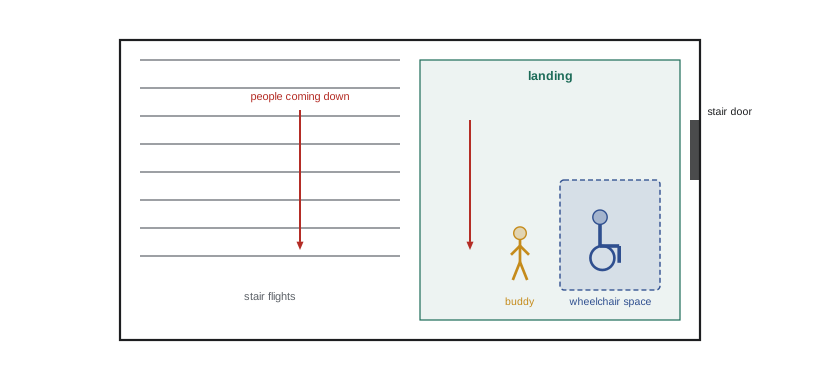
A refuge is a waiting place, not a destination. Someone must know that a person is there, and someone must come for them. The plan must say who reports the person's location, how it gets to the chief warden and the fire service, and who will move them. In a working refuge, the buddy stays with the person if safe, the floor warden reports the location, and the chief warden tells the fire service on arrival with the exact floor and stair.
Methods of moving people
The safest method is the one the person agrees to and the helpers are trained for. Wardens should not attempt lifts and carries they have not practised, because dropping someone on a stair can cause serious injury to the person and to the helpers.
- Evacuation chairs are lightweight chairs with tracks or skids that let one or two trained operators take a seated person down stairs with control. They need to be stored near stairs, checked regularly and practised with.
- Evacuation elevators may be used only where the building and plan provide for it, usually under the control of the fire service or trained staff. Some newer buildings have occupant evacuation elevators designed for use during a fire.
- Horizontal movement through a fire separation to another compartment, common in hospitals and care homes, avoids stairs entirely.
- Carries without equipment, using two or more people, are a last resort when there is immediate danger and no other option.
Power wheelchairs are heavy and cannot be carried down stairs. A person who uses one will usually transfer to an evacuation chair and leave the power chair behind, which means losing their mobility at the assembly area; plans should consider how the chair will be recovered after the event and how the person will be supported in the meantime.
Worked problem
How long will an assisted evacuation take?
On the seventh floor of an office building, three people need evacuation chairs: two wheelchair users and one person who cannot manage stairs after surgery. The floor has two evacuation chairs and four trained operators, so two teams of two. Drills show that transferring a person into the chair takes about 2 minutes, descending takes about 25 seconds per storey with the chair, and the team needs about 3 minutes to climb back up seven storeys. The plan has chair teams wait about 5 minutes until the main flow has passed, so they are not slowed by a crowded stair. Estimate when the last person reaches the ground floor.
Show solution
- Descent time from floor 7 to floor 1: 6 storeys × 25 s = 150 s, or 2.5 minutes.
- First round, both teams at once: wait 5 minutes, transfer 2 minutes, descend 2.5 minutes. Two people reach the ground floor at about 9.5 minutes.
- One team returns for the third person: climb 3 minutes, transfer 2 minutes, descend 2.5 minutes. Third person reaches the ground at 9.5 + 3 + 2 + 2.5 = 17 minutes.
- The third person waits at the refuge with a buddy for about 12 minutes after the main evacuation. The plan must make sure the location is reported, the refuge is protected and the person is not left alone.
- Options to cut the time: a third chair and a third trained team, starting the chair evacuation sooner where the stair layout allows the chair to use the inside of the stair, or using an evacuation elevator if the building provides one under the plan.
Answer: Two people reach the ground at about 9.5 minutes and the third at about 17 minutes; a third chair and team would bring everyone down at about 9.5 minutes.
Alerting people who cannot hear the alarm
Strobe lights work only if the person can see one. People who are deaf or hard of hearing may be in washrooms, quiet rooms or stairwells without visual alarms, or may be asleep in residential buildings. Methods include visual alarms in all areas where people may be alone, vibrating pagers or phone alerts linked to the fire alarm, buddies who know to alert the person, and the warden's sweep. Text-based alerts on screens and phones help but should not be the only method, because phones may be silent, out of reach or out of signal.
Communicating during an evacuation
Good communication is part of assistance. Speak directly to the person, not to their companion. Ask what help they need rather than assuming. Explain what is happening and what you will do, especially to someone who is blind or has low vision. Offer your arm rather than pulling or pushing. For people with cognitive or mental health conditions, use short, calm instructions and allow a little more time. Never separate a person from their mobility aid or assistance animal unless they agree and it is unavoidable.
Helpers and buddies
A buddy is a colleague who agrees to help a specific person in an emergency, usually by alerting them, staying with them, or helping them reach a refuge. Buddy systems fail when the buddy is absent, so each person who needs help should have at least two buddies, and wardens should check on arrival at the start of the day or shift who is present. Buddies should not be expected to carry anyone or operate an evacuation chair unless they are trained. Buddies should also know what to do if they themselves cannot stay, for example because of smoke: report the person's exact location to the warden and leave.
After the evacuation
At the assembly area, people who needed help may need shelter, a place to sit, medication they left behind, or help to contact someone. A person whose wheelchair was left inside may be stranded. Wardens should report anyone still in a refuge to the chief warden and the fire service and keep reporting until they are confirmed out. After the event, the plan owner should talk with each person who needed help about how it went and update their PEEP.
Common mistakes
MistakeWriting PEEPs without involving the person concerned.
InsteadAgree each PEEP with the person; they know their own needs best.
MistakeLeaving someone at a refuge without reporting their location.
InsteadReport the exact floor and stair to the chief warden at once and confirm the fire service has it.
MistakeLetting untrained helpers attempt carries down stairs.
InsteadUse only methods the helpers are trained for, such as evacuation chairs.
MistakeRelying on one buddy who may be absent.
InsteadAssign at least two buddies and check who is present each day.
MistakeSpeaking to a companion instead of the person who needs help.
InsteadSpeak directly to the person and ask what help they need.
Summary and key terms
- Many people may need help: wheelchair users, people with sensory, cognitive or hidden conditions, temporary injuries, and visitors.
- PEEPs record agreed arrangements; AODA section 27 requires individualized information in Ontario.
- General plans cover visitors and people without a PEEP.
- Refuges are waiting places where someone must know the person is there and someone must come for them.
- Use evacuation chairs, evacuation elevators or horizontal movement only as planned and trained.
- Alerting people who cannot hear the alarm needs visual alarms, devices, buddies and sweeps.
- Each person should have at least two buddies, and PEEPs should be reviewed after drills and changes.
- PEEP
- Personal emergency evacuation plan for an individual who needs help.
- GEEP
- General emergency evacuation plan for people without a PEEP, such as visitors.
- Refuge area
- A protected place where people who cannot use stairs wait for help.
- Area of refuge
- A code term for a protected waiting area, often with two-way communication.
- Evacuation chair
- A chair with tracks or skids for taking a seated person down stairs.
- Evacuation elevator
- An elevator designated for evacuating people during an emergency under the plan.
- Buddy
- A colleague who agrees to help a specific person in an emergency.
- Two-way communication
- A system that lets a person in a refuge talk to a central point.
- Assistance animal
- A trained animal that helps a person with a disability.
- Hidden disability
- A condition that affects evacuation but is not visible to others.
Practice problems
Work each problem on paper first, then reveal the answer to check.
Give three groups of people who may need help to evacuate.
Show answer
Any three: wheelchair users, people who are blind or deaf, people with cognitive or hidden conditions, people with temporary injuries, visitors.
Who should be involved in writing a PEEP?
Show answer
The person concerned, with the plan owner or warden.
What should a PEEP record?
Show answer
Location, how they are alerted, route and method, buddies, equipment and information for the fire service.
What is a GEEP for?
Show answer
People who need help but have no PEEP, such as visitors.
Why is a refuge not a destination?
Show answer
Someone must know the person is there and someone must come for them.
A chair descent takes 25 s per storey. How long from floor 9 to floor 1?
Show answer
8 × 25 = 200 s, about 3.3 minutes.
Why can power wheelchairs not be carried down stairs?
Show answer
They are too heavy; the person usually transfers to an evacuation chair.
How can people who are deaf be alerted where there are no strobes?
Show answer
Vibrating pagers or phone alerts, buddies and the warden sweep.
Why assign at least two buddies?
Show answer
One may be absent.
What should a buddy do if smoke forces them to leave a person at a refuge?
Show answer
Report the exact location to the warden and leave.
Lesson quiz · 5 questions
Score 60% or more to complete this lesson.
Create a free account to save your progress, take quizzes and earn a certificate.