
HSE-222 · Lesson 2 of 12 · 24 min
Emergency action plans, OSHA and warden duties in the US
Warden programs in the US rest on several overlapping sets of rules. OSHA's emergency action plan and fire prevention plan standards set duties for employers. State and local fire codes, usually based on the International Fire Code or NFPA 1, and the NFPA 101 Life Safety Code where adopted, set duties for building owners, including evacuation drills. Some large cities add their own high-rise rules. Disability rights law shapes how people who need assistance are included. This lesson maps those sources so that you understand why your building's plan looks the way it does. Requirements change when codes are updated and adopted locally, so always check the edition in force where you work.
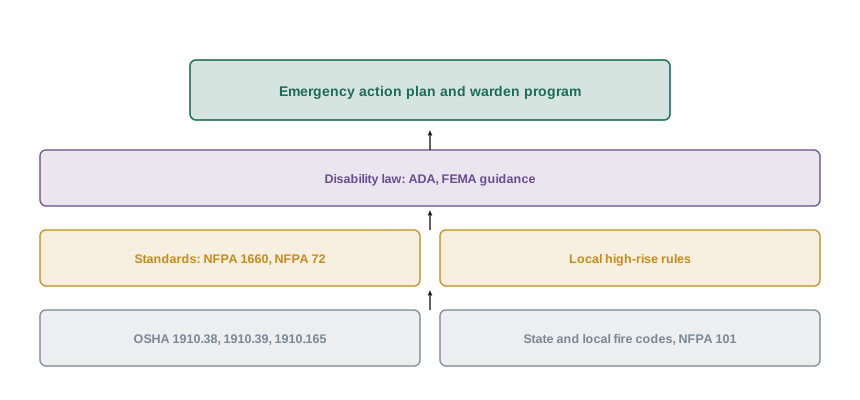
OSHA: the emergency action plan
OSHA's emergency action plan standard, 29 CFR 1910.38, applies when another OSHA standard requires an emergency action plan, which covers most workplaces with fire extinguishers, fixed extinguishing systems or fire alarm systems. The plan must be in writing, kept in the workplace and available to employees, unless the employer has 10 or fewer employees, in which case it may be communicated orally. At a minimum it must include procedures for reporting a fire or other emergency, procedures for emergency evacuation including the type of evacuation and exit route assignments, procedures for employees who remain to operate critical plant operations before they evacuate, procedures to account for all employees after evacuation, procedures for employees performing rescue or medical duties, and the name or job title of every employee who may be contacted for more information about the plan.
Section 1910.38(e) requires an employer to designate and train employees to assist in a safe and orderly evacuation of other employees. Section 1910.38(f) requires the employer to review the plan with each employee covered by it when the plan is developed or the employee is assigned initially, when the employee's responsibilities under the plan change, and when the plan is changed. OSHA's evacuation plans eTool adds guidance: generally, one warden for every 20 employees should be adequate, wardens should be on duty whenever people are working, and wardens may check offices, washrooms and other spaces before being the last to leave an area.
Fire prevention plans and alarm systems
Section 1910.39 requires a fire prevention plan when another OSHA standard requires one. It must be in writing, except for employers with 10 or fewer employees, and must list the major fire hazards and their handling and storage, potential ignition sources and their control, the type of fire protection equipment needed, procedures to control accumulations of flammable and combustible waste, maintenance procedures for heat-producing equipment, and the names or job titles of the people responsible for equipment maintenance and for controlling fuel source hazards. Section 1910.165 covers employee alarm systems: alarms must be perceived above ambient noise and light levels by all employees in the affected area, must be distinctive and recognizable as a signal to evacuate, and must be tested and maintained. Where not all employees can hear the alarm, visual or tactile means must be used.
Fire codes and the Life Safety Code
Most states and cities adopt a fire code based on either the International Fire Code (IFC) or NFPA 1, and many adopt the NFPA 101 Life Safety Code for some occupancies, particularly health care facilities that receive Medicare and Medicaid funding. The IFC requires fire safety and evacuation plans for many occupancies, including high-rise buildings, assembly occupancies, schools and health care, and requires emergency evacuation drills at set frequencies. NFPA 101 sets out general drill requirements in Chapter 4.7, including that drills are held with enough frequency to familiarize occupants with the procedures and that they are held at unexpected times and under varying conditions. The occupancy chapters then set frequencies, for example monthly drills in schools while in session (with some exceptions), quarterly drills on each shift in health care, and drills in larger business occupancies.
City high-rise rules
Several large cities add their own rules for high-rise buildings. New York City is the best-known example: after the September 11, 2001 attacks, the city adopted Local Law 26 of 2004, which, among other things, required emergency action plans for office buildings in addition to fire safety plans. Today the FDNY requires high-rise office buildings, hotels and buildings with voice-communication fire alarm systems to have a Fire and Life Safety Director holding an F-89 Certificate of Fitness on the premises during regular business hours, supported by fire wardens and deputy fire wardens on each floor. Chicago has a high-rise emergency evacuation ordinance requiring evacuation plans and trained floor wardens. If you work in a large city, check whether local rules add to the state code.
Disability law and guidance
The Americans with Disabilities Act (ADA) requires employers to provide reasonable accommodations for qualified employees with disabilities, and emergency evacuation planning is part of that duty. The ADA allows employers to ask employees to self-identify if they will need assistance in an emergency, provided the information is used only for that purpose and kept confidential. The US Access Board and the ADA Standards for Accessible Design set requirements for accessible means of egress and areas of refuge in new construction, through the building codes. FEMA and the US Fire Administration publish guidance on including people with disabilities in emergency plans, and the Job Accommodation Network publishes practical guidance on personal emergency evacuation plans. Lesson 9 covers these plans in detail.
Standards
NFPA 1660, Standard for Emergency, Continuity, and Crisis Management, published in its 2024 edition, consolidated NFPA 1600, NFPA 1616 and NFPA 1620 into one document. It sets out a management system for emergency preparedness that many large organizations use. NFPA 72, the National Fire Alarm and Signaling Code, sets requirements for alarm audibility, visible notification and voice communication. NFPA 101 and the International Building Code set the physical features wardens depend on, such as exits, areas of refuge and fire alarm systems.
| Source | What it requires of a warden program |
|---|---|
| 29 CFR 1910.38 | Written emergency action plan, designated and trained evacuation assistants, accounting for employees, plan reviews |
| 29 CFR 1910.39 and 1910.165 | Fire prevention plan; alarm systems perceived by all employees |
| State and local fire codes (IFC or NFPA 1), NFPA 101 | Fire safety and evacuation plans, drills by occupancy |
| City high-rise rules (e.g., New York, Chicago) | Certified directors, floor wardens, evacuation plans |
| ADA, FEMA and JAN guidance; NFPA 1660, NFPA 72 | Accommodation in evacuation, program management, alarm requirements |
Worked problem
How many wardens does OSHA guidance suggest?
A three-story office has 260 employees on day shift and 45 on an evening shift. Using OSHA's general guidance of one warden per 20 employees, how many wardens are needed on each shift, and how many trained deputies should the employer appoint if it wants one deputy per warden?
Show solution
- Day shift: 260 ÷ 20 = 13 wardens.
- Evening shift: 45 ÷ 20 = 2.25, so round up to 3 wardens.
- Deputies: one per warden gives 13 deputies on days and 3 in the evening.
- Total trained people: (13 + 13) + (3 + 3) = 32, before allowing extra cover for absences and hybrid schedules.
Answer: 13 wardens on days and 3 in the evening, plus 16 deputies: 32 trained people in total.
Putting the sources together
In practice, a warden program serves several masters at once. The building owner or property manager runs the overall plan required by the fire code. Each tenant employer appoints wardens for its own floors, meets its own workplace safety duties, and provides individualized plans for its employees who need assistance. The fire department reviews the plan, may attend drills and responds to real alarms. The best programs write all of this into a single coordinated plan with clear roles, so that wardens do not have to work out who is in charge on the day.
What the rules mean for a floor warden
For an individual floor warden, the legal framework comes down to a few practical points. You act under your employer's emergency action plan and, in many buildings, the building owner's fire safety and evacuation plan required by the local fire code. Your employer designated you and must train you before you take on evacuation duties, and must review the plan with you when your responsibilities change. Your duties are those written in the plans, not whatever someone asks of you on the day. If a plan is out of date, unclear or does not match what happens in drills, you should say so, and the owner or employer must update it; the IFC expects fire safety and evacuation plans to be reviewed or updated annually or as changes require.
Wardens are also employees, and their own safety is protected by the OSH Act. A warden is never required to enter smoke, fight a fire beyond their training, or stay behind in danger. OSHA's portable fire extinguisher rule, 1910.157, lets employers choose whether employees will fight incipient fires at all, and requires training for those who will. Section 11(c) of the OSH Act protects employees from retaliation for raising safety concerns, which includes a warden who reports that the plan or equipment does not work.
Where a building has several tenants, the owner's plan and each tenant's emergency action plan must fit together. In practice, the property manager or fire safety director usually runs a building emergency program, sets building-wide signals, routes and assembly areas, and runs drills, while each tenant names its floor wardens, keeps its own lists of employees and people who need assistance, and trains its staff. Wardens should know both their tenant contact and the building's fire safety contact.
Finally, remember that requirements differ across the country. About half the states and territories run OSHA-approved state plans, which must be at least as effective as federal OSHA and may add their own emergency planning rules. States and cities adopt different editions of the IFC, NFPA 1 and NFPA 101, often with local amendments, and some cities add high-rise rules of their own. When in doubt, ask the building owner, your employer's safety contact or the local fire marshal which rules apply to your building.
Common mistakes
MistakeAssuming a written plan is optional because the business is small.
InsteadEmployers with 10 or fewer employees may communicate the plan orally, but all covered employers need a plan.
MistakeGiving warden responsibilities before training.
InsteadDesignate and train evacuation assistants before relying on them.
MistakeRunning one drill a year in every building regardless of occupancy.
InsteadCheck the frequency for the occupancy under the adopted fire code and NFPA 101.
MistakeKeeping no record of employees who need help to evacuate.
InsteadInvite employees to self-identify and build confidential individual plans, as the ADA allows.
MistakeRelying on an old code edition.
InsteadCheck the edition in force where you work; requirements and section numbers change.
Summary and key terms
- OSHA 1910.38 requires an emergency action plan, written for employers with more than 10 employees.
- Employers must designate and train employees to assist in evacuation and review the plan with employees.
- OSHA guidance suggests one warden per 20 employees, on duty whenever people work.
- 1910.39 covers fire prevention plans and 1910.165 requires alarms that all employees can perceive.
- State and local fire codes and NFPA 101 set drill frequencies by occupancy.
- Cities such as New York and Chicago add high-rise rules and certified directors.
- Owners, tenants and the fire department should be brought together in one coordinated plan.
- Fire safety plan
- The Canadian fire code document setting out fire emergency procedures, supervisory staff and drills.
- Emergency action plan
- The OSHA-required plan for reporting emergencies, evacuating and accounting for employees.
- Fire prevention plan
- The OSHA-required plan listing fire hazards and their controls.
- Supervisory staff
- People designated under a Canadian fire safety plan to carry out fire safety duties.
- High building
- A tall building, as defined in the building code, that needs extra fire safety measures such as voice communication.
- Emergency warden
- The title used for wardens in federal Canadian workplaces under COHSR Part XVII.
- Monitor
- A person appointed to help an employee who needs special assistance to evacuate.
- Individualized emergency response information
- A personal plan for an employee with a disability, required in Ontario where necessary.
- Life Safety Code
- NFPA 101, a code setting minimum requirements for egress and life safety, including drills.
- Fire and Life Safety Director
- A certified person required in many New York City high-rise buildings to run the fire and emergency plan.
Practice problems
Work each problem on paper first, then reveal the answer to check.
Which OSHA standard covers emergency action plans?
Show answer
29 CFR 1910.38.
When may an emergency action plan be oral?
Show answer
When the employer has 10 or fewer employees.
What warden ratio does OSHA guidance suggest?
Show answer
Generally one warden per 20 employees.
Name three things an emergency action plan must include.
Show answer
Any three of: reporting procedures, evacuation procedures and routes, procedures for critical operations, accounting for employees, rescue and medical duties, contacts.
What must an employee alarm system do under 1910.165?
Show answer
Be perceived by all employees above ambient noise and light and be distinctive.
Which NFPA 101 chapter sets general drill requirements?
Show answer
Chapter 4.7.
What may an employer ask under the ADA for evacuation planning?
Show answer
That employees self-identify if they need help in an emergency, kept confidential.
Which NFPA standard consolidated NFPA 1600, 1616 and 1620?
Show answer
NFPA 1660 (2024).
Why should owners and tenants share one coordinated plan?
Show answer
So wardens know who is in charge and procedures do not conflict on the day.
Name a city with its own high-rise rules.
Show answer
New York City or Chicago.
Lesson quiz · 5 questions
Score 60% or more to complete this lesson.
Create a free account to save your progress, take quizzes and earn a certificate.