
HSE-222 · Lesson 1 of 12 · 26 min
The fire warden's role and authority
When a fire alarm sounds in an office tower, a school or a warehouse, most occupants do what the people around them do. If someone calm and visible in a coloured vest says "This way, use the north stair, leave your coffee", people follow. If nobody leads, groups stand at their desks, wait for confirmation, go back for coats, or head for the elevator they always use. Research on human behaviour in fire has shown again and again that the delay before people start to move, called the pre-movement time, is often longer than the time they spend actually walking out. Fire wardens exist to shorten that delay, to guide people along safe routes, to make sure nobody is left behind, and to give the fire service accurate information when it arrives.
This course is for people who take on those duties: floor wardens, deputy wardens, searchers, evacuation helpers, chief wardens and the managers who organize them. It assumes you have completed HSE-105, which covered how fires start, fire codes at an overview level, extinguishers and the basics of evacuation for every worker. Here we go deeper into the leader's side of the job. This is an awareness-level course. It does not make you a fire code official, a fire prevention officer, a fire alarm technician or a certified fire safety director, and it does not replace the specific training your building's fire safety plan or emergency action plan requires.
What a fire warden is
A fire warden is a person appointed by the employer or building owner to carry out defined duties in a fire or other emergency. The title varies. Canadian buildings commonly use chief fire warden, deputy chief, floor warden and searcher. Federal workplaces in Canada use chief emergency warden and floor emergency warden. US workplaces often use evacuation warden, floor captain or emergency coordinator. Hospitals and care homes often fold the role into charge nurses and unit leaders. Whatever the title, a warden has three things that ordinary occupants do not: a defined area of responsibility, specific training in the building's procedures, and the authority to give instructions during an emergency.
Most of the work happens before an emergency. Wardens check that exits are clear, that fire doors close, that they know who on their floor needs help to evacuate, and that new staff know the procedure. They take part in drills and report problems. During an emergency their job is to lead, not to fight fires: they make sure the alarm has been raised, direct people to the right exits, check their area is empty, help people who need assistance, and report to the chief warden or the person in charge at the assembly point.
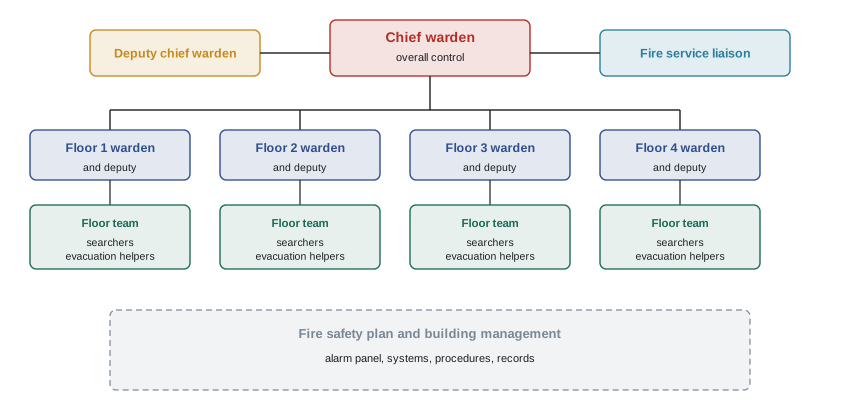
Why buildings need wardens
Fire codes and workplace safety rules require buildings and employers to plan for emergencies, and wardens are the people who make those plans work on the day. Three reasons stand out.
- People wait before they move. In many evacuations studied after real fires, occupants spent several minutes gathering belongings, finishing tasks, looking for information or waiting for others before they started to leave. A warden who gives a clear instruction cuts this time sharply.
- Routes need managing. Smoke, a blocked stair or a fire near one exit can make the usual route dangerous. A warden who knows the alternative routes can redirect people.
- Somebody must account for everyone. The fire service needs to know quickly whether anyone is still inside and where. Only an organized sweep and headcount can answer that.
These reasons explain the pattern of the duties throughout this course: reduce delay, manage routes, account for people, and hand accurate information to those who arrive to fight the fire.
Authority and its limits
Wardens act on behalf of the employer or building owner, and their authority comes from the fire safety plan or emergency action plan, from their appointment, and from the employer's policies. Occupants, including senior managers, contractors and visitors, are expected to follow a warden's instructions during an alarm. Good programs say this plainly in the plan, in induction training and in contractor orientation, so that nobody is surprised when a junior employee in a vest tells the vice-president to leave now.
Authority has limits. Wardens do not have police powers and cannot physically force anyone to leave. If someone refuses, the warden should give a clear instruction, explain the danger, note the person's name and location, leave, and report the refusal to the chief warden and the fire service. A warden should never put themselves at risk to argue with a refusing occupant. Wardens also do not override the fire service. When firefighters arrive, the incident commander takes charge, and wardens provide information and follow instructions.
| Wardens do | Wardens do not |
|---|---|
| Raise the alarm and confirm the fire service has been called | Investigate a fire alarm before the evacuation starts |
| Direct occupants to safe exits and away from smoke | Use elevators, unless they are designated evacuation elevators under the plan |
| Sweep their area and close doors behind them | Re-enter a smoke-filled area to search |
| Help or arrange help for people who need assistance | Carry people down stairs without training and equipment |
| Report to the chief warden and hand information to firefighters | Fight a fire beyond the incipient stage or block their own escape |
| Keep records of drills, problems and occupants who need assistance | Share personal medical details beyond what the plan needs |
Fighting fires: where wardens stand
Some wardens are trained to use portable extinguishers, and HSE-105 covered how and when to do so. A warden's first duty is still evacuation. Many plans allow a trained warden to attempt to extinguish a small, incipient fire only if the alarm has been raised, the fire is small and not spreading, the warden has the right extinguisher and an exit behind them, and someone else is leading the evacuation of their area. If any of these conditions is missing, the warden evacuates. A warden who spends three minutes fighting a fire while their floor waits for direction has made the wrong choice.
The warden mindset
Good wardens share a few habits. They are visible: they wear a vest, hat or armband during drills and real alarms so occupants can find them. They speak in short, specific instructions, such as "Leave now by the east stair", instead of general ones such as "Everyone should probably head out". They know their floor in detail, including storage rooms, washrooms, meeting rooms and quiet corners where someone wearing headphones might not hear the alarm. They know who might need help, and they have a plan for each person. And they stay calm, because occupants take their cue from the leader.
Wardens also accept that most alarms will be false or minor. Burnt toast, a contractor's dust or a faulty detector cause many alarms. The temptation is to treat every alarm as probably false and to delay. The discipline of a warden program is that every alarm is treated as real until the fire service or the person in charge says otherwise. A warden who waits to find out whether an alarm is genuine has already lost time that cannot be recovered.
Worked problem
How much time can a warden save?
In a drill on a floor of 120 office workers with no wardens, the observers recorded a median pre-movement time of 3.5 minutes: people kept typing, phoned colleagues and collected coats. After the building appointed and trained wardens who walk the floor giving direct instructions as soon as the alarm sounds, the median pre-movement time in the next drill fell to 1.0 minute. Travel from the farthest desk to the stair takes about 1.2 minutes in both cases. Estimate the time for a typical occupant to reach the stair before and after.
Show solution
- Before: time to reach the stair = pre-movement + travel = 3.5 + 1.2 = 4.7 minutes.
- After: time to reach the stair = 1.0 + 1.2 = 2.2 minutes.
- Time saved = 4.7 − 2.2 = 2.5 minutes, a reduction of about 53 %.
- Most of the saving came from shortening pre-movement time, which is exactly what wardens are there to do. Lesson 8 adds flow through stairs and doors to this simple estimate.
Answer: About 4.7 minutes before and 2.2 minutes after, a saving of about 2.5 minutes, almost all from shorter pre-movement time.
Who becomes a warden
Wardens should be people who are normally in their area, so that they are present when alarms happen and know the space and the people. A senior manager who travels three days a week is a poor choice as a floor warden; the receptionist who is always at the front desk, or a team lead who sits in the middle of the floor, may be an excellent one. Wardens need to be able to move around the floor quickly, to speak clearly and to stay calm under pressure. Because people are absent through holidays, illness, remote work and shift patterns, every warden needs at least one deputy, and many buildings appoint more.
In Canada, the National Fire Code and the provincial fire codes require building owners to appoint and train supervisory staff where a fire safety plan is required, and federal workplaces must appoint emergency wardens under the Canada Occupational Health and Safety Regulations. Lesson 2 covers these rules in detail.
Hybrid work and changing occupancy
Many workplaces no longer have the same people at the same desks every day. Hybrid schedules, hot-desking and shared floors mean that a warden may not know who is in the building on a given morning. Programs have adapted by appointing more wardens than strictly needed, by scheduling warden coverage on known office days, by using sign-in or desk-booking systems to estimate who is present, and by training every regular occupant in the basic sweep and assembly procedure so that anyone can step into the role. Lesson 3 returns to coverage planning.
Wardens and the rest of the emergency system
Wardens are one part of a larger system. The building has fire protection systems such as detectors, alarms, sprinklers, standpipes, fire doors and smoke control. The fire safety plan or emergency action plan sets out procedures. Building management and security staff often monitor the fire alarm panel and call the fire department. The fire service responds and takes command. Wardens connect these pieces at floor level: they turn the alarm into action, they confirm that the procedures work, and they feed information back to the people in charge. When any part of the system is weak, for example a fire door wedged open or an alarm that cannot be heard in one room, wardens are often the first to notice.
The rest of this course follows that system. Lesson 2 sets out the legal framework in your country. Lessons 3 and 4 cover organizing a team and preparing before an emergency. Lesson 5 explains alarm and building systems. Lessons 6 to 10 cover the evacuation itself: leading people out in the first minutes, reading smoke and choosing routes, estimating evacuation time and stair capacity, helping those who need assistance, and running the assembly area, headcount and handover. Lesson 11 covers high-rise buildings, phased evacuation and special occupancies, and Lesson 12 covers drills, debriefs and keeping the program alive.
Common mistakes
MistakeTreating the warden role as an honorary title with no preparation.
InsteadWardens need training, a defined area, current information about occupants and regular drill practice.
MistakeAppointing people who are rarely in the building.
InsteadChoose people who are normally present in the area and appoint deputies to cover absences.
MistakeSpending time investigating whether the alarm is real.
InsteadTreat every alarm as real and start the evacuation immediately.
MistakeArguing with or trying to drag out an occupant who refuses to leave.
InsteadGive a clear instruction, note the person and location, leave and report to the chief warden and fire service.
MistakeFighting a fire while nobody leads the evacuation of the area.
InsteadEvacuation comes first; attempt extinguishment only under the plan's conditions and with someone else leading.
Summary and key terms
- Fire wardens shorten pre-movement time, manage routes, account for people and inform the fire service.
- Most warden work happens before an emergency: checks, planning for people who need help, training and drills.
- Wardens act under the authority of the fire safety plan or emergency action plan and the employer.
- Wardens cannot force people to leave and do not override the fire service.
- Evacuation comes before firefighting; extinguishers are used only under strict conditions.
- Good wardens are visible, specific, calm and familiar with their area and its people.
- Wardens and deputies should be people who are normally present, with extra coverage for hybrid work.
- Fire warden
- A person appointed and trained to lead occupants of a defined area during a fire or other emergency.
- Chief warden
- The person who coordinates all wardens in a building and liaises with the fire service.
- Deputy warden
- A trained person who replaces a warden when the warden is absent.
- Searcher
- A person who checks rooms and enclosed spaces to confirm they are empty.
- Pre-movement time
- The time between an alarm and the moment an occupant starts to move toward an exit.
- Fire safety plan
- A written plan, required under Canadian fire codes for many buildings, setting out fire emergency procedures and supervisory staff duties.
- Emergency action plan
- A written plan, required under OSHA rules for many US workplaces, setting out evacuation and emergency procedures.
- Incident commander
- The fire service officer who takes command of the emergency on arrival.
- Incipient fire
- A fire in its earliest stage, small enough to be controlled with a portable extinguisher.
- Supervisory staff
- The term used in Canadian fire codes for people appointed to carry out fire safety duties under a fire safety plan.
Practice problems
Work each problem on paper first, then reveal the answer to check.
Name the three things a warden has that an ordinary occupant does not.
Show answer
A defined area of responsibility, specific training in the building procedures, and authority to give instructions in an emergency.
What is pre-movement time and why does it matter?
Show answer
The time before occupants start moving after an alarm; it is often longer than travel time, and wardens can shorten it.
What should a warden do if an occupant refuses to leave?
Show answer
Give a clear instruction, explain the danger, note the name and location, leave, and report to the chief warden and fire service.
Who takes command when the fire service arrives?
Show answer
The fire service incident commander.
List four conditions under which a trained warden may try to extinguish a small fire.
Show answer
The alarm has been raised, the fire is small and not spreading, the right extinguisher is available with an exit behind, and someone else is leading the evacuation.
Why are deputies essential?
Show answer
Wardens are absent through holidays, illness, travel and remote work, and the area still needs a leader.
A floor's median pre-movement time is 2.5 minutes and travel to the stair is 1.5 minutes. What is the time to reach the stair?
Show answer
4.0 minutes.
Give two ways programs adapt warden coverage to hybrid work.
Show answer
Appoint extra wardens, schedule coverage on office days, use sign-in or desk booking, and train all regular occupants in the sweep procedure.
Why should wardens treat every alarm as real?
Show answer
Waiting to confirm wastes time that cannot be recovered if the fire is real.
What makes a warden visible to occupants?
Show answer
A vest, hat or armband worn in drills and alarms, and active presence on the floor.
Lesson quiz · 5 questions
Score 60% or more to complete this lesson.
Create a free account to save your progress, take quizzes and earn a certificate.