
HSE-218 · Lesson 2 of 12 · 28 min
Law, standards and training requirements
Lift truck safety in Canada rests on three layers: the general duties in each jurisdiction's occupational health and safety act, specific regulations that deal with lifting devices and mobile equipment, and the national consensus standard CSA B335, Safety standard for lift trucks. This lesson explains how those layers fit together, what they require of employers, supervisors and operators, and what operator training and evaluation must include. Facts are current to October 2026; regulations change, so check the current version before relying on a specific requirement.
General duties
Every Canadian jurisdiction places a general duty on employers to protect workers. In Ontario, section 25 of the Occupational Health and Safety Act requires the employer to provide equipment that is maintained in good condition (clause 25(1)(b)), to provide information, instruction and supervision to protect workers (clause 25(2)(a)), and to take every precaution reasonable in the circumstances for the protection of a worker (clause 25(2)(h)). Supervisors must ensure workers use equipment as required and must advise workers of hazards. Workers must use equipment as trained and report defects. The other provinces, the territories and the federal Canada Labour Code contain equivalent duties.
Specific regulations
Specific lift truck rules differ by province. The table below summarizes the main provisions in four jurisdictions. Section numbers are given only where we confirmed them against the official text or the regulator's own guidance in October 2026.
| Jurisdiction | Main provisions |
|---|---|
| Ontario, Regulation 851 (industrial establishments) | Section 51(1)(a): a lifting device, which Ontario reads as the whole lift truck, must be constructed, installed and maintained to safely handle its rated load. Section 51(1)(b): a competent person must thoroughly examine it before first use and at least once a year, with a permanent signed record. Section 51(1)(c): it must be plainly marked so the operator can determine its maximum rated load. Section 51(2)(a): it must be operated only by a competent person. Other sections deal with mobile equipment, vehicles and material handling generally. |
| Ontario, O. Reg. 213/91 (construction projects) | Contains provisions for vehicles, machines and equipment on construction projects, including signallers where an operator's view is obstructed. |
| British Columbia, OHS Regulation Part 16 | Section 16.3: pre-use inspection by the operator each shift. Section 16.6: designated walkways or other protection to separate pedestrians. Section 16.9: securing unattended equipment. Section 16.43(1)(a): lift trucks must meet CSA B335-15 (or listed ANSI/ITSDF or ISO standards). Section 16.43(2): operator training must meet clause 6 of CSA B335. |
| Alberta, OHS Code Part 19 (powered mobile equipment) | Sections on operator responsibilities (256), visual inspection (257), dangerous movement (258), pedestrian traffic (259), inspection and maintenance (260), unattended equipment (263), load and slope limitations (282), load charts (283) and seat belts (284). |
| Federal, Canada Occupational Health and Safety Regulations Part XIV | Materials handling equipment rules for federally regulated workplaces, including protective structures (14.4), rollover protection and battery restraint (14.6), and operator instruction and training (14.23). |
Two practical points follow from Ontario's approach. First, the annual examination under section 51(1)(b) is about load-handling capability and is usually done by a qualified technician; Ontario's guideline notes that it is generally satisfied by examination about every 2,000 hours of use, or more often for multi-shift use, severe environments or modified trucks, and at least annually even for trucks used rarely. Second, Regulation 851 does not define how competence is established. The ministry's guideline puts that responsibility on the employer and expects training, a demonstration of skills to a person with expert knowledge, and records of the truck class assessed, the assessor and the date.
Consensus standards
CSA B335, Safety standard for lift trucks, covers the design, operation and maintenance of powered lift trucks in Classes 1 to 5 and 7, with some clauses applying to Class 6 tractors, non-powered high-lift trucks and personnel and burden carriers. The current edition, CSA B335:25, was published on 30 April 2025 and replaces CSA B335-15. A standard has legal force only where a regulation adopts it. British Columbia's regulation still cited B335-15 when we checked in October 2026, and other provinces refer to it in guidance rather than law. Even where it is not mandatory, inspectors, courts and insurers treat it as the benchmark of good practice. Clause 6 of B335 sets out operator training: who may train, the knowledge and skills to cover, the practical evaluation and refresher training.
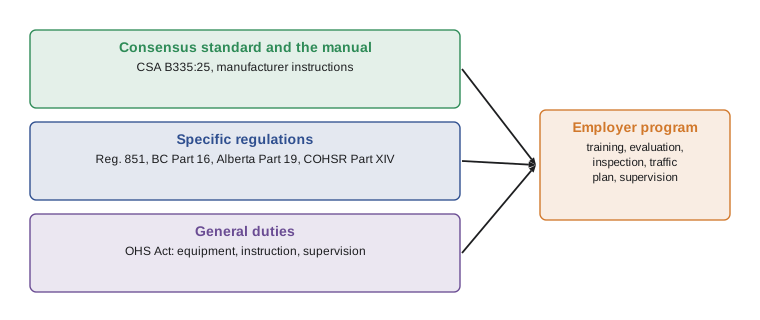
The manufacturer's instructions
Every regulation and standard points back to the manufacturer. The operator's manual sets the inspection points, the rated capacity at given load centres and lift heights, the approved attachments, the charging or fuelling procedure and the maintenance intervals. The data plate on the truck summarizes the capacity information. A truck modified without the manufacturer's approval, for example by adding an attachment or a heavier battery, may no longer match its data plate, and both Canadian and US rules require the rating to be updated when approved modifications change it.
Operator training and evaluation
Whatever the province, an operator is competent when they have the knowledge, training and experience to operate the specific truck safely in the specific workplace, know the hazards and the law that applies, and have shown it in a practical evaluation. A training program that follows CSA B335 clause 6 and the Ontario guideline typically has three parts:
- Formal instruction: classroom or online learning on truck principles, stability, controls, inspection, the site's rules and the law.
- Practical training: hands-on operation of the class of truck the worker will use, under the direct supervision of a qualified trainer, in conditions like those of the workplace.
- Practical evaluation: an assessment of the operator's performance on the truck, in the workplace, by a person with expert knowledge, with written records.
Training must cover the truck-related topics (controls, capacity, stability, inspection, refuelling or charging, the manual's warnings) and the workplace-related topics (surface conditions, loads, pedestrian traffic, narrow aisles, ramps, hazardous locations, ventilation and the site's own rules). An operator trained on a counterbalanced truck is not automatically competent on a reach truck or an order picker, and the evaluation should name the class assessed.
Refresher training and re-evaluation are required whenever an operator is seen operating unsafely, is involved in an incident or near miss, is assigned to a different type of truck, or when workplace conditions change. CSA B335 and most provincial guidance also expect periodic re-evaluation; many employers re-evaluate every three years so that every operator is checked regularly, matching the US practice.
Records matter. The employer should keep, for each operator, the training content, the dates of instruction and evaluation, the class of truck, the name and qualifications of the trainer and evaluator, and the result. Many employers issue a wallet card or permit, but the card belongs to the employer's program; it is not a licence that travels with the worker to a new job, because a new employer must still confirm competence on its own trucks and site.
Worked problem
Does this operator need refresher training?
Priya was trained and evaluated on a counterbalanced propane truck 20 months ago. This month (a) her site installs new racking with narrower aisles, (b) she is asked to cover shifts on a stand-up reach truck, and (c) a supervisor sees her travelling with the forks raised to shoulder height. What does each event require?
Show solution
- (a) A change in workplace conditions that affects safe operation: refresher training on the new aisles and re-evaluation before she works there.
- (b) A different class of truck: full training and a practical evaluation on the reach truck before she operates it. Her counterbalanced evaluation does not cover it.
- (c) Unsafe operation observed: immediate correction, refresher training and re-evaluation.
- Her next routine re-evaluation, if the site uses a three-year cycle, is not due for 16 months, but each event triggers retraining now.
Answer: All three events require action before the next routine evaluation. Competence is tied to the truck, the workplace and observed behaviour, not to the date on a card.
Duties of supervisors
Supervisors carry much of the practical load in a lift truck program. A supervisor should:
- confirm that each worker assigned to a truck is trained and evaluated for that class of truck, and keep unauthorized people off trucks;
- make sure pre-use inspections are done and defective trucks are taken out of service;
- enforce traffic rules, speed limits and pedestrian separation;
- watch for unsafe practices and arrange refresher training when they see them;
- make sure loads, racking, floors and lighting are fit for the work;
- investigate near misses and damage, not just injuries.
In Ontario, a supervisor must be competent within the meaning of the OHSA: qualified by knowledge, training and experience to organize the work, familiar with the Act and regulations that apply, and aware of the hazards. A supervisor who never operated a lift truck can still supervise lift truck work, but must understand the hazards well enough to recognize unsafe operation.
Worked problem
Checking an operator file
An inspector asks to see the file for Marcus, a lift truck operator. The file contains a wallet card from a training company dated four years ago, showing 'Class 4 and 5', and nothing else. What is missing?
Show solution
- Evidence that the current employer confirmed his competence on its own trucks and site: a site-specific practical evaluation with date, assessor and truck class.
- Training on the site's workplace hazards and rules, such as traffic routes, docks and charging procedures.
- Evidence of periodic re-evaluation; four years without an evaluation falls outside the three-year cycle most programs use.
- Records of any refresher training after incidents or changes.
Answer: The file shows only an old external card. The employer cannot show that Marcus is competent on its trucks in its workplace or that he has been re-evaluated recently.
Enforcement and consequences
Inspectors can issue orders to stop using a truck, to train operators or to fix conditions, and prosecutions under provincial OHS acts can bring large fines for corporations and fines or jail for individuals. Lift truck deaths have also led to charges of criminal negligence under section 217.1 of the Criminal Code, which places a legal duty on anyone who directs work to take reasonable steps to prevent bodily harm.
Contractors, temporary workers and multi-employer sites
Lift truck work often involves people the site does not directly employ: temporary agency workers, contractors' operators and drivers from carriers. In Ontario, the OHSA places duties on both the agency and the client employer, and the employer that directs the work must still confirm that each operator is competent on its trucks and site. A temporary worker who arrives with a card from the agency still needs site-specific training, an evaluation on the trucks they will use and a clear briefing on the traffic plan. Where a contractor brings its own equipment, such as a telehandler on a construction project, the constructor or owner should confirm that the machine has been inspected and that the operator is trained before work starts.
A simple rule covers all of these cases: nobody operates a truck on site until the site has seen evidence of training, completed its own evaluation or verified one that covers the same truck and conditions, and briefed the operator on local rules.
Common mistakes
MistakeTreating a wallet card from another employer as a licence.
InsteadEvaluate every operator on your own trucks and in your own workplace before authorizing them.
MistakeAssuming a trained operator can drive any class of truck.
InsteadTrain and evaluate for each class or type of truck the operator will use.
MistakeWaiting for the routine re-evaluation date after an incident.
InsteadUnsafe operation, incidents, new truck types and workplace changes trigger retraining immediately.
MistakeSkipping the annual load-handling examination because the truck is rarely used.
InsteadRegulation 851 requires the examination at least once a year regardless of hours.
MistakeAdding attachments without updating the capacity plate.
InsteadGet the manufacturer's approval and a revised rating before using a modified truck.
Summary and key terms
- General duties in the OHSA require good equipment, instruction, supervision and every reasonable precaution.
- Ontario Regulation 851 section 51 requires load-handling examinations at least annually, rated load marking and competent operators.
- CSA B335:25 replaced B335-15 in April 2025; BC adopts B335 by reference and requires training to its clause 6.
- Training combines formal instruction, practical training and a practical evaluation in the workplace.
- Unsafe operation, incidents, a new truck type or a workplace change trigger refresher training.
- Competence is specific to the truck and workplace; the employer must confirm it and keep records.
- Competent person
- A person qualified by knowledge, training and experience, familiar with the law and aware of the hazards (OHSA).
- CSA B335
- The Canadian safety standard for lift trucks; the current edition is CSA B335:25.
- ANSI/ITSDF B56.1
- The US consensus safety standard for low lift and high lift trucks.
- Practical evaluation
- An assessment of an operator's skill on the truck in the workplace by a qualified person.
- Refresher training
- Additional training after unsafe operation, an incident, a new truck type or a workplace change.
- Data plate
- The manufacturer's plate on the truck showing rated capacity at specified load centres and lift heights.
- General duty
- The broad legal obligation on an employer to protect workers from hazards.
Practice problems
Work each problem on paper first, then reveal the answer to check.
Which section of Regulation 851 requires a lift truck to be operated only by a competent person?
Show answer
Clause 51(2)(a).
What are the three parts of operator training?
Show answer
Formal instruction, practical training and a practical evaluation in the workplace.
List four events that trigger refresher training.
Show answer
Observed unsafe operation, an incident or near miss, assignment to a different truck type, a change in workplace conditions (and a poor evaluation).
How often must a lift truck be examined for load-handling capability in Ontario?
Show answer
Before first use and at least once a year, more often if the manufacturer or conditions require.
What is the current edition of CSA B335?
Show answer
CSA B335:25, published April 2025, replacing B335-15.
Why is a wallet card from a previous employer not enough?
Show answer
Competence is specific to the truck and workplace; the new employer must train and evaluate on its own trucks and site.
What should an operator record include?
Show answer
Operator name, training content, dates of training and evaluation, truck class, trainer and evaluator, and result.
Why does the manufacturer's manual matter legally?
Show answer
Regulations and standards require trucks to be used, inspected and maintained according to the manufacturer's instructions and rating.
Give three duties of a supervisor in a lift truck program.
Show answer
Confirm operator authorization, ensure inspections, enforce traffic rules, correct unsafe practices, check loads and floors, investigate near misses.
What must happen before an attachment that changes capacity is used?
Show answer
The manufacturer must approve the modification and the capacity plate must be updated.
Lesson quiz · 5 questions
Score 60% or more to complete this lesson.
Create a free account to save your progress, take quizzes and earn a certificate.