
HSE-218 · Lesson 2 of 12 · 27 min
Law, standards and training requirements
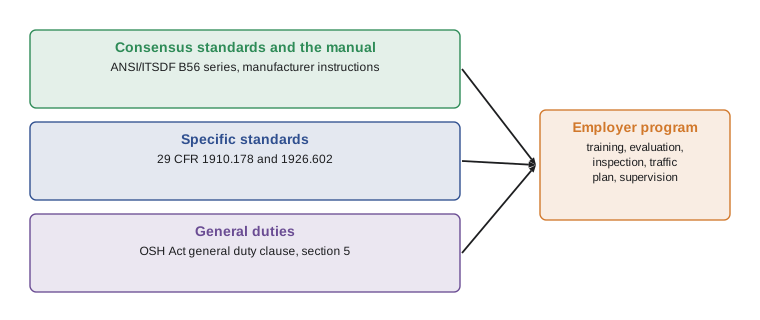
Forklift safety in the United States rests on three layers: the general duty clause of the Occupational Safety and Health Act, OSHA's specific standard for powered industrial trucks at 29 CFR 1910.178, and the ANSI/ITSDF B56 series of consensus standards for truck design and use. This lesson explains how those layers fit together, what they require of employers, supervisors and operators, and what operator training and evaluation must include. Facts are current to October 2026; regulations change, so check the current version before relying on a specific requirement. State-plan states may have their own rules that are at least as effective as OSHA's.
General duties
Section 5(a)(1) of the OSH Act, the general duty clause, requires every employer to furnish a workplace free from recognized hazards that are causing or likely to cause death or serious physical harm. Section 5(a)(2) requires employers to comply with OSHA standards, and section 5(b) requires employees to comply with standards and rules that apply to their own conduct. OSHA can use the general duty clause for recognized hazards that no specific standard covers, such as some aspects of pedestrian traffic management that 1910.178 does not address.
Specific regulations
OSHA's powered industrial truck standard is 29 CFR 1910.178 for general industry. Construction uses 29 CFR 1926.602(c) for lifting and hauling equipment, and 1926.602(d) requires construction operators to be trained under the general industry training rules in 1910.178(l). Maritime employers have their own rules in Parts 1915, 1917 and 1918. The table below summarizes the main paragraphs of 1910.178.
| Paragraph of 1910.178 | Subject |
|---|---|
| (a) | General requirements, including design to ANSI B56.1-1969 for trucks bought after the standard took effect, labeling, and no modifications affecting capacity without the manufacturer's written approval ((a)(4)) |
| (b) to (f) | Designations of truck types for use in hazardous (classified) locations |
| (g) | Changing and charging storage batteries |
| (h) and (i) | Lighting for operating areas and control of noxious gases and fumes |
| (j) and (k) | Dockboards, and trucks, trailers and railroad cars: brakes set and wheel chocks on highway trucks ((k)(1)), wheel stops on railroad cars ((k)(2)), fixed jacks for uncoupled semitrailers ((k)(3)) |
| (l) | Operator training: competence, training content, refresher training and evaluation at least every three years, certification |
| (m) | Truck operations: no one under elevated parts ((m)(2)), no unauthorized riders ((m)(3)), unattended trucks ((m)(5)) |
| (n) | Traveling: following distance of about three truck lengths ((n)(1)), slow down and sound the horn at cross aisles ((n)(4)), grades over 10 percent with the load upgrade ((n)(7)(i)), speed that permits a safe stop ((n)(8)) |
| (o) and (p) | Loading: only stable loads within rated capacity; operation of the truck |
| (q) | Maintenance: trucks examined before being placed in service, at least daily ((q)(7)); unsafe trucks removed from service |
Two practical points follow. First, 1910.178 is old: most of it dates from 1971 and refers to the 1969 edition of ANSI B56.1. In February 2022 OSHA proposed updating the design and construction requirements to incorporate current ANSI/ITSDF B56 standards; at the time of writing we found no final rule, so check the Federal Register for the current status. Second, OSHA's general enforcement policy treats compliance with a newer consensus standard that gives equal or greater protection as a de minimis condition rather than a violation, so trucks built to later B56 editions are generally acceptable.
Consensus standards
The ANSI/ITSDF B56 series, published by the Industrial Truck Standards Development Foundation, covers the design, operation and maintenance of industrial trucks. B56.1 covers low lift and high lift trucks, B56.6 covers rough terrain forklift trucks, B56.5 covers driverless and guided industrial vehicles, and other parts cover personnel and burden carriers and manually propelled trucks. Each standard has a user section that sets out operator and owner responsibilities: inspection, maintenance, operator qualifications and safe operating practices. Where OSHA has not adopted the current edition, these standards are still evidence of what a reasonable employer should do.
The manufacturer's instructions
Every regulation and standard points back to the manufacturer. The operator's manual sets the inspection points, the rated capacity at given load centers and lift heights, the approved attachments, the charging or fueling procedure and the maintenance intervals. The data plate on the truck summarizes the capacity information. A truck modified without the manufacturer's approval, for example by adding an attachment or a heavier battery, may no longer match its data plate, and both Canadian and US rules require the rating to be updated when approved modifications change it.
Operator training and evaluation
Under 1910.178(l)(1)(i), the employer must ensure that each operator is competent to operate a powered industrial truck safely, as demonstrated by successful completion of training and evaluation. Paragraph (l)(2) requires training to consist of a combination of three parts:
- Formal instruction: lecture, discussion, interactive computer learning, video or written material.
- Practical training: demonstrations by the trainer and practical exercises performed by the trainee, under the direct supervision of a person with the knowledge, training and experience to train operators.
- Evaluation: an evaluation of the operator's performance in the workplace.
Paragraph (l)(3) lists the training topics. Truck-related topics include operating instructions and warnings, differences from an automobile, controls and instruments, engine or motor operation, steering, visibility, fork and attachment adaptation and limits, capacity, stability, inspection and maintenance the operator must do, refueling and battery charging, and operating limits. Workplace-related topics include surface conditions, load composition and stability, load handling and stacking, pedestrian traffic, narrow aisles and restricted places, hazardous locations, ramps and sloped surfaces, closed environments where exhaust could build up, and other unique conditions. Training must also cover the requirements of the standard itself.
Under (l)(4)(ii), refresher training is required when the operator has been observed operating unsafely, has been involved in an accident or near miss, has received an evaluation showing unsafe operation, is assigned to a different type of truck, or when a condition in the workplace changes in a way that could affect safe operation. Under (l)(4)(iii), each operator's performance must be evaluated at least once every three years. Under (l)(5), an operator who has already been trained on a topic need not repeat it if the employer has evaluated them as competent.
Under (l)(6), the employer must certify that each operator has been trained and evaluated. The certification must include the operator's name, the date of training, the date of evaluation and the identity of the person performing the training or evaluation. A wallet card from a previous employer or a training company is not a portable license: a new employer must still confirm the operator's competence on its own trucks and in its own workplace.
Worked problem
Does this operator need refresher training?
Priya was trained and evaluated on a counterbalanced propane forklift 20 months ago. This month (a) her site installs new racking with narrower aisles, (b) she is asked to cover shifts on a stand-up reach truck, and (c) a supervisor sees her traveling with the forks raised to shoulder height. What does each event require?
Show solution
- (a) A workplace change that could affect safe operation: refresher training on the new aisles under (l)(4)(ii)(E).
- (b) Assignment to a different type of truck: training and evaluation on the reach truck under (l)(4)(ii)(D) before she operates it.
- (c) Observed unsafe operation: refresher training under (l)(4)(ii)(A), plus immediate correction.
- Her three-year evaluation under (l)(4)(iii) is not due for 16 months, but each event triggers retraining now.
Answer: All three events require action before the next routine evaluation. Competence is tied to the truck, the workplace and observed behavior, not to the date on a card.
Duties of supervisors
Supervisors carry much of the practical load in a lift truck program. A supervisor should:
- confirm that each worker assigned to a truck is trained and evaluated for that class of truck, and keep unauthorized people off trucks;
- make sure pre-use inspections are done and defective trucks are taken out of service;
- enforce traffic rules, speed limits and pedestrian separation;
- watch for unsafe practices and arrange refresher training when they see them;
- make sure loads, racking, floors and lighting are fit for the work;
- investigate near misses and damage, not just injuries.
OSHA does not define supervisor duties for forklifts separately, but citations for training and operations violations fall on the employer, and the employer acts through its supervisors. A supervisor who sees unsafe operation and does nothing creates a willful or repeat exposure for the company and a real risk for the workers.
Worked problem
Checking an operator file
An OSHA compliance officer asks to see the file for Marcus, a forklift operator. The file contains a wallet card from a training company dated four years ago, showing 'Class IV and V', and nothing else. What is missing?
Show solution
- A certification by the current employer that names Marcus, gives the dates of training and evaluation and identifies the trainer and evaluator, as (l)(6) requires.
- Evidence of site-specific training on workplace-related topics under (l)(3)(ii).
- An evaluation within the last three years, as (l)(4)(iii) requires; four years is overdue.
- Records of any refresher training after incidents or changes.
Answer: The file shows only an old external card. The employer cannot show that Marcus is competent on its trucks in its workplace or that he has been re-evaluated recently.
Enforcement and consequences
OSHA can issue citations with penalties that are adjusted each year for inflation. The powered industrial truck standard, 1910.178, regularly appears in OSHA's annual list of the ten most frequently cited standards. Willful violations that cause a death can be referred for criminal prosecution under section 17(e) of the OSH Act.
Contractors, temporary workers and multi-employer sites
Forklift work often involves people the site does not directly employ: temporary staffing agency workers, contractors' operators and drivers from carriers. OSHA treats the staffing agency and the host employer as joint employers for temporary workers; the host usually controls the workplace and must provide the site-specific training and evaluation that 1910.178(l) requires. Under OSHA's multi-employer citation policy, a controlling employer on a construction site can be cited for hazards it could reasonably have prevented, such as an untrained subcontractor operating a telehandler. Before work starts, confirm the machine has been inspected and the operator is trained and evaluated.
A simple rule covers all of these cases: nobody operates a truck on site until the site has seen evidence of training, completed its own evaluation or verified one that covers the same truck and conditions, and briefed the operator on local rules.
Common mistakes
MistakeTreating a wallet card from another employer as a license.
InsteadEvaluate every operator on your own trucks and in your own workplace before authorizing them.
MistakeAssuming a trained operator can drive any class of truck.
InsteadTrain and evaluate for each class or type of truck the operator will use.
MistakeWaiting for the routine re-evaluation date after an incident.
InsteadUnsafe operation, incidents, new truck types and workplace changes trigger retraining immediately.
MistakeRelying on 1971 design rules without checking the manufacturer and current B56 standards.
InsteadUse the manufacturer's instructions and current B56 user requirements as the benchmark of good practice.
MistakeAdding attachments without updating the capacity plate.
InsteadGet the manufacturer's approval and a revised rating before using a modified truck.
Summary and key terms
- The general duty clause covers recognized hazards that no specific standard addresses.
- 29 CFR 1910.178 covers design, batteries, docks, training, operations, travel, loading and maintenance.
- The ANSI/ITSDF B56 standards are the current consensus benchmark; OSHA proposed updating its design rules in 2022.
- Training combines formal instruction, practical training and a practical evaluation in the workplace.
- Unsafe operation, incidents, a new truck type or a workplace change trigger refresher training.
- Competence is specific to the truck and workplace; the employer must confirm it and keep records.
- Competent person
- A person with the knowledge, training and experience to perform a task safely; for forklifts, the operator competence required by 1910.178(l).
- CSA B335
- The Canadian safety standard for lift trucks; the current edition is CSA B335:25.
- ANSI/ITSDF B56.1
- The US consensus safety standard for low lift and high lift trucks.
- Practical evaluation
- An assessment of an operator's skill on the truck in the workplace by a qualified person.
- Refresher training
- Additional training after unsafe operation, an incident, a new truck type or a workplace change.
- Data plate
- The manufacturer's plate on the truck showing rated capacity at specified load centers and lift heights.
- General duty
- The broad legal obligation on an employer to protect workers from hazards.
Practice problems
Work each problem on paper first, then reveal the answer to check.
Which paragraph of 1910.178 requires operator competence?
Show answer
1910.178(l)(1)(i).
What are the three parts of operator training?
Show answer
Formal instruction, practical training and a practical evaluation in the workplace.
List four events that trigger refresher training.
Show answer
Observed unsafe operation, an incident or near miss, assignment to a different truck type, a change in workplace conditions (and a poor evaluation).
How often must a forklift be examined before use?
Show answer
Before being placed in service, at least daily, and after each shift if used around the clock.
What does ANSI/ITSDF B56.1 cover?
Show answer
Design, operation and maintenance of low lift and high lift trucks.
Why is a wallet card from a previous employer not enough?
Show answer
Competence is specific to the truck and workplace; the new employer must train and evaluate on its own trucks and site.
What should an operator record include?
Show answer
Operator name, training content, dates of training and evaluation, truck class, trainer and evaluator, and result.
Why does the manufacturer's manual matter legally?
Show answer
Regulations and standards require trucks to be used, inspected and maintained according to the manufacturer's instructions and rating.
Give three duties of a supervisor in a lift truck program.
Show answer
Confirm operator authorization, ensure inspections, enforce traffic rules, correct unsafe practices, check loads and floors, investigate near misses.
What must happen before an attachment that changes capacity is used?
Show answer
The manufacturer must approve the modification and the capacity plate must be updated.
Lesson quiz · 5 questions
Score 60% or more to complete this lesson.
Create a free account to save your progress, take quizzes and earn a certificate.