
HSE-218 · Lesson 11 of 12 · 31 min
Supervising operators and investigating incidents
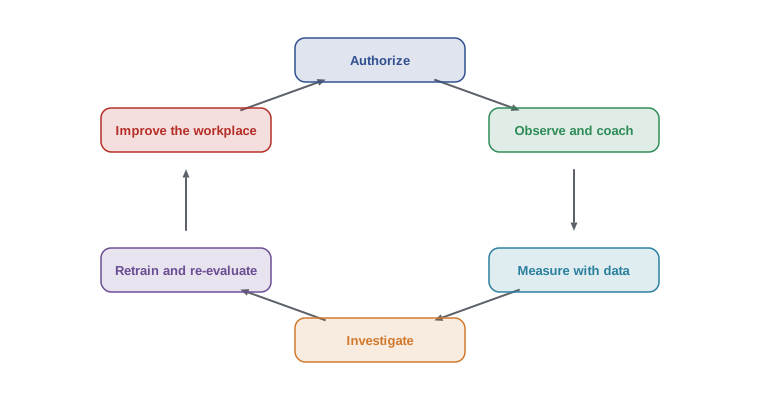
Training and evaluation make an operator competent on the day of the evaluation. Supervision keeps them that way. This lesson covers how to authorize operators, how a practical evaluation works, how to observe and coach operators on the job, what telematics and data can and cannot do, and how to investigate lift truck incidents so that the real causes are found and fixed.
Authorizing operators
An authorization system ensures that only people who have been trained and evaluated for a specific type of truck can operate it. A typical system includes:
- a written list of authorized operators for each truck type, kept current and visible to supervisors;
- a permit, card or electronic credential showing the classes and attachments each operator is authorized for;
- key control or access control on the trucks, so that unauthorized people cannot start them;
- a process to suspend authorization after unsafe operation or an incident until retraining is complete;
- a schedule for periodic re-evaluation.
Modern trucks and add-on telematics units can require an operator to log in with a card or code, complete a pre-use checklist and acknowledge any defects before the truck will start. These systems make authorization enforceable and produce useful data, but they depend on accurate records and on supervisors acting on what the data show.
Fitness for duty
Operating a lift truck safely requires adequate vision, hearing, alertness and physical ability for the controls and the work. Employers may set requirements linked to these essential tasks, but must also respect human rights law: decisions about a worker's fitness must be based on an individual assessment of their actual abilities, with accommodation to the point of undue hardship. On alcohol and drugs, Canadian law allows testing in safety-sensitive work in defined circumstances, such as after an incident or with reasonable cause, but the Supreme Court of Canada's 2013 decision in Irving Pulp & Paper limited random testing in unionized workplaces to situations with evidence of a general problem. Whatever the testing policy, a supervisor who believes an operator is impaired, by any cause including fatigue, must remove them from the truck.
The practical evaluation
A practical evaluation tests whether the operator can actually do the work safely. It is done on the class of truck the operator will use, preferably in the workplace or in a setting that reproduces its conditions, by an evaluator who knows the truck and the work. A structured checklist makes evaluations consistent and defensible.
| Stage | What the evaluator watches for |
|---|---|
| Pre-use inspection | Completes every item, identifies seeded defects, knows what takes the truck out of service |
| Mounting and start-up | Three points of contact, seatbelt, adjusts seat and mirrors, checks path |
| Travel | Speed control, looking in the direction of travel, horn at intersections, following distance, load low and tilted back |
| Load handling | Squares up, sets fork spread, enters fully, lifts and tilts correctly, checks behind before reversing |
| Stacking and racking | Raises only when stopped, mast vertical when placing, avoids rack contact |
| Ramps and docks | Load uphill on ramps, checks trailer restraint and floor before entering |
| Pedestrians | Stops for people, makes eye contact, avoids pedestrian areas |
| Parking and shutdown | Forks lowered, controls neutral, brake set, power off, key removed |
| Refuelling or charging | Follows the procedure for the truck's power source |
Most checklists separate critical items, which cause the evaluation to be failed if done wrong, from minor items, which can be coached. An operator who fails is not authorized until they have been retrained and evaluated again. The evaluation record should show the date, the truck class and attachment, the evaluator's name and qualifications, the score and the decision.
Worked problem
Scoring an evaluation
An evaluation checklist has 40 items, 8 of them critical. A candidate completes 37 items correctly but forgets to fasten the seatbelt before moving, and twice travels with the forks raised well above travel height while reversing from a rack. The site passes candidates who score at least 90 per cent with no critical failures. What is the result?
Show solution
- Score: \( 37 / 40 = 92.5 \) per cent, above the 90 per cent threshold.
- Seatbelt use is a critical item; not fastening it is a critical failure.
- Travelling with a raised load is also normally a critical item.
- Any critical failure means the evaluation is failed regardless of the score.
Answer: Fail. The candidate needs coaching and retraining on restraints and travel height, then a new evaluation. A high overall score does not offset a critical error.
Observing and coaching on the job
Behaviour drifts after training. Shortcuts that save a few seconds become habits, especially under production pressure. Regular, brief observations by supervisors catch this drift early. A good observation program:
- sets a target, such as observing each operator at least once a month;
- uses a short checklist of the behaviours that matter most: speed, seatbelt use, load height, horn use, pedestrian interaction, parking;
- gives immediate, specific feedback, recognizing safe behaviour as well as correcting unsafe behaviour;
- looks for the reasons behind unsafe behaviour, such as unrealistic pick rates, poor layout or broken equipment;
- records observations so trends can be seen.
Production pressure is often the hidden cause of unsafe operation. If operators can only meet their targets by speeding or skipping inspections, the targets are part of the hazard. Supervisors should raise this with management rather than simply disciplining operators.
Telematics and data
Telematics systems record who used each truck, for how long, at what speeds, and whether impacts occurred. Impact sensors can lock out a truck after a heavy hit until a supervisor resets it, which forces every impact to be reported. Speed data can show whether limits are respected in different zones. Pre-use checklist records show whether inspections are done. These data are powerful leading indicators, but they need clear rules on use, privacy and discipline, and they work best when operators understand that the aim is to fix problems, not to catch people.
Worked problem
Using impact data
Impact sensors on a fleet of 20 trucks record 95 impacts above the threshold in a month. Sixty occur on the night shift, which has 6 of the 20 operators, and 40 of those happen in one aisle where new racking was installed. What do these data suggest?
Show solution
- Night shift share: \( 60 / 95 = 63 \) per cent of impacts from 30 per cent of operators.
- Within that, 40 impacts in one aisle point to a location problem, not just operator skill.
- Possible causes: the new racking narrowed the aisle, lighting at night is poor in that area, or night operators were not retrained after the change.
- Action: inspect the aisle and racking, check lighting, retrain night operators on the new layout (a workplace change that triggers refresher training), and watch the data next month.
Answer: The pattern points first to the new aisle and the night-shift conditions. Data help direct attention to the right place before someone is hurt.
Measuring performance
Injury rates allow comparison over time and with other sites. In Canada, provincial boards report injury frequency per 100 workers, and many companies calculate a lost-time injury frequency per 200,000 hours, the same base used in the United States. Leading indicators, such as observations completed, near misses reported, impacts per 1,000 operating hours and inspection completion rates, show whether controls are working before injuries occur.
Worked problem
Calculating an incident rate
A warehouse recorded 3 lift truck-related injuries needing medical treatment beyond first aid in a year, with 410,000 hours worked by all employees. Calculate the rate per 200,000 hours.
Show solution
- \( \text{rate} = \tfrac{3 \times 200\,000}{410\,000} \).
- \( = \tfrac{600\,000}{410\,000} = 1.46 \).
- This means about 1.5 lift truck injuries for every 100 full-time workers in a year.
Answer: About 1.46 per 200,000 hours. Compare it with the site's own trend and with leading indicators, because small numbers swing widely from year to year.
Investigating incidents
Every lift truck incident, including near misses and property damage, is a chance to learn. The aim of an investigation is to find out what happened and why, and to prevent it happening again, not to assign blame. A structured approach helps:
- Make the scene safe, care for anyone injured and call emergency services if needed.
- Preserve the scene and the truck: do not move the truck, reset its controls or download and clear its data until the investigators are ready, unless needed to rescue someone or prevent further harm.
- Gather facts: photographs, measurements, the truck's condition and settings, telematics and camera records, inspection and maintenance records, training and evaluation records, schedules and workload.
- Interview the operator, witnesses and others promptly and separately, with open questions.
- Analyze causes, looking past the immediate act to the conditions behind it: layout, equipment, procedures, training, supervision, production pressure.
- Recommend controls that follow the hierarchy, assign owners and dates, and follow up to confirm they work.
Reporting duties apply. In Ontario, section 51 of the OHSA requires the employer to notify a ministry inspector, the joint health and safety committee or representative and the union immediately when a worker is killed or critically injured, to send a written report within 48 hours, and not to disturb the scene except to save life, relieve suffering or prevent further harm until an inspector permits. Section 52 requires written notice within four days of other injuries that disable a worker or require medical attention. Other provinces have similar rules, and workers' compensation claims have their own deadlines.
Worked problem
Finding root causes
An operator struck a rack upright while reversing, bringing down a pallet that narrowly missed a picker. The first report says 'operator error, operator disciplined.' Use the five whys to look deeper.
Show solution
- Why did the truck hit the upright? The operator was reversing faster than usual and misjudged the turn.
- Why faster than usual? The operator was behind on a rush order with a fixed departure time.
- Why was a picker nearby? Picking and replenishment were scheduled in the same aisle at the same time.
- Why was the upright vulnerable? The rack end had no column guard, and earlier damage had not been reported.
- Why was earlier damage unreported? Operators feared discipline, so damage reports had stopped.
Answer: Root causes include production pressure, scheduling that mixed pickers and trucks, missing rack protection and a reporting culture that punishes honesty. Disciplining one operator fixes none of these.
Discipline and a just culture
Supervisors must enforce rules, and serious or repeated violations, such as removing a seatbelt interlock or lifting a person on the forks, warrant firm consequences. But discipline used as the main response to incidents drives reporting underground: if every rack strike leads to a suspension, operators stop reporting rack strikes, and the site loses its best early warning. A just culture distinguishes honest mistakes, which are met with coaching and system fixes, from at-risk shortcuts, which are met with coaching and removal of the pressures behind them, and from reckless disregard, which is met with discipline.
In Ontario, workers have the right to refuse unsafe work under section 43 of the OHSA, and section 50 prohibits reprisals against workers who act in compliance with the Act or seek its enforcement. An operator who refuses to drive a truck with failed brakes is exercising a legal right, and a supervisor who punishes that refusal breaks the law. Other provinces have equivalent protections.
Common mistakes
MistakeTreating a passed evaluation as permanent proof of competence.
InsteadObserve operators regularly and re-evaluate after changes, incidents and on a set cycle.
MistakePassing a candidate with a high score despite a critical error.
InsteadAny critical failure means the evaluation is failed.
MistakeUsing telematics only to discipline operators.
InsteadUse data to find locations, conditions and practices that need fixing.
MistakeMoving the truck and clearing its data right after an incident.
InsteadPreserve the scene and the truck except to rescue people or prevent further harm.
MistakeClosing an investigation with operator error.
InsteadLook for the conditions behind the act: layout, scheduling, equipment, pressure and supervision.
Summary and key terms
- Authorization systems and access control ensure only trained, evaluated operators use each truck type.
- Fitness for duty decisions must be individual and respect human rights law; impaired operators must be removed.
- Practical evaluations use structured checklists with critical items that cause automatic failure.
- Regular observation and coaching catch behavioural drift; production pressure is often the hidden cause.
- Telematics and impact data are powerful leading indicators when used to fix problems.
- Investigations preserve evidence, look for root causes and meet legal reporting deadlines.
- Authorization
- Formal permission for a trained and evaluated worker to operate a specific type of truck.
- Critical item
- An evaluation item whose failure causes the evaluation to be failed regardless of score.
- Telematics
- Systems that record and transmit truck usage, speed, impacts and checklist data.
- Impact sensor
- A device that detects collisions above a set force and can lock out the truck.
- Incident rate
- The number of cases multiplied by 200,000 and divided by hours worked.
- Root cause
- An underlying condition that, if corrected, prevents recurrence.
- Five whys
- A technique of asking why repeatedly to move from an immediate cause to root causes.
Practice problems
Work each problem on paper first, then reveal the answer to check.
Name three elements of an operator authorization system.
Show answer
Authorized operator list, permits or credentials, key or access control, suspension process and re-evaluation schedule.
What makes a fitness-for-duty decision lawful?
Show answer
An individual assessment of actual abilities with accommodation to the point of undue hardship.
What happens if a candidate makes a critical error but scores 95 per cent?
Show answer
They fail the evaluation.
Why observe operators after they have been evaluated?
Show answer
Behaviour drifts and shortcuts develop over time.
What can impact sensors do?
Show answer
Detect heavy impacts and lock out the truck until a supervisor resets it.
Calculate the rate for 2 cases and 250,000 hours.
Show answer
2 × 200,000 / 250,000 = 1.6.
What should happen to the truck after a serious incident?
Show answer
Leave it and its data undisturbed until investigators are ready, except to rescue or prevent harm.
When must an Ontario employer notify an inspector of a critical injury?
Show answer
Immediately, with a written report within 48 hours.
Why is operator error a poor final finding?
Show answer
It ignores the conditions, pressures and system failures that led to the act.
Give two leading indicators for a lift truck program.
Show answer
Observations completed, near misses reported, impacts per 1,000 hours, inspection completion rate.
Lesson quiz · 5 questions
Score 60% or more to complete this lesson.
Create a free account to save your progress, take quizzes and earn a certificate.