
HSE-218 · Lesson 8 of 12 · 27 min
Fuel, batteries and charging
Every lift truck carries a large store of energy: a cylinder of liquefied gas, a tank of fuel, a battery weighing as much as a small car, or a tank of compressed hydrogen. That energy brings hazards that have nothing to do with driving: carbon monoxide poisoning, fires and explosions, acid burns, crush injuries during battery changes and thermal runaway in lithium-ion packs. This lesson covers each power source, the exposure limits for exhaust gases, and how to set up and run refuelling and charging areas safely.
Propane
Propane (liquefied petroleum gas, LPG) is the most common fuel for indoor engine trucks in North America. It is stored as a liquid under pressure in a cylinder mounted on the truck, typically holding about 15 to 20 kg of fuel, and changed when empty. Its hazards include:
- Fire and explosion. Propane vapour is heavier than air and can collect in low areas, pits and drains. It is flammable between about 2 and 10 per cent in air.
- Cold burns. Liquid propane boils at about minus 42 °C and causes frostbite on contact with skin.
- Carbon monoxide from the engine exhaust.
- Strains and crush injuries from lifting and mounting heavy cylinders.
Changing a cylinder safely means doing it outdoors or in a well-ventilated area away from ignition sources, with the engine off, the cylinder valve closed and the engine run until the fuel in the line is used up. The worker wears gloves and eye protection, checks the new cylinder for damage, makes sure the locating pin engages so the relief valve points upward, connects the coupling, opens the valve slowly and checks for leaks with a leak detector solution, never a flame. Cylinders must be stored in a secure, ventilated cage outdoors or in an approved storage area, away from exits and stairways.
In Canada, propane storage and handling follow CSA B149.2, the Propane storage and handling code, as adopted by each province. In Ontario, propane is regulated by O. Reg. 211/01 under the Technical Standards and Safety Act and administered by the Technical Standards and Safety Authority, which sets training requirements for people who handle propane. Check the current requirements for workers who exchange lift truck cylinders at your site. HSE-353 covers cylinder exchange and refilling in more depth.
Carbon monoxide
Every engine that burns propane, gasoline, diesel or natural gas produces carbon monoxide (CO), a colourless, odourless gas that binds to haemoglobin in the blood and starves the body of oxygen. Early symptoms are headache, dizziness, nausea and fatigue, easily mistaken for flu. Higher exposures cause confusion, collapse and death. A poorly tuned propane truck can produce far more CO than a well-maintained one, and trucks working in trailers, freezers, small rooms or buildings closed up for winter are where poisonings occur.
| Limit | Carbon monoxide value |
|---|---|
| Ontario, Regulation 833 (based on ACGIH) | 25 ppm 8-hour TWA; 75 ppm 30-minute excursion limit; 125 ppm ceiling excursion limit |
| ACGIH TLV | 25 ppm 8-hour TWA |
| OSHA PEL (29 CFR 1910.1000, Table Z-1) | 50 ppm 8-hour TWA |
| NIOSH REL | 35 ppm 10-hour TWA; 200 ppm ceiling |
Worked problem
Calculating an 8-hour TWA
A worker loading trailers with a propane truck has CO measured by a personal monitor: 2 hours at 60 ppm inside trailers, 4 hours at 20 ppm on the dock, and 2 hours at 5 ppm in the office. Calculate the 8-hour time-weighted average and compare it with the limits.
Show solution
- TWA \( = \tfrac{(2 \times 60) + (4 \times 20) + (2 \times 5)}{8} \).
- \( = \tfrac{120 + 80 + 10}{8} = \tfrac{210}{8} = 26.3 \) ppm.
- This exceeds Ontario's 25 ppm TWA. The 60 ppm periods are below the 75 ppm 30-minute excursion limit, but the shift average is still over the limit.
- The trailer work drives the exposure, so controls should target it: an electric truck for trailer loading, better truck maintenance and emissions testing, and ventilation at the dock.
Answer: About 26 ppm, above Ontario's 25 ppm limit. Switch trailer work to electric trucks or reduce the trailer exposure.
Controls for CO follow the hierarchy: use electric trucks indoors where possible; maintain and tune engine trucks and test their emissions regularly, often with a target well below 1 per cent CO in the exhaust; fit catalytic converters; provide general ventilation sized for the number of trucks; limit idling; and use fixed or personal CO monitors with alarms in areas at risk. Workers should know the symptoms and know to get to fresh air and report them.
Diesel and gasoline
Diesel trucks are used mainly outdoors and in large, well-ventilated buildings. Diesel exhaust contains fine particulate matter, nitrogen oxides and carbon monoxide. The International Agency for Research on Cancer classified diesel engine exhaust as carcinogenic to humans in 2012. Modern engines with diesel particulate filters produce far less soot, but older trucks indoors can create serious exposures. Gasoline trucks produce high CO levels and are rarely suitable indoors. Both fuels are flammable liquids: refuel outdoors or at a designated station, with the engine off, no smoking, and spill control materials at hand.
Lead-acid batteries
Most electric trucks still use lead-acid batteries, which serve as part of the truck's counterweight and can weigh from a few hundred to more than two thousand kilograms. Their main hazards are hydrogen gas during charging, sulphuric acid electrolyte, electrical shorts and the weight of the battery itself.
Near the end of a charge, the battery begins to gas: water in the electrolyte splits into hydrogen and oxygen. Hydrogen is flammable from about 4 per cent in air, ignites very easily, and rises, so it can collect at ceilings, in battery compartments and under covers. Charging areas need ventilation sized to keep hydrogen well below the lower flammable limit, no smoking or open flames, and chargers switched off before connecting or disconnecting the battery so the connector does not arc.
Worked problem
Hydrogen from one battery charge (illustrative)
A 48 V lead-acid battery has 24 cells. During the gassing phase at the end of a charge, assume a gassing current of 30 A. Each ampere-hour of gassing current produces about 0.42 L of hydrogen per cell. Estimate the hydrogen produced per hour and the fresh-air flow needed to keep it below 1 per cent, a common design target of one quarter of the lower flammable limit.
Show solution
- Hydrogen: \( 24 \times 30 \times 0.42 = 302 \) L/h, or about 0.30 m³/h.
- Air needed for 1 per cent: \( \tfrac{0.30}{0.01} = 30 \) m³/h for this one battery.
- A charging area with 10 batteries finishing at the same time would need about 300 m³/h before any safety factor for poor mixing.
- Real designs follow the applicable code and standard (for example IEC 62485-3 for traction batteries) and the battery manufacturer, and add safety factors.
Answer: About 0.3 m³ of hydrogen an hour per battery, needing about 30 m³/h of fresh air to stay below 1 per cent. Natural ventilation in a large building may be enough for a few trucks, but a dedicated charging room needs a calculated design.
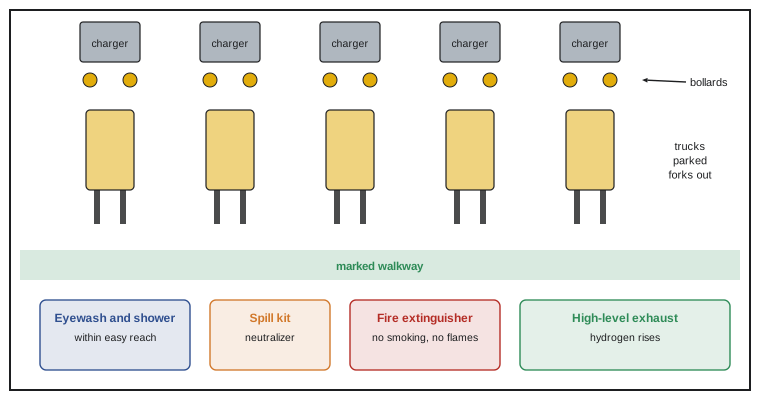
Sulphuric acid electrolyte causes severe burns to skin and eyes. Workers who water batteries or handle electrolyte need a face shield, goggles, acid-resistant gloves and apron, and an eyewash station or emergency shower within easy reach as required by provincial first aid and OHS rules. Acid is always poured into water, never water into acid. Spills are neutralized with an appropriate agent such as sodium bicarbonate and cleaned up following the site's spill procedure. Metal tools and jewellery must be kept away from battery tops, because a short circuit across terminals can cause burns, sparks and explosions.
Battery changing is a heavy lift. Batteries must be removed and installed with the equipment designed for the job, such as a battery changing stand, roller beds, a hoist with an insulated spreader bar, or a battery extractor. The battery must be restrained in the truck after installation, because a battery that shifts in a tip-over can crush the operator, and its weight must match the range on the data plate.
Lithium-ion batteries
Lithium-ion batteries have spread quickly in lift trucks because they charge faster, need no watering, do not gas in normal use and allow opportunity charging during breaks. They remove the acid and hydrogen hazards of lead-acid, but bring a different one: thermal runaway. If a cell is damaged, overcharged, short-circuited or overheated, it can heat itself uncontrollably, vent flammable and toxic gases and ignite neighbouring cells. Such fires are hard to extinguish and can reignite hours later.
Lithium-ion packs rely on a battery management system that monitors cell voltage and temperature and cuts off charging or discharging when limits are exceeded. Safe practice includes using only the charger matched to the pack, never opening or modifying a pack, removing a damaged or swollen pack from service, keeping charging areas clear of combustibles, and having an emergency plan that recognizes the hazard. HSE-322 covers battery rooms and lithium-ion hazards in more detail.
| Feature | Lead-acid | Lithium-ion |
|---|---|---|
| Charging gas | Hydrogen near end of charge | None in normal use; flammable gases if a cell fails |
| Electrolyte | Liquid sulphuric acid, needs watering | Sealed; no watering |
| Charging pattern | Full charge plus cool-down, often battery swaps on multi-shift work | Opportunity charging on the truck |
| Main fire hazard | Hydrogen ignition, shorts | Thermal runaway |
| Weight as counterweight | Heavy, part of counterweight | Lighter; trucks may carry added ballast to match rating |
Hydrogen fuel cells
Some large fleets, especially in distribution centres, use hydrogen fuel cell trucks. The truck carries hydrogen compressed to high pressure, typically around 350 bar, and refuels in a few minutes at an indoor or outdoor dispenser. The exhaust is water vapour, but hydrogen itself is flammable, burns with an almost invisible flame and leaks easily through small gaps. Installations follow codes such as the Canadian Hydrogen Installation Code (CAN/BNQ 1784-000), with leak detection, ventilation, emergency shutdown and trained refuelling.
Refuelling and charging areas
Whatever the power source, refuelling and charging areas share some requirements:
- Located away from exits, stairways, ignition sources and heavy pedestrian traffic, and protected from truck impact by bollards or barriers.
- Ventilated to control the gas or vapour involved.
- Marked with no-smoking and no-open-flame signs, and equipped with suitable fire extinguishers.
- Equipped with spill control and, for battery areas, eyewash and drench facilities.
- Used only by trained workers following a written procedure.
- Kept clean and free of combustible storage.
Emergencies involving fuel and batteries
Every site that refuels or charges trucks needs a plan for when something goes wrong. For a propane leak, the response is to shut off the cylinder valve if it can be done safely, remove ignition sources, ventilate, keep people away from low areas where vapour collects and call the fire department for any leak that cannot be stopped. For an acid splash, the response is immediate flushing at the eyewash or shower for at least 15 minutes and medical attention. For a smoking, swelling or hissing lithium-ion pack, people should move away, raise the alarm and call the fire department, telling them that a lithium-ion battery is involved; workers should not try to move a pack that is already venting. Drills should include the people who work in and near the charging and fuelling areas, not only the emergency team.
Common mistakes
MistakeRunning propane trucks inside trailers and freezers all shift without monitoring.
InsteadUse electric trucks for enclosed work or monitor CO and limit exposure.
MistakeChecking for propane leaks with a lighter.
InsteadUse a leak detector solution or approved detector.
MistakeDisconnecting a battery while the charger is still on.
InsteadSwitch off the charger first so the connector does not arc in hydrogen.
MistakePouring water into acid when mixing electrolyte.
InsteadAlways add acid to water, wearing a face shield and acid-resistant protection.
MistakeContinuing to use a swollen or damaged lithium-ion pack.
InsteadRemove it from service and follow the manufacturer's procedure.
Summary and key terms
- Propane brings fire, cold burns, carbon monoxide and cylinder handling hazards; change cylinders outdoors with the valve closed and check for leaks with solution.
- Ontario limits CO to 25 ppm as an 8-hour TWA; the OSHA PEL is 50 ppm and the ACGIH TLV is 25 ppm.
- Lead-acid charging produces hydrogen, flammable from about 4 per cent; ventilate, ban ignition sources and switch off chargers before disconnecting.
- Acid handling needs eye, face and body protection, eyewash and drench facilities, and acid added to water.
- Lithium-ion packs avoid acid and hydrogen but can suffer thermal runaway if damaged or abused.
- Fuel cells use high-pressure hydrogen and need leak detection, ventilation and trained refuelling.
- LPG
- Liquefied petroleum gas, mainly propane, stored as a liquid under pressure.
- Carbon monoxide
- A colourless, odourless toxic gas produced by incomplete combustion.
- TWA
- Time-weighted average exposure over a work shift, usually 8 hours.
- Lower flammable limit
- The lowest concentration of a gas in air that can burn.
- Gassing
- The release of hydrogen and oxygen from a lead-acid battery near the end of charge.
- Thermal runaway
- Uncontrolled self-heating of a battery cell that can lead to fire.
- Battery management system
- Electronics that monitor and protect a lithium-ion battery pack.
- Relief valve
- A valve on a propane cylinder that vents gas if pressure rises too high.
Practice problems
Work each problem on paper first, then reveal the answer to check.
Why must a propane cylinder's locating pin be engaged?
Show answer
It positions the relief valve at the top so it vents vapour rather than liquid.
How should a propane leak be checked?
Show answer
With a leak detector solution or approved detector, never a flame.
What are early symptoms of CO poisoning?
Show answer
Headache, dizziness, nausea and fatigue.
Calculate the TWA for 4 h at 40 ppm and 4 h at 10 ppm.
Show answer
(160 + 40)/8 = 25 ppm.
At what concentration does hydrogen become flammable?
Show answer
About 4 per cent in air.
Why switch off the charger before disconnecting a battery?
Show answer
To avoid an arc at the connector that could ignite hydrogen.
What PPE is needed for watering lead-acid batteries?
Show answer
Face shield, goggles, acid-resistant gloves and apron, with eyewash nearby.
What is thermal runaway?
Show answer
Uncontrolled self-heating of a lithium-ion cell that can cause fire and toxic gases.
Why must a replacement battery match the data plate weight range?
Show answer
The battery is part of the counterweight; a lighter one reduces stability and capacity.
Name four features of a good charging area.
Show answer
Ventilation, no ignition sources, impact protection, eyewash and spill kit, fire extinguisher, trained users, clear of combustibles.
Lesson quiz · 5 questions
Score 60% or more to complete this lesson.
Create a free account to save your progress, take quizzes and earn a certificate.