
HSE-218 · Lesson 12 of 12 · 31 min
Capstone: a warehouse traffic management plan
This capstone brings the course together. You will work through a traffic management and lift truck safety plan for an invented warehouse, Riverbend Distribution, step by step: describing the site, identifying hazards, choosing the fleet and training, laying out routes and crossings, securing the dock, setting up charging and fuelling, and deciding how the plan will be supervised and measured. The site, people and numbers are fictional. The method is the one you would use on a real site.
The site
Riverbend Distribution is a single-storey warehouse of about 12,000 m² that stores and ships packaged food for grocery stores. It operates two shifts, five days a week, with about 60 workers per shift, of whom 18 operate trucks. The building has:
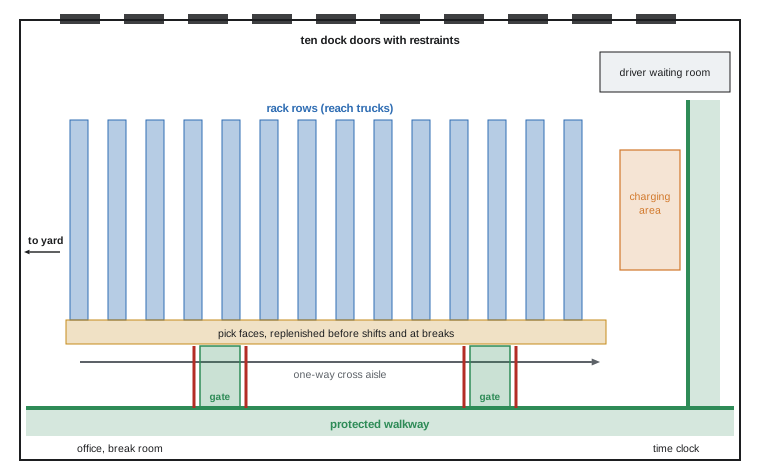
- ten dock doors on the north wall with hydraulic levellers, used for both receiving and shipping;
- selective racking 9 m high in 14 rows, with aisles currently 3.4 m wide;
- a case-picking area at floor level where pickers build mixed pallets from pick faces at the front of the racking;
- an office, washrooms and a break room along the south wall, and a time clock by the main pedestrian entrance in the southeast corner;
- a battery charging area along the east wall;
- an outdoor yard on the west side with a gravel area used to store empty pallets and a propane cylinder cage.
The current fleet is eight sit-down electric counterbalanced trucks, six powered walkie pallet trucks, three order pickers and a propane pneumatic-tire truck used in the yard. Over the last year the site recorded one injury, a picker whose foot was run over by a pallet truck, plus 140 rack repairs and four reported near misses.
Step 1: identify the hazards
Start by walking the site at different times, watching operations, reading the incident and damage records, and talking to operators, pickers and drivers. At Riverbend this turns up the following:
| Area | Hazards found |
|---|---|
| Pick area | Pickers on foot share aisles with counterbalanced trucks replenishing pick faces; pallet trucks and pedestrians in close contact |
| Rack aisles | High rack strike rate; aisle ends blocked by stacked empty pallets; poor lighting at the west end |
| Main cross aisle | Every worker crosses it from the time clock and break room to reach the racks; no marked crossing |
| Dock | Wheel chocks used inconsistently; road drivers stand on the dock while loading; two doors often left open with no trailer |
| Charging area | Chargers unprotected from truck impact; no eyewash within reach; combustible packaging stored nearby |
| Yard | Propane truck enters the building through the dock in winter; cylinder changes done inside the dock door |
| Systems | No traffic plan; operator files contain only cards from a training company; no re-evaluations in four years |
Step 2: match the fleet and training to the work
The fleet should suit the work, and every operator should be trained and evaluated for the trucks they use. Two questions arise at Riverbend: are the aisles right for the trucks, and should the propane truck come indoors at all?
Worked problem
Are the aisles wide enough?
A sit-down counterbalanced truck's manufacturer gives a right-angle stacking aisle width of 3.6 m with a 1.2 m deep pallet, including a 200 mm operating clearance. Riverbend's aisles are 3.4 m. A reach truck with the same pallet needs 2.8 m. What does this mean for the operation?
Show solution
- The counterbalanced trucks need 3.6 m but have 3.4 m, 200 mm less than the manufacturer's figure, which removes the operating clearance entirely.
- Operators are therefore turning in aisles too narrow for the truck, which explains much of the 140 rack repairs.
- Option A: widen the aisles by removing a rack row, losing storage.
- Option B: replace the counterbalanced trucks in the racking with reach trucks, which fit with 600 mm to spare, and keep counterbalanced trucks for the dock.
- Option B also needs reach truck training and evaluation for the operators who will use them.
Answer: The aisles are too narrow for the trucks working them. Moving to reach trucks in the racking addresses the cause of the rack strikes rather than blaming the operators.
For the propane truck, the hierarchy points to substitution: keep it outdoors and use an electric truck to move pallets between the yard and the dock door, or replace it with an electric pneumatic-tire truck rated for outdoor use. Cylinder changes move to the yard, at the cage, away from the building openings.
| Truck type | Number | Operators to train and evaluate |
|---|---|---|
| Reach truck (new) | 6 | 10, covering both shifts |
| Sit-down electric counterbalanced (dock) | 4 | 8 |
| Powered walkie pallet truck | 6 | All pickers who use them, about 24 |
| Order picker | 3 | 6, plus fall protection and rescue training |
| Electric pneumatic-tire yard truck | 1 | 3 |
Step 3: lay out routes and crossings
The biggest single improvement at Riverbend is to separate the pedestrian route from the truck routes. The plan proposes:
- a barrier-protected walkway, at least 1.2 m wide, running from the time clock along the south wall past the office and break room, then north along the east wall to the dock office;
- two gated crossings over the main cross aisle, at the two places where pickers need to reach the pick area, with stop lines for trucks on both sides and mirrors;
- one-way traffic in the main cross aisle and the dock aisle, reducing head-on meetings;
- the empty pallets moved from the aisle ends to the yard, clearing sight triangles;
- improved lighting at the west end of the rack rows;
- the pick area separated in time: replenishment by reach trucks in the hour before each shift and during breaks, with pickers kept out of an aisle when a replenishment truck enters it, controlled by aisle-entry lights.
Worked problem
Setting the speed limit at the gated crossings
At the crossings, operators approaching on the cross aisle can see 4 m along the walkway before the gate. Using a reaction time of 1.0 s and a wet-floor friction coefficient of 0.2 (illustrative), what is the highest speed at which a truck can stop within 4 m?
Show solution
- We need \( v \times 1.0 + \tfrac{v^{2}}{2 \times 0.2 \times 9.81} \le 4 \), that is \( v + 0.255 v^{2} \le 4 \).
- Solving \( 0.255 v^{2} + v - 4 = 0 \) gives \( v = \tfrac{-1 + \sqrt{1 + 4.08}}{0.51} = 2.46 \) m/s.
- 2.46 m/s is about 8.9 km/h.
- Allowing a margin, a limit of about 6 km/h at the crossings, with a full stop at the stop line when the gate is open, is reasonable.
Answer: About 9 km/h is the physical limit, so set the limit lower, around 6 km/h, and require a stop when pedestrians are present.
Step 4: secure the dock
The dock plan replaces inconsistent chocking with a positive system:
- vehicle restraints at all ten doors, interlocked with the levellers and doors, with red and green lights for drivers and operators;
- trailer stands for every uncoupled trailer;
- a driver waiting room with a window onto the dock; drivers may not enter the dock floor;
- paperwork and keys released by the shipper only after the restraint is disengaged;
- dock doors closed when no trailer is present, with barrier arms on the two doors used for staging;
- trailer floor and lighting checks before the first truck enters.
Step 5: charging and fuelling
The charging area is reorganized: bollards in front of the chargers, combustible packaging removed, an eyewash and drench station installed within a short, unobstructed walk, a spill kit and fire extinguisher, ventilation checked against the hydrogen output of the fleet, and a written charging procedure. As the fleet is renewed, the site will evaluate lithium-ion trucks for the reach truck fleet, which would remove watering and reduce gassing but bring thermal runaway into the emergency plan. Propane cylinder changes move to the outdoor cage, done only by trained workers.
Worked problem
Hydrogen ventilation for the charging area (illustrative)
Up to 8 lead-acid batteries, each producing about 0.30 m³ of hydrogen an hour at the end of charge, could be gassing at once. The charging area is open to the warehouse but has a local exhaust fan rated 1,200 m³/h. Is the fan adequate to keep hydrogen in the charging zone below 1 per cent?
Show solution
- Hydrogen: \( 8 \times 0.30 = 2.4 \) m³/h.
- Air needed for 1 per cent: \( 2.4 / 0.01 = 240 \) m³/h.
- The fan's 1,200 m³/h gives a factor of 5 over the minimum, allowing for imperfect mixing.
- Confirm the fan runs whenever chargers run, that its intake is high where hydrogen collects, and that the design meets the applicable code.
Answer: On these illustrative figures the fan is adequate with margin, provided it is interlocked with the chargers and located correctly.
Step 6: people, supervision and measurement
The plan also fixes the systems behind the hazards. Every operator is re-trained and evaluated on each truck type they use, with site-specific modules on the new layout, dock procedure and charging; the files will show truck class, dates, evaluator and result, and re-evaluation will follow a three-year cycle plus the usual triggers. Supervisors will observe each operator at least monthly. Telematics with impact sensors and operator log-in will be fitted to the new reach trucks. The joint health and safety committee will review the plan and take part in quarterly walk-throughs.
| Indicator | Baseline | Target after one year |
|---|---|---|
| Rack repairs | 140 a year | Fewer than 40 a year |
| Near misses reported | 4 a year | More reported at first as trust grows, then a falling trend |
| Operator observations completed | None | Each operator observed at least monthly |
| Operators with a current evaluation | Unknown | 100 per cent |
| Trailers secured by restraint before entry | Inconsistent | 100 per cent, verified by restraint logs |
| Impacts per 1,000 truck hours | Not measured | Baseline set in first quarter, then reduced |
Step 7: implement and review
A plan that sits in a binder changes nothing. Implementation needs a sequence, owners and dates. Quick wins come first: moving the empty pallets, closing open dock doors, enforcing chocks until restraints arrive, moving propane changes outdoors and fixing the charging area. Larger items follow: the walkway and crossings, the dock restraints, the reach truck fleet and the retraining program. The plan is reviewed after any incident, after any significant change to layout, fleet or volume, and at least once a year.
Worked problem
Prioritizing actions
Riverbend's manager has a limited budget this quarter. Rank these actions: (a) vehicle restraints at ten doors, (b) moving empty pallets out of aisle ends, (c) retraining and evaluating all operators, (d) a barrier-protected walkway, (e) new reach trucks.
Show solution
- (b) costs almost nothing and immediately improves sight lines: do it this week.
- (c) is required by law and addresses the missing evaluations: start now, prioritizing operators in the pick area and dock.
- (d) addresses the highest-exposure pedestrian route and is moderate in cost: plan and install this quarter.
- (a) addresses a fatal hazard; until installed, enforce chocks and key control strictly, then install restraints as budget allows, starting with the busiest doors.
- (e) is the most expensive; plan it into the next capital cycle while managing rack strikes with lower speeds and column guards in the meantime.
Answer: Do the free and legally required actions immediately, address the highest-exposure pedestrian route next, protect the dock with interim procedures until restraints arrive, and plan the fleet change for the capital budget.
Common mistakes
MistakeWriting a traffic plan without walking the site or talking to workers.
InsteadBase the plan on observation, records and the experience of operators, pickers and drivers.
MistakeBlaming operators for rack strikes without checking aisle widths.
InsteadCompare aisles and trucks with the manufacturer's figures before deciding on the cause.
MistakeFixing only what is cheap.
InsteadUse interim controls while planning the stronger, more expensive ones.
MistakeSetting targets that reward low near-miss counts.
InsteadExpect reporting to rise as trust grows; reward reporting.
MistakeTreating the plan as finished once written.
InsteadAssign owners and dates, and review after incidents, changes and at least yearly.
Summary and key terms
- A traffic management plan starts with observation, records and worker input.
- Match trucks to aisles and tasks, and train and evaluate every operator for each truck type.
- Separate pedestrians by design, control crossings and set speed limits from stopping distances.
- Secure the dock with restraints, stands, a light system and a release procedure.
- Organize charging and fuelling areas around the hazards of each power source.
- Supervise, measure with leading indicators, implement in priority order and review regularly.
- Right-angle stacking aisle
- The aisle width a truck needs to turn 90 degrees and place a load in racking.
- Operating clearance
- The extra width added to the minimum aisle so the operator has room to manoeuvre.
- Gated crossing
- A pedestrian crossing with gates that make people stop before entering a truck route.
- Training matrix
- A table showing which operators need training and evaluation on which trucks.
- Quick win
- A low-cost action that reduces risk immediately.
- Interim control
- A temporary measure used until a stronger control can be installed.
Practice problems
Work each problem on paper first, then reveal the answer to check.
What three sources of information should a traffic plan start from?
Show answer
Site observation, incident and damage records, and input from operators, pickers and drivers.
Why were the counterbalanced trucks at Riverbend striking racks?
Show answer
The aisles were narrower than the manufacturer's right-angle stacking width.
What substitution was proposed for the propane truck?
Show answer
Keep it outdoors or replace it with an electric pneumatic-tire truck.
Name three elements of the proposed walkway and crossing design.
Show answer
Barrier-protected walkway, gated crossings with stop lines and mirrors, one-way truck aisles, cleared sight triangles.
How was the pick area separated in time?
Show answer
Replenishment before shifts and during breaks, with aisle-entry lights keeping pickers out when a truck enters.
What links paperwork release to dock safety?
Show answer
Releasing paperwork and keys only after the restraint is disengaged prevents early departure.
Why might near-miss reports rise after the plan starts?
Show answer
Trust in reporting grows, revealing events that were happening already.
Which actions should come first with a limited budget?
Show answer
Free and legally required actions, then the highest-exposure pedestrian route, with interim controls for the dock.
When should the plan be reviewed?
Show answer
After incidents, after significant changes and at least once a year.
Why fit telematics to new trucks?
Show answer
To enforce authorization and checklists and to measure impacts and speeds as leading indicators.
Lesson quiz · 5 questions
Score 60% or more to complete this lesson.
Create a free account to save your progress, take quizzes and earn a certificate.