
HSE-218 · Lesson 10 of 12 · 27 min
Telehandlers and other powered mobile equipment
Warehouses and work sites use many machines beyond the counterbalanced lift truck. Telehandlers reach out and up with loads on construction sites. Order pickers lift workers to high shelves. Tow tractors pull trains of carts through factories. Skid steers, sweepers, scrubbers, utility vehicles and, increasingly, autonomous mobile robots share the same floors. This lesson covers the hazards and controls that are specific to these machines, how to read a telehandler load chart, and the narrow conditions under which a lift truck may be used to raise people.
Telehandlers
A telehandler, or variable-reach rough terrain forklift, carries its forks on a telescoping boom. That reach makes it versatile and also makes its capacity change constantly. As the boom extends and lowers, the load moves further from the front axle and the load moment grows, so the safe load falls sharply. Telehandlers are also used on uneven ground, where a tilted frame shifts the centre of gravity sideways.
The key controls for telehandlers are:
- Use the load chart in the cab for every lift, for the attachment fitted, with stabilizers up or down as the chart specifies.
- Level the frame before raising the boom, using the frame-levelling feature and the level indicator; most manufacturers allow only a few degrees out of level.
- Keep the boom retracted and low when travelling, and travel slowly on rough ground.
- Watch the load moment indicator if fitted, and never override it.
- Never use the telehandler as a crane with a hook or winch unless it is configured, rated and charted for suspended loads, and the operator is trained for that use.
- Never lift people unless the machine and platform are designed and approved for it.
When a telehandler is configured to hoist and move suspended loads with a winch or hook, crane rules may apply. Provincial crane and hoisting rules differ, so check the regulation for your jurisdiction and the manufacturer's instructions. HSE-219 covers hoisting and rigging.
Reading a load chart
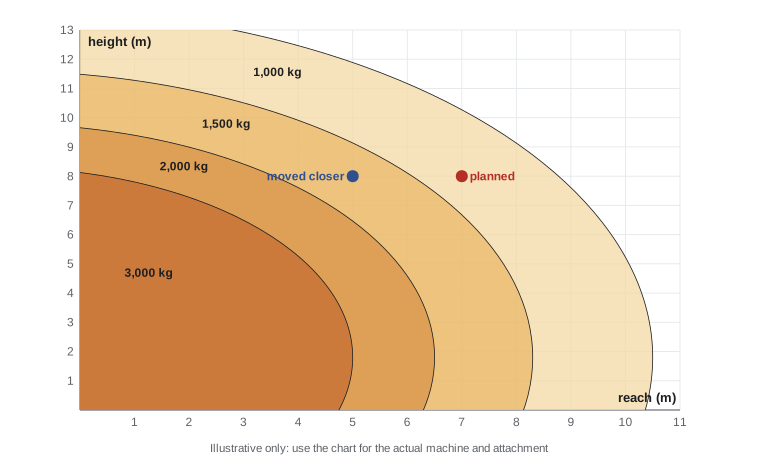
A telehandler load chart is usually drawn as a side view of the boom's working range. Curved zones show the maximum load allowed in each area, and lines show boom angle and extension. To use it, the operator finds the point where the load must be placed, in terms of height and forward reach, and reads the capacity zone at that point. If the load is heavier than the zone allows, the machine must be repositioned closer, a larger machine used or the load reduced.
Worked problem
Placing a pallet on a second floor
Using the illustrative chart, a 1,200 kg pallet of blocks must be landed on a deck 8 m high. With the telehandler parked where planned, the landing point is 7 m forward of the front axle. Can the lift go ahead? What if the machine moves 2 m closer?
Show solution
- At 7 m reach and 8 m height, the chart shows the 1,000 kg zone.
- The 1,200 kg pallet exceeds that by 200 kg, so the lift as planned is overloaded.
- Moving 2 m closer puts the landing point at 5 m reach and 8 m height, in the 1,500 kg zone.
- 1,200 kg is within 1,500 kg, so the lift is acceptable from the new position, provided the ground is firm and the frame is level.
Answer: Not from the original spot; yes from the closer position. Planning where the telehandler will stand is part of planning the lift.
Order pickers and personnel lifts
On an order picker the operator rides up with the platform. The main hazards are falls from height, being crushed between the platform and racking, and the truck tipping or moving while elevated. Controls include a full-body harness attached to the designated anchor on the truck with a lanyard short enough to prevent a fall over the edge, guardrails and gates closed, the truck travelling only at reduced speed when elevated, and rescue procedures for an operator stranded at height. HSE-212 covers fall protection equipment.
Ordinary lift trucks must never be used to lift people on the forks, on a pallet or in a bin. Where a lift truck is used to raise people, CSA B335 and provincial rules require a work platform designed for the purpose and securely attached to the truck, with guardrails, a means for the people on the platform to stop the truck's lifting and travel functions, protection from falling objects where needed, and an operator who stays at the controls. The truck must be on a firm, level surface and must not travel while the platform is raised except as the manufacturer permits. For regular work at height, a mobile elevating work platform, covered in HSE-220, is usually the better choice.
| Never acceptable | Acceptable alternative |
|---|---|
| Standing on the forks or on a pallet on the forks | An engineered work platform secured to the truck, with guardrails and a stop control |
| Riding in a bin or box on the forks | A mobile elevating work platform or scaffold |
| Reaching up from a pallet raised by a truck to change a light | A scissor lift, boom lift or ladder suitable for the task |
| Using an order picker without a harness | Harness attached to the designated anchor, gates closed |
Tow tractors and tuggers
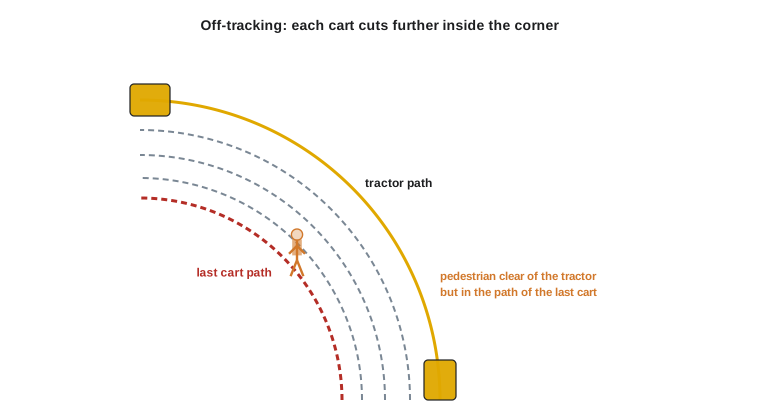
Tow tractors pull trains of carts or trailers to deliver parts and materials. Their hazards differ from those of a forklift. On a turn, the carts behind the tractor cut inside the path of the tractor itself, a behaviour called off-tracking, so a pedestrian standing clear of the tractor can be struck by the third or fourth cart. Coupling and uncoupling carts puts workers between units that can roll. Long trains take longer to stop, and loads on open carts can fall off on sharp turns.
Worked problem
Checking a tugger train
A tow tractor is rated to tow 4,500 kg. A supervisor plans a train of four carts, each weighing 150 kg and loaded with 600 kg of parts. Is the train within the rating, and what else should be checked?
Show solution
- Each cart: \( 150 + 600 = 750 \) kg.
- Train: \( 4 \times 750 = 3000 \) kg, within the 4,500 kg rating.
- Other checks: the tractor's rating on any ramps along the route, the number of carts allowed by the cart manufacturer, coupling type and condition, off-tracking clearance at every corner, and load securing on each cart.
Answer: The weight is within the rating, but the route's corners and ramps and the coupling system decide whether the train is safe.
Route planning matters as much as the tractor: mark the swept path of the full train at corners, keep pedestrian walkways outside it, set a train-length limit, and train operators to look back at the train through turns. Coupling should be done with the train stopped, the tractor's brake set and, where possible, with couplers that can be operated without stepping between carts.
Skid steers and compact loaders
Skid steer loaders and compact track loaders are common on construction and landscaping sites and in agriculture, and they also appear in warehouses for snow clearing and cleanup. They have rollover and falling object protective structures, seat belts and a seat bar that locks out the lift and travel controls when raised. The deadliest hazard is being crushed between the lift arms or bucket and the frame, usually when an operator leaves the seat with the arms raised or tries to reach the controls from outside the cab. Rules for these machines include entering and exiting only with the attachment on the ground, never bypassing the seat bar interlock, and using the manufacturer's lift arm support device before working under raised arms.
Sweepers, scrubbers and utility vehicles
Ride-on floor sweepers and scrubbers, personnel carriers, burden carriers and utility vehicles often escape attention because they do not lift loads. They are still heavy, travel at speed, and share aisles with pedestrians and trucks. They should be included in the site's traffic management plan, inspected before use, operated only by trained people and subject to the same speed limits and pedestrian rules as lift trucks. Personnel and burden carriers are covered by their own consensus standards, such as the ANSI/ITSDF B56.8 standard in the United States, and by the manufacturer's manual.
Autonomous mobile robots and guided vehicles
Automated guided vehicles and autonomous mobile robots are increasingly common in distribution centres. They bring benefits, because they can remove manual truck trips from busy areas, and new hazards, because people may not expect a vehicle without a driver. Their sensors, speed limits, safety fields and interaction with manual trucks and pedestrians are covered in ROB-440 lesson 9. For this course, the point is that automated vehicles belong in the traffic management plan alongside manual trucks, and workers need to know how they behave and how to stop them.
| Equipment | Signature hazard | Key control |
|---|---|---|
| Telehandler | Overloading as the boom extends; tipping on uneven ground | Load chart for every lift; level frame; retract boom for travel |
| Order picker | Fall from platform; crushing against racking | Harness to designated anchor; gates closed; elevated speed limits |
| Tow tractor | Off-tracking carts striking people; coupling crush | Mark swept paths; limit train length; couple only when stopped |
| Skid steer | Crushing by lift arms or bucket | Enter and exit with attachment down; never bypass interlocks |
| Sweeper or utility vehicle | Struck pedestrians in shared aisles | Include in traffic plan; training; speed limits |
| Autonomous mobile robot | Unexpected movement in shared areas | Defined zones, safety fields, worker awareness, emergency stops |
Training for other equipment
The same competence principle applies to all of these machines: training on the specific type, an evaluation by a qualified person, and authorization recorded by the employer. Telehandlers are Class 7 lift trucks, so lift truck training rules apply, with the load chart, frame levelling and any attachments added to the program. Skid steers, sweepers and utility vehicles fall under the general mobile equipment rules in provincial regulations, such as British Columbia's Part 16 and Alberta's Part 19, which require operators to be competent and equipment to be inspected before use.
Attachments deserve their own training. A telehandler with a bucket, a truss boom or a work platform behaves differently from one with forks, and each attachment has its own load chart. Operators should be authorized only for the attachments they have been trained and evaluated on.
Common mistakes
MistakeLifting a load with a telehandler without checking the chart because it is a familiar weight.
InsteadCheck the chart for the reach, height and attachment of every lift.
MistakeRaising the boom with the frame tilted on soft ground.
InsteadLevel the frame on firm ground before raising.
MistakeStanding on the forks to reach a high shelf for a moment.
InsteadUse an engineered platform, an order picker with fall protection or a work platform.
MistakeStanding just outside the tow tractor's path at a corner.
InsteadStand outside the swept path of the whole train, which cuts inside the corner.
MistakeClimbing out of a skid steer with the lift arms raised.
InsteadLower the attachment to the ground before leaving the seat.
Summary and key terms
- Telehandler capacity changes with reach and height; use the load chart for every lift and level the frame first.
- A telehandler configured to hoist suspended loads may fall under crane rules.
- Order pickers need fall protection attached to the designated anchor and closed gates.
- People may be raised only on an engineered platform secured to the truck, with a stop control and an operator at the controls.
- Tow tractor trains off-track inside corners; mark swept paths and couple only when stopped.
- Skid steers, sweepers, utility vehicles and robots all belong in the traffic plan and training program.
- Telehandler
- A variable-reach rough terrain forklift with forks on a telescoping boom.
- Load chart
- A diagram showing the maximum load at each combination of boom angle, extension and height.
- Load moment indicator
- A device that warns or cuts out functions when the load moment approaches the limit.
- Frame levelling
- A telehandler function that tilts the chassis to bring the frame level on uneven ground.
- Off-tracking
- The tendency of towed carts to follow a path inside the towing vehicle's path on turns.
- Work platform
- An engineered platform attached to a lift truck for raising people.
- Seat bar interlock
- A device on loaders that locks out controls when the seat bar is raised.
Practice problems
Work each problem on paper first, then reveal the answer to check.
Why does a telehandler's capacity change as the boom extends?
Show answer
The load moves further from the front axle, increasing the load moment.
What should be done before raising a telehandler boom on uneven ground?
Show answer
Level the frame on firm ground using the levelling feature.
A chart zone at the landing point allows 1,000 kg. The load is 1,150 kg. What are the options?
Show answer
Move the machine closer, use a larger machine or reduce the load.
When may crane rules apply to a telehandler?
Show answer
When it is configured to hoist and move suspended loads with a winch or hook.
What fall protection does an order picker operator need?
Show answer
A full-body harness attached to the designated anchor with a suitable lanyard.
What is required to raise people with a lift truck?
Show answer
An engineered platform secured to the truck, with guardrails, a stop control for the occupants, overhead protection where needed and an operator at the controls.
What is off-tracking?
Show answer
Towed carts following a path inside the tractor's path on turns.
Four carts each weigh 200 kg and carry 500 kg. What is the train weight?
Show answer
4 × 700 = 2,800 kg.
What is the main crush hazard on a skid steer?
Show answer
Being caught between the raised lift arms or bucket and the frame.
Why include sweepers and utility vehicles in the traffic plan?
Show answer
They share aisles with pedestrians and trucks and can strike people.
Lesson quiz · 5 questions
Score 60% or more to complete this lesson.
Create a free account to save your progress, take quizzes and earn a certificate.