
HSE-218 · Lesson 5 of 12 · 31 min
Pre-use inspection and maintenance
A lift truck with weak brakes, a cracked fork, a worn lift chain or a leaking propane fitting can kill even a skilled operator. Inspection and maintenance catch these defects before they cause harm. This lesson covers the operator's pre-use inspection, what to do with a defective truck, scheduled maintenance and periodic examinations, and how to check the parts that fail most often: forks, chains, tires, brakes and fuel or battery systems.
Why inspection matters
Ontario's Regulation 851 requires a lifting device to be maintained so it can safely handle its rated load, and to be examined by a competent person at least once a year. British Columbia's section 16.3 requires the operator to inspect mobile equipment before it is first operated on a shift and to report defects. Alberta's Code has sections on visual inspection and on inspection and maintenance. CSA B335 sets out daily operator checks and planned maintenance, and the manufacturer's manual gives the detailed list for each model.
The pre-use inspection is also a moment for the operator to learn the truck's normal sounds and behaviour. An operator who checks the same truck every day notices when the steering feels different or the mast drifts, often long before a mechanic would.
The pre-use inspection
A pre-use inspection has two parts: a visual check with the truck off, and an operational check with the truck running. Most employers use a checklist based on the manufacturer's manual, completed on paper or on a tablet or truck-mounted terminal that can lock the truck out until the checklist is done.
| Visual check (truck off, keys out) | What to look for |
|---|---|
| Forks | Cracks, bends, uneven tips, worn heels, locking pins in place |
| Mast and lift chains | Damage, missing or loose fasteners, chain wear, rust, kinks, uneven tension |
| Overhead guard and load backrest | Bends, cracks, missing parts |
| Hydraulics | Leaks from cylinders, hoses and fittings; puddles under the truck |
| Tires and wheels | Cuts, chunks missing, wear past the limit, low pressure on pneumatic tires, loose wheel nuts |
| Battery or fuel | Battery cables, connector and restraint secure, electrolyte level on lead-acid; propane cylinder secure, locating pin engaged, no damage or frost, hose and coupling sound |
| Fluids | Engine oil, coolant and hydraulic oil levels on engine trucks |
| Data plate and decals | Present, legible and matching any attachment |
| Safety devices | Seatbelt or restraint present and working, fire extinguisher if required, mirrors, lights |
| Operational check (truck running) | What to look for |
|---|---|
| Horn and alarms | Horn sounds; travel or reversing alarms and lights work |
| Brakes | Service brake stops the truck smoothly; parking brake holds |
| Steering | Smooth, without excessive play or noise |
| Controls | Lift, lower, tilt and side shift operate smoothly; controls return to neutral |
| Seat and operator presence switches | Truck will not drive when the operator leaves the seat or platform |
| Gauges and warning lights | No fault codes; battery discharge or fuel indicator working |
| Unusual noises or smells | Grinding, knocking, burning or fuel smells |
When a defect is found
A defect that affects safe operation means the truck does not go into service. The operator should:
- park the truck in a safe place, lower the forks, set the brake and turn it off;
- remove the key or disconnect the battery, and attach a do-not-operate tag that describes the defect;
- report the defect to the supervisor using the site's process;
- not attempt repairs unless trained and authorized to do so.
Supervisors must resist the pressure to keep a defective truck running because a shipment is due. A missing horn or a weak brake might seem minor, but these are precisely the items that prevent pedestrian strikes. Repairs that involve hydraulic, electrical or mechanical energy require the lockout and energy control procedures covered in HSE-210, including blocking a raised mast or carriage before anyone works under it.
Worked problem
Should this truck be used?
During a pre-use inspection an operator finds: (a) a small hydraulic weep at a tilt cylinder that leaves no drips on the floor, (b) a horn that sounds weakly, (c) the seatbelt buckle does not latch, and (d) a torn seat cushion. Which defects take the truck out of service?
Show solution
- (a) A slight weep with no drips should be reported and monitored, but a mechanic should decide whether it is acceptable; a dripping leak or loss of tilt control would take the truck out of service.
- (b) A weak horn reduces the warning to pedestrians. It affects safe operation and should be repaired before use in pedestrian areas.
- (c) A seatbelt that does not latch removes the protection against being thrown out in a tip-over. The truck is out of service.
- (d) A torn cushion is a comfort issue; report it for repair but it does not stop the truck unless it affects the seat switch or the operator's control.
Answer: The seatbelt and the horn take the truck out of service. The weep needs a mechanic's judgement, and the cushion is a repair item.
Forks
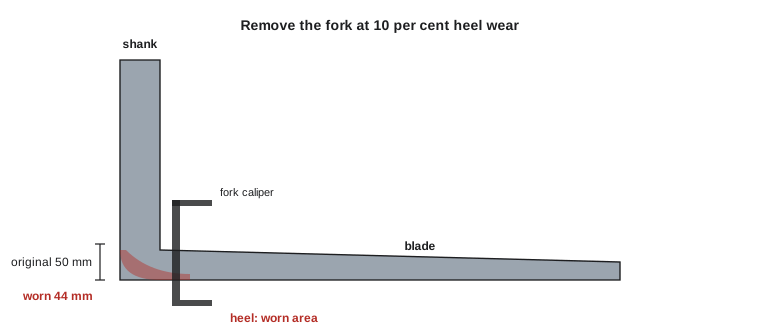
Forks wear and crack in ways that are easy to miss. The most common failure is at the heel, where the vertical shank meets the horizontal blade, because the heel drags on floors and carries the highest bending stress. Consensus standards and manufacturers set clear removal criteria. A fork should be taken out of service if:
- the heel thickness is worn to 90 per cent of its original thickness or less;
- there are any cracks, especially at the heel or the mounting hooks;
- the tips of the two forks differ in height by more than about 3 per cent of the blade length;
- the blade or shank is bent or twisted, or the angle between them has opened up;
- the positioning lock is missing or does not work.
Forks are tested and certified as a pair or individually by the manufacturer. Never heat, weld, straighten or repair a fork in the shop; replace it with an approved fork.
Worked problem
Fork heel wear
A fork's original heel thickness is 50 mm. A fork caliper now measures 44 mm at the heel. Should it be removed from service, and roughly how much bending strength has it lost?
Show solution
- Remaining thickness: \( 44 / 50 = 0.88 \), so the heel has lost 12 per cent of its thickness.
- The removal criterion is 10 per cent wear (90 per cent remaining). At 88 per cent the fork must be removed.
- Bending strength of a rectangular section is proportional to the thickness squared: \( 0.88^{2} = 0.77 \).
- The fork has lost about 23 per cent of its bending strength, even though the thickness has dropped by only 12 per cent.
Answer: Remove it. Strength falls faster than thickness, which is why the 10 per cent wear limit exists.
Lift chains
Leaf chains raise the carriage and inner mast. They stretch as the pins and plates wear, and a chain that has stretched too much can break or jump its sheave. Manufacturers usually require replacement when a chain has elongated by about 2 to 3 per cent over a measured length, or when there are cracked plates, seized or turned pins, heavy corrosion or uneven tension between the two chains. Chains are always replaced in pairs, with new anchor pins.
Worked problem
Chain elongation
A leaf chain has a nominal pitch of 15.875 mm. A technician measures 12 pitches at 196.5 mm. The manufacturer's limit is 3 per cent elongation. Does the chain need replacement?
Show solution
- Nominal length of 12 pitches: \( 12 \times 15.875 = 190.5 \) mm.
- Elongation: \( \tfrac{196.5 - 190.5}{190.5} = 0.031 \), or 3.1 per cent.
- This exceeds the 3 per cent limit.
Answer: Replace both chains and their anchor pins. Measure where the chain runs over the sheave most often, because that is where wear concentrates.
Tires, brakes and steering
Cushion tires wear down and can chunk or separate from the steel band; many have a wear line that marks the end of service life. Worn tires lower the truck, reduce ground clearance and change the stability characteristics. Pneumatic tires must be kept at the correct pressure, and split-rim wheels must only be serviced by trained people using a restraining cage, because a split rim that separates under pressure can kill. Brakes and steering should be checked on every pre-use inspection and adjusted or repaired by qualified technicians.
Planned maintenance and periodic examination
Planned maintenance follows the manufacturer's schedule, usually based on hours of operation, and covers lubrication, fluid changes, filter changes, brake and steering adjustment, and a detailed inspection. Separately, Ontario's section 51(1)(b) requires a thorough examination of load-handling capability before first use and at least once a year. The ministry's guideline notes that this is generally satisfied by an examination about every 2,000 hours, assuming 12 months of single-shift operation, and more often for double shifts, severe environments, heavy loads or modified trucks. The examination must be recorded and signed by the competent person, and the record kept for at least a year and long enough to hold the two most recent examinations.
Worked problem
Setting an examination interval
A truck runs two eight-hour shifts, five days a week, 50 weeks a year, in a cold storage freezer. Using the Ontario guideline's figure of about 2,000 hours, how often should load-handling examinations be done?
Show solution
- Annual hours: \( 2 \times 8 \times 5 \times 50 = 4000 \) hours.
- At about 2,000 hours per examination, that is two examinations a year, roughly every six months.
- The freezer is a severe environment, so a shorter interval, perhaps every four months, is reasonable.
- The legal minimum of once a year is far too long for this truck.
Answer: About every six months on hours alone, and more often because of the freezer environment.
Records
Inspection and maintenance records show that the program works and help spot trends. Keep the daily checklists for a period set by the site's policy, the planned maintenance work orders, any periodic examination reports, and the defect log showing when a truck was tagged out and when it was returned to service. A truck that keeps appearing in the defect log may need replacing, and a pattern of the same defect across the fleet may point to an operating practice that needs attention, such as forks dragging on the floor.
Who does what in maintenance
Clear roles prevent gaps. The operator does the pre-use inspection and reports defects. The supervisor makes sure inspections happen, takes defective trucks out of service and follows up on repairs. A trained technician, either in-house or from a dealer, does planned maintenance and repairs, and signs off that a truck is safe to return to service. Purchasing and fleet managers make sure that replacement parts, forks, chains, tires and batteries match the manufacturer's specifications and the data plate. When a rental or leased truck arrives, someone should check that it comes with its manual, a legible data plate and records of its last inspection before it goes into service.
A useful habit is a short weekly review of the defect log by the supervisor and the maintenance lead: which trucks were tagged out, how long they stayed out, and whether any defect keeps recurring. A truck that is repaired and returned the same day for the same fault three times in a month is telling you something about how it is used, not only about how it is fixed.
Common mistakes
MistakePencil-whipping the checklist without looking at the truck.
InsteadWalk around the truck and operate each control; supervisors should spot-check.
MistakeKeeping a truck with a defective horn or seatbelt in service until the end of the shift.
InsteadTag it out and report it; safety defects take the truck out of service immediately.
MistakeWelding or straightening a damaged fork.
InsteadReplace forks with approved parts; never repair them in the shop.
MistakeReplacing only the worn lift chain.
InsteadReplace chains in pairs with new anchor pins.
MistakeWorking under a raised carriage held only by hydraulics.
InsteadLower it or block it mechanically and follow lockout procedures.
Summary and key terms
- Operators inspect trucks before use each shift, with a visual check and an operational check.
- Any defect that affects safe operation takes the truck out of service: tag it, remove the key and report it.
- Ontario requires a thorough load-handling examination at least annually, and more often based on hours and conditions.
- Forks are removed at 10 per cent heel wear, cracks, uneven tips or bends; strength falls with the square of thickness.
- Lift chains are replaced in pairs when elongation, cracks or corrosion exceed the manufacturer's limits.
- Repairs need trained technicians and energy control; records reveal trends.
- Pre-use inspection
- The operator's check of a truck before it is used on a shift.
- Tag-out (defect tag)
- A tag attached to a defective truck to stop anyone using it until it is repaired.
- Heel
- The bend where a fork's vertical shank meets its horizontal blade.
- Leaf chain
- The flat-link chain that lifts the carriage and inner mast.
- Planned maintenance
- Scheduled servicing based on hours or time, following the manufacturer's instructions.
- Split-rim wheel
- A multi-piece wheel that can separate violently if serviced incorrectly.
- Operator presence switch
- A switch that disables travel or hydraulics when the operator leaves the seat or platform.
Practice problems
Work each problem on paper first, then reveal the answer to check.
What are the two parts of a pre-use inspection?
Show answer
A visual check with the truck off and an operational check with it running.
What should an operator do with a truck whose brakes are weak?
Show answer
Park it safely, remove the key, tag it out and report it.
At what heel wear must a fork be removed?
Show answer
When the heel is worn to 90 per cent of its original thickness or less.
A fork heel was 45 mm and now measures 39 mm. Remove it?
Show answer
Yes; 39/45 = 0.87, more than 10 per cent wear.
Why are lift chains replaced in pairs?
Show answer
Mismatched chains share the load unevenly and wear differently.
Why must split-rim wheels be serviced in a cage?
Show answer
They can separate violently under pressure and kill.
How often must Ontario lift trucks have a load-handling examination?
Show answer
Before first use and at least once a year, more often based on use.
What must be done before working under a raised mast?
Show answer
Lower it or block it mechanically and apply lockout procedures.
Why keep a defect log?
Show answer
It shows the program works and reveals trends in trucks or practices.
What does an operator presence switch do?
Show answer
Stops travel or hydraulics when the operator leaves the seat or platform.
Lesson quiz · 5 questions
Score 60% or more to complete this lesson.
Create a free account to save your progress, take quizzes and earn a certificate.