
HSE-218 · Lesson 4 of 12 · 29 min
Stability, load centre and capacity
Most lift truck tip-overs and dropped loads come down to one thing: the combined centre of gravity of the truck and load moved somewhere it should not be. This lesson explains how a counterbalanced truck stays upright, why the load centre and lift height control its capacity, how to read a data plate, and why turning, braking and slopes can tip a truck that is well within its rated load. The calculations here are for understanding. The manufacturer's data plate and manual always govern.
The seesaw principle
A counterbalanced truck works like a seesaw with the front axle as the pivot. The load on the forks creates a turning moment forward, equal to its weight multiplied by its distance ahead of the front axle. The truck and counterweight create a turning moment backward, equal to their weight multiplied by the distance of their centre of gravity behind the front axle. As long as the backward moment is larger, the rear wheels stay on the ground.
This explains why a short, heavy load may be fine while a long, lighter load of the same weight is not: the long load's centre sits further forward, so its moment is larger. It also explains why lifting a load off the ground is the moment of truth. If the rear wheels lift or the steering goes light as the forks rise, the truck is overloaded for that load centre.
The stability triangle
Most counterbalanced trucks are supported at three points: the two front wheels and the pivot pin in the middle of the rear steer axle. The rear axle can rock about that pin, so the truck behaves as though it stands on a triangle. Lines joining the front wheels to the rear pivot form the stability triangle. The truck is stable as long as the combined centre of gravity of the truck and load stays inside that triangle, as seen from above.
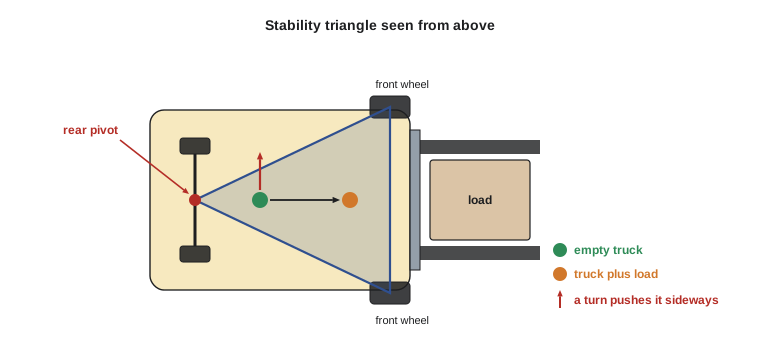
Several things move the combined centre of gravity:
- Picking up a load moves it forward, toward the front axle.
- Raising the load moves it upward, which makes the truck more sensitive to anything that pushes it sideways or forward.
- Tilting the mast forward moves it forward; tilting back moves it toward the truck.
- Turning, braking and accelerating add inertial forces that act at the centre of gravity and push it sideways, forward or back.
- Slopes tilt the triangle and the force of gravity relative to it.
Because the triangle is narrow at the rear pivot, an empty truck, whose centre of gravity sits near the rear, can tip sideways more easily than a loaded one when turned sharply. Many operators are surprised to learn that a fast turn with an empty truck is a classic tip-over scenario.
Load centre
The load centre is the horizontal distance from the vertical face of the fork shanks to the load's centre of gravity. Lift trucks are rated at a standard load centre, commonly 500 mm for small and medium trucks and 600 mm for larger ones in metric ratings, or 24 inches on trucks rated in imperial units. A standard pallet loaded evenly has its centre of gravity at about half its depth, so the rating assumes a typical pallet sitting fully back against the fork face.
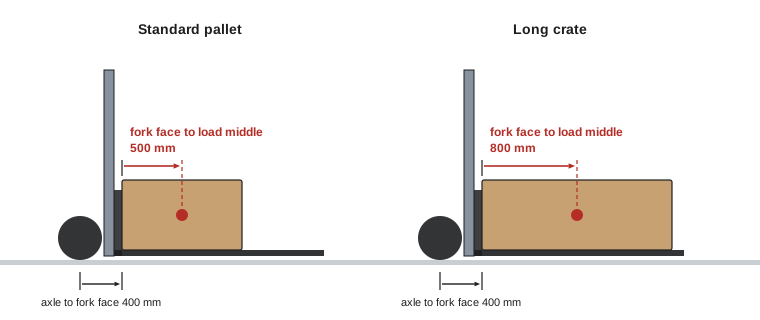
If the load is longer than standard, sits forward on the forks, or is heavier at the front, the actual load centre is greater than the rated one and the safe capacity falls. Loads with a high centre of gravity, such as tall stacked cartons, also reduce stability when raised.
Reading the data plate
The data plate, also called the capacity plate or nameplate, is the operator's primary source of capacity information. It typically shows the truck model and serial number, the truck weight, the battery or fuel type, the attachment fitted, and the rated capacity at one or more load centres and lift heights. Capacity usually falls as lift height rises, because the mast deflects and the centre of gravity rises.
| Plate item | What it tells you |
|---|---|
| Truck weight (without load) | Needed for floor, dock plate, elevator and trailer capacity checks |
| Battery weight range or fuel type | An electric truck is rated with a battery of a specified weight, which is part of the counterweight |
| Attachment | The rating applies only with the attachment listed |
| Capacity at load centre and lift height | The maximum load at that load centre and height, with the mast vertical |
| Tire type | Changing tire type may change stability and capacity |
Worked problem
Derating for a long load
A truck's data plate shows 2,500 kg at a 500 mm load centre. The distance from the centre of the front axle to the fork face is 400 mm. A crate 1.6 m long, loaded evenly, must be carried with its back against the fork face. Estimate the safe capacity two ways, for illustration only.
Show solution
- Actual load centre: half the crate length, 1.6 / 2 = 0.8 m = 800 mm.
- Simple ratio method: \( 2500 \times \tfrac{500}{800} = 1562 \) kg.
- Front-axle moment method: rated moment \( 2500 \times (400 + 500) = 2.25 \times 10^{6} \) kg·mm. Safe load \( = \tfrac{2.25 \times 10^{6}}{400 + 800} = 1875 \) kg.
- The simple ratio gives the lower, more conservative figure because it ignores the distance from the axle to the fork face.
- Neither figure replaces the manufacturer's rating. For regular long loads, ask the manufacturer or dealer for a plate or chart that shows the capacity at the larger load centre.
Answer: About 1,560 kg by the conservative ratio and 1,875 kg by the axle-moment estimate, both far below the 2,500 kg on the plate. Use the manufacturer's figure for the 800 mm load centre if one is available.
Combined centre of gravity
Combining the truck and load into one centre of gravity shows how close a lift brings the truck to tipping forward. Take moments about the front axle, counting distances behind the axle as positive and ahead of it as negative.
Worked problem
How close is the truck to tipping?
An empty truck weighs 3,800 kg with its centre of gravity 1.1 m behind the front axle. It picks up 1,500 kg whose centre is 0.9 m ahead of the axle. Find the combined centre of gravity and the theoretical load at 0.9 m that would tip the truck forward.
Show solution
- Truck moment: \( 3800 \times 1.1 = 4180 \) kg·m behind the axle.
- Load moment: \( 1500 \times 0.9 = 1350 \) kg·m ahead of the axle.
- Combined centre: \( x = \tfrac{4180 - 1350}{3800 + 1500} = 0.53 \) m behind the axle, still inside the triangle.
- Tipping load at 0.9 m: \( \tfrac{4180}{0.9} = 4640 \) kg, where the combined centre would sit right over the axle.
- The rated capacity is far lower than this theoretical figure because it must cover braking, uneven floors, mast deflection and lift height. Never treat the gap as spare capacity.
Answer: The combined centre is about 0.53 m behind the axle. Static tipping would need about 4,640 kg at 0.9 m, but the plate rating, not this figure, sets the limit.
Dynamic stability: turns, braking and slopes
The data plate rating assumes the truck is on a level, firm surface, the mast is vertical and the truck is moving slowly. Real operation adds forces. A turn pushes the centre of gravity sideways with a force that grows with the square of speed and falls with turn radius. Hard braking with a raised load pushes the load forward. A slope shifts the centre of gravity downhill relative to the triangle.
Here \( d \) is the sideways distance from the combined centre of gravity to the nearest edge of the stability triangle and \( h \) is the height of the centre of gravity. When the sideways acceleration in a turn, \( v^{2}/r \), reaches this value, the truck starts to tip. The formula is a simplification, but it shows the two things that matter: a narrow base and a high centre of gravity both lower the speed at which a turn becomes a tip-over.
Worked problem
Turning speed and tipping
Illustrative values: an empty truck has its centre of gravity 0.35 m from the edge of the triangle and 0.9 m above the floor. Estimate the speed at which a 2.5 m radius turn would start a sideways tip. Repeat with the centre of gravity raised to 1.4 m by an elevated load.
Show solution
- Critical sideways acceleration: \( a = 9.81 \times \tfrac{0.35}{0.9} = 3.8 \) m/s².
- Speed: \( v = \sqrt{a r} = \sqrt{3.8 \times 2.5} = 3.1 \) m/s, about 11 km/h.
- Raised centre of gravity: \( a = 9.81 \times \tfrac{0.35}{1.4} = 2.5 \) m/s², so \( v = \sqrt{2.5 \times 2.5} = 2.5 \) m/s, about 9 km/h.
- Many trucks can travel faster than this, which is why a fast turn, especially with the forks raised, can tip a truck with no load at all.
Answer: Roughly 11 km/h with the centre of gravity low and 9 km/h with it raised. Slow down before turning and travel with the forks low.
What keeps a truck upright in practice
The physics translates into a short list of habits that operators are trained in and supervisors should watch for:
- Know the load's weight and centre before lifting; never exceed the plate capacity for the load centre and lift height.
- Keep the load against the fork face, centred between the forks, and tilted back slightly for travel.
- Travel with the load low, just high enough to clear the floor and any obstacles.
- Slow down before turns, and never turn on a ramp or slope.
- Raise and lower loads only when the truck is stopped, and keep the mast vertical or tilted back while raising.
- Avoid sudden starts, stops and direction changes.
- Never add counterweight or have people ride on the back to lift a heavier load.
If a truck tips
Operator restraints exist because operators thrown from a tipping truck are often crushed by it. If a sit-down counterbalanced truck begins to tip sideways, the trained response is to stay in the seat with the seatbelt fastened, hold the steering wheel firmly, brace the feet and lean away from the direction of the tip. Stand-up trucks with rear entry are different: the operator is usually trained to step out the back if the truck tips or goes off a dock. Follow the manufacturer's instructions for each truck type.
Common mistakes
MistakeAssuming any load under the plate capacity is safe.
InsteadCapacity applies only at the stated load centre and lift height; long or high loads reduce it.
MistakeAdding extra counterweight or people on the back to lift more.
InsteadNever modify counterweight; use a truck rated for the load.
MistakeTurning fast with an empty truck because it has no load.
InsteadEmpty trucks tip sideways easily; slow down before every turn.
MistakeRaising or tilting the load forward while travelling.
InsteadTravel with the load low and tilted back; raise only when stopped and positioned.
MistakeTreating the gap between theoretical tipping load and plate capacity as a reserve.
InsteadThe rating already uses that margin for dynamic forces and uneven floors.
Summary and key terms
- A counterbalanced truck balances the load moment ahead of the front axle against the truck moment behind it.
- The combined centre of gravity must stay within the stability triangle formed by the front wheels and the rear pivot.
- Capacity depends on load centre and lift height; long, front-heavy or tall loads reduce it.
- The data plate governs; simple derating calculations are for understanding and planning only.
- Turning, braking and slopes add forces that can tip a truck well within its rated load, especially with a raised load or an empty truck.
- Stay in the seat with the restraint fastened if a sit-down truck tips.
- Centre of gravity
- The point where the weight of an object can be considered to act.
- Stability triangle
- The triangle formed by the two front wheels and the rear axle pivot of a three-point-supported truck.
- Load centre
- The horizontal distance from the fork face to the load's centre of gravity.
- Load moment
- The load's weight multiplied by its distance ahead of the front axle.
- Data plate
- The plate showing the truck's rated capacity at specified load centres and lift heights.
- Derating
- Reducing the permitted load because the load centre, lift height or attachment differs from the standard rating.
- Operator restraint
- A seatbelt or other device that keeps the operator inside the protected area of the truck.
Practice problems
Work each problem on paper first, then reveal the answer to check.
What acts as the pivot point of a counterbalanced truck?
Show answer
The front axle.
What three points form the stability triangle?
Show answer
The two front wheels and the pivot of the rear steer axle.
Why can an empty truck tip sideways in a fast turn?
Show answer
Its centre of gravity sits near the narrow rear of the triangle, so a small sideways force moves it outside.
A truck is rated 2,000 kg at 500 mm. Estimate the conservative capacity for a 1,000 mm load centre.
Show answer
2,000 × 500/1,000 = 1,000 kg.
Why does capacity fall as lift height increases?
Show answer
The centre of gravity rises and the mast deflects, reducing stability.
What should happen if the rear wheels go light when lifting a load?
Show answer
Lower the load immediately; the truck is overloaded for that load centre.
Name three habits that keep a truck stable.
Show answer
Travel with the load low and tilted back, slow down before turns, never turn on a slope, raise loads only when stopped.
What does a sit-down operator do if the truck starts to tip?
Show answer
Stay seated with the belt on, hold the wheel, brace and lean away from the tip.
Why must the plate be checked when a battery is replaced?
Show answer
The battery is part of the counterweight; a lighter battery may reduce capacity.
How do a narrow base and a high centre of gravity affect turning?
Show answer
Both lower the sideways acceleration, and therefore the speed, at which the truck tips.
Lesson quiz · 5 questions
Score 60% or more to complete this lesson.
Create a free account to save your progress, take quizzes and earn a certificate.