
HSE-215 · Lesson 2 of 12 · 24 min
Machine safeguarding law and standards in Canada
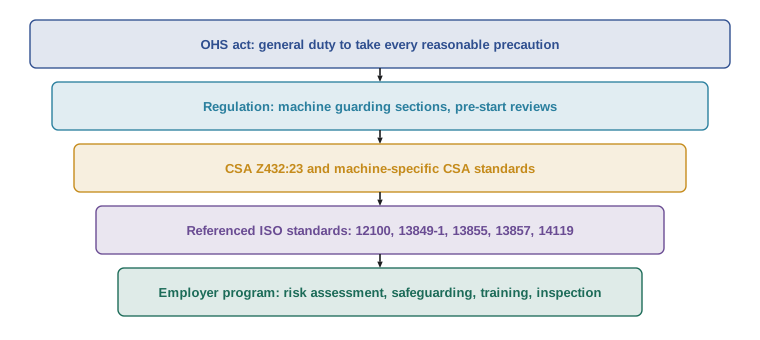
Machine safeguarding in Canada rests on three layers. The first is the general duty in every occupational health and safety statute: employers must take every precaution reasonable in the circumstances to protect workers. The second is the specific machine guarding rules in provincial, territorial and federal regulations. The third is the consensus standards, above all CSA Z432, Safeguarding of machinery, which regulations sometimes reference directly and which regulators, courts and engineers use as the benchmark for what is reasonable.
Who is responsible
Responsibility is shared. Employers must provide and maintain guards and devices, assess hazards, train and supervise workers, and make sure machines are not used without required safeguarding. Supervisors must make sure workers use the guards and follow procedures, and must advise them of hazards. Workers must use the guards and devices provided, must not remove or defeat them without authorization, and must report missing or defective guards. Suppliers, including manufacturers, distributors and those who lease or rent equipment, must ensure that the machines they supply comply with the law. Owners and constructors have duties where machines are installed on their sites. This sharing of duties is often called the internal responsibility system.
The specific rules
Each jurisdiction has its own regulation, and the wording varies, but the core requirements are similar: guard the point of operation, power transmission parts and other moving parts that can endanger a worker; make sure guards cannot easily be removed or made ineffective; use interlocks or lockout when guards must be opened; and keep machines from starting unexpectedly. The table below lists the main provisions. Section numbers change when regulations are amended, so always check the current consolidated text.
| Jurisdiction | Main machine safeguarding provisions |
|---|---|
| Ontario | Industrial Establishments Regulation, R.R.O. 1990, Reg. 851, ss. 24 to 44 (machine guarding), and s. 7 (pre-start health and safety reviews) |
| British Columbia | OHS Regulation Part 12, Tools, Machinery and Equipment, including safeguarding requirements and references to CSA Z432 |
| Alberta | OHS Code Part 25, Tools, Equipment and Machinery |
| Quebec | Regulation respecting occupational health and safety (RROHS), machine safety provisions in the division on machines |
| Federal | Canada Occupational Health and Safety Regulations, Part XIII, Tools and Machinery |
| Other provinces and territories | Machine guarding sections in each general OHS regulation, often referencing CSA Z432 |
Ontario's Regulation 851 is a good example of the detailed approach. Section 24 requires that a machine or prime mover or transmission equipment with an exposed moving part that may endanger a worker be equipped with and guarded by a guard or other device that prevents access to the moving part. Section 25 covers in-running nip hazards, and later sections deal with means of stopping machines, preventing unexpected starting, lockout during maintenance, and specific equipment. Section 7 requires a pre-start health and safety review before certain new, added or modified machines and protective elements are used. Lesson 11 explains pre-start reviews in detail.
The consensus standards
CSA Z432, Safeguarding of machinery, is the central Canadian machine safety standard. The current fourth edition, CSA Z432:23, replaced the 2016 edition. It covers the design, manufacture, rebuilding, installation, maintenance, operation and safeguarding of industrial machinery, including mobile, stationary, rebuilt, redeployed and existing machines; it excludes portable hand tools. The 2023 edition was reorganized to follow the hierarchy of controls and aligned more closely with ISO standards and with ANSI B11.19. CSA Z432 refers to a family of international standards: ISO 12100 for risk assessment, ISO 13857 for safety distances, ISO 13855 for the positioning of protective devices, ISO 14119 for interlocks, ISO 14120 for guards, ISO 13849-1 and IEC 62061 for safety-related control systems, and ISO 13850 for emergency stops.
Other Canadian standards apply to particular machines: CSA Z142 for power press operation, CSA Z434 for industrial robots and robot systems, CSA Z460 for the control of hazardous energy, and CSA B167 for overhead cranes, among others. Some regulations adopt a standard by reference, which makes it legally binding. Even where a standard is not adopted, an employer who ignores a well-known standard will find it hard to show it took every reasonable precaution.
Enforcement and consequences
Inspectors enforce the rules through orders, stop-work orders and, in some provinces, administrative penalties. Serious failures lead to prosecution. In Ontario, the maximum fine for a corporation convicted under the Occupational Health and Safety Act is $2 million per offence, and individuals, including directors and officers, can face fines and imprisonment. Courts also apply a victim fine surcharge. Machine guarding prosecutions are among the most common in Ontario, typically after a worker loses fingers or a hand in an unguarded or bypassed machine. Under section 217.1 of the Criminal Code, added in 2004 after the Westray mine disaster, anyone who directs work has a legal duty to take reasonable steps to prevent bodily harm, and organizations and individuals can face criminal negligence charges.
Worked problem
Estimating the cost of a guarding failure
A small manufacturer is prosecuted after a worker's hand is caught in an unguarded roll former. The court imposes a $150,000 fine plus a 25 % victim fine surcharge. The company also faces higher workers' compensation premiums of $30,000 a year for three years and spends $40,000 on retrofitted guarding and an engineering review. What is the total cost, ignoring production losses and legal fees?
Show solution
- Fine plus surcharge: \( 150{,}000 \times 1.25 = 187{,}500 \) dollars.
- Premium increase: \( 30{,}000 \times 3 = 90{,}000 \) dollars.
- Retrofit and review: $40,000.
- Total: \( 187{,}500 + 90{,}000 + 40{,}000 = 317{,}500 \) dollars.
Answer: About $317,500, before counting lost production, legal fees, recruitment and training of a replacement worker and the human cost. A properly designed fixed guard would have cost a small fraction of this. The figures are illustrative.
Rights of workers
Workers in every Canadian jurisdiction have the right to know about hazards, the right to participate through joint health and safety committees or representatives, and the right to refuse work they believe is likely to endanger themselves or another worker. An operator asked to run a machine with a missing guard can refuse, following the procedure in the applicable law, and cannot be disciplined for doing so in good faith. Joint committee members in Ontario can inspect the workplace monthly and make recommendations, and certified members have additional powers to stop dangerous work in some circumstances.
Putting the law into practice
The law sets minimum outcomes rather than detailed designs. It says that moving parts that can endanger a worker must be guarded, that guards must stay in place, and that machines must be stopped and isolated before people reach into them. The standards explain how to achieve that: how to assess risk, how far a guard must be from the hazard, how reliable an interlock must be and how quickly a machine must stop. An effective employer program uses the standards to meet the law: an inventory of machines, a risk assessment for each, safeguarding designed and verified by competent people, training for operators and maintainers, regular inspections, and a culture in which defeating a guard is never acceptable.
How the rules apply on a real shop floor
Consider a mid-sized manufacturer in Ontario that installs a second-hand roll former and a new robotic palletizer. Regulation 851 requires the roll former's in-running nips and drive to be guarded, and the palletizer's safeguarding may trigger a pre-start health and safety review because it relies on light curtains and interlocked gates. CSA Z432:23 tells the engineer how to assess the risk, how far the perimeter fence must be from the robot's reach and how reliable the gate interlocks must be. The Occupational Health and Safety Act makes the employer, the supervisors and the workers each responsible for using and maintaining the safeguarding once the machines are running. If an inspector visits, they can order missing guards to be installed, stop the use of a machine until it is safe, and ask to see the pre-start review report and the risk assessment.
Smaller provinces and the territories follow the same pattern with their own wording. Workers in federally regulated workplaces, such as ports, airlines, rail, telecommunications and federal government operations, fall under the Canada Labour Code Part II and the Canada Occupational Health and Safety Regulations rather than provincial law. Mines are usually covered by separate mining regulations with their own guarding requirements. When a company operates in several jurisdictions, its machine safety standard should meet the strictest requirement that applies to each site, and CSA Z432 provides a common technical baseline.
Where to find help
Workplace Safety and Prevention Services in Ontario, WorkSafeBC, the Canadian Centre for Occupational Health and Safety and similar organizations publish free machine safeguarding guides, checklists and training. CSA Group sells the standards and offers courses on applying CSA Z432. Professional engineers who specialize in machine safety can perform risk assessments, design safeguarding and complete pre-start reviews. Joint health and safety committees can recommend improvements and should be involved in machine safety decisions.
The law and the standards are written in general terms because machines vary enormously. Turning them into safe machines takes judgement, which is why the rest of this course explains the reasoning behind the rules rather than only the rules themselves.
Reading a regulation
Regulations are written in a particular style. Words such as shall and must create duties; may creates a permission. Definitions at the start of a regulation matter, because terms such as guard, machine or worker can have specific meanings. Some sections apply only to certain workplaces, such as factories or construction projects. When a regulation refers to a standard by name and edition, that edition is the one that applies, even if a newer one exists. When in doubt, regulators publish guidance and interpretations, and inspectors can explain how a section applies.
Common mistakes
MistakeBelieving a machine is legal because it was bought new.
InsteadNew machines can still be inadequately guarded for the way they are used; the employer must assess and, where required, carry out a pre-start review.
MistakeTreating consensus standards as optional extras.
InsteadRegulators and courts use standards to judge what is reasonable and feasible; some are adopted by reference and are binding.
MistakeAssuming only the employer has duties.
InsteadSupervisors, workers, suppliers and owners all have duties under Canadian OHS law.
MistakeRelying on old section numbers from training materials.
InsteadRegulations are amended; check the current consolidated text.
MistakeThinking a worker must run a machine with a missing guard if told to.
InsteadWorkers have the right to refuse unsafe work under the procedure in their OHS law.
Summary and key terms
- Canadian law combines a general duty, specific machine guarding regulations and consensus standards such as CSA Z432.
- CSA Z432:23 is the current fourth edition and is organized around the hierarchy of controls.
- Ontario Reg. 851 ss. 24 to 44 and s. 7 set detailed guarding and pre-start review requirements.
- International standards such as ISO 12100, 13849-1, 13855 and 13857 underpin the national standards.
- Penalties include orders, fines up to $2 million per offence in Ontario and Criminal Code liability.
- Workers have the right to know, to participate and to refuse unsafe work.
- Standards turn the law's general outcomes into practical design and maintenance requirements.
- General duty
- The obligation to take every precaution reasonable in the circumstances to protect workers.
- CSA Z432
- The Canadian standard for the safeguarding of machinery.
- ANSI B11
- The US series of consensus standards for machine tool and machinery safety.
- ISO 12100
- The international standard for the general principles of machine design, risk assessment and risk reduction.
- Adopted by reference
- A standard made legally binding by being named in a regulation.
- Pre-start health and safety review
- An Ontario requirement to have certain new or modified machines reviewed before use.
- Subpart O
- The part of OSHA's general industry standards that covers machinery and machine guarding.
- Multi-employer citation policy
- OSHA's policy allowing more than one employer on a site to be cited for the same hazard.
- Internal responsibility system
- The sharing of safety duties among everyone in the workplace.
- Right to refuse
- A worker's legal right to refuse work believed to be dangerous, under defined procedures.
Practice problems
Work each problem on paper first, then reveal the answer to check.
Which standard is the central Canadian machine safeguarding standard?
Show answer
CSA Z432, Safeguarding of machinery, currently the 2023 edition.
Name the international standard used for machine risk assessment.
Show answer
ISO 12100.
Which section of Ontario Reg. 851 requires pre-start health and safety reviews?
Show answer
Section 7.
Why do consensus standards matter even when not adopted by reference?
Show answer
Regulators and courts use them to judge what is reasonable, recognized and feasible.
What is the maximum fine for a corporation per offence under Ontario's OHS Act?
Show answer
$2 million, plus a victim fine surcharge.
Name two duties a worker has regarding machine guards.
Show answer
Use the guards provided, do not remove or defeat them without authorization, and report defects.
What do ISO 13855 and ISO 13857 cover?
Show answer
ISO 13855 covers positioning protective devices for approach speed; ISO 13857 covers safety distances to prevent reaching hazard zones.
Which federal regulation covers tools and machinery in federally regulated workplaces?
Show answer
COHSR Part XIII.
What should a worker do if asked to run a machine with a missing guard?
Show answer
Stop, report it to the supervisor and, if needed, use the legal right to refuse or contact the regulator.
Why check the current consolidated regulation?
Show answer
Section numbers and requirements change when regulations are amended.
Lesson quiz · 5 questions
Score 60% or more to complete this lesson.
Create a free account to save your progress, take quizzes and earn a certificate.