
HSE-215 · Lesson 6 of 12 · 26 min
Safeguarding devices: light curtains, two-hand controls, mats and scanners
Guards keep people out. Safeguarding devices work differently: they detect a person approaching a hazard, or keep the person's hands occupied away from it, and make the machine stop or prevent it from starting. They are used where a guard would get in the way of the work, for example where parts are loaded by hand at the point of operation every few seconds. Because they rely on the control system and on the machine stopping in time, they must be selected, positioned and maintained with great care.
CSA Z432:23 covers protective devices and refers to ISO 13855 for positioning them, IEC 61496 for electro-sensitive protective equipment such as light curtains and laser scanners, ISO 13851 for two-hand control devices and ISO 13856 for pressure-sensitive devices. CSA Z142 adds requirements for power presses.
Types of safeguarding devices
| Device | How it works | Typical uses | Key limitations |
|---|---|---|---|
| Light curtain | An array of infrared beams; breaking any beam sends a stop signal | Press brakes, presses, palletizers, assembly cells | Needs a machine that can stop quickly; must be placed at the safety distance; does not stop ejected parts |
| Safety laser scanner | A rotating laser measures distance and detects people in programmable zones | Robot cells, automated guided vehicles, large areas | Zones must be configured and verified; can be blocked by objects |
| Two-hand control | Both hands must press two buttons together and hold them during the hazardous motion | Presses and other machines with a single hazardous stroke | Protects only the operator, not helpers; can be defeated by tying down a button |
| Pressure-sensitive mat or edge | Detects a person standing on a mat or contact with an edge | Floor areas around machines, closing doors and tables | Slow to respond compared with light curtains; can be damaged |
| Pull-back device | Cables attached to wristbands pull the hands out as the press closes | Some older mechanical presses | Must be adjusted for each operator and inspected each shift; restricts movement |
| Restraint device | Cables attached to wristbands stop the hands reaching the hazard at all | Presses where parts are fed with tools | Must be adjusted for each operator; can be uncomfortable |
| Safety trip device | A bar, wire or rod that stops the machine when pushed or pulled | Roll mills, calenders, conveyors | Only works if the person can reach it; a stop, not a guard |
Light curtains and the safety distance
A light curtain is one of the most common safeguarding devices. It consists of a transmitter and a receiver with an array of infrared beams between them. When an object larger than the curtain's resolution, also called detection capability or object sensitivity, interrupts the beams, the curtain sends a stop signal through the safety control system to the machine. Finger-detection curtains have resolutions of about 14 mm (about 0.55 in); hand-detection curtains about 30 mm (about 1.2 in); and body-detection systems use a few widely spaced beams.
A light curtain does not protect anyone by itself. It protects only if the machine stops before a hand that breaks the curtain can reach the hazard. That means the curtain must be placed far enough from the hazard. The safety distance depends on how fast a person moves, how long the whole system takes to stop and how far a hand can reach into the curtain before it is detected.
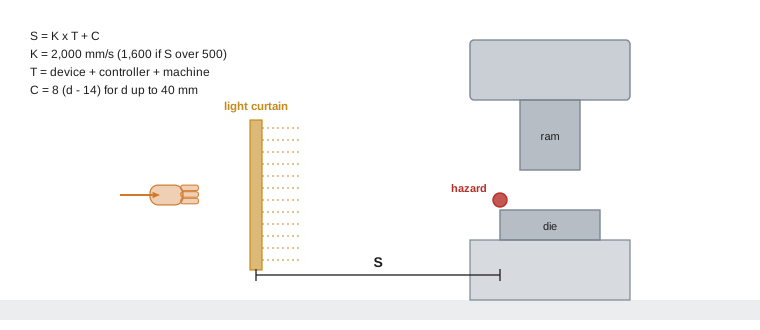
ISO 13855, referenced by CSA Z432, gives the general formula:
Here S is the minimum distance in millimetres, K is the approach speed of the body part in millimetres per second, T is the total stopping time of the system in seconds (the response time of the device and controller plus the stopping time of the machine), and C is an intrusion distance that accounts for how far a hand or finger can reach through the curtain before being detected. For light curtains with a resolution d of 40 mm or less, K is taken as 2,000 mm/s and C = 8(d − 14) mm, not less than zero. If the result is more than 500 mm, it is recalculated with K = 1,600 mm/s, and the distance must then be at least 500 mm. For coarser body-detection devices, K = 1,600 mm/s and C = 850 mm.
Worked problem
Positioning a light curtain
A press brake will be safeguarded with a light curtain of 14 mm resolution. The curtain responds in 15 ms, the safety relay in 15 ms, and the measured stopping time of the press is 120 ms. How far must the curtain be from the nearest hazard? What if a 30 mm curtain is used instead?
Show solution
- Total stopping time: \( T = 0.015 + 0.015 + 0.120 = 0.150 \text{ s} \).
- Intrusion allowance for 14 mm: \( C = 8(14 - 14) = 0 \text{ mm} \).
- \( S = 2{,}000 \times 0.150 + 0 = 300 \text{ mm} \). This is not more than 500 mm, so K = 2,000 mm/s stands.
- For a 30 mm curtain: \( C = 8(30 - 14) = 128 \text{ mm} \), so \( S = 300 + 128 = 428 \text{ mm} \).
Answer: The 14 mm curtain must be at least 300 mm from the hazard; a 30 mm curtain must be at least 428 mm away. A finer curtain can be placed closer, which matters at a press brake where the operator holds the workpiece. If the machine's stopping time increases as the brake wears, the safety distance increases too, so stopping time must be checked regularly.
Other conditions for light curtains
A light curtain is only suitable if the machine can be stopped at any point in its cycle. Full-revolution clutch mechanical presses, which cannot be stopped once a stroke starts, cannot be safeguarded with light curtains. The curtain must also be installed so that no one can reach over, under or around it, or stand between it and the hazard undetected. Additional guards often fill the gaps, and a second horizontal curtain or a scanner may be needed to detect someone standing inside a large opening. Reflective surfaces near the curtain can bounce beams around an object, so installers follow the manufacturer's alignment and spacing rules.
Some applications use muting, which temporarily disables the curtain while material passes through, for example a pallet on a conveyor. Muting must be carefully designed so that it cannot be triggered by a person, using sensors that distinguish the shape and timing of the load. Blanking, which ignores certain beams so a fixed object or the workpiece can pass, increases the effective resolution and therefore the safety distance. Both are legitimate engineering techniques, but improper muting or blanking is a common way that light curtains are defeated.
Two-hand controls
A two-hand control requires the operator to press two buttons at the same time, within about half a second of each other, and to hold them until the hazardous part of the cycle is complete. Releasing either button stops the motion. The buttons must be far enough apart and shielded so that they cannot be operated with one hand, an elbow or a forearm, and they must be placed far enough from the hazard that the operator cannot release a button and reach the hazard before it stops.
ISO 13855 gives this formula for two-hand controls, in millimetres, where the 250 mm allowance can be reduced to zero if the buttons are shrouded so a hand cannot approach while pressing.
Worked problem
Placing two-hand control buttons
A hydraulic press stops in 0.20 s after a button is released. The buttons are not shrouded. How far must they be from the nearest hazard?
Show solution
- \( S = 1{,}600 \times 0.20 + 250 = 320 + 250 = 570 \text{ mm} \).
Answer: At least 570 mm. Shrouding the buttons would allow 320 mm.
A two-hand control protects only the person operating it. If a helper stands at the back of the machine, or a second operator works the same press, each needs their own protection, often separate two-hand controls wired so that all must be pressed, or guards for the other sides. Two-hand controls are also easily defeated by taping or tying down one button, which is why anti-tie-down logic, requiring both buttons to be released and pressed again for each cycle, is required.
Pressure-sensitive mats and edges
Pressure-sensitive mats detect a person standing in an area, for example the floor in front of a machine or inside a cell, and stop the machine. They respond more slowly than a light curtain, and because a person can step quickly across them, they must cover a large enough area at the right distance. ISO 13855 uses a body approach speed of 1,600 mm/s and an allowance of 1,200 mm for mats. Pressure-sensitive edges and bumpers detect contact with closing doors, tables and mobile machines and reverse or stop the motion.
Safety laser scanners
A safety laser scanner rotates a laser beam and measures distance, building a map of a protective field around a machine or vehicle. When a person enters the protective field, the machine stops; a larger warning field can slow it first. Scanners are popular on robot cells and automated guided vehicles because zones can be programmed and switched for different modes. That flexibility is also a risk: zones must be configured by competent people, documented, protected by passwords and verified with test pieces after any change.
Common limits of all devices
Safeguarding devices share some limits that guards do not have. They do not stop parts, tooling fragments or chips from flying out, so a guard or shield may still be needed. They depend on the machine's stopping performance, which can deteriorate as brakes and valves wear. They depend on the control system being reliable enough for the risk. And they can be bypassed, muted, blanked or moved by people who find them inconvenient. Every device installation needs a verified safety distance, a reliable control system, regular functional testing, and supervision to make sure it stays effective.
Common mistakes
MistakeMounting a light curtain wherever it fits.
InsteadCalculate and verify the safety distance from the measured stopping time and the curtain resolution.
MistakeUsing a light curtain on a machine that cannot stop mid-cycle.
InsteadLight curtains need machines that can stop at any point, not full-revolution clutch presses.
MistakeAssuming a two-hand control protects everyone at the machine.
InsteadIt protects only the operator; helpers and other sides need their own protection.
MistakeBlanking or muting beams to make a job easier.
InsteadOnly competent people should configure blanking or muting, and the safety distance must be recalculated.
MistakeNever rechecking stopping time after installation.
InsteadMeasure stopping time periodically, because wear increases it and the safety distance.
Summary and key terms
- Safeguarding devices detect a person or occupy the hands and make the machine stop or stay stopped.
- Light curtains protect only if they are placed at the safety distance and the machine can stop mid-cycle.
- ISO 13855 gives S = K × T + C, with K = 2,000 mm/s and C = 8(d − 14) for fine light curtains.
- Two-hand controls protect only the operator and need anti-tie-down logic and the correct distance.
- Pressure-sensitive mats are slower and need large detection areas.
- Laser scanners use programmable zones that must be configured and verified by competent people.
- Devices do not stop ejected parts and depend on stopping performance and control reliability.
- Light curtain
- An array of infrared beams that sends a stop signal when interrupted.
- Resolution
- The smallest object a light curtain reliably detects, also called detection capability or object sensitivity.
- Safety distance
- The minimum distance between a protective device and the hazard so the machine stops first.
- Total stopping time
- The time from detection to the end of hazardous motion, including device, controller and machine.
- Two-hand control
- A device requiring both hands to operate the machine, keeping them away from the hazard.
- Anti-tie-down
- Logic requiring both buttons to be released and pressed again for each cycle.
- Muting
- Temporary, automatic suspension of a protective device during a safe part of the cycle.
- Blanking
- Ignoring selected beams of a light curtain to allow an object to pass.
- Safety laser scanner
- A device that measures distance with a rotating laser and detects people in programmed zones.
- Pressure-sensitive mat
- A floor mat that detects a person standing on it and stops the machine.
Practice problems
Work each problem on paper first, then reveal the answer to check.
Why can a light curtain not be used on a full-revolution clutch press?
Show answer
The press cannot be stopped once a stroke starts, so detection would not prevent injury.
What is the safety distance for a 14 mm curtain with a total stopping time of 0.1 s?
Show answer
200 mm, from 2,000 × 0.1 + 0.
What three parts make up the total stopping time?
Show answer
The device response time, the control system response time and the machine stopping time.
Why must two-hand control buttons be shielded and spaced?
Show answer
So they cannot be operated with one hand, an elbow or a forearm.
Who does a two-hand control protect?
Show answer
Only the person operating it.
What does anti-tie-down logic prevent?
Show answer
Tying down one button so the machine can be run with one hand.
Why does blanking increase the safety distance?
Show answer
It increases the effective resolution, so a larger object can enter before detection.
Name one limitation of pressure-sensitive mats.
Show answer
They respond more slowly and a person can step quickly across them.
What must happen after a laser scanner zone is changed?
Show answer
It must be documented and verified by a competent person with a test piece.
Why do devices often need guards as well?
Show answer
Devices do not stop ejected parts, chips or tooling fragments, and gaps around them must be closed.
Lesson quiz · 5 questions
Score 60% or more to complete this lesson.
Create a free account to save your progress, take quizzes and earn a certificate.