
HSE-215 · Lesson 3 of 12 · 27 min
Inherently safe design and the hierarchy of controls
Every safety program in this course rests on one idea: some controls are more reliable than others. A hazard that has been designed out cannot hurt anyone. A fixed guard bolted in place protects people whether they are paying attention or not. A warning sign depends on someone reading it, understanding it and choosing to obey it on a busy day. The hierarchy of controls ranks these options so that the most effective ones are considered first.
The hierarchy applied to machines
CSA Z432:23 is organized around the hierarchy of controls, and the same ranking appears in CSA Z1000, the occupational health and safety management standard, and in provincial guidance. Applied to machinery, the levels are:
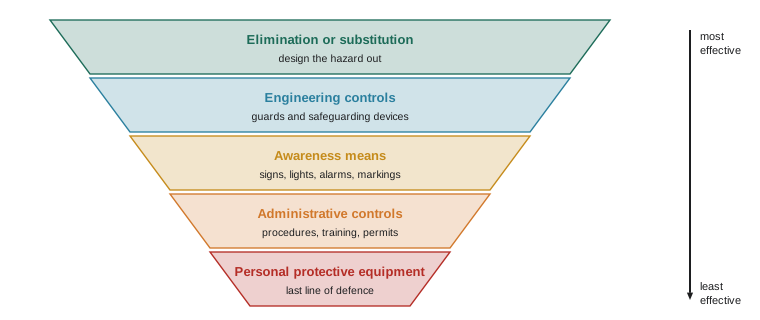
- Elimination or substitution: remove the hazard entirely or replace it with something less hazardous. Examples include automating a manual feeding task so no one needs to approach the point of operation, replacing a belt drive with a direct drive, reducing speed or force, or eliminating a pinch point by changing the geometry.
- Engineering controls: guards and safeguarding devices that keep people out of the hazard zone or stop the hazard before they reach it. Examples include fixed guards, interlocked guards, light curtains, two-hand controls and safety-rated speed monitoring.
- Awareness means: signs, labels, lights, horns and floor markings that warn people of a hazard. They do not prevent contact, but they help people recognize and avoid the hazard.
- Administrative controls: safe work procedures, training, supervision, job rotation, permits and lockout procedures. They rely on people doing the right thing every time.
- Personal protective equipment: safety glasses, face shields, hearing protection, gloves where appropriate and hair nets. PPE does not reduce the hazard; it reduces the consequence for the wearer, and only if it is worn correctly.
The hierarchy does not mean that only one level is used. Most machines need a combination: an engineering control does most of the work, training explains how to use it, signs remind people of residual hazards, and PPE protects against what remains. The point is to start at the top and justify every step down.
The three-step method of ISO 12100
International machinery standards express the same idea as a three-step method for designers, adopted in CSA Z432 and ANSI B11.0. The designer first tries to reduce risk by inherently safe design, then adds safeguarding and complementary protective measures, and finally provides information for use for the risk that remains.
| Step | What it means | Examples |
|---|---|---|
| 1. Inherently safe design measures | Remove hazards or reduce risk by choosing the design itself | Eliminate pinch points, reduce force and speed, use low voltage, design for maintenance from outside guards, avoid sharp edges |
| 2. Safeguarding and complementary protective measures | Add guards and protective devices; provide emergency stops and means to isolate energy | Fixed and interlocked guards, light curtains, two-hand controls, emergency stop devices, lockout points, safe access platforms |
| 3. Information for use | Warn and instruct users about remaining risks | Safety signs and labels, manuals, training requirements, PPE recommendations, maintenance schedules |
Inherently safe design is the most powerful step and is often overlooked by users who simply buy a machine. When you specify a new machine, you can ask the supplier to design out hazards: to locate lubrication points and adjustments outside the guards, to make the gap at a nip point too small for a finger or too large to trap a body part, to limit force so that a closing door cannot crush, or to design the machine so that jams can be cleared without reaching in.
Eliminating crushing and shearing hazards by geometry
One of the most elegant inherently safe design measures is to control the gap between moving parts. If the gap is so small that no body part can enter, there is no trap. If the gap is large enough that the body part is not crushed, there is no trap either. ISO 13854 gives the minimum gaps needed to avoid crushing different parts of the body.
| Body part | Minimum gap to avoid crushing |
|---|---|
| Body | 500 mm (about 20 in) |
| Head | 300 mm (about 12 in) |
| Leg | 180 mm (about 7 in) |
| Foot | 120 mm (about 4.7 in) |
| Arm | 120 mm (about 4.7 in) |
| Hand, wrist or fist | 100 mm (about 4 in) |
| Finger | 25 mm (about 1 in) |
Worked problem
Can a gap remove a crushing hazard?
A sliding table on a machine closes to within 80 mm of a fixed frame member at the end of its stroke. An operator's hand could be between them. Is the gap safe? What design changes could remove the hazard?
Show solution
- Compare the gap with the minimum for a hand: 100 mm. An 80 mm gap is smaller, so a hand can be crushed.
- Option 1: increase the gap to at least 100 mm by shortening the stroke or moving the frame member. Then a hand caught there would not be crushed, though fingers on other surfaces might still need checking.
- Option 2: reduce the gap below the size that lets a finger enter, using a close-fitting cover, so no body part can get in.
- Option 3: if neither is practical, guard the area so no one can reach it, and treat it as a hazard zone.
Answer: The gap is not safe for a hand. A design change that opens the gap to the minimum for a hand, closes it below finger size, or guards it would remove or control the hazard. Changing the geometry is an inherently safe measure and is preferred over relying on training.
Why administrative controls and PPE are weak on their own
It is tempting to deal with a machine hazard by writing a procedure, posting a sign and telling people to be careful. These measures cost little and can be done today. But they depend on human behaviour, and human behaviour is variable. People are tired, distracted, rushed and sometimes overconfident. Production pressure rewards shortcuts. New workers do not yet know the hazards. Experienced workers may believe they are fast enough to avoid a moving part. Studies of machine injuries repeatedly find that the injured person knew the rule but broke it because the safe way was slower or awkward.
PPE has particular limits around machines. Gloves can be caught by rotating parts and pull the hand in. A face shield protects against chips but not against a hand caught in a press. Cut-resistant gloves reduce lacerations from sharp edges but do nothing against crushing or amputation by powered motion. PPE is the last line of defence, not a substitute for guarding.
Worked problem
Ranking proposed controls
A packaging line has an exposed chain and sprocket drive at knee height beside a walkway. A team proposes four fixes: a yellow warning sign; a rule that workers stay at least one metre away; moving the drive inside the machine frame so it is fully enclosed; and a fixed mesh guard bolted over the drive. Rank them using the hierarchy of controls and recommend an approach.
Show solution
- Moving the drive inside the frame so it is enclosed is a design change that removes access to the hazard: closest to elimination.
- A fixed mesh guard bolted in place is an engineering control. It works without anyone's attention, provided the mesh openings and distance to the sprocket meet the safety distance tables.
- A rule to stay one metre away is an administrative control and depends on behaviour; people will step closer to clean, inspect or pass.
- A warning sign is an awareness means. It informs but does not prevent contact.
Answer: Rank: enclose the drive by design, then a fixed guard, then the rule, then the sign. If redesign is not practical now, install a properly sized fixed guard immediately, add a sign as a reminder, and include the drive in the lockout procedure for maintenance. Do not rely on the rule or the sign alone.
Residual risk
No machine is perfectly safe. After inherently safe design and safeguarding, some risk remains. That residual risk must be made known to users through information for use: warning labels at the point of hazard, instructions in the manual, training, and PPE where needed. The employer then decides, through its own risk assessment, whether the residual risk is acceptable in the way the machine will actually be used. If it is not, more risk reduction is needed.
Residual risk is often greatest during non-production tasks: setup, adjustment, troubleshooting, cleaning and maintenance. A machine that is well guarded for production may expose a maintainer to the same hazards when guards are open. That is why standards require designers to consider all phases of the machine's life, from transport and installation through operation, maintenance and decommissioning, and why lockout is an essential part of machine safety.
Life-cycle thinking
The hierarchy of controls is cheapest to apply early. Designing out a hazard on paper costs almost nothing; retrofitting a guard after installation costs more; and responding to an injury costs the most of all. When an organization buys, builds, moves or modifies a machine, the purchasing specification, the supplier's design, the installation plan and the commissioning checks are all opportunities to apply the hierarchy. Lesson 11 covers this in detail.
| Life-cycle phase | Example of applying the hierarchy |
|---|---|
| Specification | Require the supplier to provide a risk assessment, design out hazards and meet CSA Z432 or ANSI B11 |
| Design and build | Locate adjustments and lubrication outside guards; use safe gaps; select safety-rated components |
| Installation and commissioning | Verify guard distances, test interlocks and stopping times, train operators |
| Operation | Keep guards in place; supervise; inspect daily |
| Maintenance and cleaning | Lock out; use tools for jam clearing; provide safe access |
| Modification and relocation | Reassess risk; repeat verification; review procedures |
| Decommissioning | Isolate energy, release stored energy and remove hazards safely |
A practical habit is to ask, for every hazard on a machine, whether it could be removed altogether before deciding how to guard it. The answer is often yes for a surprising number of small hazards: a protruding set screw replaced with a flush one, an exposed coupling replaced with a shrouded design, or a manual transfer replaced with a chute.
Common mistakes
MistakeStarting with a sign or a rule because it is quick and cheap.
InsteadStart at the top of the hierarchy and justify every step down to weaker controls.
MistakeTreating PPE as protection against powered motion.
InsteadPPE does not stop crushing or amputation; guards and devices do.
MistakeAssuming a machine guarded for production is safe for maintenance.
InsteadConsider all life-cycle phases; maintenance tasks often need lockout and other measures.
MistakeLeaving design decisions to the supplier without asking.
InsteadSpecify inherently safe design, safe gaps and standards compliance in the purchase order.
MistakeUsing only one control.
InsteadMost machines need a combination of engineering controls, training, signs and sometimes PPE.
Summary and key terms
- The hierarchy ranks controls from elimination and engineering down to administrative measures and PPE.
- ISO 12100's three-step method applies inherently safe design, then safeguarding, then information for use.
- Controlling gaps between moving parts can remove crushing hazards by design.
- Administrative controls and PPE depend on behaviour and are weak on their own.
- Residual risk must be communicated and assessed in the way the machine is used.
- Maintenance and non-production tasks often carry the greatest residual risk.
- Applying the hierarchy early in a machine's life is cheaper and more effective.
- Hierarchy of controls
- A ranking of risk reduction measures from most to least effective.
- Elimination
- Removing a hazard entirely.
- Engineering control
- A physical measure, such as a guard or device, that keeps people from a hazard.
- Awareness means
- Signs, lights, labels and alarms that warn of a hazard.
- Administrative control
- Procedures, training, supervision and permits that rely on behaviour.
- Inherently safe design
- Reducing risk through the design of the machine itself.
- Information for use
- Warnings, manuals, labels and training provided for remaining risk.
- Residual risk
- The risk remaining after protective measures have been applied.
- Minimum gap
- A gap large enough to prevent crushing a given body part.
- Three-step method
- The ISO 12100 sequence of design, safeguarding and information for use.
Practice problems
Work each problem on paper first, then reveal the answer to check.
List the levels of the hierarchy of controls from most to least effective.
Show answer
Elimination or substitution, engineering controls, awareness means, administrative controls, PPE.
What are the three steps of the ISO 12100 method?
Show answer
Inherently safe design, safeguarding and complementary measures, information for use.
What is the minimum gap to avoid crushing a finger?
Show answer
About 25 mm or 1 in, based on ISO 13854.
Why are rules and signs weak controls for machine hazards?
Show answer
They rely on people noticing, understanding and choosing to comply every time.
Give one example of an inherently safe design measure.
Show answer
Locating lubrication points outside guards, reducing force or speed, or eliminating a pinch point by geometry.
Why can gloves be dangerous near machines?
Show answer
They can be caught by rotating parts and pull the hand in.
What is residual risk?
Show answer
The risk remaining after design and safeguarding measures.
Which life-cycle phases should a risk assessment consider?
Show answer
Transport, installation, commissioning, operation, setup, cleaning, maintenance, modification and decommissioning.
A gap of 90 mm can close on a hand. Is it safe?
Show answer
No; the minimum for a hand is about 100 mm, so the gap must be opened, closed below finger size or guarded.
Why is it cheaper to apply the hierarchy at the specification stage?
Show answer
Design changes on paper cost little compared with retrofits or injuries.
Lesson quiz · 5 questions
Score 60% or more to complete this lesson.
Create a free account to save your progress, take quizzes and earn a certificate.