
HSE-215 · Lesson 4 of 12 · 28 min
Machine risk assessment
You cannot choose the right safeguarding until you understand the risk. A risk assessment is the structured process of identifying the hazards a machine presents, estimating how serious the risk from each one is, deciding whether that risk is acceptable and, if not, choosing measures to reduce it. HSE-103 introduced risk assessment in general. This lesson applies it to machinery using the method that machine safety standards share.
CSA Z432:23 requires a risk assessment as the basis for safeguarding, and points to ISO 12100 for the method. Ontario's pre-start health and safety reviews, BC's safeguarding requirements and many employers' own programs also expect a documented machine risk assessment.
The risk assessment process
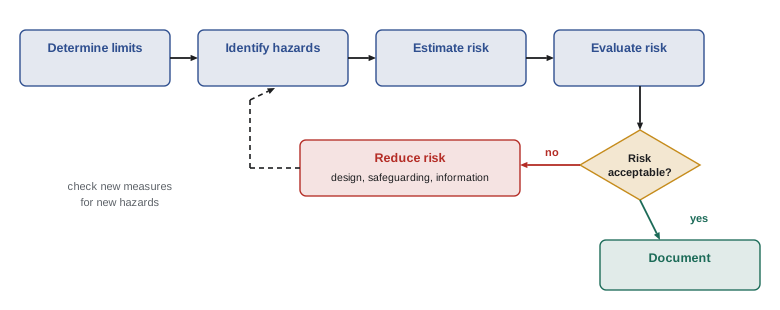
- Determine the limits of the machine. Define its intended use and reasonably foreseeable misuse, who will use it and with what training, the space it occupies and its interfaces with other equipment, the life-cycle phases, the materials processed, the speeds and the environment.
- Identify hazards. Go through every life-cycle phase and every task, and list the hazards: mechanical, electrical, thermal, noise, vibration, radiation, materials, ergonomics and environment. For each hazard, identify the hazardous situation (a person exposed to the hazard) and the hazardous event that could cause harm.
- Estimate risk. For each hazardous situation, estimate the severity of possible harm and the probability of that harm occurring, considering how often and how long people are exposed, the probability of the hazardous event and the possibility of avoiding or limiting the harm.
- Evaluate risk. Decide whether the risk is acceptable or whether further reduction is needed, using the organization's criteria and the standards.
- Reduce risk. Apply the three-step method from Lesson 3, then go back and check that the new measures have not created new hazards and that the remaining risk is acceptable.
- Document. Record the scope, the team, the hazards, the estimates, the measures chosen and the residual risk, and keep the document up to date as the machine or its use changes.
Who should be on the team
A machine risk assessment is a team activity. Operators know how the machine is really used, including the shortcuts. Maintenance workers know what goes wrong and what tasks require access. Supervisors know the production pressures. Engineers know the design and control system. A health and safety professional knows the standards and the method. Including the people who face the hazard is not just good practice; it finds hazards that the others miss, and it builds commitment to the controls.
Identifying tasks and hazards
The most common weakness in machine risk assessments is a narrow task list. Teams list normal production and forget everything else. A good task list includes start-up, normal operation, changeovers and setup, adjustments while running, inspection, troubleshooting, jam clearing, cleaning and sanitation, lubrication, tool changes, preventive maintenance, repair, calibration, teaching (for robots), and shutdown. For each task ask who does it, how often, how long it takes, which hazard zones they enter, what energy is present and whether the safeguarding still works during that task.
| Task | Who | Hazard zone entered | Typical hazards |
|---|---|---|---|
| Normal production | Operator | Load and unload station | Point-of-operation crushing, ejection |
| Changeover | Setter | Tooling area inside guards | Crushing by unexpected motion, heavy tooling, sharp edges |
| Jam clearing | Operator or setter | Infeed and point of operation | Unexpected restart, stored energy in springs or cylinders |
| Sanitation | Cleaning crew | All areas, often with power on for rinsing | Entanglement, slips, chemicals, electrical |
| Maintenance | Millwright, electrician | Drives, hydraulics, control panels | Stored energy, electrical shock, falls from height |
Estimating risk
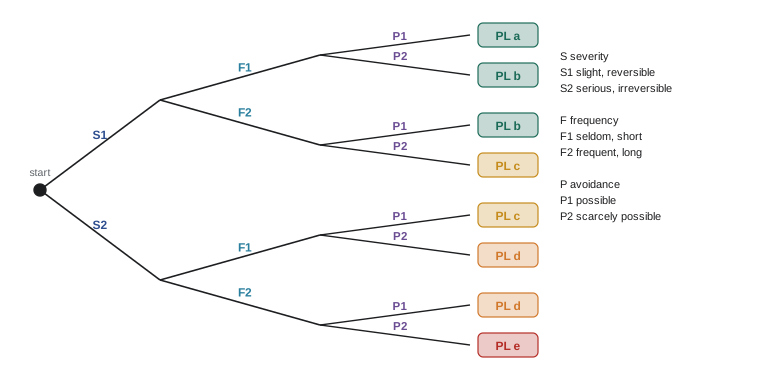
Standards do not prescribe a single risk estimation tool. Many organizations use a risk matrix that combines severity and probability. Machine safety standards often use parameters that break probability into parts: how often and how long a person is exposed, how likely the hazardous event is, and whether the person can avoid or limit the harm. Severity is usually judged on the worst credible outcome, not the most likely one, because amputation and death are always credible around powered machinery.
| Parameter | Lower level | Higher level |
|---|---|---|
| Severity (S) | S1: slight, normally reversible injury (bruise, small cut) | S2: serious, normally irreversible injury or death (amputation, fracture with lasting effects) |
| Frequency and duration of exposure (F) | F1: seldom to less often and short exposure | F2: frequent to continuous or long exposure |
| Possibility of avoiding the hazard (P) | P1: possible under specific conditions (slow motion, warning, trained person) | P2: scarcely possible (fast motion, no warning, unexpected) |
From risk to required performance level
When a risk reduction measure depends on the machine's control system, for example an interlock that stops the machine when a guard opens, the control system must be reliable enough for the risk. ISO 13849-1 expresses this reliability as a performance level, from PL a (lowest) to PL e (highest). The risk graph in the standard turns the three parameters into a required performance level, written PLr, for each safety function. Lesson 7 explains what performance levels mean for the design of the control system.
Worked problem
Determining the required performance level for a guard interlock
An interlocked access door on a robotic welding cell must stop the robot when opened. The robot can cause fatal crushing injuries. Operators open the door several times every shift to load fixtures. The robot moves quickly and without warning. What PLr does the risk graph give?
Show solution
- Severity: a crushing injury from a robot can be fatal or cause permanent disability, so S2.
- Frequency: several times every shift is frequent, so F2.
- Avoidance: fast motion without warning makes avoidance scarcely possible, so P2.
- Follow the graph: S2, F2, P2 leads to PL e.
Answer: The safety function 'stop the robot when the door opens' needs PLr e, the highest level. The interlock switch, the safety controller and the way the robot is stopped must together achieve PL e. This is why such cells use safety-rated interlocks, dual-channel wiring and safety controllers rather than ordinary switches.
Worked problem
Reducing risk can change the required level
A low-speed conveyor transfer point creates a nip that could cause a minor, reversible pinch injury. An operator reaches near it only during a weekly cleaning task, and the conveyor runs slowly enough to pull back. What is the PLr for an interlock on the cover?
Show solution
- Severity: slight, reversible injury, so S1.
- Frequency: weekly and short, so F1.
- Avoidance: slow motion, trained person, so P1.
- The graph gives PL a.
Answer: PLr a. In practice, many organizations would still choose a fixed guard and lockout for cleaning, because a fixed guard is simple and reliable. The risk graph sets the minimum for a control-system function, not a ceiling on good practice. Be careful not to underestimate severity: if the nip could catch a glove and pull in a hand, severity is S2.
Risk estimation pitfalls
Risk assessment is only as good as the honesty of the people doing it. Common pitfalls include rating severity on the most likely outcome rather than the worst credible one; assuming people will always follow procedures; ignoring tasks that are not in the manual, such as clearing jams; assuming a guard is effective without checking the safety distance; and rating avoidance as possible because experienced operators have never been hurt. A useful discipline is to ask what would happen if the most inexperienced worker did the task on the busiest day of the year.
Another pitfall is treating the risk assessment as paperwork for compliance. A risk assessment that sits in a binder does nothing. The result should drive real decisions: which guards to install, how interlocks are designed, what the lockout procedure says, what training covers, and what inspections check.
Worked problem
Calculating a simple risk score
An organization uses a 5 by 5 risk matrix. Severity is rated 1 (first aid) to 5 (fatality) and likelihood 1 (rare) to 5 (almost certain). Risk scores of 15 or more require immediate action, 8 to 14 require action within 30 days, and 7 or less are monitored. An unguarded shaft coupling could cause a fatal entanglement (severity 5), and maintenance workers pass close to it daily (likelihood 3). After a fixed guard is installed, likelihood falls to 1. What are the scores before and after?
Show solution
- Before: \( 5 \times 3 = 15 \), which requires immediate action.
- After: \( 5 \times 1 = 5 \), which can be monitored.
- Severity stays at 5 because the guard does not change what would happen if contact occurred; it changes the likelihood of contact.
Answer: The risk score falls from 15 to 5. Note that the guard reduces likelihood, not severity. Inspections must confirm the guard stays in place, or the likelihood will rise again.
Documenting and maintaining the assessment
A machine risk assessment should record the machine and its limits, the team and date, the tasks and hazards, the risk estimates before and after measures, the measures selected with the required performance levels, the verification and validation carried out, and the residual risks and how they are communicated. It should be reviewed whenever the machine is modified, moved, used for a new product or process, after an incident or near miss, when standards change, and at a regular interval set by the organization.
The assessment also links to other documents: the lockout procedure for each machine, the safeguarding inspection checklist, operator training records, and, in Ontario, any pre-start health and safety review report. Keeping these documents consistent is part of a mature machine safety program.
Some organizations add a simple check to every risk assessment: for each hazard rated high, the team must name the specific engineering control that addresses it, the person responsible and the date. Hazards that can only be controlled by procedures or PPE are flagged for a second look by an engineer. This keeps the assessment focused on real risk reduction rather than paperwork.
Common mistakes
MistakeListing only normal production tasks.
InsteadInclude setup, jam clearing, cleaning, maintenance, troubleshooting and every other life-cycle task.
MistakeRating severity on the most likely injury.
InsteadRate severity on the worst credible outcome; amputation and death are credible around powered machines.
MistakeAssuming experienced workers can always avoid the hazard.
InsteadRate avoidance on the speed and predictability of the hazard, not on confidence.
MistakeDoing the assessment alone in an office.
InsteadUse a team that includes operators and maintainers who know how the machine is really used.
MistakeFiling the assessment and never updating it.
InsteadReview it after changes, incidents, new products and at regular intervals.
Summary and key terms
- A machine risk assessment determines limits, identifies hazards, estimates and evaluates risk, and reduces it.
- The process is iterative: new measures must be checked for new hazards.
- Hazard identification must cover every task and life-cycle phase, not just production.
- Risk is estimated from severity, exposure, the probability of the event and the possibility of avoidance.
- The ISO 13849-1 risk graph converts severity, frequency and avoidance into a required performance level.
- Common pitfalls include narrow task lists, optimistic severity ratings and paperwork-only assessments.
- Assessments must be documented and reviewed when machines, uses or standards change.
- Risk assessment
- The process of identifying hazards and estimating, evaluating and reducing risk.
- Limits of the machine
- The defined intended use, foreseeable misuse, users, space, time and interfaces of a machine.
- Hazardous situation
- A circumstance in which a person is exposed to a hazard.
- Hazardous event
- An event that can cause harm.
- Reasonably foreseeable misuse
- Use of a machine in a way not intended but likely given human behaviour.
- Severity
- How serious the possible harm is.
- Performance level (PL)
- The ability of a safety-related control system to perform its safety function, from a to e.
- Required performance level (PLr)
- The performance level needed for a safety function given the risk.
- Risk graph
- A decision tree used to determine the PLr from severity, frequency and avoidance.
- Risk matrix
- A grid combining severity and likelihood to score and rank risks.
Practice problems
Work each problem on paper first, then reveal the answer to check.
List the steps of the ISO 12100 risk assessment process.
Show answer
Determine limits, identify hazards, estimate risk, evaluate risk, reduce risk, then repeat and document.
Name four tasks that should be in a machine task list besides production.
Show answer
Setup, jam clearing, cleaning, maintenance, troubleshooting, lubrication or tool changes.
What three parameters does the ISO 13849-1 risk graph use?
Show answer
Severity (S), frequency and duration of exposure (F) and possibility of avoidance (P).
What PLr results from S2, F1, P2?
Show answer
PL d.
What PLr results from S1, F2, P2?
Show answer
PL c.
Why should operators be on the risk assessment team?
Show answer
They know how the machine is really used, including shortcuts and problem tasks.
A guard reduces likelihood from 4 to 1 on a severity 5 hazard. What are the matrix scores?
Show answer
20 before and 5 after.
Why rate severity on the worst credible outcome?
Show answer
Because serious injuries such as amputation are credible around powered machinery even if not most likely.
When should a machine risk assessment be reviewed?
Show answer
After modifications, relocation, new products, incidents or near misses, standard changes and at regular intervals.
What is reasonably foreseeable misuse?
Show answer
A way of using the machine that was not intended but is likely given human behaviour, such as reaching in to clear a jam.
Lesson quiz · 5 questions
Score 60% or more to complete this lesson.
Create a free account to save your progress, take quizzes and earn a certificate.