
HSE-215 · Lesson 9 of 12 · 27 min
Guarding common machines: presses, saws, grinders, conveyors and robots
The principles in this course apply to every machine, but certain machines appear again and again in injury reports. This lesson looks at how the general principles apply to the most common ones, and at the specific standards that cover them. It is an overview for recognizing hazards and good practice, not a design manual: each machine type has detailed standards that a competent person must follow.
Power presses and press brakes
Power presses punch, form, draw and stamp sheet metal using a ram that closes a die. They cause a large share of amputations in manufacturing. Mechanical presses are driven by a flywheel through a clutch. Full-revolution clutch presses, an older design, cannot be stopped once a stroke starts until the crankshaft completes its revolution; part-revolution clutch presses can be stopped at any point in the stroke. Hydraulic presses use a cylinder and can usually be stopped at any point. Press brakes bend long sheets and are often hand-fed, with the operator holding the workpiece close to the dies.
CSA Z142, Code for power press operation: health, safety and guarding requirements, covers power presses in Canada, and some provinces refer to it. Point-of-operation safeguarding options include fixed die enclosure guards, interlocked guards, light curtains (only on presses that can stop mid-stroke), two-hand controls and, on some older presses, pull-back or restraint devices. Press brakes increasingly use laser-based systems mounted on the ram that detect fingers just below the punch and stop or slow the closing motion.
The most important rule for presses is that no part of the body should ever need to enter the die area during the stroke. Feeding with hand tools, automatic feeds, chutes and ejectors keeps hands out. Where hands must load parts, the safeguarding must ensure the press cannot close while they are there. Setup and die changes are high-risk tasks that need die blocks, lockout and safe procedures.
Saws
Saws cut by contact with a sharp, fast-moving blade, so any contact with the blade causes serious injury. Each type has its own hazards and guards.
| Saw | Main hazards | Key safeguards |
|---|---|---|
| Table saw | Blade contact, kickback of the workpiece toward the operator | Blade guard over the cut, riving knife or splitter, anti-kickback pawls, push sticks, sometimes active contact-detection brakes |
| Band saw | Contact with the exposed blade near the table, blade breakage | Adjustable upper guard set just above the work, guards enclosing the wheels and the blade behind the table, push sticks |
| Radial arm and mitre saws | Blade contact, saw climbing toward the operator | Self-adjusting lower guard, upper hood, return mechanism, keeping hands clear of the marked danger zone |
| Cut-off and chop saws for metal | Wheel breakage, sparks, blade contact | Wheel guards, clamps for the workpiece, eye and face protection |
| Meat and food slicers | Blade contact during slicing and cleaning | Ring guard around the blade, carriage interlocks, cut-resistant gloves for cleaning, lockout for cleaning |
Kickback deserves special mention. On a table saw, the rear of the blade, which rises toward the operator, can catch a workpiece that pinches it and throw it back at high speed. A riving knife, a curved blade that sits just behind the saw blade and rises and falls with it, keeps the kerf open and greatly reduces kickback. Push sticks and push blocks keep hands away from the blade when ripping narrow pieces.
Abrasive wheels and grinders
Bench and pedestal grinders are found in almost every shop. Their main hazards are wheel breakage, which can throw fragments at very high speed, contact with the wheel, and the workpiece being caught between the wheel and the work rest and pulling the hand in. Guards and adjustments are simple but critical.
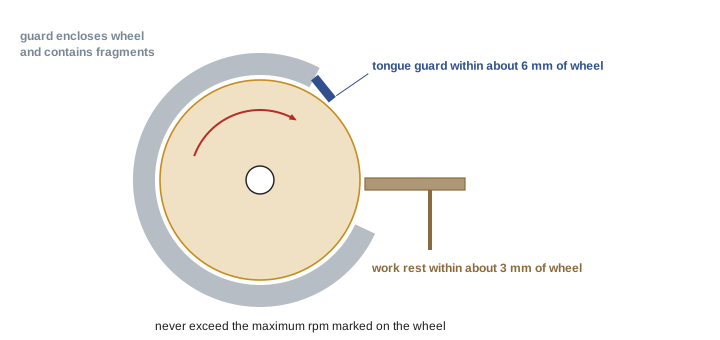
Provincial regulations and the widely used ANSI B7.1 safety code for abrasive wheels set out the main rules: keep the wheel enclosed in a guard strong enough to contain fragments, keep the work rest adjusted close to the wheel, commonly within about 3 mm (1/8 in), so work cannot be wedged between them, keep the adjustable tongue guard at the top of the opening close to the wheel, commonly within about 6 mm (1/4 in), never exceed the maximum speed marked on the wheel, ring-test vitrified wheels for cracks before mounting, and stand to the side when starting a new wheel. Check your provincial regulation for exact requirements.
Worked problem
Checking a grinder wheel speed
A 200 mm diameter grinding wheel is marked with a maximum speed of 3,820 rpm. It will be mounted on a grinder that runs at 3,600 rpm. Is it safe, and what is the peripheral speed?
Show solution
- Compare speeds: the spindle runs at 3,600 rpm, below the wheel's 3,820 rpm rating, so the wheel is within its rating.
- Peripheral speed: \( v = \pi D N = \pi \times 0.200 \times 3{,}600 / 60 \approx 37.7 \text{ m/s} \).
Answer: The wheel can be used at 3,600 rpm. Its rim moves at about 38 m/s, roughly 136 km/h, which shows why a broken wheel is so dangerous and why the guard must contain fragments. Never fit a wheel rated below the spindle speed, and remember that a smaller wheel worn down does not make a higher spindle speed safe unless the wheel and machine are rated for it.
Conveyors
Conveyors move material through almost every warehouse, plant and mine. Because they run continuously and often unattended, people work near them all day, and they are frequently involved in entanglement, nip point and crushing injuries. Hazards include belt-to-pulley nip points at head, tail, snub and take-up pulleys, chain and sprocket drives, rollers, transfer points between conveyors, screw conveyors, and the material itself falling or jamming.
CSA Z432 and provincial regulations require guarding of conveyor nip points and drives. Many Canadian operations also follow ASME B20.1, the North American safety standard for conveyors. Key practices include fixed guards on all pulleys, drives and nip points within reach; pull-cord emergency stops along accessible lengths; guards on return rollers in walkways; covers on screw conveyors that cannot be removed while running; crossovers rather than climbing over conveyors; and lockout before clearing jams or cleaning belts.
Belt cleaning and tracking adjustments are classic conveyor hazards. Workers are tempted to scrape build-up from a running belt or adjust a tracking roller while watching the belt run. Engineering solutions include belt cleaners and scrapers that work without human contact, tracking adjustments placed outside guards, and guards with inspection windows. Where a task truly requires the belt to move, it should be done at slow speed with specific procedures, not by reaching past guards.
Robots and cobots
Industrial robots move fast, with great force, and can move unexpectedly as they follow programs. CSA Z434, which adopts ISO 10218 with Canadian deviations, covers industrial robot safety; the new 2025 editions of ISO 10218-1 and -2 absorbed the earlier collaborative robot technical specification ISO/TS 15066. Traditional robot cells use perimeter fences with interlocked gates, light curtains or scanners at openings, and reduced-speed teach modes with enabling devices. Collaborative applications allow people and robots to share space, using speed and separation monitoring or power and force limiting, but they still require a risk assessment of the whole application, including the tool and the parts being handled. ROB-450 and HSE courses on robotics cover this in depth.
Other common machines
| Machine | Main hazard | Typical safeguards |
|---|---|---|
| Lathe | Entanglement in rotating chuck and stock; ejected chuck keys and chips | Chuck guard interlocked with the spindle, self-ejecting chuck key, chip shield, no gloves or loose clothing near rotating parts |
| Drill press | Entanglement in spindle and bit; workpiece spinning | Spindle guard, clamps or vices to hold work, no gloves near rotating parts |
| Milling machine | Contact with the cutter, entanglement, chips | Cutter guards, interlocked enclosures on CNC machines, chip shields |
| Mixer (food or industrial) | Contact with agitator, entanglement | Interlocked bowl guard or lid, bowl lowering interlock, lockout for cleaning |
| Roll mill or calender | In-running nip between rolls | Safety trip bars or wires within reach, fixed nip guards, stopping distance limits |
| Jointer | Contact with cutter head | Self-adjusting guard over the head, push blocks, guard behind the fence |
| Baler and compactor | Crushing by the ram, entanglement in baling wire | Interlocked gates, lockout for clearing, age restrictions in some jurisdictions |
| Power transmission (any machine) | Belts, pulleys, chains, gears, shafts, couplings | Fixed guards enclosing all parts within reach |
CNC machines and automation
Computer numerically controlled machines are usually supplied with interlocked enclosures that stop the spindle and axes when the door opens. Their hazards shift toward setup, tool changes, programming errors that cause crashes, and the temptation to override door interlocks to watch a cut or speed up setup. Many CNC injuries involve a door interlock that has been defeated. Modern controls provide safe setup modes with reduced speeds and hold-to-run controls so the door does not need to be bypassed.
Worked problem
Choosing safeguarding for a hand-fed operation
A small shop has a hydraulic press used to press bushings into housings. The operator places each housing on a fixture and the press stroke is short. The current safeguarding is a single foot pedal. The press can stop at any point in its stroke. Which safeguarding options would you consider, and why?
Show solution
- First ask whether the fixture can be redesigned so the operator loads it outside the press and slides it in, or whether the opening can be made too small for fingers: inherently safe design.
- If not, consider a fixed die enclosure guard with a feeding slot meeting the safety distance tables.
- If the operator must place parts in the die area, use a two-hand control placed at the calculated safety distance, or a light curtain, which is possible because the press can stop mid-stroke.
- Remove or guard the foot pedal, because it leaves both hands free to be in the die area while the press closes.
- Add lockout and die-change procedures for setup.
Answer: A foot pedal alone is not adequate point-of-operation protection. A redesigned fixture, a fixed enclosure, a two-hand control or a properly positioned light curtain would each be better, with the choice depending on the risk assessment, production needs and stopping time. Combining a fixed guard on the sides and back with a light curtain or two-hand control at the front is common.
Common mistakes
MistakeUsing a light curtain on a full-revolution clutch press.
InsteadFull-revolution presses cannot stop mid-stroke; use guards or other suitable means.
MistakeRemoving the riving knife or blade guard on a table saw for convenience.
InsteadKeep the riving knife and guard in place and use push sticks; they prevent kickback and contact.
MistakeLeaving a large gap between a grinder's work rest and wheel.
InsteadKeep the work rest within about 3 mm and the tongue guard within about 6 mm of the wheel.
MistakeScraping or adjusting a running conveyor belt.
InsteadUse belt cleaners and external adjustments, and lock out for tasks inside guards.
MistakeAssuming a collaborative robot needs no risk assessment.
InsteadThe whole application, including tools and parts, must be assessed.
Summary and key terms
- Presses must keep hands out of the die area during the stroke; light curtains suit only presses that can stop mid-stroke.
- Saws need blade guards, riving knives and push sticks; kickback is a major table saw hazard.
- Grinders need strong guards, close work rest and tongue guard settings, and wheels rated for the spindle speed.
- Conveyor nip points, drives and rollers must be guarded, with pull-cord stops and lockout for jams.
- Robot safety follows ISO 10218 (2025 editions), adopted through national standards, and collaborative applications still need risk assessment.
- Lathes, drill presses, mixers, roll mills and other machines each have characteristic hazards and safeguards.
- Defeated CNC door interlocks are a common cause of injury; safe setup modes remove the need.
- Part-revolution clutch
- A press clutch that can be disengaged at any point in the stroke.
- Full-revolution clutch
- A press clutch that, once engaged, completes a full revolution before stopping.
- Press brake
- A press that bends long sheets of metal between a punch and die.
- Riving knife
- A curved blade behind a saw blade that keeps the kerf open and reduces kickback.
- Kickback
- A workpiece thrown back toward the operator by a saw blade.
- Work rest
- The support for the workpiece in front of a grinding wheel.
- Tongue guard
- The adjustable part of a grinder guard at the top of the opening.
- Ring test
- Tapping a vitrified wheel and listening for a clear ring to detect cracks.
- Pull-cord stop
- An emergency stop operated by a cord along a conveyor.
- Collaborative application
- A robot application in which people and robots share space under specific safeguards.
Practice problems
Work each problem on paper first, then reveal the answer to check.
Why can a light curtain not safeguard a full-revolution clutch press?
Show answer
The press cannot stop once the stroke starts.
What does a riving knife do?
Show answer
Keeps the cut open behind the blade, reducing kickback.
What are the typical work rest and tongue guard gaps on a bench grinder?
Show answer
About 3 mm and about 6 mm.
What is the rim speed of a 150 mm wheel at 3,000 rpm?
Show answer
About 23.6 m/s, from π × 0.15 × 3,000 / 60.
Name three conveyor hazards.
Show answer
Belt-to-pulley nip points, chain and sprocket drives, return rollers, transfer points or screw conveyors.
Why are foot pedals poor point-of-operation protection on presses?
Show answer
They leave both hands free to be in the die area while the press closes.
Which standard series covers industrial robot safety internationally?
Show answer
ISO 10218, parts 1 and 2, with 2025 editions.
Why should gloves not be worn near a lathe chuck?
Show answer
They can be caught and pull the hand into the rotating chuck.
What is a safe alternative to defeating a CNC door interlock during setup?
Show answer
A controlled setup mode with reduced speed and hold-to-run controls.
What should be done before clearing a conveyor jam inside a guard?
Show answer
Stop and lock out the conveyor and release stored energy.
Lesson quiz · 5 questions
Score 60% or more to complete this lesson.
Create a free account to save your progress, take quizzes and earn a certificate.