
HSE-215 · Lesson 12 of 12 · 26 min
Inspection, auditing, incident lessons and capstone: guarding a fabrication shop
Safeguarding is not a one-time project. Guards are removed and refitted, fasteners go missing, interlock switches wear out, light curtains drift out of alignment, brakes wear, new tasks appear and new workers arrive. A machine that was well guarded at commissioning can become dangerous within months. This final lesson covers how to keep safeguarding effective through inspection and auditing, what incidents teach, and how to put the whole course together in a guarding assessment of a small fabrication shop.
Levels of inspection
Effective programs use several layers of inspection, each with a different purpose and frequency.
| Inspection | Who | How often | What it covers |
|---|---|---|---|
| Pre-use check | Operator | Each shift or before use | Guards in place and secure, interlocks and emergency stops work, no obvious damage |
| Functional test of devices | Operator or setter | Daily or per manufacturer | Light curtain test-piece test, two-hand control function, mat response |
| Planned workplace inspection | Supervisor, joint committee member or representative | Monthly in Ontario for committee members, or as set by the program | Missing guards, bypasses, housekeeping, procedures followed |
| Preventive maintenance | Maintenance | Per schedule | Interlock switch wear, guard condition, brake and valve performance, stopping time |
| Safeguarding audit | Competent person or engineer | Annually or after changes | Risk assessment current, safety distances, performance levels, documentation |
Pre-use checks are short and practical. An operator should be able to complete them in a minute or two with a simple checklist: are all guards present and fastened, does opening each interlocked door stop the machine, does the emergency stop work and latch, is the light curtain test piece detected along the whole height, are there any signs of tampering. Problems are reported and the machine is tagged out of service until fixed.
Auditing the program
An audit looks beyond individual machines to the system that keeps them safe. A safeguarding audit asks whether there is an inventory of machines, whether each has a current risk assessment, whether safeguarding meets current standards, whether safety functions have been validated, whether lockout procedures exist for each machine, whether operators and maintainers are trained, whether inspections are done and findings closed, whether modifications go through management of change, and whether bypasses are found and investigated. It produces a prioritized action plan.
Worked problem
Scoring an audit
An audit checks 40 items across a plant's machine safeguarding program. Each item scores 2 if fully in place, 1 if partly in place and 0 if missing. The plant scores 2 on 22 items, 1 on 12 items and 0 on 6 items. What is the percentage score, and how should the results be used?
Show solution
- Points earned: \( 22 \times 2 + 12 \times 1 + 6 \times 0 = 44 + 12 = 56 \).
- Maximum points: \( 40 \times 2 = 80 \).
- Score: \( 56 / 80 = 70 \% \).
Answer: The program scores 70 %. The number matters less than the six missing items, which should be ranked by risk and fixed first. An overall score can hide a single critical gap, such as an unguarded press, so audits should flag high-risk findings regardless of the total.
What incidents teach
Machine incidents follow familiar patterns. The cases below are composites, built from common findings in incident investigations and enforcement reports rather than from any single event. Each illustrates lessons from earlier in the course.
Composite case 1, the jam: a worker on a packaging line reached through an opening in a guard to free a jammed carton. The infeed rollers were still running, caught her glove and drew her hand in. The opening had been cut in the guard months earlier to make jam clearing faster. Lessons: guard openings must meet safety distances; jams are a reasonably foreseeable task that needs a safe method; modifications to guards need management of change; and frequent jams are a warning sign.
Composite case 2, the bypassed interlock: a maintenance worker on a CNC machine was injured when the spindle started while he was adjusting a tool. A co-worker had defeated the door interlock with a spare actuator so the machine could run with the door open while he watched a cut. Lessons: interlocks must be tamper-resistant; setup modes with reduced speed remove the need to bypass; supervisors must look for bypasses; and lockout is required for adjustments inside the machine.
Composite case 3, the light curtain: an operator at a press brake lost two fingers when the ram closed even though her hand was in the light curtain. Investigation found the curtain had been remounted closer to the dies during a tooling change, and the press's stopping time had increased as its valves wore. Lessons: safety distances must be recalculated whenever devices are moved; stopping time must be remeasured periodically; and changes need revalidation.
Composite case 4, the cleaning shift: a young worker employed by a contract sanitation company was cleaning a conveyor at night when the belt started. He had not been trained in lockout and the host plant's procedure did not cover contractors. Lessons: host employers must ensure contractors follow lockout; cleaning tasks need specific procedures and modes; and young and new workers need close supervision.
Composite case 5, the used machine: a small shop bought a used shear at auction. Its point-of-operation guard had been removed by a previous owner. An operator's fingers were amputated in the first week. Lessons: used machines must be assessed and upgraded before use, and price is not a substitute for a risk assessment.
Investigating machine incidents
When a machine incident or near miss happens, the investigation should look past the immediate act to the conditions that made it possible. Useful questions include: was the hazard identified in the risk assessment; was the safeguarding adequate for the task being done; had safeguarding been modified, bypassed or poorly maintained; did stopping performance meet the design; was the worker trained and supervised for this task; what production pressures or design problems encouraged the shortcut; and were there earlier near misses or complaints. Corrective actions should follow the hierarchy of controls: fix the design first, then procedures and training.
In Canada, serious injuries must be reported to the regulator, and in Ontario the scene must not be disturbed except to save life or prevent further injury until an inspector permits it. Joint health and safety committees or representatives must be notified and can take part in the investigation.
Capstone: a guarding assessment of a small fabrication shop
You have been asked to assess machine safeguarding in a small metal fabrication shop with eight employees. The shop has a mechanical power press, a press brake, a bench grinder, a band saw, a drill press, a belt conveyor that carries parts to a finishing area, and an iron worker. Your walk-through finds the issues numbered on the plan below.
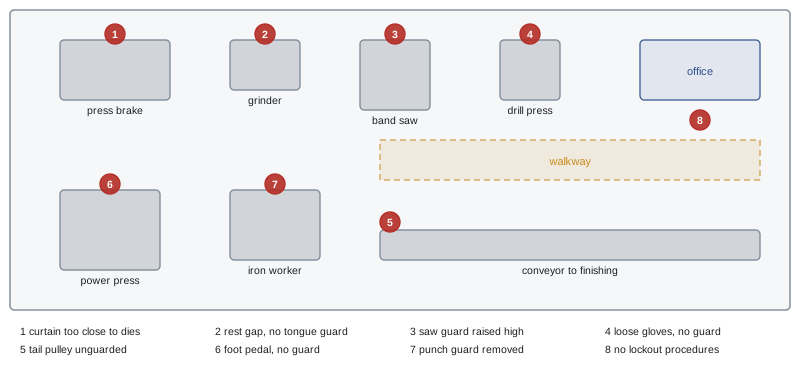
Use the organization's 5 by 5 risk matrix (severity 1 to 5 times likelihood 1 to 5) to rank the findings, then propose controls following the hierarchy.
| Finding | Severity | Likelihood | Score | Priority |
|---|---|---|---|---|
| 6 Power press: foot pedal, no point-of-operation guard | 5 | 4 | 20 | Immediate: stop use |
| 1 Press brake light curtain too close to dies | 5 | 4 | 20 | Immediate: stop use |
| 7 Iron worker punch guard removed | 5 | 3 | 15 | Immediate |
| 5 Conveyor tail pulley unguarded by walkway | 5 | 3 | 15 | Immediate |
| 8 No lockout procedures | 5 | 3 | 15 | Immediate, program-wide |
| 4 Drill press: loose gloves, no spindle guard | 4 | 3 | 12 | Within days |
| 2 Grinder work rest gap and missing tongue guard | 4 | 3 | 12 | Within days |
| 3 Band saw upper guard raised high | 4 | 3 | 12 | Within days |
Worked problem
Correcting the press brake light curtain
The press brake has a 14 mm light curtain mounted 180 mm from the dies. You measure a total stopping time of 140 ms. What distance is required, and what must be done?
Show solution
- Required distance: \( S = 2{,}000 \times 0.140 + 8(14 - 14) = 280 \text{ mm} \).
- The curtain is 100 mm too close.
- Options: move the curtain to the required distance and guard the gaps, repair the press so it stops faster, or fit a laser-based press brake safeguarding system designed for close work.
Answer: The curtain must be at least 280 mm from the dies. Until it is corrected and revalidated, the press brake must not be used.
Building the action plan
A good action plan for the shop would include:
- Immediately take the power press, press brake and iron worker out of service and tag them until safeguarded.
- Fit a fixed guard to the conveyor tail pulley the same day, checked against the safety distance tables.
- For the power press, determine whether it has a full-revolution or part-revolution clutch. Fit a die enclosure or fixed barrier guard; if hands must enter the die area and the press can stop mid-stroke, add two-hand controls or a light curtain at the calculated distance, and remove the foot pedal.
- Refit the iron worker punch guard and find out why it was removed.
- Adjust the grinder work rest and fit the tongue guard; add a pre-use check.
- Install a drill press spindle guard, provide vices or clamps, and set a rule against loose gloves near rotating parts.
- Train operators to set the band saw guard just above the work, and include it in pre-use checks.
- Write machine-specific lockout procedures under CSA Z460 and the provincial regulation, and train all workers, including any contract cleaners.
- Complete documented risk assessments for every machine and set up monthly inspections and an annual audit.
- Review purchasing so future machines arrive properly safeguarded, and assess any used machines before use.
The capstone shows how the parts of the course connect. Hazard recognition finds the problems. The law and standards set the expectations. The hierarchy of controls and risk assessment guide the choices. Guards, devices and reliable controls do the protecting. Lockout covers maintenance. Inspection, auditing and good purchasing keep the safeguarding working for the life of each machine.
Finally, close the loop with the workers. Share the findings and the action plan, explain why some machines are out of service, and ask for their ideas. People who helped find the problems are more likely to keep the safeguards in place once they are fixed.
Common mistakes
MistakeInspecting only for missing guards.
InsteadCheck function, safety distances, signs of tampering and stopping performance too.
MistakeLetting a high overall audit score hide a critical gap.
InsteadFlag and fix high-risk findings regardless of the total score.
MistakeBlaming the injured worker and stopping there.
InsteadInvestigate the design, maintenance, supervision and pressures that made the shortcut possible.
MistakeFixing findings in the order they were found.
InsteadRank findings by risk and take machines with the highest scores out of service first.
MistakeTreating an action plan as complete once written.
InsteadAssign owners and dates, verify corrections and revalidate safety functions.
Summary and key terms
- Safeguarding degrades over time and needs layered inspection: pre-use, functional tests, planned inspections, maintenance and audits.
- Audits check the whole program and produce a risk-ranked action plan.
- Incidents repeatedly involve jams, bypassed interlocks, moved devices, untrained contractors and used machines.
- Investigations should look for underlying conditions and apply the hierarchy of controls to corrective actions.
- Serious injuries must be reported to the regulator, and in Ontario the scene preserved.
- A capstone assessment ranks findings by risk and prioritizes immediate stops for the worst hazards.
- Machine safety is a life-cycle program, not a one-time project.
- Pre-use check
- A short check by the operator that safeguards are in place and working before use.
- Functional test
- A test confirming that a device, such as a light curtain, detects and stops as intended.
- Planned inspection
- A scheduled workplace inspection that includes machine safeguarding.
- Safeguarding audit
- A systematic review of the machine safety program and its effectiveness.
- Action plan
- A list of corrective actions with priorities, owners and dates.
- Composite case
- An illustrative case built from common findings rather than a single real event.
- Near miss
- An event that could have caused injury but did not.
- Root cause
- An underlying condition that allowed an incident to happen.
- Out of service tag
- A tag that prevents a defective machine from being used until repaired.
- Revalidation
- Retesting safety functions after changes or repairs.
Practice problems
Work each problem on paper first, then reveal the answer to check.
Name the layers of safeguarding inspection.
Show answer
Pre-use checks, functional tests, planned inspections, preventive maintenance and audits.
What should an operator's pre-use check include?
Show answer
Guards present and secure, interlocks and emergency stops working, device test, signs of tampering.
An audit earns 64 of 80 points. What is the score?
Show answer
80 %.
What lesson does the jam case teach?
Show answer
Jams are foreseeable and need a safe method; guard openings must meet safety distances and modifications need review.
Why should stopping time be remeasured periodically?
Show answer
Wear increases stopping time, making devices too close to the hazard.
Which capstone findings require immediate action?
Show answer
The power press, press brake, iron worker, conveyor tail pulley and the lack of lockout procedures.
A 14 mm curtain system stops in 0.12 s. What distance is required?
Show answer
240 mm.
What should investigations look for besides the worker's action?
Show answer
Design, safeguarding adequacy, maintenance, training, supervision, production pressure and earlier warnings.
What must happen to an Ontario incident scene after a critical injury?
Show answer
It must not be disturbed, except to save life or prevent further harm, until an inspector permits it.
Why should a high audit score not end the discussion?
Show answer
A single critical gap, such as an unguarded press, can be hidden in a good total.
Lesson quiz · 5 questions
Score 60% or more to complete this lesson.
Create a free account to save your progress, take quizzes and earn a certificate.