
HSE-215 · Lesson 2 of 12 · 24 min
OSHA machine guarding standards and the law in the US
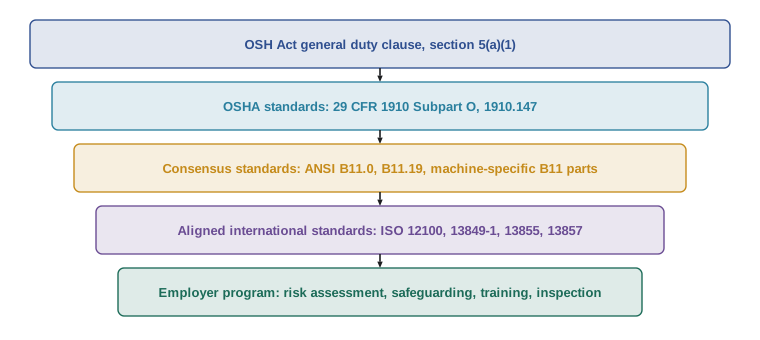
Machine guarding in the United States rests on three layers. The first is the general duty clause of the Occupational Safety and Health Act of 1970, section 5(a)(1), which requires every employer to keep the workplace free from recognized hazards likely to cause death or serious harm. The second is OSHA's specific standards in 29 CFR 1910 Subpart O, Machinery and Machine Guarding, and related rules. The third is the consensus standards, above all the ANSI B11 series, which OSHA uses to interpret what is feasible and recognized, and which engineers use to design safeguarding.
Who is responsible
Under the OSH Act, the employer carries the legal duty to comply with OSHA standards and the general duty clause. Employees must comply with standards and rules that apply to their own conduct, but OSHA cites employers, not workers. Manufacturers are not regulated by OSHA's machine guarding standards directly, but they face product liability law and voluntary standards such as ANSI B11 that assign duties to suppliers and users. On multi-employer worksites, OSHA's multi-employer citation policy allows more than one employer to be cited for the same hazard: the creating, exposing, correcting and controlling employers can each be responsible.
The specific rules
OSHA's machine guarding rules sit mostly in Subpart O. The general requirement, 1910.212, applies to every machine not covered by a more specific standard. More specific rules cover woodworking machinery, abrasive wheels, mechanical power presses, forging machines and mechanical power transmission apparatus. Other subparts add rules for particular industries and situations. The table lists the main provisions.
| Standard | What it covers |
|---|---|
| 29 CFR 1910.212 | General requirements for all machines: guard the point of operation, nip points, rotating parts and flying chips; anchor fixed machines |
| 29 CFR 1910.213 | Woodworking machinery: saws, jointers, shapers, sanders and similar machines |
| 29 CFR 1910.215 | Abrasive wheel machinery: wheel guards, work rests and tongue guards |
| 29 CFR 1910.217 | Mechanical power presses: point-of-operation guards and devices, safety distance, inspections |
| 29 CFR 1910.218 | Forging machines |
| 29 CFR 1910.219 | Mechanical power transmission apparatus: belts, pulleys, shafts, gears and sprockets |
| 29 CFR 1910.147 | Control of hazardous energy (lockout/tagout) during servicing and maintenance |
| 29 CFR 1926.300 to .307 | Tools and machinery in construction |
The general requirement in 1910.212(a)(1) says one or more methods of machine guarding shall be provided to protect the operator and other employees from hazards such as those created by point of operation, ingoing nip points, rotating parts, flying chips and sparks. Guards must be affixed to the machine where possible, must not themselves create a hazard, and must be designed so that no part of the body can enter the danger zone during the operating cycle. 1910.212(a)(3)(ii) requires that the point of operation of machines whose operation exposes an employee to injury be guarded, and lists examples such as guillotine cutters, shears, power presses, milling machines, power saws, jointers, portable power tools and forming rolls.
The consensus standards
The ANSI B11 series covers machine tools and general machine safety. ANSI B11.0, Safety of Machinery, sets the general requirements and the risk assessment process, and ANSI B11.19, Performance Requirements for Risk Reduction Measures, covers guards, devices and their performance. Machine-specific standards in the series cover presses, press brakes, shears, saws, robots and other machines. ANSI B11 standards are harmonized in many respects with international standards such as ISO 12100 (risk assessment), ISO 13855 (positioning of protective devices), ISO 13857 (safety distances), ISO 13849-1 and IEC 62061 (safety-related control systems) and ISO 13850 (emergency stops). OSHA does not enforce ANSI B11 directly, but OSHA interpretations and the courts use it as evidence of recognized hazards and feasible controls.
Other standards apply to particular machines: ANSI B11.1 for mechanical power presses, ANSI B11.3 for press brakes, ANSI/A3 R15.06 for industrial robots, ANSI/ASSP Z244.1 for alternative methods of hazardous energy control, and NFPA 79 for the electrical equipment of industrial machinery. OSHA has incorporated some consensus standards by reference, and many older Subpart O provisions were based on ANSI standards from the early 1970s. Where an OSHA standard is outdated, OSHA's de minimis policy can allow compliance with a newer consensus standard instead.
Enforcement and consequences
OSHA enforces through inspections, citations and penalties. Penalty maximums are adjusted for inflation each year; as of January 2025, the maximum for a serious violation was $16,550 and for a willful or repeated violation $165,514, so check the current amounts. Machine guarding citations are often classed as serious because amputation is a likely outcome, and OSHA's Severe Violator Enforcement Program can apply after repeated or willful violations. A willful violation that causes a worker's death can be prosecuted criminally under section 17(e) of the OSH Act. States that run their own OSHA-approved plans, such as California, Washington and Michigan, enforce standards at least as effective as federal OSHA and sometimes stricter.
Worked problem
Estimating the cost of a guarding failure
A small manufacturer receives an OSHA citation after a worker's hand is caught in an unguarded roll former. The final penalty for one serious and one repeat violation is $80,000. The company also faces higher workers' compensation costs of $30,000 a year for three years and spends $40,000 on retrofitted guarding and an engineering review. What is the total cost, ignoring production losses, legal fees and civil claims?
Show solution
- Penalty: $80,000.
- Workers' compensation increase: \( 30{,}000 \times 3 = 90{,}000 \) dollars.
- Retrofit and review: $40,000.
- Total: \( 80{,}000 + 90{,}000 + 40{,}000 = 210{,}000 \) dollars.
Answer: About $210,000, before counting lost production, legal fees, recruitment and training of a replacement worker, possible civil claims and the human cost. A properly designed fixed guard would have cost a small fraction of this. The figures are illustrative.
Rights of workers
Workers have the right to a safe workplace, the right to file a confidential complaint with OSHA, and protection from retaliation under section 11(c) of the OSH Act. Under 29 CFR 1977.12, a worker may refuse to perform a task in limited circumstances: where there is a reasonable belief of imminent danger of death or serious injury, the worker has asked the employer to fix the hazard, there is not enough time to get OSHA to inspect, and refusing in good faith. A worker asked to run a machine with a missing guard should report it immediately and can contact OSHA.
Putting the law into practice
The law sets minimum outcomes rather than detailed designs. It says that moving parts that can endanger a worker must be guarded, that guards must stay in place, and that machines must be stopped and isolated before people reach into them. The standards explain how to achieve that: how to assess risk, how far a guard must be from the hazard, how reliable an interlock must be and how quickly a machine must stop. An effective employer program uses the standards to meet the law: an inventory of machines, a risk assessment for each, safeguarding designed and verified by competent people, training for operators and maintainers, regular inspections, and a culture in which defeating a guard is never acceptable.
How the rules apply on a real shop floor
Consider a mid-sized manufacturer in Ohio that installs a second-hand roll former and a new robotic palletizer. OSHA 1910.212 requires the roll former's in-running nips to be guarded, and 1910.219 covers its belt and chain drive. ANSI B11.19 and ANSI/A3 R15.06 tell the engineer how far the palletizer's perimeter fence must be from the robot's reach and how reliable the gate interlocks must be. The employer is responsible for compliance even though the palletizer came from a reputable supplier. If OSHA inspects, perhaps under the amputations National Emphasis Program because the plant is in a targeted manufacturing industry, the compliance officer will check guarding, lockout procedures and training, and may cite each unguarded hazard separately.
Twenty-two states and Puerto Rico run their own OSHA-approved plans covering private-sector workers, and a few more cover only public employees. State plans must be at least as effective as federal OSHA and can adopt stricter rules: California's Cal/OSHA, for example, has its own detailed General Industry Safety Orders on machine guarding. Mines are covered by the Mine Safety and Health Administration rather than OSHA. When a company operates in several states, its machine safety standard should meet the strictest requirement that applies to each site, and the ANSI B11 series provides a common technical baseline.
Where to find help
OSHA publishes free machine guarding eTools, fact sheets and a booklet on safeguarding equipment, and its On-Site Consultation Program offers free, confidential help to small businesses without citations. NIOSH and the National Safety Council publish research and guidance. ANSI standards are available from the publishers, and machine safety consultants and registered professional engineers can perform risk assessments and design safeguarding. Safety committees and workers should be involved in machine safety decisions.
The law and the standards are written in general terms because machines vary enormously. Turning them into safe machines takes judgment, which is why the rest of this course explains the reasoning behind the rules rather than only the rules themselves.
Reading a regulation
Regulations are written in a particular style. Words such as shall and must create duties; may creates a permission. Definitions at the start of a regulation matter, because terms such as guard, machine or worker can have specific meanings. Some sections apply only to certain workplaces, such as factories or construction projects. When a regulation refers to a standard by name and edition, that edition is the one that applies, even if a newer one exists. When in doubt, regulators publish guidance and interpretations, and inspectors can explain how a section applies.
Common mistakes
MistakeBelieving a machine is legal because it was bought new.
InsteadNew machines can still be inadequately guarded for the way they are used; the employer remains responsible for compliance with OSHA standards.
MistakeTreating consensus standards as optional extras.
InsteadRegulators and courts use standards to judge what is reasonable and feasible; some are adopted by reference and are binding.
MistakeAssuming only the employer has duties.
InsteadWorkers must follow safety rules, and on multi-employer sites more than one employer can be cited.
MistakeRelying on old section numbers from training materials.
InsteadRegulations are amended; check the current consolidated text.
MistakeThinking a worker must run a machine with a missing guard if told to.
InsteadWorkers should report the hazard and are protected from retaliation; in imminent danger they may refuse under 29 CFR 1977.12.
Summary and key terms
- US law combines the general duty clause, OSHA Subpart O standards and consensus standards such as ANSI B11.
- OSHA 1910.212 applies to all machines not covered by a more specific standard.
- Machine guarding was tenth on OSHA's most-cited list for fiscal year 2025, with 1,498 violations.
- International standards such as ISO 12100, 13849-1, 13855 and 13857 underpin the national standards.
- Penalties are adjusted each year, and willful violations causing death can be prosecuted criminally.
- Workers are protected from retaliation and may refuse in limited cases of imminent danger.
- Standards turn the law's general outcomes into practical design and maintenance requirements.
- General duty
- The obligation under section 5(a)(1) of the OSH Act to keep the workplace free of recognized serious hazards.
- CSA Z432
- The Canadian standard for the safeguarding of machinery.
- ANSI B11
- The US series of consensus standards for machine tool and machinery safety.
- ISO 12100
- The international standard for the general principles of machine design, risk assessment and risk reduction.
- Adopted by reference
- A standard made legally binding by being named in a regulation.
- Pre-start health and safety review
- An Ontario requirement to have certain new or modified machines reviewed before use.
- Subpart O
- The part of OSHA's general industry standards that covers machinery and machine guarding.
- Multi-employer citation policy
- OSHA's policy allowing more than one employer on a site to be cited for the same hazard.
- Internal responsibility system
- The sharing of safety duties among everyone in the workplace.
- Right to refuse
- A worker's legal right to refuse work believed to be dangerous, under defined procedures.
Practice problems
Work each problem on paper first, then reveal the answer to check.
Which OSHA standard sets the general requirements for all machines?
Show answer
29 CFR 1910.212.
Name the international standard used for machine risk assessment.
Show answer
ISO 12100.
Which OSHA standard covers mechanical power presses?
Show answer
29 CFR 1910.217.
Why do consensus standards matter even when not adopted by reference?
Show answer
Regulators and courts use them to judge what is reasonable, recognized and feasible.
What was OSHA's maximum penalty for a serious violation as of January 2025?
Show answer
$16,550, adjusted each year for inflation.
Name two duties a worker has regarding machine guards.
Show answer
Use the guards provided, do not remove or defeat them without authorization, and report defects.
What do ISO 13855 and ISO 13857 cover?
Show answer
ISO 13855 covers positioning protective devices for approach speed; ISO 13857 covers safety distances to prevent reaching hazard zones.
Which OSHA standard covers belts, pulleys, shafts and gears?
Show answer
29 CFR 1910.219.
What should a worker do if asked to run a machine with a missing guard?
Show answer
Stop, report it to the supervisor and, if needed, use the legal right to refuse or contact the regulator.
Why check the current consolidated regulation?
Show answer
Section numbers and requirements change when regulations are amended.
Lesson quiz · 5 questions
Score 60% or more to complete this lesson.
Create a free account to save your progress, take quizzes and earn a certificate.