
HSE-107 · Lesson 7 of 12 · 29 min
Safe lifting technique and team lifts
Even in well-designed workplaces, people still lift things by hand. When a manual lift cannot reasonably be eliminated or redesigned, good technique reduces the load on the back and shoulders and lowers the chance of a slip or drop. This lesson explains the principles behind safe lifting, how to plan and carry out lifts and team lifts, and what the evidence says about lifting training, back belts and other popular measures. The key message is that technique matters, but it is the last line of defence, not the first.
What the evidence says about lifting training
For decades, the standard response to back injuries was to teach workers to bend their knees and keep their backs straight. Research has not supported training alone as an effective way to prevent back pain. Systematic reviews, including a Cochrane review of randomized and cohort studies of manual handling training and advice, found no good evidence that training in lifting technique, on its own, prevents back pain or back injury. One reason is that people often cannot use the taught technique in real tasks: the load is in a deep bin, the space is cramped, the pace is fast, or the textbook squat lift puts the load farther from the body. Another reason is that training does nothing to change heavy, frequent or awkward tasks.
This does not mean technique is irrelevant. Biomechanics shows clearly that keeping loads close, avoiding twisting and moving smoothly reduce the load on the spine, as Lesson 2 showed. Training is valuable when it is part of a broader program that also redesigns tasks, provides lifting aids and gives workers time to use them. Training should teach workers to recognize risky tasks, report them and use the equipment provided, as well as to lift well.
Before the lift: plan it
Most lifting problems can be avoided by stopping to plan for a few seconds before lifting:
- Is a manual lift necessary? Can the load be pushed, rolled or slid instead, or moved with a cart, hand truck, hoist, conveyor or lift table?
- How heavy is it? Check labels, test by tilting a corner or rocking the load, and assume unmarked loads may be heavy or unevenly weighted.
- Is the load stable? Liquids, loose contents and live animals shift during a lift.
- Where is it going? Clear the route of obstacles and tripping hazards, open doors in advance and make sure the destination has room.
- Do you need help? Ask for help or a lifting aid if the load is heavy, bulky, awkward or must be carried far.
- Do you need gloves or safety footwear? Choose gloves that improve grip rather than reduce it, and wear footwear suited to the floor.
Principles of a good lift
There is no single correct way to lift every object, but these principles apply to most two-handed lifts:
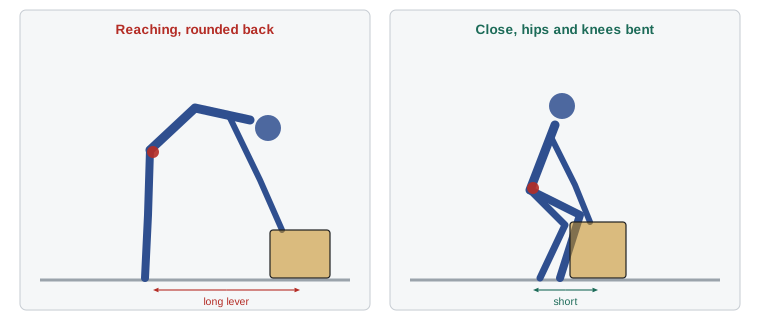
- Get close. Stand as close to the load as possible, with the load between your feet or directly in front. Slide the load toward you before lifting. Every centimetre of reach adds load on the back.
- Use a stable base. Place your feet about shoulder width apart, one slightly forward, so you can balance and shift your weight.
- Bend at the hips and knees, keeping the natural curve of the lower back. A slight bend in the back is acceptable at the start of the lift, but avoid rounding it fully, especially with heavy loads.
- Get a secure grip. Use the whole hand rather than the fingertips, use handles where they exist, and hug the load close to the body. Grip diagonally opposite corners of a box if there are no handles.
- Lift smoothly. Keep the head up once you have a good grip, and lift by straightening the hips and knees in a smooth, controlled motion. Avoid jerking, which sharply raises forces.
- Do not twist. Turn by moving your feet, not by twisting your trunk. Twisting while bent and loaded is one of the most hazardous combinations for the lower back.
- Keep the load between knuckle and shoulder height while carrying it.
- Put it down the same way. Lowering can be as hazardous as lifting. Bend at the hips and knees, keep the load close and set it down before adjusting its position.
Squat, stoop or something in between?
A full squat lift, bending the knees deeply with an upright trunk, keeps the back straighter but can be slow and tiring, needs strong knees and thighs, and forces the load farther from the body if the object is too large to fit between the knees. A stoop lift, bending at the waist with straight legs, is faster and uses less energy but loads the back heavily. Research suggests that the distance of the load from the body matters more than whether the knees or back are bent. In practice, a semi-squat or freestyle lift, bending at both hips and knees while keeping the load as close as possible, suits most loads and most people. Small and compact loads that fit between the knees suit a squat; large boxes are often lifted better by straddling a corner and bringing it close.
For light objects picked from the floor, such as a dropped tool or a piece of paper, the golfer's lift is useful: support yourself with one hand on a stable surface, keep your back straight and lift one leg behind you as you bend forward. For lifting from deep bins, car trunks or truck beds, the load is necessarily far away; reduce the risk by sliding the load toward you first, tilting bins, using bins with drop-down sides or spring-loaded bases, and keeping loads in these locations light.
Lifting from high places and at awkward heights
Loads above shoulder height are harder to control and place strain on the shoulders and back, and a dropped load can strike the head. Use a step platform or platform ladder so the load is between waist and shoulder height, slide the load toward you before lifting it down, and test its weight before taking it fully. Store heavy items between knuckle and shoulder height, light items above and below. The NIOSH equation reflects this: the vertical multiplier is zero above 175 cm (70 in).
Worked problem
Using a step platform to lower boxes from a high shelf
Workers lower 8 kg boxes from a shelf where their hands are at 180 cm, to a cart at 80 cm, about once every 5 minutes (0.2 lifts per minute) for up to 1 hour. H is 35 cm, there is no twist and coupling is good. The employer considers providing a step platform that raises the worker by 40 cm. What are the RWL and LI at the origin with and without the platform?
Show solution
- Without the platform: V = 180 cm, more than 175 cm, so VM = 0 and RWL = 0. The task is outside the safe range of the equation.
- With the platform, V relative to the worker's feet is 180 − 40 = 140 cm. VM = 1 − 0.003 × |140 − 75| = 0.805.
- D measured from the platform: the cart is 80 − 40 = 40 cm above the worker's feet, so D = 140 − 40 = 100 cm and DM = 0.82 + 4.5 ÷ 100 = 0.865. HM = 25 ÷ 35 = 0.714. AM = 1, FM = 1.00, CM = 1.00.
- RWL = \( 23 \times 0.714 \times 0.805 \times 0.865 \approx 11.4 \) kg. LI = \( 8 \div 11.4 \approx 0.70 \).
- Check the destination: stepping down from the platform with a box is itself a hazard. Better still, place the cart beside the platform at a height that lets the worker set the box down without stepping, or move the boxes to a lower shelf.
Answer: Without a platform the task is unacceptable (RWL of zero). With the platform the LI is about 0.7, acceptable, provided the box can be set down without stepping down while loaded.
Team lifts
Some loads are too heavy, long or bulky for one person and cannot be handled mechanically. A team lift can work, but it is harder to do safely than it looks. Team members may be different heights, so the load tilts toward the shorter person; one person may slip or lose grip and leave the others suddenly carrying more; and visibility is often poor. For these reasons, the capacity of a team is less than the sum of its members' individual capacities. A common rule of thumb, used in UK guidance, is that a two-person team can handle about two-thirds of the sum of their individual capacities, and a three-person team about half the sum.
Worked problem
Planning a two-person lift
Two workers must lift a 40 kg panel from the floor to a bench. Under the task conditions, an assessment gives each worker an individual recommended limit of about 25 kg. Using the two-thirds rule of thumb, can they lift the panel safely as a pair? What else should be considered?
Show solution
- Sum of individual limits: \( 25 + 25 = 50 \) kg.
- Team capacity: \( \tfrac{2}{3} \times 50 \approx 33 \) kg.
- The 40 kg panel exceeds the estimated team capacity of about 33 kg.
- Options: use a panel cart or vacuum lifter, use a lift table so the panel does not start at the floor, add a third person with suitable handles if space allows, or store panels upright on a rack at a better height.
Answer: No; the panel exceeds the pair's estimated capacity. Use a mechanical aid or change the storage so the lift does not start at the floor.
When a team lift is appropriate, plan it carefully:
- Choose team members of similar height and strength where possible, and make sure all are trained and fit for the task.
- Appoint one person as the leader, who gives clear signals such as ready, lift, walk, stop and lower.
- Agree the route, the destination and how the load will be set down before lifting. Clear the path.
- Make sure each person has a secure grip; use handles, straps or carrying aids for long or flat loads.
- Lift, move and lower together, smoothly and at the pace of the slowest person.
- Anyone may call stop if they lose grip, footing or visibility.
Back belts are not a control
Back belts, also called back support belts or lumbar supports, are elastic or rigid belts worn around the lower back during lifting. They are widely sold and sometimes provided to workers, but they are not an effective way to prevent back injuries. In 1994, NIOSH reviewed the scientific literature and concluded that there was insufficient evidence that back belts prevent injuries, and it did not recommend them as an injury prevention measure for uninjured workers. A large study published in the Journal of the American Medical Association in 2000 followed more than 9,000 materials handling workers in 160 retail stores and found that belt use, whether required by store policy or chosen by the worker, did not reduce back injury claims or low back pain.
Belts may give workers a false sense of security, encouraging them to lift more than they otherwise would, and they may raise blood pressure and heart rate during heavy exertion. A medical professional may prescribe a support for an individual during recovery from an injury; that is a treatment decision, not a workplace control. Back belts should not be listed as personal protective equipment for lifting or used in place of task redesign and lifting aids.
Exoskeletons, stretching and fitness
Industrial exoskeletons are wearable devices that support the back, shoulders or arms during lifting or overhead work. Passive exoskeletons use springs to store and return energy; active ones use motors. Some studies show reduced muscle activity for specific tasks, but evidence about long-term injury prevention, comfort, effects on other body parts and acceptance is still developing, and standards are emerging. Treat exoskeletons as a possible engineering or support measure for specific tasks after trials and assessment, not as a substitute for redesigning the job.
Pre-shift stretching and warm-up programs are popular and can improve team communication and readiness, but evidence that they prevent MSDs is limited. General physical fitness supports health and may aid recovery after injury. These are worthwhile wellness measures, but they do not reduce the demands of a poorly designed task, and they should never be presented as the main ergonomic control.
Building good habits
Good lifting habits are easier to keep when the workplace supports them. Supervisors should allow time to get help or a lifting aid without penalty, keep aids close to where they are needed, maintained and easy to use, and model good practice themselves. Workers should report tasks that are hard to do safely. Refresher training can be short and practical, using the actual loads and locations of the job, and can be combined with discussions about what makes the job hard and how to fix it.
Common mistakes
MistakeRelying on lifting technique training to prevent back injuries.
InsteadRedesign tasks and provide lifting aids; use training as support.
MistakeTwisting the trunk to place a load.
InsteadMove your feet to turn, keeping the load in front of you.
MistakeSquatting with a large box held far in front of the knees.
InsteadKeep the load as close as possible, even if that means a semi-squat or straddling a corner.
MistakeAssuming two people can lift twice what one can.
InsteadEstimate team capacity at about two-thirds of the sum for two people, and plan the lift.
MistakeIssuing back belts as PPE.
InsteadBack belts have not been shown to prevent injuries; use proven controls.
Summary and key terms
- Lifting technique training alone has not been shown to prevent back pain.
- Plan the lift: check weight, stability, route, destination and need for help or aids.
- Get close, use a stable base, bend hips and knees, grip securely, lift smoothly and do not twist.
- Load distance from the body matters more than knee or back bend; a semi-squat suits most lifts.
- Use step platforms for high loads and keep heavy items between knuckle and shoulder height.
- Team capacity is less than the sum of individuals; plan team lifts with a leader and signals.
- Back belts, stretching programs and exoskeletons do not replace task redesign.
- Squat lift
- Lift with deeply bent knees and an upright trunk.
- Stoop lift
- Lift bending at the waist with straight legs.
- Semi-squat lift
- Lift bending both hips and knees moderately.
- Golfer's lift
- One-handed light pick-up supported by the other hand, with one leg extended behind.
- Team lift
- Lift by two or more people working together.
- Team capacity
- Estimated safe load for a team, less than the sum of individual limits.
- Back belt
- Lumbar support belt; not proven to prevent back injuries.
- Exoskeleton
- Wearable device that supports the body during work.
- Lowering
- Moving a load downward; as hazardous as lifting.
- Coupling
- The quality of grip between the hands and the load.
Practice problems
Work each problem on paper first, then reveal the answer to check.
What did systematic reviews find about lifting training alone?
Show answer
No good evidence that it prevents back pain or injury.
List three questions to ask before lifting.
Show answer
Is it necessary, how heavy and stable is it, where is it going, do I need help or an aid?
How should you turn while carrying a load?
Show answer
Move your feet rather than twisting the trunk.
Which matters more, the bend of the knees or the distance of the load?
Show answer
The distance of the load from the body.
What is the golfer's lift used for?
Show answer
Picking up light objects from the floor.
Two workers each have an individual limit of 30 kg. What is their estimated team capacity?
Show answer
About 40 kg (two-thirds of 60 kg).
What should a team lift leader do?
Show answer
Give clear signals and coordinate the route, lift and lowering.
What did the 2000 JAMA study of retail workers find about back belts?
Show answer
They did not reduce back injury claims or low back pain.
Where should heavy items be stored?
Show answer
Between knuckle and shoulder height.
What is the evidence on pre-shift stretching for MSD prevention?
Show answer
Limited; it does not replace task redesign.
Lesson quiz · 5 questions
Score 60% or more to complete this lesson.
Create a free account to save your progress, take quizzes and earn a certificate.