
HSE-107 · Lesson 10 of 12 · 30 min
Repetitive work, hand tools and vibration
Not all musculoskeletal disorders come from heavy loads. Many come from small, light motions repeated thousands of times a day, from gripping and twisting hand tools, and from vibration transmitted through tools and vehicles. These exposures mainly affect the hands, wrists, elbows, shoulders and neck, and they include some of the most disabling MSDs, such as carpal tunnel syndrome and hand-arm vibration syndrome. This lesson explains how to recognize and reduce the risks of repetitive work, how to choose and use hand tools that fit the hand and the task, and how to assess and control exposure to vibration.
Repetitive work
Repetitive work involves performing the same or similar motions over and over, often in short cycles. Examples include assembly line work, meat and poultry cutting, packing, sewing, scanning items at a checkout, keying data, and sorting parcels. Repetition alone is a risk factor, but the risk rises sharply when repetition is combined with force (gripping, pinching, pressing), awkward postures (bent wrists, raised arms), lack of recovery time, cold, vibration and machine pacing.
Ergonomists describe repetitiveness in several ways: the cycle time (the time to complete one unit of work), the number of motions or exertions per minute for a body part, and the proportion of the cycle spent doing the same motion. Rough screening guides suggest that upper limb work is highly repetitive when the cycle time is less than about 30 seconds, or when the same fundamental motion takes up more than half the cycle. Detailed tools such as the Strain Index, OCRA and the ACGIH hand activity TLV (Lesson 5) quantify repetition together with force and recovery.
Worked problem
Counting exertions on a packing line
A worker packs items into boxes. Each box takes 24 seconds and involves 6 forceful pinch grips to fold and tuck flaps, plus 4 lighter reaches. The worker packs boxes for 7 hours of an 8-hour shift. How many forceful pinch exertions does the worker make per minute and per shift? Is the task highly repetitive?
Show solution
- Boxes per minute: \( 60 \div 24 = 2.5 \).
- Forceful pinches per minute: \( 2.5 \times 6 = 15 \).
- Forceful pinches per shift: \( 15 \times 60 \times 7 = 6\,300 \).
- Cycle time is 24 seconds, under the 30-second screening guide, and the forceful pinch is the dominant motion, so the task is highly repetitive and should be assessed in detail.
- Possible controls: pre-folded boxes or a box erector, folding tools that replace pinching, task rotation with non-hand tasks, and sufficient micro-pauses.
Answer: About 15 forceful pinches a minute and 6,300 a shift; the task is highly repetitive and needs detailed assessment and controls.
Controlling repetitive work
Controls for repetitive work follow the hierarchy of controls:
- Eliminate or automate the most repetitive or forceful elements, such as using automatic box erectors, powered cutters or semi-automatic fastening systems.
- Redesign the task to reduce force and improve posture: better tools, parts presented at the right height and angle, fixtures that hold parts so workers do not have to, and reduced reach distances.
- Reduce the number of exertions per cycle, for example by combining operations or redesigning the product to need fewer fasteners or folds.
- Enlarge jobs to include varied tasks that use different muscle groups.
- Rotate workers between tasks with different demands. Rotation can spread exposure but does not reduce total exposure, and it only helps if the tasks truly use different body parts; rotating between two hand-intensive tasks does little.
- Provide recovery time through scheduled rest breaks and short micro-pauses. Self-paced work generally carries less risk than machine-paced work.
- Manage line speed and production standards so that workers are not pushed beyond sustainable rates, and allow new and returning workers time to build up to full pace.
Hand tool design
A well-designed hand tool lets the user work with a straight wrist, a relaxed grip, minimal force and no pressure points. Poorly designed tools force the wrist into bent positions, require hard gripping, concentrate pressure on the palm or fingers, and transmit vibration and torque to the arm. Key principles include:
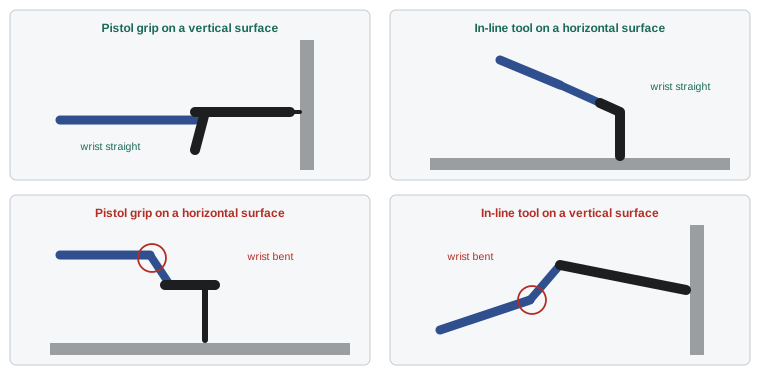
- Bend the tool, not the wrist. Choose the tool shape to suit the work surface: a pistol-grip tool for work on vertical surfaces at about elbow height, and an in-line (straight) tool for work on horizontal surfaces below elbow height. Using the wrong shape bends the wrist.
- Handle size. For power grips, handle diameters of about 30 to 50 mm (1.25 to 2 in) suit most adults; for precision grips, about 8 to 16 mm (0.3 to 0.6 in). Handles that are too small or too large reduce grip strength.
- Handle length. Handles should extend beyond the palm, about 100 to 125 mm (4 to 5 in) or more, so the end does not press into the centre of the palm, where nerves and blood vessels pass.
- Handle surface. Use non-conductive, slightly compressible, non-slip materials. Avoid sharp edges and deep finger grooves, which rarely fit every hand and create pressure points.
- Spring-return handles on pliers and cutters, so the user does not have to open the tool with the fingers.
- Triggers operated by several fingers, not a single finger, or by a lever or a push-to-start mechanism. Repeated single-finger triggering is linked to trigger finger.
- Tool weight. Keep tools light; for one-handed tools used for long periods, a common guide is under about 2.3 kg (5 lb). Use balancers, tool supports or articulating arms for heavier tools.
- Tools for both hands. Provide tools suitable for left-handed workers and in a range of sizes.
Power tools and torque reaction
Power tools reduce force for many tasks, but they bring their own risks: weight, vibration, noise, and torque reaction. When a nutrunner or screwdriver reaches its set torque and stops, the reaction torque jerks the handle and the user's wrist and arm. Repeated jerks are linked to hand, wrist and elbow disorders. Controls include torque reaction arms that absorb the reaction, tools with clutches or automatic shut-off that reduce reaction, pulse or impulse tools that transmit less reaction torque, and choosing the right tool size for the torque needed. Fixtures that hold the part, balancers that support the tool, and good placement of the work also help.
Gloves and cold
Gloves protect hands from cuts, chemicals, heat and cold, and they can improve grip on some surfaces. But poorly fitting or thick gloves reduce dexterity and sensation, so workers grip harder to hold a tool securely, increasing hand force. Gloves should fit well, be no thicker than needed and be chosen with the task in mind. Selection of gloves for protection from other hazards is covered in the personal protective equipment course. Cold reduces dexterity and blood flow, increases the force workers use, and worsens the effects of vibration. Keep hands warm and dry, direct cold exhaust air from pneumatic tools away from the hands, and provide warm rest areas in cold work.
Hand-arm vibration
Hand-arm vibration (HAV) is vibration transmitted into the hands and arms from power tools and hand-held machines such as grinders, sanders, impact wrenches, chipping hammers, jackhammers, chainsaws, hammer drills, and controls of some vehicles and equipment. Regular, long-term exposure can cause hand-arm vibration syndrome (HAVS), which includes vascular effects (blanching of the fingers, often called vibration white finger, triggered by cold), neurological effects (numbness, tingling, loss of sensation and dexterity) and musculoskeletal effects. HAV also contributes to carpal tunnel syndrome. HAVS is progressive and largely irreversible once established, so prevention and early detection are essential.
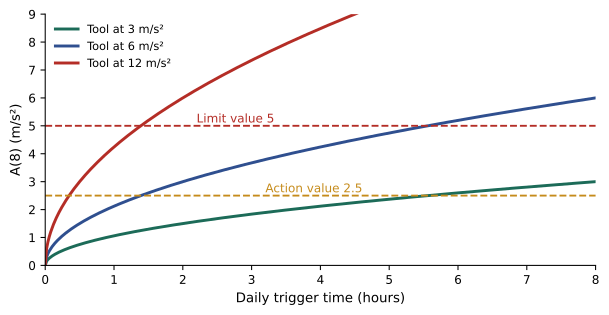
Vibration magnitude is measured as a frequency-weighted acceleration in metres per second squared (m/s²), combining the three directions of vibration. Because the effect depends on both magnitude and time, exposure is expressed as a daily vibration exposure normalized to an 8-hour reference period, A(8):
Here \( a_{hv} \) is the vibration magnitude of the tool in use and T is the daily trigger time in hours, the time the tool is actually vibrating in the hands, which is usually much less than the time the worker spends on the job. Widely used reference values, from European Union rules and adopted in many guidelines, are a daily exposure action value of 2.5 m/s² A(8), above which employers should act to reduce exposure and provide health surveillance, and a daily exposure limit value of 5 m/s² A(8), which should not be exceeded.
In Canada, several jurisdictions address vibration by adopting or referencing ACGIH threshold limit values. British Columbia's regulation, for example, requires employers to control vibration exposure according to the ACGIH TLVs. Where no specific rule exists, the general duty applies. CSA Z1004 and provincial guidance support vibration risk assessment.
Worked problem
Daily vibration exposure from two tools
A maintenance worker uses an angle grinder with a vibration magnitude of 6 m/s² for 1.5 hours of trigger time and an impact wrench at 9 m/s² for 30 minutes in a shift. Calculate the partial and total daily exposures A(8) and compare them with the action value of 2.5 m/s² and the limit value of 5 m/s².
Show solution
- Grinder: \( A_1(8) = 6 \times \sqrt{1.5 \div 8} = 6 \times 0.433 \approx 2.60 \) m/s².
- Impact wrench: \( A_2(8) = 9 \times \sqrt{0.5 \div 8} = 9 \times 0.25 = 2.25 \) m/s².
- Total: \( \sqrt{2.60^2 + 2.25^2} = \sqrt{6.76 + 5.06} \approx 3.44 \) m/s².
- The total exceeds the action value of 2.5 but is below the limit value of 5. The employer should reduce exposure, for example by choosing lower-vibration tools, reducing trigger time and maintaining tools, and should provide health surveillance and training.
Answer: A total daily exposure of about 3.4 m/s² A(8): above the action value, below the limit value, so reduction measures and health surveillance are needed.
Worked problem
How long until the limit?
A breaker (jackhammer) has a vibration magnitude of 15 m/s². How much trigger time per day would reach the action value of 2.5 m/s² A(8) and the limit value of 5 m/s² A(8)?
Show solution
- Rearrange the formula: \( T = 8 \times (A(8) \div a_{hv})^2 \).
- Action value: \( T = 8 \times (2.5 \div 15)^2 = 8 \times 0.0278 \approx 0.22 \) h, about 13 minutes.
- Limit value: \( T = 8 \times (5 \div 15)^2 = 8 \times 0.111 \approx 0.89 \) h, about 53 minutes.
Answer: Only about 13 minutes of trigger time reaches the action value and about 53 minutes the limit value, so high-vibration tools need strict time limits, alternatives or mechanized methods.
Controlling hand-arm vibration
- Eliminate or reduce the need for vibrating tools: change the process (for example, cast parts more accurately to reduce grinding), use mechanized or remote-controlled equipment such as breaker attachments on machines.
- Choose low-vibration tools. Compare manufacturers' declared vibration values, remembering that real-use values are often higher, and measure where possible.
- Maintain tools: keep cutters sharp, balance wheels, replace worn parts and anti-vibration mounts.
- Use tool supports, balancers and fixtures so workers do not have to grip and push hard.
- Limit trigger time and plan work to spread exposure among workers and over the week.
- Keep hands warm and dry; avoid smoking, which reduces blood flow.
- Train workers to recognize early symptoms (tingling, numbness, finger blanching) and report them. Provide health surveillance for exposed workers.
Anti-vibration gloves are of limited value: they reduce some higher-frequency vibration but little at the lower frequencies that cause most harm, and they can increase grip force. They are not a substitute for low-vibration tools and time limits.
Whole-body vibration
Whole-body vibration (WBV) is transmitted through the seat or feet from vehicles and machines such as forklifts, trucks, tractors, earth-moving equipment, mining vehicles and some floors near heavy machinery. Long-term exposure, especially with shocks and jolts, is associated with low back pain and spinal disorders, and it often occurs together with prolonged sitting, twisting to look behind and manual handling when getting off the vehicle. Reference values commonly used are an action value of 0.5 m/s² A(8) and a limit value of 1.15 m/s² A(8), with international measurement methods set out in ISO 2631-1. Controls include choosing suitable vehicles, maintaining roads and floors, fitting and adjusting suspension seats to the driver's weight, maintaining vehicle suspension and tires, controlling speed over rough ground, and taking breaks to get off the vehicle and move.
Common mistakes
MistakeRotating workers between two hand-intensive tasks.
InsteadRotate to tasks that use different body parts, and reduce exposure at the source.
MistakeUsing a pistol-grip tool on a horizontal surface below elbow height.
InsteadUse an in-line tool for horizontal surfaces; bend the tool, not the wrist.
MistakeCounting time on the job as vibration exposure time.
InsteadUse actual trigger time when calculating A(8).
MistakeRelying on anti-vibration gloves.
InsteadChoose low-vibration tools, maintain them and limit trigger time.
MistakeIgnoring tingling or white fingers.
InsteadReport early symptoms; HAVS is progressive and largely irreversible.
Summary and key terms
- Repetition is most harmful when combined with force, awkward posture, cold, vibration and little recovery.
- Cycle times under about 30 seconds suggest highly repetitive upper limb work.
- Automate, redesign tasks, enlarge jobs, rotate to different tasks and provide recovery time.
- Bend the tool, not the wrist: pistol grips for vertical surfaces, in-line tools for horizontal ones.
- Choose handle sizes, lengths, triggers and weights that fit the hand and the task.
- A(8) = a × √(T ÷ 8); action value 2.5 and limit value 5 m/s² for hand-arm vibration.
- Whole-body vibration from vehicles contributes to back pain; use suspension seats and good roads.
- Cycle time
- Time to complete one unit of repetitive work.
- Micro-pause
- Very short break within or between work cycles.
- Pistol grip
- Tool handle at an angle to the body of the tool.
- In-line tool
- Tool with the handle in line with its working axis.
- Torque reaction
- Jerk transmitted to the hand when a power tool stops at set torque.
- Hand-arm vibration (HAV)
- Vibration transmitted to the hands from tools.
- Hand-arm vibration syndrome (HAVS)
- Vascular, nerve and muscle damage from HAV.
- A(8)
- Daily vibration exposure normalized to 8 hours.
- Trigger time
- Time a tool is actually vibrating in the hands.
- Whole-body vibration (WBV)
- Vibration transmitted through the seat or feet.
Practice problems
Work each problem on paper first, then reveal the answer to check.
What cycle time suggests highly repetitive upper limb work?
Show answer
Less than about 30 seconds.
A task involves 8 exertions every 20 seconds. How many per minute?
Show answer
24.
When is job rotation effective?
Show answer
When the tasks use different body parts and loads.
Which tool shape suits work on a vertical surface at elbow height?
Show answer
A pistol grip.
What handle diameter suits power grips?
Show answer
About 30 to 50 mm (1.25 to 2 in).
Why should handles extend beyond the palm?
Show answer
To avoid pressure on nerves and vessels in the centre of the palm.
A tool vibrates at 8 m/s² for 2 hours. What is A(8)?
Show answer
8 × √(2/8) = 4 m/s².
What are the HAV action and limit values commonly used?
Show answer
2.5 and 5 m/s² A(8).
Name three controls for hand-arm vibration.
Show answer
Low-vibration tools, maintenance, limiting trigger time, mechanization, supports, warmth, health surveillance.
What controls reduce whole-body vibration?
Show answer
Suitable vehicles, suspension seats, maintained roads and suspension, speed control, breaks.
Lesson quiz · 5 questions
Score 60% or more to complete this lesson.
Create a free account to save your progress, take quizzes and earn a certificate.