
HSE-107 · Lesson 6 of 12 · 26 min
The NIOSH lifting equation in practice
The revised NIOSH lifting equation is the most widely used tool for evaluating two-handed lifting and lowering tasks. Published by the US National Institute for Occupational Safety and Health in 1991 and explained in detail in its 1994 applications manual, it calculates a recommended weight limit (RWL) for a specific task: the weight that nearly all healthy workers could lift over a substantial period, up to eight hours, without an increased risk of developing lifting-related low back pain. Comparing the actual load with the RWL gives a lifting index that shows how risky the task is. More importantly, the equation shows which features of the task are driving the risk, so you know what to change.
The equation is used in both Canada and the US, and it is the basis of parts of ISO 11228-1. This lesson explains each part of the equation, works through a full calculation, shows how to use the results to redesign a task, and sets out the limits of the method.
The equation
The RWL is a load constant multiplied by six multipliers, each between 0 and 1, that reduce the recommended weight as the task moves away from ideal conditions.
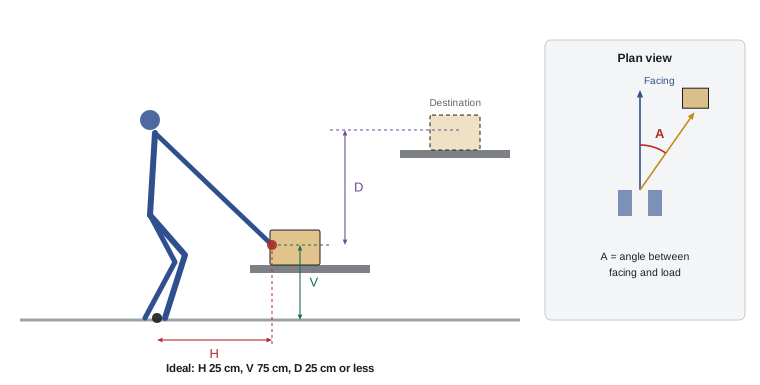
The load constant (LC) is 23 kg. It is the maximum recommended weight under ideal conditions: a load held close to the body (25 cm out), at about knuckle height (75 cm), moved only a short vertical distance, directly in front of the body, lifted infrequently, with good handles. Every departure from these conditions lowers the RWL.
The six multipliers
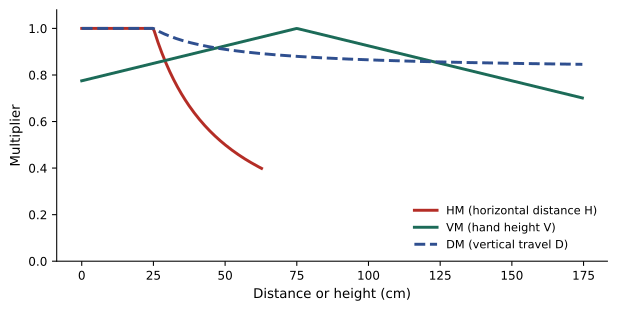
Horizontal multiplier (HM): H is the horizontal distance from the midpoint between the ankles to the hands (the centre of the grip), measured in centimetres. HM equals 25 divided by H. If H is less than 25 cm, use 25 (HM = 1). If H is more than 63 cm, HM = 0, because the load is too far out to be lifted safely. This multiplier reflects the lever effect explained in Lesson 2.
Vertical multiplier (VM): V is the height of the hands above the floor, in centimetres. VM equals 1 minus 0.003 times the absolute value of V minus 75. VM is 1 at 75 cm (knuckle height) and falls for lifts lower or higher. If V is more than 175 cm, VM = 0.
Distance multiplier (DM): D is the vertical travel distance of the hands between the origin and the destination of the lift, in centimetres. DM equals 0.82 plus 4.5 divided by D. If D is less than 25 cm, use 25 (DM = 1). If D is more than 175 cm, DM = 0.
Asymmetric multiplier (AM): A is the angle of asymmetry, in degrees, between the direction the body faces at the start of the lift (the sagittal plane) and the direction of the load. AM equals 1 minus 0.0032 times A. If A is more than 135 degrees, AM = 0. Twisting while lifting reduces the recommended weight because it combines bending and rotation of the spine.
Frequency multiplier (FM): depends on how many lifts are made per minute, how long the lifting continues (up to 1 hour, 1 to 2 hours, or 2 to 8 hours), and whether the hands start below or above 75 cm (30 in). FM is read from a table. Higher frequencies and longer durations give lower multipliers.
Coupling multiplier (CM): depends on how well the hands can grip the load: good (well-designed handles or handholds), fair (less than ideal handles, or a box gripped with fingers flexed under it) or poor (no handles, bulky, slippery or awkward objects). CM is read from a table.
| Lifts per minute | Up to 1 hour | 1 to 2 hours | 2 to 8 hours |
|---|---|---|---|
| 0.2 or less | 1.00 | 0.95 | 0.85 |
| 0.5 | 0.97 | 0.92 | 0.81 |
| 1 | 0.94 | 0.88 | 0.75 |
| 2 | 0.91 | 0.84 | 0.65 |
| 3 | 0.88 | 0.79 | 0.55 |
| 4 | 0.84 | 0.72 | 0.45 |
| 5 | 0.80 | 0.60 | 0.35 |
| 6 | 0.75 | 0.50 | 0.27 |
| Coupling | V below 75 cm (30 in) | V at or above 75 cm (30 in) |
|---|---|---|
| Good | 1.00 | 1.00 |
| Fair | 0.95 | 1.00 |
| Poor | 0.90 | 0.90 |
The duration categories refer to the length of continuous lifting followed by recovery time. Up to 1 hour assumes the lifting period is followed by a recovery period (light work) of at least 1.2 times its length; 1 to 2 hours assumes recovery of at least 0.3 times its length; otherwise use the 2 to 8 hour column.
The lifting index
The lifting index (LI) compares the actual load with the RWL:
An LI of 1.0 or less means the task is acceptable for nearly all healthy workers. An LI above 1.0 means the task poses an increased risk of lifting-related low back pain for some workers, and the goal should be to redesign it to bring the LI to 1.0 or below. NIOSH notes that many workers are at elevated risk when the LI exceeds 3.0. Research since the equation was published has found that the risk of low back pain rises as the LI increases, which supports its use as a ranking tool for setting priorities.
For each lift, calculate the RWL at the origin of the lift. If the worker must control the load at the destination, for example placing it precisely on a high shelf or setting it down gently, also calculate the RWL at the destination and use the lower of the two.
A full calculation
Worked problem
Lifting cases from a low pallet to a conveyor
A worker lifts cases weighing 12 kg from a pallet to a conveyor, 2 times a minute for an 8-hour shift. At the origin, the hands are 30 cm above the floor and 40 cm in front of the ankles. The conveyor is at 100 cm, so the vertical travel is 70 cm. The worker turns about 30 degrees to place each case. The cases have hand-hold cut-outs that are less than ideal (fair coupling). Calculate the RWL and LI at the origin.
Show solution
- HM = 25 ÷ 40 = 0.625. VM = 1 − 0.003 × |30 − 75| = 1 − 0.135 = 0.865.
- DM = 0.82 + 4.5 ÷ 70 = 0.82 + 0.064 = 0.884. AM = 1 − 0.0032 × 30 = 0.904.
- FM: 2 lifts per minute, 2 to 8 hours, V below 75 cm: 0.65 from the table. CM: fair coupling with V below 75 cm: 0.95.
- RWL = \( 23 \times 0.625 \times 0.865 \times 0.884 \times 0.904 \times 0.65 \times 0.95 \approx 6.1 \) kg.
- LI = \( 12 \div 6.1 \approx 1.96 \).
Answer: The RWL is about 6.1 kg and the LI is about 2.0, so the task poses increased risk for many workers and should be redesigned.
Note that a 12 kg (26.5 lb) case, a weight many people would consider light, produced an LI of about 2. The load was not the problem; the task design was. The multipliers show where the losses come from: the frequency and duration (FM 0.65) and the horizontal reach (HM 0.625) are the largest reductions, followed by the low starting height (VM 0.865), the vertical travel (DM 0.884) and the twist (AM 0.904).
Using the results to redesign
The power of the equation lies in what it tells you to change. Look for the smallest multipliers and ask how to raise them:
- Low HM: bring the load closer. Remove obstacles between the worker and the load, use pallets and bins that can be approached from more than one side, use turntables, reduce the size of the load, or place items at the front of shelves.
- Low VM: raise low loads and lower high ones. Use lift tables, pallet positioners, spring-loaded or self-levelling bins, and racks that keep loads between knuckle and shoulder height.
- Low DM: reduce vertical travel by keeping origin and destination at similar heights.
- Low AM: eliminate twisting by arranging the workstation so that origin and destination are in front of the worker, or provide room for the worker to step and turn the feet.
- Low FM: reduce the lift rate, add recovery breaks, rotate workers between lifting and non-lifting tasks, or use mechanical handling for part of the work.
- Low CM: provide handles or hand-hold cut-outs, use containers designed for gripping, or use grips and vacuum lifters.
- If the RWL is still too low, reduce the weight of the load: smaller cases, partial loads or two-person handling as a temporary measure, or eliminate the manual lift with conveyors, hoists or automation.
Worked problem
Redesigning the conveyor task
For the task in the previous example, the employer installs a pallet positioner that keeps the top layer at 75 cm and turns the pallet so the worker can face both pallet and conveyor without twisting. The hands are now 30 cm from the ankles, the vertical travel is 25 cm (75 to 100 cm), the angle is 0 degrees, and the frequency and duration are unchanged. With V at 75 cm, fair coupling gives CM = 1.00. Calculate the new RWL and LI.
Show solution
- HM = 25 ÷ 30 = 0.833. VM = 1 − 0.003 × |75 − 75| = 1.00.
- DM = 0.82 + 4.5 ÷ 25 = 1.00. AM = 1.00. FM = 0.65 (unchanged; the FM table for V at or above 75 cm gives the same value at 2 lifts per minute). CM = 1.00.
- RWL = \( 23 \times 0.833 \times 1 \times 1 \times 1 \times 0.65 \times 1 \approx 12.5 \) kg.
- LI = \( 12 \div 12.5 \approx 0.96 \).
Answer: The pallet positioner roughly doubles the RWL and brings the LI from about 2.0 to just under 1.0, so the task becomes acceptable for nearly all healthy workers without changing the load or the rate.
When the equation does not apply
The revised NIOSH equation is designed for specific conditions. It should not be used, or should be used with great caution and specialist advice, when:
- The lift is one-handed, or the worker is seated or kneeling.
- The worker lifts in a restricted space, such as under a low ceiling, where normal posture is impossible.
- The load is unstable, such as liquids that shift, or the lift is very fast or jerky.
- Lifting is combined with significant carrying (more than a few steps), pushing, pulling or holding, or the worker does other demanding manual work during the shift.
- The floor is slippery, or the working environment is very hot, cold or humid.
- The load is a person or an animal. Handling people requires different methods (Lesson 9).
For jobs with several different lifting tasks, NIOSH provides a composite lifting index (CLI) that combines the tasks, giving more weight to the most demanding ones. Calculating a CLI is beyond this course, but you should know it exists. Free NIOSH tools, including a calculator app, make the arithmetic quick, but you still need careful measurements of each lift.
Common measuring tips
Measure H from the midpoint of the ankles to the centre of the hands, not from the front of the body. Measure V at the hands, not at the bottom of the box. Observe and count the actual frequency over a representative period, including peaks. Use the actual weight of the heaviest loads commonly handled, not the average. For a range of loads or heights, analyse the worst common case and consider analysing several cases. Record photographs and measurements so that the analysis can be checked and repeated after changes.
Common mistakes
MistakeAssuming a light load is always safe to lift.
InsteadCalculate the RWL; distance, height, frequency and twisting can make light loads risky.
MistakeMeasuring H from the front of the body.
InsteadMeasure from the midpoint between the ankles to the centre of the grip.
MistakeUsing the average lift rate and average load.
InsteadUse realistic peak frequencies and the heaviest common loads.
MistakeApplying the equation to one-handed, seated or patient lifts.
InsteadCheck the limits of use and choose another method when they are not met.
MistakeCalculating the LI and stopping there.
InsteadUse the smallest multipliers to choose redesign options and recalculate.
Summary and key terms
- RWL = LC × HM × VM × DM × AM × FM × CM, with LC = 23 kg (51 lb).
- Ideal conditions: load close, at knuckle height, short travel, no twist, infrequent, good handles.
- LI = load ÷ RWL; above 1.0 means increased risk, and above 3.0 many workers are at elevated risk.
- Check the RWL at the destination when the load must be controlled there.
- The smallest multipliers show what to change first.
- Raising low loads and bringing loads close usually make the biggest difference.
- Do not use the equation for one-handed, seated, unstable, patient or combined tasks.
- Recommended weight limit (RWL)
- Load nearly all healthy workers can lift safely in given conditions.
- Lifting index (LI)
- Ratio of the actual load to the RWL.
- Load constant (LC)
- Maximum RWL under ideal conditions, 23 kg (51 lb).
- Horizontal multiplier (HM)
- Reduction for the load's distance from the body.
- Vertical multiplier (VM)
- Reduction for hand height away from knuckle height.
- Distance multiplier (DM)
- Reduction for vertical travel distance.
- Asymmetric multiplier (AM)
- Reduction for twisting away from the front of the body.
- Frequency multiplier (FM)
- Reduction for lift rate and duration.
- Coupling multiplier (CM)
- Reduction for poor handles or grip.
- Composite lifting index (CLI)
- Combined index for jobs with several lifting tasks.
Practice problems
Work each problem on paper first, then reveal the answer to check.
What is HM when H = 50 cm?
Show answer
0.50.
What is VM when V = 15 cm?
Show answer
1 − 0.003 × 60 = 0.82.
What is DM when D = 45 cm?
Show answer
0.92.
What is AM for a 90 degree twist?
Show answer
1 − 0.288 = 0.712.
What FM applies to 1 lift per minute for 2 to 8 hours, low origin?
Show answer
0.75.
An 18 kg load has an RWL of 9 kg. What is the LI?
Show answer
2.0.
What does an LI of 0.8 mean?
Show answer
The task is acceptable for nearly all healthy workers.
When should the RWL also be calculated at the destination?
Show answer
When the worker must control the load at the destination.
Which multiplier would a lift table usually improve most?
Show answer
VM, and often HM and DM as well.
Name two situations where the equation should not be used.
Show answer
One-handed, seated, kneeling, restricted space, unstable loads, carrying, patient handling, slippery floors.
Lesson quiz · 5 questions
Score 60% or more to complete this lesson.
Create a free account to save your progress, take quizzes and earn a certificate.