
HSE-107 · Lesson 3 of 12 · 28 min
The scale and cost of musculoskeletal disorders
Musculoskeletal disorders are not rare events that happen to unlucky people. They are among the most common work injuries in North America, they account for a large share of time lost from work, and they drive a large share of compensation costs. This lesson looks at what the statistics show, how to calculate injury rates and costs for your own workplace, and why the numbers usually understate the true burden. Knowing the scale of the problem helps make the case for investment in prevention.
How MSDs are counted
MSD statistics come from workers' compensation claims, government surveys and employer records. Each source counts differently, so figures are not always comparable. Compensation boards count accepted claims, usually split into lost-time claims, where the worker misses work beyond the day of injury, and no-lost-time or health care only claims. Surveys classify injuries by their nature (such as sprain, strain or tear), the part of the body, and the event or exposure (such as overexertion in lifting, repetitive motion or bodily reaction). Some MSDs are recorded as sprains and strains; others as specific diagnoses such as carpal tunnel syndrome or tendinitis. Many MSDs, especially gradual ones, are never reported at all.
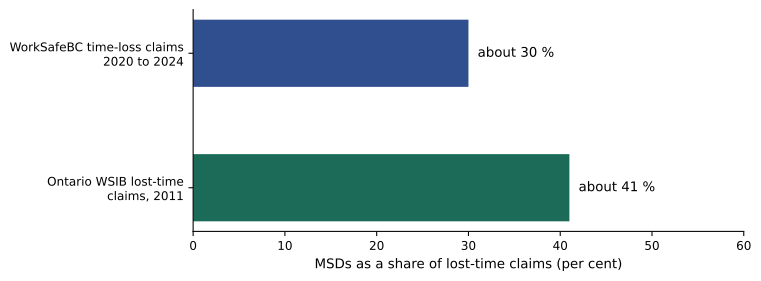
In Canada, the Association of Workers' Compensation Boards of Canada (AWCBC) compiles national statistics from provincial and territorial boards. In 2022, boards across Canada accepted 348,747 lost-time claims. Individual boards publish more detail. WorkSafeBC reports that musculoskeletal injuries are the most common workplace injury in British Columbia: from 2020 to 2024 it accepted about 88,000 time-loss claims for MSIs, about 30 per cent of all time-loss claims, with total claim costs of more than $2.35 billion. MSIs were most common in health care, retail, local government, restaurants, public schools and the skilled trades. In Ontario, MSDs have long been the leading type of lost-time injury reported to the Workplace Safety and Insurance Board (WSIB); in 2011, for example, they made up about 41 per cent of allowed lost-time claims.
The most costly cause of serious injury
Canadian compensation boards consistently report that sprains, strains and other MSDs are among the largest drivers of lost days and claim costs, because MSD claims tend to last longer than many other injuries and are more likely to become chronic. Back injuries in particular often involve long recovery periods, and a small number of long-duration claims can account for a large part of total costs. The same pattern appears in the US, where the insurer Liberty Mutual's annual Workplace Safety Index has ranked overexertion involving outside sources (lifting, pushing, pulling, holding, carrying or throwing objects) as the most costly cause of serious workplace injury for many years.
Across both countries, the message is the same: handling materials and working in awkward or repetitive ways injures more workers, and costs more, than almost any other hazard.
Who is most affected
MSDs occur in every sector, but some jobs carry much higher risk. High-risk groups include:
- Health care and personal support workers who lift, transfer and reposition patients and residents.
- Warehouse, distribution and delivery workers who handle cases, parcels and freight at high rates.
- Construction trades such as drywall installers, roofers, masons, carpenters, ironworkers and plumbers.
- Manufacturing and assembly workers doing repetitive, paced work.
- Meat, poultry and food processing workers using knives and repetitive cutting motions, often in cold environments.
- Retail and grocery workers stocking shelves, unloading trucks and working checkouts.
- Hospitality workers such as hotel housekeepers who lift mattresses, push carts and clean bathrooms.
- Cleaners and janitorial staff, waste collectors, and truck and bus drivers exposed to whole-body vibration and loading.
- Office and call centre workers exposed to prolonged sitting, static postures and intensive computer use.
Within these groups, newer workers and workers in their first months on a job often have higher injury rates, because they are less familiar with tasks, may not yet know shortcuts that reduce effort, and may be reluctant to ask for help.
Calculating injury rates
Raw counts of injuries do not allow fair comparison between workplaces of different sizes. Injury rates adjust for the number of hours worked. The most common rate in North America expresses injuries per 100 full-time equivalent workers per year, using 200,000 hours as the base (100 workers × 40 hours × 50 weeks).
The same formula works for any type of case: all recordable MSDs, lost-time MSDs, or a severity rate based on days lost. A severity rate uses the number of days lost instead of the number of cases and shows how serious the injuries are.
Worked problem
MSD rates for a distribution centre
A distribution centre worked 1,240,000 hours last year. It had 31 recordable injuries, of which 19 were MSDs. Eleven MSDs involved days away from work, totalling 486 days lost. Calculate the MSD rate, the lost-time MSD rate and the MSD severity rate, and the share of all injuries that were MSDs.
Show solution
- MSD rate: \( 19 \times 200\,000 \div 1\,240\,000 \approx 3.06 \) per 100 full-time workers.
- Lost-time MSD rate: \( 11 \times 200\,000 \div 1\,240\,000 \approx 1.77 \) per 100 full-time workers.
- MSD severity rate: \( 486 \times 200\,000 \div 1\,240\,000 \approx 78.4 \) days lost per 100 full-time workers.
- Share of injuries: \( 19 \div 31 \approx 0.61 \), or 61 per cent. Average days lost per lost-time MSD: \( 486 \div 11 \approx 44 \) days.
Answer: About 3.1 MSDs and 1.8 lost-time MSDs per 100 full-time workers, a severity rate of about 78 days per 100 workers, and MSDs made up about 61 per cent of injuries, averaging 44 days lost each.
Direct and indirect costs
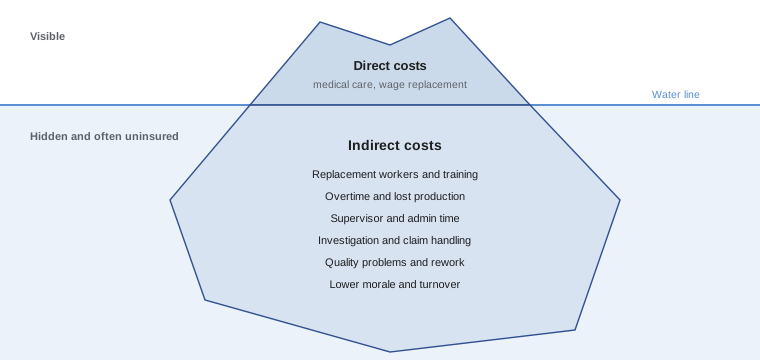
The direct costs of an MSD are those paid by the compensation system or insurer: medical treatment, physiotherapy, wage replacement, and in serious cases long-term disability benefits and retraining. Employers pay for these through premiums, which in most systems rise with the employer's claim experience. Indirect costs fall on the employer and are often uninsured: time spent by supervisors and co-workers, hiring and training replacements, overtime, lost production, reduced quality, administrative work on claims and investigations, and lower morale. Estimates of the ratio of indirect to direct costs vary widely, from about 1 to more than 4, depending on the industry and how costs are counted.
Worked problem
How much extra sales does an MSD cost?
A food manufacturer has a profit margin of 5 per cent. A line worker develops a shoulder injury from repetitive reaching. The direct claim cost is $36,000. The company estimates indirect costs at twice the direct cost. How much additional revenue must the company earn to cover the total cost of this one injury?
Show solution
- Indirect cost: \( 2 \times 36\,000 = 72\,000 \) dollars.
- Total cost: \( 36\,000 + 72\,000 = 108\,000 \) dollars.
- Revenue needed at a 5 per cent margin: \( 108\,000 \div 0.05 = 2\,160\,000 \) dollars.
Answer: About $2.16 million in extra sales is needed to replace the profit lost to a single shoulder injury.
In most provinces, employer premiums are set by industry rate group and adjusted by experience rating programs that raise or lower an employer's rate based on its claim costs. Under these programs, a few long-duration MSD claims can significantly raise premiums for several years. Some boards also offer incentive programs that reward employers for effective safety and return-to-work programs.
Human costs
Numbers cannot capture the human cost of MSDs. Chronic back pain or a damaged shoulder can make it hard to sleep, care for children, play sports, do household tasks or return to a chosen trade. Long periods off work can lead to financial strain, isolation and depression. Some workers move to lower-paid jobs or leave the workforce altogether. Families and communities share these costs. Prevention protects not just the employer's bottom line but people's lives and livelihoods.
Why the numbers understate the problem
Official counts are only the visible part of the problem. Many MSDs are not reported because workers see aches and pains as a normal part of the job, fear being seen as weak or losing their job, are paid by the piece or rely on bonuses for injury-free records, or do not connect gradual symptoms with work. Some workers treat symptoms on their own or through personal health insurance. Gradual-onset disorders may be harder to establish as work-related in compensation claims. Underreporting is greatest among temporary, contract, migrant and young workers. An employer that sees few MSD claims should not assume it has no MSD problem; discomfort surveys and job observations often reveal hidden risks.
Leading and lagging indicators
Injury rates and costs are lagging indicators: they measure harm that has already happened. A good ergonomics program also tracks leading indicators, which show whether prevention activities are happening and predict future performance. Examples include the number of jobs assessed, the percentage of high-risk jobs with controls implemented, the number of early symptom reports and how quickly they are addressed, worker discomfort survey scores, participation in ergonomics training and the number of improvement suggestions made by workers. Early reports of discomfort should be counted as a positive sign that workers trust the system, not as a failure.
| Indicator type | Examples | What it tells you |
|---|---|---|
| Lagging | MSD rate, lost-time MSD rate, days lost, claim costs, premiums | How much harm has already occurred |
| Leading | Jobs assessed, controls implemented, early reports, discomfort survey scores, training, suggestions | Whether prevention is working before injuries happen |
Worked problem
Comparing two departments
Department A has 4 MSDs in 180,000 hours and 22 early discomfort reports. Department B has 2 MSDs in 150,000 hours and no early reports. Which department has the higher MSD rate, and what might the early report counts suggest?
Show solution
- Department A MSD rate: \( 4 \times 200\,000 \div 180\,000 \approx 4.4 \).
- Department B MSD rate: \( 2 \times 200\,000 \div 150\,000 \approx 2.7 \).
- Department A has the higher rate, but it also has an active early reporting culture. Its injuries may be caught earlier and be less severe.
- Department B's lack of any early reports may signal underreporting rather than a lack of risk. A discomfort survey and job observations in Department B would be wise.
Answer: Department A has the higher rate (4.4 against 2.7 per 100 workers), but Department B's silence on early symptoms is a warning sign that deserves investigation.
Statistics also guide where to start. Within your own workplace, sorting MSD reports by department, job, body part and type of task quickly shows where the problems cluster, and those clusters are the natural first targets for the assessments described in the next lessons.
Common mistakes
MistakeComparing raw injury counts between sites of different sizes.
InsteadUse rates based on hours worked, such as cases per 200,000 hours.
MistakeCounting only direct claim costs.
InsteadInclude indirect costs such as replacement, overtime, lost production and training.
MistakeAssuming few claims means few MSD risks.
InsteadCheck for underreporting with discomfort surveys and job observations.
MistakeTreating early discomfort reports as bad news.
InsteadEncourage early reports; they allow fixes before serious injury.
MistakeComparing statistics from different sources or years without checking definitions.
InsteadNote the source, year and definitions before drawing conclusions.
Summary and key terms
- MSDs are among the most common and costly work injuries in Canada and the US.
- Overexertion in handling objects is a leading cause of serious injury costs.
- Health care, warehousing, construction, manufacturing and food processing are high-risk sectors.
- Injury rate = number of cases × 200,000 ÷ hours worked.
- Indirect costs often equal or exceed direct costs and are largely uninsured.
- MSDs are underreported, especially gradual disorders and among vulnerable workers.
- Track leading indicators such as early reports and controls implemented, not just injury rates.
- Lost-time claim
- Compensation claim where the worker misses work beyond the day of injury.
- DART case
- US case involving days away, restricted work or job transfer.
- Incidence rate
- Number of cases per 100 full-time workers per year.
- Severity rate
- Days lost per 100 full-time workers per year.
- Direct cost
- Medical and wage replacement costs paid by compensation or insurance.
- Indirect cost
- Uninsured costs such as lost production, overtime and training.
- Experience rating
- Premium adjustment based on an employer's claim history.
- Underreporting
- Injuries that occur but are never reported or recorded.
- Lagging indicator
- Measure of past harm, such as injury rates.
- Leading indicator
- Measure of prevention activity that predicts future performance.
Practice problems
Work each problem on paper first, then reveal the answer to check.
What base number of hours is used for rates per 100 full-time workers?
Show answer
200,000 hours.
A site had 6 MSDs in 400,000 hours. What is the MSD rate?
Show answer
3.0 per 100 full-time workers.
A site lost 240 days to MSDs in 600,000 hours. What is the severity rate?
Show answer
80 days per 100 full-time workers.
Name three sectors with high MSD risk.
Show answer
Health care, warehousing, construction, manufacturing, food processing, retail, hospitality.
Give three examples of indirect costs.
Show answer
Replacement workers, overtime, lost production, training, supervisor time, lower morale.
A $50,000 injury at a 4 per cent margin requires how much revenue to replace?
Show answer
$1.25 million.
Why might a department with no early reports be a concern?
Show answer
It may be underreporting rather than free of risk.
Name two leading indicators for ergonomics.
Show answer
Jobs assessed, controls implemented, early reports, discomfort surveys, training, suggestions.
Why are MSDs often underreported?
Show answer
Workers see pain as normal, fear consequences, do not link gradual symptoms to work, or are paid by output.
Why do MSD claims often cost more than other injuries?
Show answer
They tend to last longer and can become chronic.
Lesson quiz · 5 questions
Score 60% or more to complete this lesson.
Create a free account to save your progress, take quizzes and earn a certificate.