
HSE-107 · Lesson 1 of 12 · 30 min
What ergonomics is and why it matters
Every job asks something of the body. A warehouse picker lifts and twists hundreds of times a shift, a cashier scans and bags items for hours, a nurse turns and repositions patients, a carpenter drives screws overhead, and an office worker types and reads a screen for most of the day. When the demands of the work fit the people doing it, the work gets done well and people go home healthy. When the demands exceed what bodies can tolerate, the result is fatigue, discomfort, errors and, over time, injuries to muscles, tendons, nerves, joints and the spine. Ergonomics is the discipline that studies this fit and improves it.
This course is about manual handling and ergonomics at work. It covers why musculoskeletal injuries happen, how big the problem is, what the law requires, how to assess risk with recognized tools, how to lift, push, pull and carry more safely, how to reduce risk in repetitive work, tool use and vibration, how to set up office and remote workstations, and how to run an ergonomics program that keeps improving. Each lesson includes worked examples, common mistakes and practice questions.
This is an awareness-level course. It helps you recognize ergonomic hazards, understand the main assessment methods and choose sensible controls. It does not qualify you as an ergonomist, kinesiologist, occupational therapist or physiotherapist, and it does not replace the training your employer must provide for your specific tasks and equipment. Complex or high-risk jobs, and workers who already have symptoms, should be assessed by a qualified professional. Laws and standards change; always check the current requirements that apply in your jurisdiction and workplace.
What ergonomics means
The word ergonomics comes from the Greek words ergon, meaning work, and nomos, meaning laws or rules. The International Ergonomics Association defines ergonomics, also called human factors, as the scientific discipline concerned with understanding the interactions among humans and other elements of a system, and the profession that applies theory, principles, data and methods to design in order to optimize human well-being and overall system performance. In plain terms, ergonomics means designing work, equipment and environments to suit people, rather than forcing people to adapt to poorly designed work.
The central idea is often summed up as fit the task to the worker, not the worker to the task. A shelf that requires short workers to reach overhead, a tool handle that is too large for small hands, a conveyor that runs too fast to keep up without rushing, or a schedule that never allows recovery all force people to adapt. Some people can adapt for a while, but the cost appears as strain, fatigue and injury. Good design removes the need to adapt.
Three domains of ergonomics
Ergonomists usually describe three overlapping domains. Physical ergonomics deals with the body: anatomy, anthropometry (body dimensions), physiology and biomechanics as they relate to physical work. Manual handling, posture, repetitive movement, workstation layout and vibration all belong here, and they are the main focus of this course. Cognitive ergonomics deals with mental processes such as perception, memory, attention, reasoning and decision making, for example in the design of displays, controls, alarms and procedures. Organizational ergonomics deals with how work is organized: shift schedules, work pace, teamwork, communication, job design and the culture of a workplace.
| Domain | Focus | Examples at work |
|---|---|---|
| Physical | Body dimensions, strength, posture, movement, physiology | Lifting, carrying, reaching, repetitive tasks, tool design, workstation height, vibration, heat |
| Cognitive | Perception, attention, memory, decision making, workload | Control panel layout, alarm design, labels, procedures, error prevention, mental fatigue |
| Organizational | Work design, schedules, pace, teams, culture | Shift rotation, rest breaks, job rotation, production quotas, incentive pay, participation |
The domains interact. A worker who must meet a strict pick rate (organizational) may skip using a lift assist because it is slow (physical), and may make more picking errors when fatigued (cognitive). Effective solutions usually look at all three.
The work system
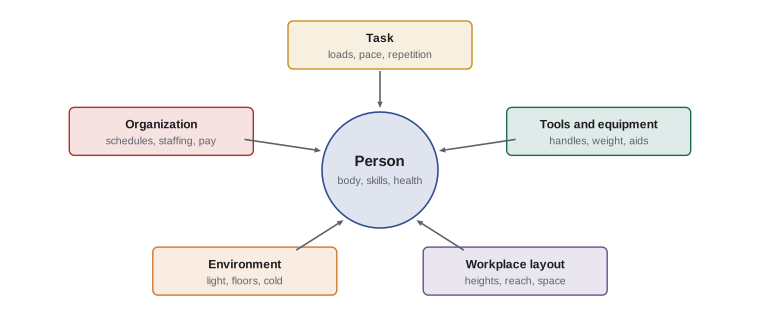
Ergonomics treats work as a system with several parts that affect each other: the person, the task, the tools and equipment, the workplace layout, the physical environment (lighting, temperature, noise, floors) and the organization (schedules, staffing, training, pay systems and management). An injury rarely has a single cause. A back injury while lifting a box may involve the weight of the box, the height of the pallet it sat on, the distance the worker had to reach, the floor space available to step, the pace set by the warehouse system, the lack of a lift table, the time of the shift and the worker's own fitness and history. Changing any part of the system can change the risk.
People vary: designing for a range
People differ in height, reach, strength, endurance, hand size, age, health and experience. Ergonomic design accounts for this variation using anthropometric data, which are measurements of body dimensions collected from large samples of people. Designers often use percentiles. The 5th percentile value of a dimension is the value below which 5 per cent of a population falls; the 95th percentile is the value below which 95 per cent falls. Designing to accommodate people from the 5th to the 95th percentile covers about 90 per cent of users for that single dimension.
Three principles guide design for a range of people. Design for the extremes when one limit matters most: clearances such as door heights and leg room should fit large users, and reach distances such as the location of a frequently used control should fit small users. Design for adjustability where possible: adjustable chairs, work surfaces, platforms and monitor arms let each worker set the station to fit. Design for the average only as a last resort, because an average design fits few people well.
Worked problem
Setting a shelf height for frequent picking
A store wants to place its fastest-moving items on a shelf that workers can reach without raising their hands above shoulder height. For the workforce, standing shoulder height is about 132 cm at the 5th percentile and about 157 cm at the 95th percentile (illustrative values; use data for your own population). At what maximum height should the top of the frequently used shelf be placed?
Show solution
- Identify the critical user. To avoid overhead reaching for most workers, the shelf must suit shorter workers, so the 5th percentile is the limiting value.
- Set the limit: place the top frequently used shelf no higher than about 132 cm.
- Check taller workers: a 95th percentile worker with a shoulder height of 157 cm reaches 132 cm easily, below shoulder height.
- Check the lower limit too: very low shelves force bending. Keep frequently picked items between roughly knuckle height and shoulder height, and use high and low shelves for light or rarely used items.
Answer: Place the top shelf for frequently picked items at about 132 cm or lower, so that most workers can reach it without lifting their hands above shoulder height.
A short history
People have adapted tools to the body for as long as there have been tools, but ergonomics as a science grew in the twentieth century. Early studies of fatigue and work methods in factories looked at how to make work more efficient. During the Second World War, engineers and psychologists found that many aircraft accidents were caused not by pilot failure but by confusing controls and displays, and they began to design equipment around human capabilities. This led to the field called human factors in North America and ergonomics in the United Kingdom and Europe. From the 1970s onward, rising rates of back injuries and of disorders such as carpal tunnel syndrome and tendinitis in manufacturing, meat processing and office work turned attention to physical ergonomics and manual handling. Lifting guidelines, posture assessment methods and workstation standards were developed, and many of them are covered in this course.
Why ergonomics matters
Musculoskeletal disorders (MSDs), also called musculoskeletal injuries (MSIs), are injuries and disorders of the muscles, tendons, ligaments, nerves, joints, cartilage, spinal discs and supporting structures. They include back strains, rotator cuff injuries, tendinitis, epicondylitis (tennis elbow), carpal tunnel syndrome and many others. They are among the most common causes of lost-time injuries in both Canada and the United States, as Lesson 3 shows. They are often painful and slow to heal, they can end careers, and they cost employers and compensation systems billions of dollars each year.
Ergonomics also benefits productivity and quality. Work that fits people is usually faster, involves fewer errors and less rework, and produces less fatigue. Workers who are not in pain are more attentive and more engaged. Many ergonomic improvements, such as raising a pallet to waist height with a lift table or placing parts within easy reach, reduce wasted motion and save time. Ergonomics is not just a cost of compliance: it is part of designing good work.
Worked problem
Payback on a lift table
A packing station has a history of back strains. The direct cost of one back strain claim at this site averages $18,000 and the company estimates indirect costs (replacement worker, training, lost production, supervisor time) at 1.5 times direct costs. Before the change, the station averaged one back strain claim every two years. A scissor lift table that keeps cases at waist height costs $6,500 installed and is expected to cut back strain claims at the station by 75 per cent. Ignoring any productivity gains, what is the simple payback period?
Show solution
- Total cost per claim: \( 18\,000 + 1.5 \times 18\,000 = 45\,000 \) dollars.
- Expected claim cost per year before the change: \( 45\,000 \div 2 = 22\,500 \) dollars.
- Expected annual saving: \( 0.75 \times 22\,500 = 16\,875 \) dollars.
- Simple payback: \( 6\,500 \div 16\,875 \approx 0.39 \) years, or about 4.6 months.
Answer: The lift table pays for itself in about five months on injury costs alone, before counting any time saved.
Ergonomics within occupational health and safety
Ergonomic hazards are workplace hazards like any other, and they are managed using the same process taught in the hazard recognition and risk assessment course: identify the hazard, assess the risk, control it using the hierarchy of controls, and check that the controls work. What makes ergonomic hazards different is that harm often builds up gradually from many small exposures, rather than coming from a single event. A worker may lift thousands of boxes without incident and then feel a sharp pain while picking up a pencil. The pencil did not cause the injury; the accumulated load did.
The hierarchy of controls applies fully. Elimination and substitution might mean removing a manual lift altogether by automating it, or buying materials in smaller packages. Engineering controls include lift tables, hoists, conveyors, adjustable workstations and better tools. Administrative controls include job rotation, rest breaks, training and work procedures. Personal protective equipment has only a small role in ergonomics; gloves can help grip and reduce cold exposure, but back belts are not an effective way to prevent back injuries, as Lesson 7 explains. Training workers to lift with good technique is useful, but it is never a substitute for fixing a poorly designed task.
Signs that a job needs attention
Ergonomic problems often show themselves before anyone is seriously hurt. Watch for these warning signs:
- Workers report aches, pain, numbness or tingling, especially if symptoms continue after work or during days off.
- Workers modify their equipment or workstations themselves, for example by padding tool handles, standing on boxes or stacking phone books under monitors.
- Workers avoid certain tasks, trade tasks among themselves, or wear wrist braces or bandages that they bought on their own.
- Injury records show sprains, strains, tendinitis or carpal tunnel syndrome concentrated in certain jobs or departments.
- Work involves heavy loads, awkward postures, high repetition, forceful gripping, vibration, long periods in one position or pressure from fast pace.
- Turnover, absenteeism, errors or quality problems are higher in some jobs than others.
Any of these signs is a reason to look more closely at the job using the assessment tools in Lessons 5 and 6.
Who does ergonomics
Ergonomics is a shared responsibility. Employers are responsible for identifying and controlling ergonomic hazards under occupational health and safety law. Supervisors see daily work and can spot problems and make sure controls are used. Workers know their jobs better than anyone and are often the best source of practical solutions; participatory ergonomics, covered in Lesson 12, builds on this. Joint health and safety committees and representatives help identify problems and review controls. Engineers, purchasing staff and facility planners decide what equipment and buildings look like and can prevent problems at the design stage, when changes are cheapest.
Professional ergonomists in Canada may hold the Canadian Certified Professional Ergonomist (CCPE) designation from the Association of Canadian Ergonomists, which requires education, experience and an examination. Kinesiologists, occupational therapists and physiotherapists also do ergonomic assessments, often in connection with return to work. Provincial workers' compensation boards and safety associations such as WorkSafeBC, Workplace Safety and Prevention Services (WSPS) in Ontario and the CNESST in Quebec publish free ergonomic guides and tools.
How this course is organized
Lesson 2 explains how musculoskeletal disorders develop and what risk factors cause them. Lesson 3 looks at the scale and cost of the problem. Lesson 4 sets out the legal duties that apply where you work. Lessons 5 and 6 cover risk assessment tools, including the revised NIOSH lifting equation. Lessons 7 and 8 cover lifting, team lifts, pushing, pulling, carrying and mechanical aids. Lesson 9 introduces handling people in health care and community care. Lesson 10 covers repetitive work, hand tools and vibration. Lesson 11 covers office, computer and remote workstations. Lesson 12 brings everything together in an ergonomics program and a capstone exercise.
Common mistakes
MistakeTreating ergonomics as buying expensive chairs and gadgets.
InsteadTreat ergonomics as fitting the whole work system to people, including tasks, layout, tools and organization.
MistakeRelying on lifting technique training to prevent back injuries.
InsteadRedesign the task first; use training to support, not replace, engineering and administrative controls.
MistakeDesigning a workstation for the average worker.
InsteadDesign for adjustability or for the limiting user, such as the 5th percentile for reach.
MistakeIgnoring discomfort until it becomes an injury claim.
InsteadTreat early symptoms and worker-made modifications as warning signs that a job needs review.
MistakeAssuming the last lift caused the injury.
InsteadLook at cumulative exposure: repetition, posture, force and recovery time over days and years.
Summary and key terms
- Ergonomics fits work, equipment and environments to people to protect health and improve performance.
- The three domains are physical, cognitive and organizational ergonomics, and real problems often involve all three.
- Work is a system of person, task, tools, layout, environment and organization.
- People vary; design for adjustability or for the limiting percentile rather than the average.
- Musculoskeletal disorders are among the most common and costly workplace injuries.
- Ergonomic hazards are managed with the hierarchy of controls; training alone is not enough.
- Discomfort, self-made workstation changes and clusters of strains are warning signs.
- Ergonomics
- Science of fitting work to people to optimize well-being and performance.
- Human factors
- Another name for ergonomics, common in North America.
- Physical ergonomics
- The domain concerned with body dimensions, posture, force and movement.
- Anthropometry
- Measurement of the dimensions of the human body.
- Percentile
- The value below which a given percentage of a population falls.
- Musculoskeletal disorder (MSD)
- Injury or disorder of muscles, tendons, nerves, joints or discs.
- Musculoskeletal injury (MSI)
- Term used in several Canadian regulations for an MSD.
- Work system
- The person, task, tools, layout, environment and organization working together.
- Cumulative trauma
- Damage that builds from many small exposures over time.
- Participatory ergonomics
- Involving workers directly in identifying and solving ergonomic problems.
Practice problems
Work each problem on paper first, then reveal the answer to check.
What does fit the task to the worker mean?
Show answer
Design work, tools and layouts so people do not have to strain to adapt to them.
Name the three domains of ergonomics.
Show answer
Physical, cognitive and organizational.
Which percentile limits the placement of a control that must be reached?
Show answer
A small value such as the 5th percentile, so short users can reach it.
Which percentile limits a clearance such as door height?
Show answer
A large value such as the 95th percentile, so tall users fit.
Give two examples of organizational ergonomic factors.
Show answer
Work pace, quotas, shift schedules, rest breaks, job rotation, incentive pay.
A claim costs $20,000 direct and indirect costs are 1.5 times direct. What is the total?
Show answer
$50,000.
Why is the last lift before an injury often not the real cause?
Show answer
MSDs usually result from cumulative load over time.
Name two warning signs that a job needs ergonomic review.
Show answer
Reported discomfort, self-made modifications, task avoidance, clusters of strains, high turnover.
Where does PPE fit in ergonomic controls?
Show answer
It plays only a small role, such as gloves for grip; back belts are not effective.
Who is often the best source of practical ergonomic solutions?
Show answer
The workers who do the job.
Lesson quiz · 5 questions
Score 60% or more to complete this lesson.
Create a free account to save your progress, take quizzes and earn a certificate.