
HSE-107 · Lesson 2 of 12 · 29 min
Musculoskeletal disorders: anatomy and risk factors
To prevent musculoskeletal disorders, it helps to understand what is being injured and why. This lesson introduces the tissues of the musculoskeletal system, the common disorders that affect them, and the risk factors that cause them. It also explains a simple but powerful idea from biomechanics: the distance between a load and the body multiplies the strain on the back and shoulders. That idea underlies most of the lifting guidance in this course.
The musculoskeletal system
The musculoskeletal system supports the body, protects internal organs and allows movement. Its main parts are:
- Bones, which form the skeleton and act as levers.
- Joints, where bones meet, lined with cartilage and held together by ligaments.
- Muscles, which contract to produce force and movement.
- Tendons, tough cords that attach muscles to bones and transmit muscle force.
- Ligaments, which connect bone to bone and stabilize joints.
- Nerves, which carry signals between the brain, spinal cord and the rest of the body; they are part of the nervous system but are often injured by the same work factors.
- Blood vessels, which supply oxygen and nutrients to working tissues and remove waste.
- Spinal discs, the pads of fibrous tissue with a gel-like centre that sit between the vertebrae of the spine and absorb load.
These tissues can adapt to load. Muscles grow stronger with training, and tendons and bones become more robust. But they also have limits. When load exceeds what a tissue can tolerate, or when there is not enough time to recover between loads, damage occurs. Muscles and tendons have relatively limited blood supply at their attachment points, and discs have almost none in adults, so they heal slowly.
The spine and the lower back
The spine is a column of 33 vertebrae: 7 cervical (neck), 12 thoracic (upper back), 5 lumbar (lower back), and the fused sacrum and coccyx. The lumbar spine carries the weight of the upper body plus anything held in the hands, and it is the most common site of work-related back pain. Between the lumbar vertebrae, the discs are compressed and sheared every time a person bends, lifts or twists. The back muscles that hold the trunk upright and straighten it after bending run close to the spine, just a few centimetres behind the discs.
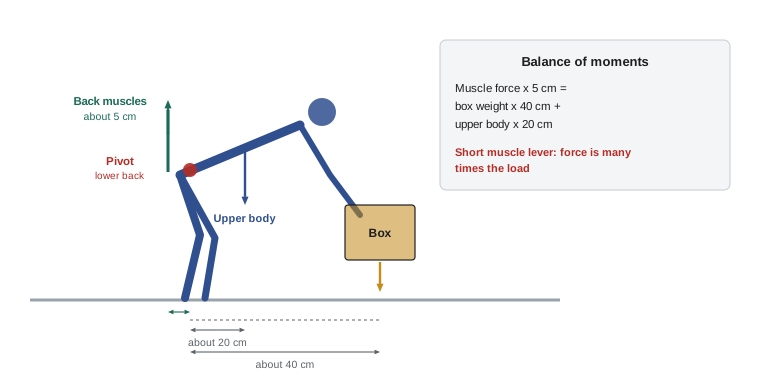
This geometry creates a mechanical disadvantage. A load held in the hands is usually much farther from the spine than the back muscles are. To balance the load, the back muscles must pull with a force many times greater than the weight of the load, and that muscle force presses the vertebrae together. Most of the compression on a lumbar disc during lifting comes not from the weight of the load itself but from the back muscles working to balance it.
Levers and moments
A moment, or torque, is the turning effect of a force about a pivot point. It equals the force multiplied by its perpendicular distance from the pivot, called the moment arm. For lifting, the pivot is roughly the lower lumbar disc. The weight of the load and the weight of the upper body create forward moments that try to bend the trunk forward. The back extensor muscles create a backward moment to resist. For balance, the two moments must be equal.
Because the back muscles act at a moment arm of only about 5 cm, while a load may be 30 to 60 cm in front of the spine, the muscle force must be roughly 6 to 12 times the weight of the load, plus extra force to hold up the trunk. This is why holding a load close to the body is the single most effective change a worker can make in a lift, and why reaching across a table or into a deep bin is so hard on the back.
Worked problem
How much force do the back muscles produce?
A worker bends forward to lift a 15 kg box. The centre of the box is 40 cm in front of the lower lumbar disc. The worker's upper body weighs about 40 kg and its centre of mass is 20 cm in front of the disc. The back extensor muscles act about 5 cm behind the disc. Estimate the muscle force needed to hold this position, and repeat the calculation if the worker brings the box to 20 cm from the disc. Use \( g = 9.81 \) m/s².
Show solution
- Weight of box: \( 15 \times 9.81 \approx 147 \) N. Moment: \( 147 \times 0.40 \approx 58.9 \) N·m.
- Weight of upper body: \( 40 \times 9.81 \approx 392 \) N. Moment: \( 392 \times 0.20 \approx 78.5 \) N·m.
- Total forward moment: \( 58.9 + 78.5 = 137.4 \) N·m. Muscle force: \( 137.4 \div 0.05 \approx 2\,750 \) N.
- With the box at 20 cm: box moment \( 147 \times 0.20 \approx 29.4 \) N·m. Total \( 29.4 + 78.5 = 107.9 \) N·m. Muscle force: \( 107.9 \div 0.05 \approx 2\,160 \) N.
- If the worker also stands more upright so the upper body centre of mass is only 10 cm forward, the trunk moment halves to about 39 N·m and the muscle force falls to about \( (29.4 + 39.2) \div 0.05 \approx 1\,370 \) N.
Answer: About 2,750 N with the box at 40 cm, about 2,160 N with it at 20 cm, and about 1,370 N with the box close and the trunk more upright: half the original force from two simple changes.
The compression on the disc is roughly the muscle force plus the component of the body and load weights along the spine. Biomechanical research used to develop the original NIOSH lifting guide in 1981 set an action limit of about 3,400 N of lumbar disc compression, a level above which some workers are at increased risk of injury, and a maximum of about 6,400 N, above which most workers are at risk. The example shows how easily a bent, extended reach can approach the action limit even with a moderate load.
Common musculoskeletal disorders
MSDs can affect almost any part of the body. They range from short-term strains that heal in days to chronic conditions that last for years. Some are sudden, such as a back strain during a heavy lift; others develop gradually, such as carpal tunnel syndrome after years of forceful gripping.
| Disorder | Tissue and location | Typical work causes |
|---|---|---|
| Low back strain or sprain | Muscles and ligaments of the lower back | Heavy or awkward lifting, twisting, prolonged bending |
| Herniated (slipped) disc | Lumbar or cervical disc pressing on a nerve | Repeated or heavy lifting with bending, whole-body vibration |
| Rotator cuff injury | Shoulder tendons | Overhead work, reaching, repeated arm elevation |
| Tendinitis and tenosynovitis | Tendons and their sheaths, often wrist or shoulder | Repetitive motion with force, awkward wrist postures |
| Lateral epicondylitis (tennis elbow) | Tendons on the outside of the elbow | Forceful gripping and twisting, tool use |
| Carpal tunnel syndrome | Median nerve at the wrist | Forceful repetitive hand work, bent wrists, vibration |
| Trigger finger | Finger flexor tendons | Repeated gripping, pressing triggers on tools |
| Hand-arm vibration syndrome | Blood vessels, nerves and muscles of the hands | Regular use of vibrating power tools |
| Tension neck syndrome | Neck and upper shoulder muscles | Static neck postures, computer work, raised shoulders |
Early symptoms of MSDs include aching, stiffness, burning, tingling, numbness, swelling, reduced range of motion, weakness and clumsiness. Symptoms that appear during work and fade overnight are an early warning. Symptoms that continue overnight or during days off, that wake a person from sleep, or that interfere with daily activities show that injury is progressing. Early reporting and early action greatly improve outcomes, which is why reporting systems are a key part of every ergonomics program.
The physical risk factors
Research has identified a set of physical risk factors that increase the likelihood of MSDs. The risk rises when factors are combined, for example high force with high repetition and awkward posture, and when exposure lasts a long time without recovery.
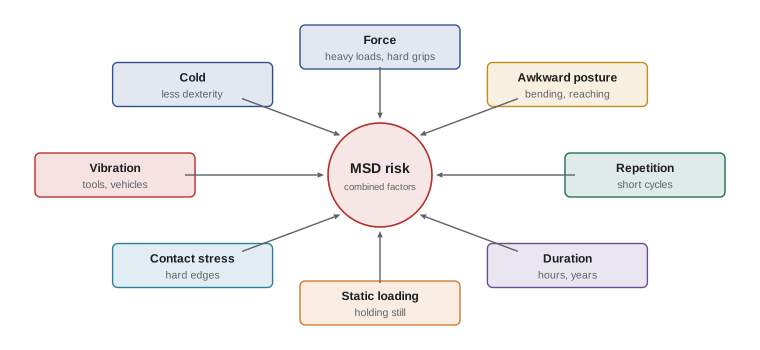
- Force: the effort needed to lift, push, pull, carry, grip or press. Heavy loads, stiff tools, tight connectors and slippery or awkward objects all increase force. A pinch grip, using the fingertips, is about four or five times weaker than a full power grip, so the same object demands more relative effort when pinched.
- Awkward posture: positions away from the neutral, mid-range position of a joint, such as bending or twisting the back, reaching overhead or behind the body, bending the neck, bending the wrist, or kneeling and squatting. Awkward postures reduce strength and increase the load on tissues.
- Repetition: performing the same motion many times. High repetition gives tissues little time to recover. Rough guides suggest that cycle times under about 30 seconds, or more than half the cycle spent on the same motion, indicate high repetition for the upper limbs.
- Duration: the length of exposure over a shift, a week and a career. Longer exposure to any factor increases risk.
- Static loading: holding a posture or load without moving, such as holding arms raised or standing in one place. Static muscle contraction restricts blood flow and leads to fatigue quickly.
- Contact stress: pressure from a hard or sharp edge on soft tissue, such as resting wrists on a desk edge, using the palm as a hammer or tool handles that dig into the hand.
- Vibration: hand-arm vibration from power tools and whole-body vibration from vehicles and machines, covered in Lesson 10.
- Cold: cold temperatures and cold air blowing on hands reduce dexterity and sensation, lead people to grip harder and add to vibration effects.
Tissue tolerance and recovery
A useful way to think about MSDs is to compare the load on a tissue with its tolerance. Every task places some load on tissues. If the load is below the tissue's tolerance and there is time to recover, the tissue adapts and may become stronger. If a single load exceeds the tolerance, as in a very heavy lift, an acute injury results. If loads are moderate but repeated many times without recovery, fatigue damage accumulates and the tissue's tolerance itself falls, until a load that would normally be harmless causes an injury. This is why recovery time, breaks and variation in tasks matter as much as the size of each load.
Worked problem
Cumulative load on a shift
An order picker lifts 45 cases an hour for 7.5 hours of a shift, plus walks between locations. Each lift creates a peak lumbar moment of about 110 N·m. A redesign with a pick cart at waist height and a two-level slot layout cuts the average peak moment per lift to 70 N·m. How many lifts occur per shift, and by what percentage does the redesign reduce the sum of peak moments over the shift (a rough index of cumulative load)?
Show solution
- Lifts per shift: \( 45 \times 7.5 = 337.5 \), or about 338 lifts.
- Before: \( 338 \times 110 \approx 37\,200 \) N·m (summed peak moments).
- After: \( 338 \times 70 \approx 23\,700 \) N·m.
- Reduction: \( (37\,200 - 23\,700) \div 37\,200 \approx 0.36 \), or about 36 per cent.
Answer: About 338 lifts per shift; the redesign cuts the cumulative load index by about 36 per cent without changing the number of cases picked.
Individual factors
People differ in their susceptibility to MSDs. Age, previous injuries, general fitness, body size, some medical conditions (such as diabetes, arthritis and thyroid disorders), pregnancy and activities outside work can all affect risk. These factors are real, but they should not be used to blame workers or to screen people out of jobs. The most effective prevention is to design work that is within the capacity of a wide range of people. When individual workers need accommodation, for example after an injury or during pregnancy, employers have duties to accommodate them under human rights, disability and return-to-work law, as Lesson 12 explains.
Psychosocial and organizational factors
Research shows that MSDs are also linked to psychosocial and organizational factors: high work demands with little control, time pressure, machine-paced work, monotonous tasks, low support from supervisors and co-workers, job insecurity and incentive pay systems that reward speed. These factors may raise muscle tension, reduce breaks, discourage reporting and make people more likely to take risks such as skipping a lift assist. They also affect how people experience and recover from pain. A complete ergonomic assessment considers how work is organized, not just how it is physically performed.
The neutral posture
Each joint has a neutral posture in which it is strongest and the tissues are under the least strain. For the back, neutral means upright with the natural curves of the spine. For the neck, it means the head balanced over the shoulders, looking straight ahead or slightly down. For the shoulders, it means the upper arms hanging relaxed at the sides. For the elbows, it means bent at roughly 90 degrees. For the wrists, it means straight, in line with the forearm. Working close to neutral postures as much as possible, and changing position often, is a basic ergonomic principle that appears in every lesson that follows.
Common mistakes
MistakeAssuming disc compression comes mostly from the weight of the load.
InsteadMost compression comes from back muscles balancing the load; keep loads close to cut muscle force.
MistakeLooking at one risk factor in isolation.
InsteadAssess combinations of force, posture, repetition and duration together.
MistakeIgnoring symptoms that fade overnight.
InsteadTreat early symptoms as warnings and report them so the job can be reviewed.
MistakeBlaming injuries on individual weakness or age.
InsteadDesign work that fits a wide range of people and accommodate individuals as needed.
MistakeOverlooking time pressure and pay systems.
InsteadInclude psychosocial and organizational factors in the assessment.
Summary and key terms
- MSDs affect muscles, tendons, ligaments, nerves, joints, discs and blood vessels.
- The back muscles work at a short moment arm, so they must pull with many times the load.
- Keeping a load close and the trunk upright greatly reduces back muscle force and disc compression.
- Key physical risk factors are force, awkward posture, repetition, duration, static loading, contact stress, vibration and cold.
- Injury occurs when load exceeds tissue tolerance, either at once or through accumulated fatigue.
- Psychosocial and organizational factors such as time pressure also raise MSD risk.
- Early symptoms should be reported and acted on promptly.
- Moment
- Turning effect of a force, equal to force times moment arm.
- Moment arm
- Perpendicular distance from a pivot to the line of a force.
- Lumbar spine
- The five vertebrae of the lower back.
- Spinal disc
- Pad of fibrous tissue between vertebrae that absorbs load.
- Tendon
- Tissue connecting muscle to bone.
- Carpal tunnel syndrome
- Compression of the median nerve at the wrist.
- Neutral posture
- Joint position where the body is strongest and least strained.
- Static loading
- Holding a posture or load without movement.
- Contact stress
- Pressure on soft tissue from a hard or sharp edge.
- Tissue tolerance
- The load a tissue can withstand without damage.
Practice problems
Work each problem on paper first, then reveal the answer to check.
Name four tissues that MSDs can affect.
Show answer
Muscles, tendons, ligaments, nerves, joints, discs or blood vessels.
How many lumbar vertebrae are there?
Show answer
Five.
What is a moment?
Show answer
Force multiplied by its perpendicular distance from a pivot.
A 10 kg load is held 50 cm from the lower back. What is its moment? Use g = 9.81 m/s².
Show answer
About 49 N·m.
If the back muscles act at 5 cm, what muscle force balances a 49 N·m moment?
Show answer
About 980 N.
Why is a pinch grip riskier than a power grip?
Show answer
It is much weaker, so the same object requires more relative effort.
What is static loading?
Show answer
Holding a posture or load without moving, which restricts blood flow.
Give two psychosocial factors linked to MSDs.
Show answer
High demands with low control, time pressure, monotony, low support, incentive pay.
What is the neutral posture of the wrist?
Show answer
Straight, in line with the forearm.
Which symptoms show an MSD is progressing?
Show answer
Symptoms continuing overnight or on days off, waking from sleep, interfering with daily life.
Lesson quiz · 5 questions
Score 60% or more to complete this lesson.
Create a free account to save your progress, take quizzes and earn a certificate.