
HSE-104 · Lesson 7 of 12 · 28 min
Respiratory protection II: programs, fit testing and medical evaluation
A respirator is only as good as the program behind it. Lesson 6 explained how respirators, filters and cartridges work and how to choose a type with an adequate protection factor. But the assigned protection factors in that lesson assume that the respirator is the right size, seals properly to the wearer's face, is worn correctly for the whole exposure, is maintained in good condition, and is used by someone who is medically able to breathe through it. Studies of real workplaces have repeatedly found that respirators worn without fit testing, training and maintenance give far less protection than their ratings suggest, sometimes almost none. That is why both Canadian and US rules require a written respiratory protection program wherever respirators are needed. This lesson covers the elements of a program, medical evaluation, fit testing, user seal checks, facial hair, cartridge change schedules, cleaning and storage, and voluntary use.
The written respiratory protection program
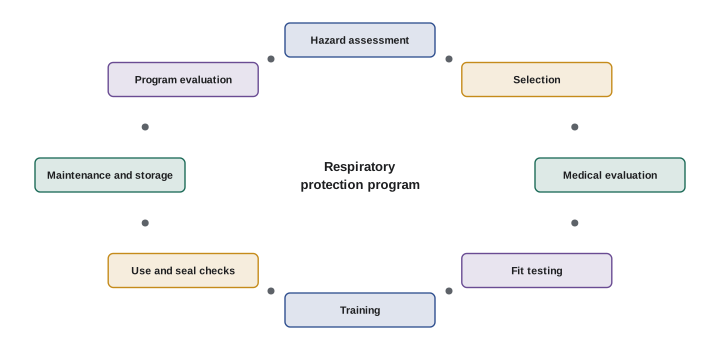
In Canada, provincial and federal regulations require employers to establish a written respiratory protection program wherever workers wear respirators, and most refer to CSA Z94.4, Selection, use, and care of respirators, for its content. CSA Z94.4 sets out program administration, hazard assessment, selection, fit testing, training, use, maintenance, medical surveillance and program evaluation. Some provinces add their own requirements; for example, British Columbia's OHS Regulation Part 8 and Alberta's OHS Code Part 18 require a written program and fit testing in accordance with CSA Z94.4, and Ontario regulations for designated substances and for health care set additional rules.
Whatever the jurisdiction, a good program answers practical questions: who needs a respirator and for which tasks; which models and sizes are approved for use; who does fit testing and when; how workers get new cartridges and when they must change them; where respirators are cleaned and stored; what to do in an emergency; and how the program is checked and improved. The program should be written in plain language, available to workers, and updated whenever tasks, materials, equipment or the workforce change.
Medical evaluation
Breathing through a respirator places extra load on the heart and lungs. Tight-fitting negative-pressure respirators add breathing resistance, all respirators add some weight and heat, and SCBA can weigh 10 to 15 kg. People with certain heart or lung conditions, claustrophobia, or other health problems may not be able to wear some respirators safely. For this reason, workers must be medically evaluated before they are fit tested or required to use a respirator.
In Canada, CSA Z94.4 calls for a health screening of respirator users, usually by a questionnaire reviewed by a qualified health professional, with a further medical examination where the screening identifies concerns. Provincial requirements vary in detail; some require screening before initial use and periodically afterwards, and many employers follow the CSA approach as a minimum.
A medical evaluation is not a one-time formality. Workers should report symptoms such as shortness of breath, dizziness, chest pain or anxiety while wearing a respirator, and supervisors should watch for signs of difficulty, especially in hot conditions or during heavy work.
Why fit testing matters
Tight-fitting respirators, including filtering facepieces such as N95s, elastomeric half and full facepieces, and tight-fitting PAPR and SCBA facepieces, depend on a seal between the mask and the face. If the seal leaks, contaminated air takes the path of least resistance and enters around the edges instead of through the filter. Faces vary greatly in size and shape, and no single model fits everyone. Fit testing is a structured test that checks whether a specific model and size of respirator seals adequately on a specific person. It must be done before first use, whenever a different model, size or make is used, at least annually in most jurisdictions, and whenever there are changes in the wearer's face, such as significant weight change, dental work, facial surgery or scarring, that could affect the fit.
Qualitative and quantitative fit testing
There are two main types of fit test:
- Qualitative fit testing (QLFT) is a pass or fail test that relies on the wearer's sense of taste, smell or irritation to detect leakage of a test agent. Common agents are saccharin (sweet) and Bitrex, or denatonium benzoate (bitter), sprayed as an aerosol into a hood over the wearer's head, and isoamyl acetate (banana smell) for organic vapour cartridges. The wearer first does a sensitivity test without a respirator to confirm they can detect the agent. Qualitative testing is generally limited to respirators that need a fit factor of 100 or less, such as half masks and filtering facepieces.
- Quantitative fit testing (QNFT) uses an instrument to measure leakage numerically and calculate a fit factor, the ratio of the concentration outside the respirator to the concentration inside. Common methods include condensation nuclei counting, which counts ambient particles inside and outside the mask, and controlled negative pressure, which measures leak rate. Quantitative testing is required for full-facepiece respirators where a fit factor above 100 must be demonstrated, and many programs use it for all tight-fitting respirators because it gives an objective number.
During both methods, the wearer performs a series of exercises intended to simulate work movements: normal and deep breathing, turning the head side to side, moving the head up and down, talking aloud, bending over and normal breathing again. A respirator passes if no leak is detected in a qualitative test, or if the overall fit factor meets the required level in a quantitative test, commonly at least 100 for half masks and at least 500 for full facepieces.
| Feature | Qualitative fit test | Quantitative fit test |
|---|---|---|
| Result | Pass or fail | Numerical fit factor |
| Detection | Wearer's taste, smell or irritation | Instrument measurement |
| Common agents or methods | Saccharin, Bitrex, isoamyl acetate | Particle counting, controlled negative pressure |
| Typical use | Half masks and filtering facepieces | Full facepieces and any tight-fitting respirator |
| Typical pass level | No detection during exercises | Fit factor 100 (half), 500 (full) |
| Advantages | Low equipment cost, portable | Objective, documents the quality of fit |
Worked problem
Interpreting a quantitative fit test
A worker is fit tested on a full-facepiece respirator using a particle-counting instrument. The exercise fit factors are 1,450, 980, 610, 220, 870, 1,200 and 1,520. The overall fit factor is calculated as the harmonic mean of the exercise results. The required fit factor for a full facepiece is 500. Does the worker pass, and what does the low result tell you?
Show solution
- The harmonic mean is \(n / \sum (1/FF_i)\) with \(n = 7\).
- Reciprocals: 0.00069, 0.00102, 0.00164, 0.00455, 0.00115, 0.00083 and 0.00066; their sum is about 0.01054.
- Overall fit factor: \(7 / 0.01054 \approx 664\).
- This exceeds 500, so the worker passes, but the exercise result of 220 shows a leak during one movement, often talking or bending, which should prompt checking strap tension, facepiece size and how the mask sits.
Answer: The overall fit factor is about 664, a pass; the single low exercise shows a weak point worth addressing through adjustment or coaching.
User seal checks
A user seal check, sometimes called a fit check, is a quick test the wearer does every time they put on a tight-fitting respirator, to confirm that it is seated properly. It does not replace a fit test.
- Negative pressure check: cover the filter or cartridge inlets with the palms or seal them, inhale gently, and hold the breath for about ten seconds. The facepiece should collapse slightly and stay collapsed with no inward leakage.
- Positive pressure check: cover the exhalation valve and exhale gently. The facepiece should bulge slightly without air escaping around the edges.
For filtering facepieces, the wearer cups both hands over the respirator and exhales sharply, feeling for air leaking around the edges, especially near the nose and under the chin. If a seal check fails, the wearer should readjust the straps and nosepiece and try again, and if it still fails, leave the contaminated area and get help or a different respirator.
Facial hair and other interferences
Anything that comes between the sealing surface of a tight-fitting respirator and the skin can cause leakage, including beards, stubble, sideburns and moustaches that cross the seal, as well as jewellery, the temples of glasses, head coverings and some hairstyles. Even one day's stubble can significantly reduce the fit. For this reason, both Canadian and US rules require that tight-fitting respirators not be worn by people with facial hair that interferes with the seal or valve function. Where workers have beards for religious, cultural, medical or personal reasons, employers should look for alternatives, such as loose-fitting PAPR hoods or helmets, which do not rely on a face seal, rather than simply excluding the worker. Full-facepiece wearers who need vision correction should use spectacle kits that mount inside the facepiece rather than ordinary glasses, whose temples break the seal.
Cartridge change schedules
As explained in Lesson 6, chemical cartridges become saturated over time, and most have no reliable end-of-service-life indicator. A change schedule sets how long cartridges may be used before replacement, based on the contaminant and its concentration, humidity and temperature, the wearer's breathing rate and workload, and data or software from the manufacturer. High humidity can greatly shorten the service life of carbon cartridges, and some contaminants, such as low-boiling-point organics, migrate through cartridges during storage, so partially used cartridges should not be stored and reused the next day unless the manufacturer's data supports it. A conservative program will round down the calculated service time, change cartridges at the end of each shift, and replace them immediately if the wearer detects any odour, taste, irritation or increased breathing resistance.
Worked problem
Setting a cartridge change schedule
Manufacturer software estimates a service life of 7.5 hours for an organic vapour cartridge at 150 ppm of a solvent, 30 °C, 80 % relative humidity and a moderate work rate. The program applies a safety factor of 50 %. Workers wear the respirators for about 6 hours per shift. What change schedule should be set?
Show solution
- Apply the safety factor: \(7.5 \times 0.5 = 3.75\) hours.
- Round down to a practical interval: 3.5 hours.
- Workers wearing respirators for 6 hours need a cartridge change partway through the shift, for example at lunch, plus a fresh pair at the start of each shift.
- Record the schedule in the written program, communicate it to workers, and re-evaluate if concentrations, temperature or humidity change.
Answer: Change cartridges at least every 3.5 hours of use, including a mid-shift change, and never carry used cartridges over to the next day.
Cleaning, inspection, storage and repair
Reusable respirators must be cleaned and disinfected regularly: daily for respirators issued to one worker and used often, after each use for shared or emergency respirators, and after fit testing and training. Cleaning usually involves removing filters and cartridges, washing the facepiece in warm water with a mild detergent, disinfecting as the manufacturer recommends, rinsing, air drying and reassembling. Before each use, the wearer should inspect the facepiece for cracks, tears, distortion and stiffness; the head straps for elasticity; the valves for warping, dirt and missing flaps; and the filters and cartridges for damage, correct type and expiry date. Respirators should be stored in a clean, dry place away from sunlight, heat, chemicals and dust, in a way that does not distort the facepiece, such as a sealed bag or container. Emergency respirators, including escape respirators and SCBA, must be inspected at least monthly and after each use, and SCBA cylinders kept fully charged. Repairs must use only the manufacturer's approved parts and be done by trained people.
Training
Respirator users must be trained before first use and at least annually, and whenever there are changes that make previous training obsolete. Training covers why the respirator is needed and how improper fit, use or maintenance can reduce its protection; the respirator's limitations and capabilities; how to use it in an emergency, including if it malfunctions; how to inspect, put on, remove and seal check it; maintenance and storage; and how to recognize medical signs and symptoms that may limit its use. Training should include hands-on practice, and workers should be able to demonstrate what they have learned.
Voluntary use
Workers sometimes choose to wear a respirator when it is not required, for example a filtering facepiece for comfort against nuisance dust. In Canada, CSA Z94.4 and provincial rules expect the employer to ensure that voluntary use does not itself create a hazard, for instance by confirming that workers understand the limitations of the respirator and that reusable respirators are kept clean. The details vary by jurisdiction.
Program evaluation
The program should be evaluated regularly to make sure it is working. Evaluation includes observing workers using respirators, talking with them about fit, comfort and problems, reviewing air monitoring results to confirm that the selected respirators are still adequate, checking fit-test and training records, inspecting stored respirators and cartridge supplies, and investigating any symptoms or incidents. Common problems uncovered by evaluations include workers wearing respirators they were not fit tested on, cartridges not being changed, facial hair, respirators hanging around necks between uses, and dirty or damaged equipment.
Common mistakes
MistakeHanding out respirators without fit testing.
InsteadFit test every wearer on the exact model and size.
MistakeTreating a seal check as a fit test.
InsteadSeal check each time; fit test at least annually.
MistakeAllowing beards under tight-fitting masks.
InsteadRequire a clean seal or provide a loose-fitting PAPR.
MistakeSkipping medical evaluation for short tasks.
InsteadEvaluate every required user before fit testing.
MistakeStoring used cartridges for the next day.
InsteadFollow the change schedule and replace each shift.
Summary and key terms
- Respirators need a written program to deliver their rated protection.
- Canadian programs generally follow CSA Z94.4 and provincial rules.
- Workers must be medically evaluated before fit testing and use.
- Fit testing confirms a specific model and size seals on a specific person.
- Qualitative tests give pass or fail; quantitative tests give a fit factor.
- Seal checks are done every time a tight-fitting respirator is put on.
- Facial hair, change schedules, maintenance and training all affect protection.
- Respiratory protection program
- Written plan covering all aspects of respirator use.
- Program administrator
- Trained person responsible for the program.
- Medical evaluation
- Assessment of fitness to wear a respirator.
- Fit test
- Test of the seal of a specific respirator on a person.
- Qualitative fit test
- Pass or fail test using taste, smell or irritation.
- Quantitative fit test
- Instrument test producing a fit factor.
- Fit factor
- Ratio of outside to inside concentration during a fit test.
- User seal check
- Quick positive and negative pressure check at each donning.
- Change schedule
- Planned replacement interval for chemical cartridges.
- Voluntary use
- Wearing a respirator when it is not required.
Practice problems
Work each problem on paper first, then reveal the answer to check.
Why do respirators need a program?
Show answer
Ratings assume correct fit, use, maintenance and training.
What must happen before a fit test?
Show answer
Medical evaluation.
Name two qualitative fit test agents.
Show answer
Saccharin, Bitrex, isoamyl acetate.
What does a quantitative fit test produce?
Show answer
A numerical fit factor.
Typical pass fit factor for a full facepiece?
Show answer
500.
How often is fit testing usually required?
Show answer
At least annually and when the respirator or face changes.
Describe a negative pressure seal check.
Show answer
Cover inlets, inhale, the mask should collapse and stay collapsed.
What option suits a worker with a beard?
Show answer
A loose-fitting PAPR hood or helmet.
Service life 6 hours with a 50 % factor; change interval?
Show answer
3 hours.
How often should emergency respirators be inspected?
Show answer
At least monthly and after each use.
Lesson quiz · 5 questions
Score 60% or more to complete this lesson.
Create a free account to save your progress, take quizzes and earn a certificate.