
HSE-104 · Lesson 5 of 12 · 27 min
Hearing protection
Noise-induced hearing loss is one of the most common occupational diseases in both Canada and the United States. It develops slowly and painlessly over years of exposure, so workers often do not notice it until the damage is permanent. Loud noise damages the sensory hair cells of the inner ear, which do not grow back; once lost, the hearing cannot be restored by surgery or medication, and hearing aids only partly compensate. Noise also causes tinnitus, a persistent ringing or buzzing, and contributes to fatigue, stress, communication errors and accidents. Hearing protectors are an important part of preventing this damage, but only as part of a hearing conservation program that measures noise, reduces it at the source wherever possible, and monitors workers' hearing. This lesson explains how sound is measured, the exposure limits, the main types of hearing protectors, how attenuation ratings work and how to derate them, and how to choose, fit and maintain protectors.
Measuring sound
Sound level is measured in decibels (dB), a logarithmic scale on which an increase of 10 dB represents ten times the sound energy and is perceived as roughly twice as loud, and an increase of 3 dB represents a doubling of sound energy. Occupational noise is usually measured with the A-weighting, written dBA, which adjusts the measurement to match the ear's sensitivity to different frequencies. Typical levels include quiet conversation at about 60 dBA, heavy traffic at about 85 dBA, a power drill or lawn mower at about 90 to 95 dBA, a chainsaw or grinder at about 100 to 110 dBA, and a jackhammer or gunshot well above 110 dBA. A practical rule of thumb is that if you must raise your voice to be understood by someone about one metre away, the noise level is probably above 85 dBA and should be measured.
Noise exposure depends on both level and duration. The daily noise dose combines these into a single figure, usually expressed as an eight-hour time-weighted average (TWA, or Lex,8h) or as a percentage of the allowable daily dose. Noise is measured with sound level meters for spot readings and with personal noise dosimeters, worn by workers during a shift, for exposure.
Exposure limits and the exchange rate
Exposure limits specify the maximum allowed level for an eight-hour day, called the criterion level, and how the allowed time changes as levels rise, called the exchange rate. With a 3 dB exchange rate, the allowed time halves for every 3 dB increase, which matches the physics of sound energy; with a 5 dB exchange rate, it halves for every 5 dB increase.
In Canada, most provinces and territories set a criterion level of 85 dBA for eight hours with a 3 dB exchange rate, including British Columbia, Alberta, Saskatchewan, Manitoba, Ontario, Quebec and the Atlantic provinces, while federally regulated workplaces under the Canada Occupational Health and Safety Regulations use 87 dBA with a 3 dB exchange rate. Several jurisdictions also set a peak limit for impulse noise, commonly 140 dB. Most jurisdictions require noise measurement, engineering controls where practicable, hearing protection above the limit, training and, in many cases, audiometric testing of exposed workers. CSA Z94.2, Hearing protection devices, sets performance, selection, care and use requirements for protectors, and CSA Z1007 covers hearing loss prevention program management.
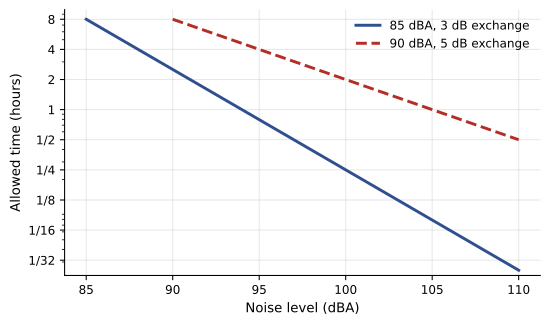
Here \(T\) is the allowed time in hours at level \(L\), \(L_c\) is the criterion level and \(q\) is the exchange rate in decibels. With \(L_c = 85\) dBA and \(q = 3\), the allowed time at 94 dBA is \(8 / 2^{3} = 1\) hour.
Worked problem
Calculating a daily noise dose
Using an 85 dBA criterion with a 3 dB exchange rate, a worker spends 2 hours at 88 dBA, 1 hour at 94 dBA and the rest of the shift below 80 dBA. What is the daily dose?
Show solution
- Allowed time at 88 dBA: \(8 / 2^{(88-85)/3} = 8/2 = 4\) hours.
- Allowed time at 94 dBA: \(8 / 2^{(94-85)/3} = 8/8 = 1\) hour.
- Dose = actual time divided by allowed time, summed: \(2/4 + 1/1 = 0.5 + 1.0 = 1.5\), or 150 %.
- Exposure below 80 dBA contributes little and is ignored here.
Answer: A dose of 150 %, exceeding the limit; noise controls and hearing protection are required.
Types of hearing protectors
Hearing protectors fall into a few main categories:
- Foam earplugs: soft, expanding plugs that are rolled into a thin cylinder, inserted into the ear canal and allowed to expand. They can provide high attenuation when fitted properly, but are often inserted too shallowly.
- Pre-moulded earplugs: reusable plugs made of flexible plastic or silicone with flanges, available in sizes. They are easier to insert than foam plugs but must match the size of the ear canal.
- Custom-moulded earplugs: made from impressions of an individual's ear canals, comfortable for long wear and often fitted with filters.
- Banded protectors (canal caps): plugs on a headband, convenient for intermittent use.
- Earmuffs: cups lined with foam and sealed by cushions around the ears, held by a headband or mounted on a hard hat. They are easy to fit correctly, but the seal is broken by glasses arms, long hair and head coverings, and they can be hot.
- Electronic and communication protectors: earmuffs or plugs with level-dependent electronics that amplify quiet sounds and limit loud ones, built-in radios or Bluetooth communication, useful where speech and warning signals matter.
For very loud environments, combining earplugs and earmuffs, called double protection, provides more attenuation than either alone, though less than the sum of their ratings.
Attenuation ratings
Hearing protectors are tested in laboratories and given ratings that describe how much they reduce noise.
In Canada, CSA Z94.2 classifies protectors into classes such as A, B and C based on their attenuation, with Class A providing the most protection, and also uses grades and the US Noise Reduction Rating for products sold in both markets. Products may also carry the European Single Number Rating (SNR). Selection tables in CSA Z94.2 match protector classes to exposure levels.
Laboratory ratings overstate real-world protection, because in the workplace protectors are often fitted less carefully, worn inconsistently, or degraded. For this reason, safety professionals derate laboratory figures. A widely used method, from OSHA and NIOSH guidance, is applied to the NRR when noise is measured in dBA:
The subtraction of 7 corrects for the difference between C-weighted and A-weighted measurements, and the division by 2 is a 50 % derating that OSHA recommends when evaluating the effectiveness of hearing protectors in practice. NIOSH has recommended other derating factors by protector type, such as 25 % for earmuffs, 50 % for foam earplugs and 70 % for other earplugs. The important point is that a protector labelled NRR 33 does not reduce exposure by 33 dB in practice.
Worked problem
Estimating protection from earplugs
A worker's noise exposure is 100 dBA TWA. They wear foam earplugs labelled NRR 32. Using the OSHA derating method, what is the estimated protected exposure? What if they also wear earmuffs with NRR 27?
Show solution
- Earplugs alone: \(100 - (32 - 7)/2 = 100 - 12.5 = 87.5\) dBA.
- For double protection, a common practice is to add 5 dB to the attenuation of the higher-rated protector: \(100 - [(32 - 7)/2 + 5] = 100 - 17.5 = 82.5\) dBA.
- With plugs alone, the protected exposure is still above 85 dBA; double protection brings it below.
- Engineering controls to reduce the source level should still be pursued.
Answer: About 87.5 dBA with plugs alone, and about 82.5 dBA with plugs and muffs together.
Fit testing for hearing protection
Because fit is so variable, many hearing conservation programs now use individual fit testing of hearing protectors, also called field attenuation estimation. Fit-test systems measure the attenuation a specific person achieves with a specific protector, producing a personal attenuation rating. Fit testing identifies workers who are not getting enough protection, teaches correct insertion, and helps choose the right size or type for each person. It is increasingly recommended in standards and best practice, though not universally required by law.
Fitting earplugs and earmuffs
For foam earplugs, roll the plug into a thin, crease-free cylinder with clean hands; reach over the head with the opposite hand and pull the top of the ear up and back to straighten the ear canal; insert the plug deeply, so that little of it is visible from the front; and hold it in place for 20 to 30 seconds while it expands. A well-fitted plug makes your own voice sound louder and deeper. For pre-moulded plugs, pull the ear up and back and insert until the flanges seal. For earmuffs, position the cups fully over the ears, adjust the headband so the cushions seal firmly, and move hair away from the cushions. Check the fit by noticing whether surrounding noise is noticeably reduced.
Over-protection and communication
More attenuation is not always better. Protectors that reduce noise far below what is needed can isolate workers, making it hard to hear speech, warning signals, alarms and approaching vehicles, which may lead them to remove the protectors altogether. A common target is a protected level of about 70 to 80 dBA. For workers who need to communicate or hear signals, flat-attenuation earplugs, which reduce all frequencies more evenly, or level-dependent electronic protectors may be better. Workers with existing hearing loss need particular attention, because protectors can make it harder for them to hear, and some may need specialized devices.
Care, hygiene and replacement
Disposable foam plugs should be used once or as the manufacturer directs, inserted with clean hands and discarded when dirty or no longer expanding. Reusable plugs should be washed with mild soap and water and stored in a case. Earmuff cushions harden and crack with age and should be replaced as the manufacturer recommends, often every six months to a year, and headbands lose tension over time, reducing the seal. Shared protectors should not be used without cleaning, and earplugs should never be shared.
Hearing conservation programs
Hearing protectors are only one part of a hearing conservation or hearing loss prevention program. A complete program includes noise surveys and personal monitoring; engineering controls, such as quieter equipment, enclosures, barriers, damping and maintenance; administrative controls, such as limiting time in noisy areas and posting signs; hearing protection selection, fitting and training; audiometric testing, with baseline and periodic hearing tests to detect early changes; and recordkeeping and program evaluation. When audiometric tests show a significant shift in a worker's hearing, the program should investigate the cause, refit or change protectors, and retrain.
Noise outside work and ototoxic substances
Hearing damage adds up from every source, not just work. Loud music through earbuds, power tools at home, motorsports, concerts and recreational shooting all contribute, so hearing conservation training often encourages workers to protect their hearing off the job too. Some chemicals, called ototoxic substances, can damage hearing on their own or make the ear more vulnerable to noise, including certain solvents such as toluene, styrene and xylene, carbon monoxide, lead and some medications. Workers exposed to both noise and ototoxic substances may need audiometric testing even when noise levels alone would not require it.
Hearing protection in practice
Hearing protection only works if it is worn for the whole time a worker is in noise. Removing protectors for even a short time greatly reduces the protection achieved over a shift, because of the logarithmic nature of sound: protectors with 25 dB of attenuation worn for only half of an eight-hour shift deliver an effective protection of only about 3 dB. Making protectors easy to get, comfortable and compatible with other PPE, and marking noisy areas clearly with signs, helps workers keep them on.
Common mistakes
MistakeAssuming the labelled rating equals real protection.
InsteadDerate laboratory ratings and use fit testing.
MistakeInserting foam earplugs shallowly.
InsteadRoll, pull the ear up and back, insert deeply and hold.
MistakeWearing earmuffs over glasses arms and hair.
InsteadUse thin-temple glasses and keep the seal clear.
MistakeChoosing the highest rating regardless of need.
InsteadAvoid over-protection; target about 70–80 dBA.
MistakeRelying on protectors instead of reducing noise.
InsteadUse engineering controls and a full program.
Summary and key terms
- Noise-induced hearing loss is permanent and develops slowly.
- Sound is measured in dBA; a 3 dB rise doubles sound energy.
- Most Canadian jurisdictions use 85 dBA with a 3 dB exchange rate.
- Protectors include foam, pre-moulded and custom plugs, earmuffs and electronic devices.
- Laboratory ratings overstate protection and should be derated.
- Correct fitting and fit testing greatly improve real protection.
- Hearing protection is one part of a hearing conservation program.
- Decibel
- Logarithmic unit of sound level.
- dBA
- A-weighted decibels matching human hearing.
- Time-weighted average
- Average exposure over an eight-hour day.
- Criterion level
- Allowed level for an eight-hour exposure.
- Exchange rate
- Level increase that halves the allowed time.
- Noise dose
- Exposure as a percentage of the allowed daily amount.
- Noise Reduction Rating
- US laboratory attenuation rating for protectors.
- Derating
- Reducing a laboratory rating to estimate real protection.
- Double protection
- Wearing earplugs and earmuffs together.
- Audiometric testing
- Hearing tests to detect changes over time.
Practice problems
Work each problem on paper first, then reveal the answer to check.
Why is noise-induced hearing loss so serious?
Show answer
It is permanent and painless, so it often goes unnoticed.
What does a 3 dB increase mean?
Show answer
Doubling of sound energy.
Allowed time at 91 dBA with 85 dBA and 3 dB exchange?
Show answer
2 hours.
Dose for 4 hours at 88 dBA with 85/3 criteria?
Show answer
100 %.
Name three types of hearing protector.
Show answer
Foam plugs, pre-moulded plugs, custom plugs, earmuffs, electronic.
Protected level at 98 dBA with NRR 29 using the OSHA method?
Show answer
98 − 11 = 87 dBA.
Why subtract 7 from the NRR?
Show answer
To convert from C-weighted to A-weighted measurement.
What is a sign of a well-fitted foam earplug?
Show answer
Your own voice sounds louder and deeper.
Why avoid over-protection?
Show answer
Workers cannot hear speech or warnings and may remove protectors.
Name three parts of a hearing conservation program.
Show answer
Monitoring, engineering controls, protectors, audiometric testing, training, records.
Lesson quiz · 5 questions
Score 60% or more to complete this lesson.
Create a free account to save your progress, take quizzes and earn a certificate.