
HSE-104 · Lesson 1 of 12 · 26 min
PPE as the last line of defence
Personal protective equipment, usually shortened to PPE, is the equipment a worker wears to reduce exposure to a hazard: hard hats, safety glasses, face shields, hearing protectors, respirators, gloves, safety footwear, high-visibility apparel, protective clothing and fall protection harnesses. PPE is familiar, visible and often the first thing people think of when they think of workplace safety. It is also the least reliable way to control a hazard, because it depends on the right equipment being chosen, fitted, worn correctly, kept in good condition and replaced when it wears out, every time, by every person. This course explains how each major type of PPE works, how it is selected and used, what the law in Canada and the United States requires, and why PPE must always be part of a wider system of controls rather than a substitute for them.
This is an awareness-level course. It explains general principles and the main requirements in Canadian jurisdictions, but it does not replace the training your employer must provide for the specific hazards, equipment and procedures at your workplace, and it is not a certification. Some PPE, such as respirators and fall arrest equipment, requires workplace-specific training, fitting and, in many provinces, documented instruction by a competent person. Always follow the law in your province or territory, the manufacturer's instructions and your employer's procedures.
Why PPE is the last line of defence
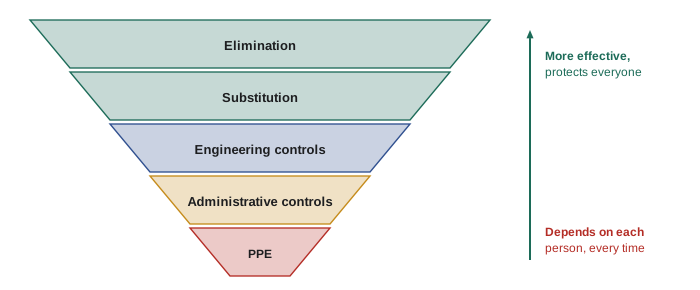
The hierarchy of controls, introduced in HSE-103, ranks ways of dealing with hazards from most to least effective: elimination, substitution, engineering controls, administrative controls and, at the bottom, personal protective equipment. The ranking reflects a simple idea. Controls at the top act on the hazard itself, so they protect everyone, all the time, without depending on individual behaviour. Controls at the bottom act on the individual worker, so they protect only the person wearing them, only while they are worn, and only if they work as intended.
Consider noise from a large compressor. Replacing it with a quieter model or moving it outside eliminates or substitutes the hazard. Building an acoustic enclosure around it is an engineering control. Limiting how long workers spend near it, and posting the area, are administrative controls. Earplugs are PPE. The earplugs may provide excellent protection on paper, but in practice they are often inserted poorly, removed to talk, forgotten, or worn only part of the shift. Studies of hearing protectors in real workplaces consistently find that the protection workers actually receive is far lower than laboratory ratings suggest. The enclosure, by contrast, works every minute the compressor runs, for every person nearby.
When PPE is the right answer
Despite its place at the bottom of the hierarchy, PPE is essential in many situations, and in some it is the main protection available. PPE is appropriate:
- While higher-level controls are being designed or installed, as an interim measure.
- When higher-level controls cannot reduce the hazard enough on their own, so PPE provides an additional layer, as with safety glasses in a shop where machine guards are already in place.
- For short, non-routine tasks where engineering controls are not practicable, such as cleaning out a tank, responding to a spill or working at height for a brief inspection.
- In emergencies and rescue, where conditions are unknown and changing.
- Where the hazard is inherent to the work, such as handling sharp metal, working near traffic or entering an atmosphere that cannot be ventilated.
The key point is that PPE should be a deliberate choice made after higher controls have been considered, not a default because it is quick and cheap. When an assessment concludes that PPE is needed, the assessment should also record why higher controls were not sufficient and when that decision will be reviewed.
How PPE works
Every type of PPE works by placing a barrier between the worker and a hazard, or by absorbing, filtering, deflecting or spreading energy. Hard hats spread the force of a falling object across the head and absorb some of the energy. Safety glasses stop flying particles. Hearing protectors reduce the sound energy reaching the eardrum. Respirators filter contaminants from air or supply clean air. Gloves resist cuts, chemicals or heat. Safety footwear protects toes from crushing and soles from punctures. High-visibility apparel makes a worker easier to see. Fall arrest equipment stops a fall and limits the force on the body. Understanding the mechanism matters, because it explains the limits: a barrier can be bypassed if it does not fit, overwhelmed if the hazard exceeds its rating, or degraded by wear, chemicals, heat and age.
Limitations of PPE
PPE has limitations that every worker and supervisor should understand:
- It protects only the wearer, not other people nearby.
- It works only when worn correctly, for the entire exposure.
- It must fit the individual. A respirator that leaks at the edges, a glove that is too large or a harness that is loose may give little protection.
- It can fail without warning. Cartridges become saturated, gloves are permeated by chemicals before any visible change, and hard hats weaken with sunlight and age.
- It can create new hazards: heat stress from protective clothing, reduced vision from fogged goggles, reduced hearing of warning signals from earmuffs, and strain from heavy equipment.
- It can give a false sense of security, encouraging people to take risks they would otherwise avoid.
- It depends on a program: selection, fitting, training, inspection, maintenance, storage and replacement. Without a program, PPE quickly becomes ineffective.
| Hazard | Higher-level control example | PPE example |
|---|---|---|
| Noise from a compressor | Quieter compressor or acoustic enclosure | Earplugs or earmuffs |
| Flying chips from grinding | Guarding and local exhaust | Safety glasses and face shield |
| Solvent vapour in cleaning | Water-based cleaner or ventilated booth | Respirator and chemical gloves |
| Falling tools from height | Toe boards, tool tethers and exclusion zones | Hard hat |
| Struck by vehicles | Separated pedestrian routes and barriers | High-visibility apparel |
The PPE hazard assessment
Choosing PPE starts with a hazard assessment focused on PPE. The general approach described in HSE-103 applies, but a PPE assessment asks specific questions for each task and area: what parts of the body could be harmed, by what kind of hazard, how severe the exposure could be, how long it lasts, and what PPE, with what performance rating, would protect against it. A practical PPE assessment:
- Walks through the workplace and observes each task, including maintenance, cleaning and occasional work.
- Identifies sources of impact, penetration, compression, chemicals, heat and cold, harmful dust, light radiation, electrical hazards, noise, falls, sharp objects and moving vehicles.
- Reviews injury and incident records, safety data sheets, exposure monitoring results and equipment manuals.
- Considers who does the work, including new workers, contractors and people of different sizes and needs.
- Records the hazards, the controls already in place, the PPE required and the standard or rating it must meet.
- Is reviewed when tasks, materials, equipment or people change, and after incidents.
Worked problem
A PPE assessment for a metal fabrication cell
A small fabrication shop has a cell where a worker cuts steel with an abrasive chop saw, grinds edges and stacks finished parts on a pallet. What PPE might an assessment identify, assuming guarding and local exhaust are already in place?
Show solution
- Eyes and face: flying particles and sparks from cutting and grinding. Safety glasses with side protection, plus a face shield during grinding.
- Hearing: chop saws and grinders often exceed 90 dBA. Hearing protection, confirmed by noise measurement.
- Hands: sharp edges and hot metal. Cut-resistant gloves for handling; gloves must not be worn near rotating parts where they could be caught.
- Feet: dropped steel parts. Safety footwear with toe protection.
- Lungs: metal and abrasive dust. If local exhaust does not control exposure below limits, as shown by monitoring, a respirator selected under a respiratory protection program.
- Record the hazards, the controls, the PPE and its rating, and review when equipment or work changes.
Answer: Safety glasses and a face shield, hearing protection, cut-resistant gloves used away from rotating parts, safety footwear, and a respirator only if monitoring shows that exhaust is not enough.
Standards and certification marks
PPE is designed, tested and certified to performance standards. Standards define how equipment must perform, how it is tested and how it must be marked, so that employers and workers can choose equipment confidently. In Canada, most PPE standards are published by CSA Group, and many provincial regulations require PPE to meet a named CSA standard. In the United States, OSHA standards generally refer to consensus standards published by ANSI, the International Safety Equipment Association (ISEA), ASTM International and the National Fire Protection Association (NFPA), and respirators must be approved by the National Institute for Occupational Safety and Health (NIOSH). Equipment is marked with the standard it meets and often with a class, type or rating. Workers should learn to read these markings, because they are the quickest way to confirm that equipment is suitable. Lesson 2 sets out the legal framework, and each later lesson explains the markings for its type of PPE.
Shared responsibilities
PPE works only when everyone plays their part. Employers are responsible for assessing hazards, selecting suitable PPE, providing it, ensuring it fits, training workers, enforcing its use and maintaining or replacing it. Supervisors are responsible for making sure workers in their area wear the right PPE correctly and for correcting problems. Workers are responsible for wearing PPE as instructed, inspecting it before use, caring for it, and reporting defects, poor fit or problems. Manufacturers and suppliers are responsible for providing equipment that meets the claimed standards, with clear instructions. When any link in this chain fails, the protection fails. Lesson 12 returns to PPE programs that bring these responsibilities together.
Common myths about PPE
Several myths undermine PPE use. "PPE is all I need" ignores the hierarchy of controls. "If it fits loosely, it still works" ignores the fact that most PPE depends on fit. "Any glove protects against chemicals" ignores the fact that different materials resist different chemicals for very different times. "My hard hat is fine until it cracks" ignores the gradual degradation of plastics in sunlight. "Earplugs make it impossible to hear alarms" overlooks the fact that well-chosen hearing protection can reduce harmful noise while still allowing speech and warning signals to be heard. Correcting these myths is part of good training.
PPE for everyone
PPE has historically been designed around the body sizes of a relatively narrow group of workers, often men of average build. Workers who are smaller or larger than this group, many women, and workers with religious head coverings, facial hair worn for religious reasons, or disabilities have often found that standard PPE fits poorly, which reduces protection and comfort. Good PPE programs provide a range of sizes and styles, consider accommodation needs, and involve workers in selection. Lesson 12 discusses inclusive PPE in more depth.
PPE and the cost of protection
Some employers see PPE as the cheapest control because a pair of safety glasses costs less than a machine guard. Over the life of a hazard, this is often not true. PPE must be bought again and again, for every worker, and it brings ongoing costs for fitting, training, supervision, cleaning, storage, replacement and recordkeeping. It also depends on daily human behaviour, so its protection varies from person to person and day to day. An engineering control usually costs more at the start but protects everyone continuously, with little effort from workers. When comparing options, look at the total cost over several years and the reliability of protection, not just the purchase price.
Signs, labels and communication
Clear communication supports every PPE requirement. Mandatory-action signs at area entrances, using standard symbols such as a blue circle with a white pictogram of a hard hat, glasses or ear protection, remind everyone what is needed before they enter. Labels on machines and containers, safety data sheets, and job instructions should state PPE requirements consistently, so workers do not receive mixed messages.
Common mistakes
MistakeReaching for PPE before considering other controls.
InsteadApply the hierarchy of controls first and use PPE for remaining risk.
MistakeAssuming laboratory ratings equal real protection.
InsteadExpect lower protection in practice and ensure correct fit and use.
MistakeIssuing PPE without a hazard assessment.
InsteadAssess each task and record the PPE and rating required.
MistakeIgnoring new hazards created by PPE.
InsteadConsider heat stress, vision, hearing and strain when selecting PPE.
MistakeTreating PPE as the worker's problem alone.
InsteadShare responsibility among employer, supervisor, worker and supplier.
Summary and key terms
- PPE reduces exposure by placing a barrier between the worker and the hazard.
- It is the least reliable control because it depends on each person, every time.
- PPE is appropriate as an interim, additional, short-term or emergency measure.
- PPE protects only the wearer and only when it fits and is worn correctly.
- A PPE hazard assessment identifies hazards, controls and the PPE and rating required.
- Standards and certification marks show what equipment is designed to do.
- Employers, supervisors, workers and suppliers share responsibility for PPE.
- Personal protective equipment
- Equipment worn to reduce exposure to a hazard.
- Hierarchy of controls
- Ranking of controls from most to least effective.
- Engineering control
- Physical change that reduces a hazard at its source or path.
- Administrative control
- Procedures, schedules and training that reduce exposure.
- PPE hazard assessment
- Evaluation of tasks to determine the PPE required.
- Performance standard
- Document defining how equipment must perform and be tested.
- Certification mark
- Marking showing equipment meets a standard.
- Fit
- How well PPE matches the wearer's body.
- False sense of security
- Taking more risk because protection is worn.
- PPE program
- System for selecting, fitting, training, maintaining and replacing PPE.
Practice problems
Work each problem on paper first, then reveal the answer to check.
Why is PPE at the bottom of the hierarchy of controls?
Show answer
It protects only the wearer and depends on correct use every time.
Name two situations where PPE is appropriate.
Show answer
Interim control, additional layer, short non-routine tasks, emergencies.
Give an engineering control for compressor noise.
Show answer
An acoustic enclosure.
Name three limitations of PPE.
Show answer
Protects only the wearer, depends on fit and use, can fail without warning, creates new hazards.
What new hazard can protective clothing create?
Show answer
Heat stress.
What should a PPE assessment record?
Show answer
Hazards, existing controls, PPE required and its rating.
Who approves respirators in the US?
Show answer
NIOSH.
Who publishes most PPE standards in Canada?
Show answer
CSA Group.
Why must gloves not be worn near rotating parts?
Show answer
They can be caught and pull the hand in.
Why does inclusive sizing matter?
Show answer
Poorly fitting PPE gives less protection.
Lesson quiz · 5 questions
Score 60% or more to complete this lesson.
Create a free account to save your progress, take quizzes and earn a certificate.