
HSE-104 · Lesson 3 of 12 · 26 min
Head protection
Head injuries at work range from cuts and bruises to skull fractures, brain injuries and death. They happen when objects fall from above, when workers strike their heads on fixed objects such as beams, pipes and low ceilings, when workers fall, and when the head contacts electrical conductors. Protective headwear, commonly called a hard hat or safety helmet, is designed to reduce the force of impacts, resist penetration by sharp objects and, in some designs, protect against electric shock. This lesson explains how hard hats work, how they are classified, how to choose, wear, inspect and replace them, and when bump caps or other head protection are appropriate.
When head protection is required
Head protection is required wherever there is a danger of head injury from falling, flying or thrown objects, from bumping into fixed objects, or from electrical contact. Typical workplaces include construction sites, where it is generally required at all times; shipyards, mines and forestry; warehouses with high racking and overhead handling; industrial plants with overhead cranes or conveyors; utility work near energized lines; and maintenance work in tight spaces with low clearances. A PPE assessment should identify these hazards area by area. Even where hard hats are required, higher-level controls such as toe boards, debris netting, tool tethers, overhead protection and exclusion zones beneath work at height remain essential, because a hard hat cannot protect against a large or heavy falling object.
How a hard hat works
A hard hat has two main parts that work together. The shell is a rigid outer layer, usually made of high-density polyethylene, polycarbonate, ABS, fibreglass or other composites, that deflects objects and spreads the force of an impact over a wider area. The suspension is a system of straps and a headband inside the shell that holds the shell away from the head, typically leaving a gap of about 25 to 30 mm. When an object strikes the shell, the shell flexes and the suspension stretches, absorbing energy and spreading the load across the top of the head rather than concentrating it at one point. The clearance between shell and head is critical: if the suspension is adjusted so that the shell sits on the head, or if objects are stored inside the shell, the shell can transmit the impact directly to the skull. Many hard hats also have a brow pad, a chin strap attachment and slots for accessories such as earmuffs and face shields.
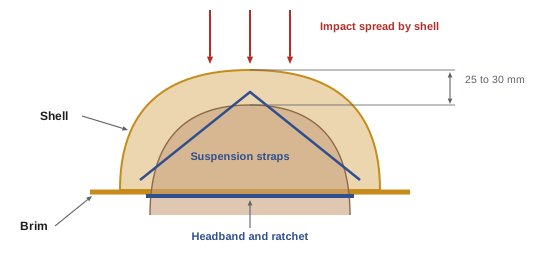
Classifications: impact type and electrical class
Hard hats are classified in two ways: by the direction of impact they are designed to protect against, and by their electrical performance.
- Type 1 headwear is designed to reduce the force of impact from blows to the top of the head.
- Type 2 headwear is designed to reduce the force of impact from blows to the top and sides of the head, and must also resist off-centre penetration. Type 2 hats usually have a foam liner and are increasingly chosen where workers might be struck from the side or might fall.
- Class E (electrical) headwear is tested to protect against contact with conductors at high voltage; the test voltage is 20,000 volts.
- Class G (general) headwear is tested at 2,200 volts and protects against low-voltage contact.
- Class C (conductive) headwear provides no electrical protection and may be vented or made of metal.
These designations are used in both the Canadian and American standards, and many hard hats are certified to both. Markings inside the shell show the manufacturer, the standard, the type and class, the date of manufacture and the size range, and some hats show additional markings such as "reverse donning" for hats that may be worn backwards and "HV" for high visibility.
| Marking | Meaning | Typical use |
|---|---|---|
| Type 1 | Protects against top impacts | General construction and industry |
| Type 2 | Protects against top and side impacts | Work with side impact or fall risk |
| Class E | Tested at 20,000 V | Work near electrical conductors |
| Class G | Tested at 2,200 V | General use with limited electrical risk |
| Class C | No electrical protection | Hot environments with no electrical risk |
| Reverse donning | May be worn backwards | Welding or confined spaces where the brim gets in the way |
| HV | High-visibility shell | Traffic and low-light work |
In Canada, CSA Z94.1, Industrial protective headwear: Performance, selection, care, and use, sets out these requirements, and provincial regulations generally require headwear to meet it. CSA-certified hats carry a CSA or other accredited certification mark.
Safety helmets
In recent years, many employers have begun replacing traditional hard hats with climbing-style safety helmets, which have a lower profile, a chin strap that keeps the helmet on during a fall, and an inner liner that absorbs impact from multiple directions. Some include rotational impact protection, which aims to reduce the twisting forces associated with brain injuries. Helmets that meet Type 2 requirements and include a chin strap are particularly suited to work at height, where a traditional hard hat can come off in a fall and leave the head unprotected. Organizations that switch to helmets should consider electrical class, compatibility with hearing protection and face shields, comfort in heat, and training on correct fit and chin strap use.
Choosing the right headwear
Choosing headwear starts from the hazard assessment:
- Identify impact directions: are objects likely to fall from above only, or could workers be struck from the side or fall?
- Identify electrical hazards: will workers be near energized conductors? If so, Class E is required, and metal or vented hats are not acceptable.
- Identify heat, cold, rain and sun exposure: vented hats help in heat if there is no electrical hazard; winter liners must be compatible with the hat and not affect the suspension.
- Consider visibility needs: high-visibility colours or retroreflective markings help in traffic and low light.
- Consider accessories: earmuffs, face shields, lamps and welding visors must be compatible with the specific hat and approved by the manufacturer.
- Consider fit and comfort for all wearers, including different head sizes and shapes, hairstyles and head coverings.
Colour coding of hard hats, such as white for supervisors and other colours for trades or visitors, is a site convention rather than a standard requirement, so workers should learn the conventions at each site.
Wearing headwear correctly
A hard hat protects only when it is worn correctly. Adjust the headband so the hat sits level and firmly on the head without being tight, with the brim facing forward unless the hat is marked for reverse donning. Use the chin strap when working at height, in wind, or when bending and climbing. Do not wear other caps under the hard hat unless the manufacturer allows a specific liner, because baseball caps and similar items interfere with the suspension. Never store gloves, cigarettes, phones or other objects in the space between the suspension and the shell. Do not drill holes in the shell, paint it, or apply solvents or most stickers, because they can weaken the plastic or hide cracks; manufacturers specify which labels may be used and where.
Inspection, care and replacement
Hard hats degrade over time, especially when exposed to sunlight, heat, cold and chemicals. Ultraviolet light makes many plastics brittle, so a hat that looks fine may break under impact. Inspect the shell and suspension before each use:
- Check the shell for cracks, dents, gouges, chalky or faded surfaces, and stiffness or brittleness. Flexing the brim and listening for cracking sounds can reveal UV damage on some models.
- Check the suspension for cracked or torn straps, broken clips and a worn headband.
- Replace any hat that has received a significant impact, even if no damage is visible, because the shell or suspension may be weakened.
- Follow the manufacturer's guidance on service life, which commonly recommends replacing suspensions about every 12 months and shells every few years, sooner in harsh conditions. The manufacture date is moulded into the shell, often as a clock-style date code.
- Clean with mild soap and water, never with solvents, and store away from direct sunlight and heat, such as the rear window shelf of a vehicle.
Worked problem
Is this hard hat still serviceable?
A roofing worker's hard hat was manufactured four years ago, has been worn outdoors in summer every year, and the shell surface now looks faded and slightly chalky. The suspension was replaced last year. Last week a small piece of metal flashing fell about 3 m and struck the hat without leaving a mark. Should it be replaced?
Show solution
- The faded, chalky surface suggests ultraviolet degradation, which reduces impact resistance.
- The hat has received an impact; manufacturers advise replacement after any significant impact even without visible damage.
- Four years of outdoor summer use may exceed the manufacturer's recommended shell life for harsh conditions.
- Replace the whole hat and record the replacement; check the new hat's markings for the correct type and class.
Answer: Yes. UV degradation, the impact and its age all point to replacing the hat now.
Bump caps and other head protection
Bump caps are lightweight caps with a thin plastic shell inside fabric, designed to protect against minor bumps and scrapes from fixed objects, such as when working under vehicles, in crawl spaces or in food processing. They are not designed for falling objects and do not meet hard hat standards, so they must never be used where a hard hat is required. Other forms of head protection include firefighter helmets, welding helmets with integrated head protection, and specialized helmets for arborists, rescue and rope access. Hair nets and caps used for hygiene in food and pharmaceutical work protect the product, not the worker, and do not count as head protection.
Head protection and inclusion
Head protection must work for every worker. Different head sizes and shapes, long hair, braids and religious head coverings can make standard hard hats uncomfortable or poorly fitting. Manufacturers now offer a wider range of sizes, low-profile shells, adjustable suspensions and designs compatible with some head coverings. In Canada and the US, religious accommodation in safety equipment is a human rights and equal employment issue as well as a safety issue, and some jurisdictions have specific rules; for example, some provinces have exempted turban-wearing Sikh workers from hard hat requirements in certain circumstances. Employers should discuss options with affected workers, consider alternative controls and equipment, and seek advice where legal requirements apply.
Accessories and add-ons
Hard hats often carry accessories: earmuffs, face shields and welding helmets that clip into slots in the shell, chin straps that keep the hat on when the worker bends, climbs or works in wind, winter liners, sweatbands, sun brims and neck shades. Accessories should be made or approved by the hard hat manufacturer for that model, because attachments that are not designed for the hat can change how it performs in an impact or reduce its electrical insulation. Chin straps are strongly recommended for work at height, on ladders and in aerial lifts, where a falling hard hat is both a lost protector and a hazard to people below. Stickers and paint can hide cracks and some solvents in paints and markers weaken plastic shells, so most manufacturers limit decoration to approved labels placed away from the edge of the shell.
Hard hats in hot and cold weather
Heat is one of the most common reasons workers remove hard hats. Vented shells improve airflow but are not available in Class E, because the vents compromise electrical insulation, so workers near electrical hazards must use unvented shells. Light-coloured shells reflect more sunlight and stay cooler than dark ones, and sun brims, neck shades and cooling liners designed for the model can help. In cold weather, winter liners approved by the manufacturer keep the head warm without changing the fit; ordinary knit hats or hoods worn under the hard hat can push the shell up, reduce the clearance between the shell and the head, and make the hat fall off more easily. Whatever the weather, the suspension must still be adjusted so the hat sits level and secure.
Common mistakes
MistakeStoring gloves or a phone inside the hard hat.
InsteadKeep the space between suspension and shell clear.
MistakeWearing a cap under the hard hat.
InsteadUse only liners approved by the manufacturer.
MistakeKeeping a hat after an impact because it looks fine.
InsteadReplace headwear after any significant impact.
MistakeUsing a vented or Class C hat near electrical conductors.
InsteadUse Class E headwear where electrical contact is possible.
MistakeUsing a bump cap where hard hats are required.
InsteadUse bump caps only for minor bumps from fixed objects.
Summary and key terms
- Head injuries come from falling objects, bumps, falls and electrical contact.
- The shell spreads impact and the suspension absorbs energy; the clearance gap matters.
- Type 1 protects the top of the head; Type 2 protects top and sides.
- Class E is tested at 20,000 V, Class G at 2,200 V, and Class C gives no electrical protection.
- Choose headwear from the hazard assessment, including heat, cold, visibility and accessories.
- Inspect before each use and replace after impact, damage or end of service life.
- Bump caps protect only against minor bumps and are not hard hats.
- Shell
- Rigid outer layer of a hard hat.
- Suspension
- Straps and headband that hold the shell off the head.
- Type 1
- Headwear protecting against top impacts.
- Type 2
- Headwear protecting against top and side impacts.
- Class E
- Electrical headwear tested at 20,000 volts.
- Class G
- General headwear tested at 2,200 volts.
- Class C
- Conductive headwear with no electrical protection.
- Reverse donning
- Marking allowing a hat to be worn backwards.
- Date code
- Moulded marking showing the date of manufacture.
- Bump cap
- Light cap for minor bumps, not a hard hat.
Practice problems
Work each problem on paper first, then reveal the answer to check.
Name three causes of head injury at work.
Show answer
Falling objects, bumping fixed objects, falls, electrical contact.
What does the suspension do?
Show answer
Holds the shell away from the head and absorbs energy.
Typical clearance between shell and head?
Show answer
About 25–30 mm.
Difference between Type 1 and Type 2?
Show answer
Type 2 also protects against side impacts.
Test voltage for Class E?
Show answer
20,000 V.
Why is a chin strap important at height?
Show answer
It keeps the helmet on during a fall.
What damages hard hats over time?
Show answer
Sunlight, heat, cold and chemicals.
When should a hat be replaced?
Show answer
After impact, damage or end of service life.
Where can you find the date of manufacture?
Show answer
The date code moulded in the shell.
When is a bump cap acceptable?
Show answer
Only for minor bumps from fixed objects where hard hats are not required.
Lesson quiz · 5 questions
Score 60% or more to complete this lesson.
Create a free account to save your progress, take quizzes and earn a certificate.