
HSE-104 · Lesson 4 of 12 · 26 min
Eye and face protection
The eyes are among the most vulnerable parts of the body, and eye injuries are among the most common workplace injuries. Most are caused by small particles, chips and dust striking or scratching the eye, but splashes of chemicals, hot metal, radiation from welding and lasers, and blows from larger objects can cause permanent loss of sight. Almost all of these injuries are preventable with the right protection, worn correctly. This lesson explains the hazards to the eyes and face, the main types of eye and face protectors, how they are classified and marked, how to choose and fit them, and how to look after them.
Eye and face hazards
Eye and face hazards fall into several groups:
- Impact: flying particles, chips, sparks and fragments from grinding, chipping, cutting, drilling, hammering, sawing and machining, and larger objects such as tools or parts.
- Dust: fine particles from sanding, woodworking, sweeping and handling powders, which can scratch the cornea and cause irritation.
- Chemicals: splashes, mists, vapours and fumes from acids, alkalis, solvents and cleaning products. Alkalis such as caustic soda are particularly dangerous because they penetrate the eye quickly.
- Heat: hot liquids, molten metal and radiant heat from furnaces.
- Optical radiation: ultraviolet, visible and infrared radiation from welding, cutting, brazing, furnaces and some lamps, which can cause painful "welder's flash" (photokeratitis) or longer-term damage; lasers, which can cause instant retinal injury.
- Biological: splashes of blood and body fluids in health care, laboratories and first aid.
A PPE assessment should identify which of these hazards are present at each task, because each requires different protection.
Types of eye and face protectors
The main types of protectors are:
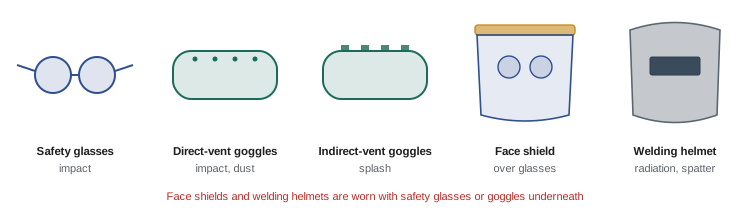
- Safety glasses (spectacles): impact-rated lenses in frames designed for protection, usually with side shields or wraparound lenses. They protect against flying particles from the front and sides but not against splashes, fine dust or impacts from below.
- Goggles: protectors that seal around the eyes. Direct-vented goggles allow air flow and suit impact and dust; indirect-vented goggles have covered vents and protect against splashes; non-vented goggles protect against vapours, mists and fine dust but are prone to fogging.
- Face shields: transparent visors covering the face, used for splashes, sparks and larger impacts. A face shield is a secondary protector and must be worn with safety glasses or goggles, because it does not seal around the eyes and objects can travel under it.
- Welding helmets and hand shields: shields with filter lenses that protect against intense optical radiation and spatter; auto-darkening filters switch from a light to a dark shade when the arc strikes.
- Respirator facepieces: full-facepiece respirators with impact-rated lenses provide eye and face protection as well as respiratory protection.
- Laser safety eyewear: filters matched to specific laser wavelengths and optical densities.
Classifications and markings
In Canada, CSA Z94.3, Eye and face protectors, classifies protectors by type and class, such as Class 1 spectacles, Class 2 goggles, Class 3 welding helmets, Class 4 welding hand shields, Class 5 hoods, Class 6 face shields and Class 7 respirator facepieces, each with subclasses for specific hazards. CSA Z94.3.1 provides guidance on selection, use and care. Protectors are marked with the manufacturer, the certification mark and, for filter lenses, the shade number. Many protectors sold in Canada are certified to both CSA Z94.3 and ANSI/ISEA Z87.1.
In both countries, high-impact protectors are tested by striking them with a steel ball at high velocity and with a heavy pointed projectile, while basic-impact protectors pass a less severe test. Lenses are also tested for optical quality, so that they do not distort vision.
| Hazard | Minimum protection | Better choice |
|---|---|---|
| Flying chips from grinding | High-impact safety glasses with side protection | Glasses plus face shield |
| Fine dust from sanding | Direct-vented goggles | Goggles rated for dust or fine dust |
| Chemical splash | Indirect-vented splash goggles | Goggles plus face shield |
| Molten metal splash | Safety glasses plus face shield | Goggles plus heat-resistant face shield |
| Arc welding | Welding helmet with correct shade, plus safety glasses | Auto-darkening helmet with glasses |
| Laser alignment | Laser eyewear matched to wavelength | Engineering controls plus eyewear |
Welding filters and shade numbers
Filter lenses for welding and cutting are rated by shade number: the higher the number, the darker the lens and the less light it transmits. The required shade depends on the process and the current. Gas welding and cutting typically require shades from about 3 to 8, shielded metal arc welding from about 10 to 14 depending on current, and gas metal arc and gas tungsten arc welding about 10 to 14. A good practice is to start with a darker shade than needed and move lighter until the weld zone can be seen clearly without discomfort, without going below the minimum. Helpers and people nearby also need protection, either from screens and curtains around the welding area or from their own filter lenses, because arc radiation reflects off surfaces and can cause flash burns at a distance.
Worked problem
Choosing a shade for stick welding
A maintenance worker will weld with shielded metal arc welding (stick) at about 150 amps. A shade selection guide recommends a minimum shade of 10 and a suggested shade of 12 for currents from 60 to 160 A. How should the shade be chosen?
Show solution
- The minimum protective shade for this current range is 10; never use a lighter shade.
- Start with shade 12, the suggested comfort shade.
- If the weld puddle cannot be seen clearly, try shade 11; if the light is still uncomfortable, try 13.
- Wear safety glasses under the helmet to protect against chips when the helmet is raised, and screen the area to protect others.
Answer: Start at shade 12, adjust between 11 and 13 for visibility and comfort, never below 10, and wear safety glasses underneath.
Prescription eyewear and contact lenses
Ordinary prescription glasses are not safety glasses: their lenses and frames are not designed or tested to resist impact. Workers who need vision correction have several options: prescription safety glasses with impact-rated lenses, frames and side shields, marked to the relevant standard; goggles or face shields designed to fit over prescription glasses (often called over-the-glasses or OTG protectors); or full-facepiece respirators with prescription inserts. Contact lenses can generally be worn with appropriate eye protection, but in environments with dust, chemicals or heat, workers should follow the employer's policy and medical advice, because particles or chemicals trapped under a lens can increase injury. Eye wash procedures should account for contact lenses, which may need to be removed during irrigation.
Fit, comfort and fogging
Eye protection works only if it is worn, and comfort strongly affects whether people keep it on. Glasses should fit close to the face without touching the eyelashes, with side protection covering the gap between the frame and the face. Adjustable temples and nose pads help achieve a good fit for different face shapes. Goggles should seal evenly with the strap adjusted firmly but comfortably. Fogging is one of the most common reasons workers remove eye protection; anti-fog coatings, ventilated designs, sweat bands and anti-fog wipes reduce it. When workers wear several types of PPE together, such as respirators, hearing protection and hard hats with eye protection, compatibility must be checked, because an ill-fitting combination can break the seal of a respirator or push glasses out of position.
Care and replacement
Clean lenses with water or a lens cleaner and a soft cloth, because dry wiping grinds dust into the surface. Store protectors in a case or clean place away from tools. Inspect before use for scratches, pits, cracks and damaged frames, straps or headgear. Replace protectors when lenses are scratched enough to impair vision, when frames are damaged, after any significant impact, or when the manufacturer's service life has passed. Shared protectors should be cleaned and disinfected between users.
Emergency eyewash and first aid
Where workers may be exposed to corrosive or irritating chemicals, regulations and standards require emergency eyewash facilities, and often emergency showers, within easy reach. The widely used ANSI/ISEA Z358.1 standard, which is referenced in both countries, calls for plumbed or self-contained units that deliver tepid water for at least 15 minutes and that can be reached within about 10 seconds. If a chemical enters the eye, rinse immediately and continuously with clean water, holding the eyelids open, remove contact lenses if possible, continue rinsing for at least the time recommended on the safety data sheet, and get medical attention. For particles, do not rub the eye; rinse gently and seek first aid. For embedded objects, do not attempt removal; cover both eyes loosely and get medical help. HSE-110 covers first aid in more detail.
Laser and other optical radiation
Lasers are increasingly common in workplaces, in cutting and welding, surveying, alignment tools, medical and cosmetic treatments, and research. Laser beams can damage the eye instantly, because the lens of the eye focuses the beam onto a tiny spot on the retina. Lasers are grouped into classes according to their hazard, from low-power devices that are safe under normal use to high-power lasers that can cause eye and skin injury from the direct beam, reflections and even diffuse reflections. Laser protective eyewear must be chosen for the specific wavelength and power of the laser, and is marked with the wavelengths it blocks and its optical density at those wavelengths; ordinary safety glasses and welding filters do not protect against most lasers. Workplaces with higher-class lasers need a laser safety officer, controlled areas, warning signs and engineering controls such as beam enclosures and interlocks.
Ultraviolet radiation from sunlight, germicidal lamps and curing lamps can cause painful burns of the cornea, sometimes called welder's flash or snow blindness, and long-term exposure contributes to cataracts. Infrared radiation from furnaces, molten glass and metal can damage the lens over years. Eyewear marked for ultraviolet or infrared filtering, and tinted lenses for outdoor work, address these hazards. Workers outdoors should be aware that dark lenses without ultraviolet filtering can increase exposure, because the pupils open wider behind them.
Choosing lenses and coatings
Lens choice affects both protection and comfort. Clear lenses suit most indoor work. Grey or smoke lenses reduce glare outdoors. Amber or yellow lenses increase contrast in low light but distort colour and should not be used where colour recognition matters, such as reading coloured wires or signals. Indoor and outdoor lenses with a light mirror coating help workers who move between bright and dim areas. Photochromic lenses darken in sunlight but may change too slowly when a worker walks into a dark building, and they do not darken well behind vehicle windscreens. Coatings matter too: anti-fog coatings help in humid or cold conditions and when combined with masks, and hard coatings resist scratches, which otherwise scatter light and strain the eyes. Polycarbonate lenses offer the best impact resistance for their weight and block most ultraviolet radiation.
Eye protection with other PPE
Eye protection must be compatible with other equipment. Safety glasses with thick temples can break the seal of earmuffs and some respirators. Goggles can push down on a half-mask respirator and create leaks, or the respirator can push the goggles out of position, so a full-facepiece respirator is often a better choice when both eye and respiratory protection are needed. Face shields must be designed to attach to the hard hat model in use. Workers should try on the whole combination before work begins to make sure it seals, stays in place and allows a clear field of view.
Eye protection for visitors and short tasks
Many eye injuries happen during short, unplanned tasks, such as a quick cut with a grinder, blowing off a bench with compressed air, or walking past someone else's work. For this reason, many workplaces require basic safety glasses at all times in production areas, not only for specific tasks, and keep visitor glasses and over-glasses at entrances. Compressed air used for cleaning is a particular hazard, because it drives chips and dust into the eyes at high speed; air nozzles should be pressure-limited, and the task may call for goggles or a face shield as well as glasses. Supervisors who wear eye protection consistently, even for a quick look, set the expectation for everyone else.
Common mistakes
MistakeWearing a face shield without glasses or goggles.
InsteadAlways wear primary eye protection under a face shield.
MistakeUsing ordinary prescription glasses as safety glasses.
InsteadUse prescription safety glasses or over-the-glasses protectors.
MistakeUsing safety glasses for chemical splash.
InsteadUse indirect-vented splash goggles, plus a face shield as needed.
MistakeChoosing too light a welding shade.
InsteadNever go below the minimum shade for the process and current.
MistakeDry wiping lenses.
InsteadRinse and clean with lens cleaner and a soft cloth.
Summary and key terms
- Eye hazards include impact, dust, chemicals, heat, radiation and biological fluids.
- Safety glasses protect against impact; goggles seal against dust and splash.
- Face shields are secondary protectors worn over glasses or goggles.
- Welding filters are rated by shade number, chosen by process and current.
- Protectors are classified and marked under the applicable national standard.
- Prescription glasses are not safety glasses unless rated and marked.
- Fit, anti-fog features, care and eyewash facilities support protection.
- Safety glasses
- Impact-rated spectacles with side protection.
- Goggles
- Protectors that seal around the eyes.
- Indirect vent
- Covered vent that blocks splashes.
- Face shield
- Visor protecting the face, worn over eye protection.
- Shade number
- Darkness rating of a welding filter.
- Auto-darkening filter
- Lens that darkens when the arc strikes.
- Photokeratitis
- Painful corneal burn from ultraviolet radiation.
- High impact
- Protector tested to resist severe impacts.
- Over-the-glasses protector
- Goggles designed to fit over prescription glasses.
- Eyewash station
- Facility for flushing chemicals from the eyes.
Practice problems
Work each problem on paper first, then reveal the answer to check.
Name four types of eye hazard.
Show answer
Impact, dust, chemicals, heat, radiation, biological.
Why are alkalis especially dangerous to eyes?
Show answer
They penetrate the eye quickly.
Which goggles protect against splashes?
Show answer
Indirect-vented goggles.
Why must glasses be worn under a face shield?
Show answer
Shields do not seal and objects can pass underneath.
What does a higher shade number mean?
Show answer
A darker filter.
Minimum and suggested shade for stick welding at 150 A in the example?
Show answer
Minimum 10, suggested 12.
Are ordinary prescription glasses safety glasses?
Show answer
No.
Name two ways to reduce fogging.
Show answer
Anti-fog coatings, ventilated designs, sweat bands, wipes.
How long should an eyewash flow?
Show answer
At least 15 minutes.
What should you do with an embedded object in the eye?
Show answer
Do not remove it; cover both eyes and get medical help.
Lesson quiz · 5 questions
Score 60% or more to complete this lesson.
Create a free account to save your progress, take quizzes and earn a certificate.