
HSE-104 · Lesson 10 of 12 · 26 min
High-visibility and protective clothing
Clothing is the PPE that covers the most skin and is worn for the longest time, so it shapes both protection and comfort for the whole working day. This lesson covers two broad groups. High-visibility apparel makes workers easier to see, protecting them from being struck by vehicles and mobile equipment, which is one of the leading causes of workplace deaths in road work, construction, warehousing, mining, ports and emergency response. Protective clothing protects the skin and body against hazards such as chemicals, heat and flame, electric arcs, molten metal, cold, biological agents and cuts. In each case, the right choice depends on the hazard assessment, recognized standards and the limits of the garment. A garment that is the wrong class, the wrong material or worn incorrectly can give little protection, and some ordinary clothing, such as synthetic fabrics near flames or arcs, can make an injury worse.
How high-visibility apparel works
High-visibility apparel uses two kinds of material. Background material is a fluorescent fabric, usually fluorescent yellow-green, fluorescent orange-red or fluorescent red, which converts ultraviolet light into visible light and appears unusually bright in daylight, dusk and dawn. Retroreflective material, usually silver-grey tape, reflects light from vehicle headlights back toward the driver, making the wearer visible at night. Fluorescent colours do not work well at night, and retroreflective tape does little in daylight, so garments combine both. The arrangement of the tape matters too: bands around the torso, over the shoulders, and around the arms and legs outline the human shape, which drivers recognize more quickly than a patch of colour. Visibility is reduced when garments are dirty, faded, worn, covered by other clothing or equipment, or when the background colour blends with the surroundings, such as fluorescent orange in autumn leaves.
High-visibility standards
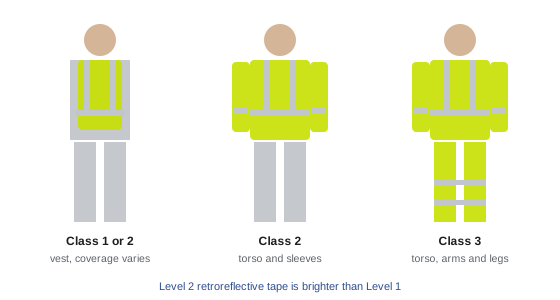
In Canada, high-visibility safety apparel is covered by CSA Z96, High-visibility safety apparel (current edition Z96-22), and its companion guideline CSA Z96.1, Guideline on selection, use, and care of high-visibility safety apparel. CSA Z96 classifies garments by the amount and placement of background and retroreflective material: Class 1 offers the least coverage, typically a harness or straps for low-risk environments; Class 2 includes vests and shirts covering the torso; and Class 3 adds sleeves and leg coverage for the highest visibility. Retroreflective materials are rated Level 1 or Level 2, with Level 2 brighter. The standard also specifies arrangements of tape, including the characteristic "X" on the back in some designs, and requirements for flame-resistant high-visibility garments. Provincial regulations require high-visibility apparel for workers exposed to vehicle traffic, often specifying the CSA class for traffic control and roadway work.
| Class (CSA Z96) | Coverage | Typical use |
|---|---|---|
| Class 1 | Least background and tape, often a harness | Low-risk areas with slow-moving equipment |
| Class 2 | Torso coverage, vest or shirt | Roadway, warehouse and parking areas with traffic |
| Class 3 | Torso plus sleeves and legs | High-speed traffic, poor visibility, night work |
High-visibility apparel should be chosen based on the speed and volume of traffic, lighting conditions, weather, the complexity of the background, and the distance between workers and vehicles. As a general rule, the faster the traffic and the poorer the light, the higher the class needed. Garments should fit over outer clothing, be fastened so tape bands are continuous, and not be covered by tool belts, harnesses or jackets, unless those items are themselves high-visibility. Garments should be replaced when faded, soiled, torn or when the retroreflective tape is cracked or peeling, following the manufacturer's guidance on the number of washes.
Chemical protective clothing
Chemical protective clothing ranges from aprons, sleeves and lab coats for small splashes, through disposable coveralls for dusts and light splashes, to fully encapsulating gas-tight suits for emergency response to toxic gases. As with gloves, chemicals can degrade, penetrate or permeate garment materials, so selection must be based on the manufacturer's permeation data for the specific chemicals, the type of exposure and the duration of work. Seams, zips and closures are common weak points, and taped or welded seams give better protection than stitched seams.
Emergency response suits are often grouped into four ensemble levels, used widely in North America:
- Level A: fully encapsulating vapour-tight suit with SCBA, for the highest level of skin, respiratory and eye protection against unknown or highly toxic vapours.
- Level B: chemical splash suit with SCBA, for the highest level of respiratory protection with less skin protection, where vapours are not a skin hazard.
- Level C: chemical splash suit with an air-purifying respirator, where the contaminant and concentration are known and an APR is adequate.
- Level D: work uniform with no respiratory protection, for nuisance contamination only.
Wearing chemical protective clothing, especially fully encapsulating suits, places heavy heat stress on the wearer, because the suit traps body heat and sweat. Work periods must be limited, workers must be medically fit and monitored, and decontamination procedures must be planned before entry, so that contaminants are removed before the suit is taken off.
Flame-resistant clothing
Ordinary clothing, especially synthetic fabrics such as polyester and nylon, can ignite, burn, melt and drip onto the skin when exposed to a flash fire, molten metal or an electric arc, turning a brief exposure into a severe burn. Flame-resistant (FR) clothing is made from fabrics that resist ignition and self-extinguish when the ignition source is removed, either because of inherent fibre properties, as with aramids and modacrylics, or because of chemical treatment, as with treated cotton blends. FR clothing is used in the oil and gas industry, chemical plants, refineries, utilities, foundries and welding. It does not make the wearer fireproof; it reduces the severity of burns by limiting the contribution of the clothing itself to the injury and giving the wearer time to escape.
In Canada, flame-resistant clothing for flash fire hazards is covered by CAN/CGSB 155.20, Workwear for protection against hydrocarbon flash fire, and CAN/CGSB 155.21 for selection, care and use, which are referenced in the oil and gas sector.
FR clothing must be worn correctly to work: sleeves rolled down and fastened, shirts tucked in, outer layers FR, and underlayers of natural fibres such as cotton or wool, or FR, never meltable synthetics. It must be laundered according to the manufacturer's instructions, because some detergents, bleaches and fabric softeners can reduce the effectiveness of treated fabrics, and contamination with flammable substances such as oil can make the garment burn.
Arc-rated clothing
An electric arc flash releases intense heat, light and pressure in a fraction of a second, with temperatures at the arc that can exceed those at the surface of the sun. The thermal energy reaching a worker is measured as incident energy, in calories per square centimetre (cal/cm²). An incident energy of about 1.2 cal/cm² on bare skin is enough to cause a second-degree burn. Arc-rated (AR) clothing is tested to measure how much incident energy it can block before the wearer would receive a second-degree burn, expressed as the arc thermal performance value (ATPV) or the energy breakopen threshold (EBT), whichever is lower, and marked on the garment as its arc rating in cal/cm². All arc-rated clothing is flame resistant, but not all FR clothing is arc rated.
In Canada, CSA Z462, Workplace electrical safety (current edition Z462-24), sets out the arc flash risk assessment and the selection of arc-rated PPE. The employer must either calculate the incident energy at the work location through an engineering study and select PPE with an arc rating at least equal to it, or use the arc flash PPE category tables for specified equipment and conditions. The four PPE categories call for minimum arc ratings of 4, 8, 25 and 40 cal/cm².
| PPE category | Minimum arc rating | Typical clothing |
|---|---|---|
| 1 | 4 cal/cm² | Arc-rated long-sleeve shirt and trousers or coverall, face shield |
| 2 | 8 cal/cm² | Arc-rated shirt and trousers or coverall, arc-rated face shield and balaclava or hood |
| 3 | 25 cal/cm² | Arc flash suit with hood, or layered arc-rated clothing |
| 4 | 40 cal/cm² | Arc flash suit with hood |
Worked problem
Checking an arc rating
An incident energy analysis labels an electrical panel at 6.2 cal/cm² at the working distance. A worker has an arc-rated shirt rated 5.6 cal/cm² and an arc-rated coverall rated 8.7 cal/cm². Which garment is adequate, and what else is needed?
Show solution
- The garment's arc rating must be at least the incident energy: 6.2 cal/cm².
- The shirt at 5.6 cal/cm² is below 6.2, so it is not adequate on its own.
- The coverall at 8.7 cal/cm² exceeds 6.2, so it is adequate.
- Add an arc-rated face shield and balaclava or hood rated at least 6.2 cal/cm², hard hat, safety glasses, hearing protection, leather or rubber insulating gloves as required, and leather footwear.
- Remember that arc-rated PPE is the last line of defence; de-energizing the equipment and establishing an electrically safe work condition is the primary control.
Answer: Wear the 8.7 cal/cm² coverall with matching head, face and hand protection; the 5.6 cal/cm² shirt alone is not enough. Detailed arc flash work belongs in an electrical safety course.
Heat, molten metal and cold
Workers exposed to radiant heat, such as in foundries, glass making and firefighting, use aluminized garments that reflect radiant heat. Welders and workers near molten metal use leather jackets, sleeves, aprons and spats, or wool and treated fabrics, that resist sparks and spatter and do not melt. Clothing must have no cuffs, open pockets or gaps where sparks and molten metal can lodge. Cold environments require layered clothing: an inner layer that wicks moisture from the skin, an insulating middle layer, and an outer layer that blocks wind and water while allowing moisture to escape. Insulated gloves, warm footwear and head coverings, including hard hat liners, protect the extremities, which are most at risk of frostbite. Heat stress is a concern with most protective clothing, so work and rest schedules, hydration and monitoring are important companions to the garments.
Care, laundering and replacement
Protective clothing must be maintained to keep its protection. High-visibility garments lose fluorescence with sun exposure and washing; FR and arc-rated garments can be weakened by bleach and softeners and lose protection if contaminated with flammable materials; chemical protective garments may be single-use or need decontamination and testing before reuse. Many employers provide laundering services for protective clothing, which ensures correct washing and keeps contaminated clothing out of workers' homes, where it could expose family members. Garments should be replaced when torn, worn thin, contaminated beyond cleaning or past the manufacturer's service life.
Protective clothing for biological hazards
Health care workers, laboratory staff, waste handlers, cleaners and first responders may be exposed to blood, body fluids and infectious agents. Protective clothing for these hazards includes gowns, coveralls, aprons, sleeve covers and shoe covers, chosen according to the expected exposure: light contact may need only a fluid-resistant gown, while heavy splashing or highly infectious agents may call for fluid-proof coveralls with taped seams, combined with gloves, eye and face protection and respiratory protection. The order of putting on and taking off this equipment matters, because most contamination of the wearer happens while removing it; workplaces should post and practise donning and doffing sequences and provide hand hygiene at each step.
Cut-resistant and puncture-resistant clothing
Workers handling glass, sheet metal, knives and sharp materials may need cut-resistant sleeves, aprons, vests or full garments made from the same high-performance fibres used in cut-resistant gloves. Butchers and meat processors often wear chain-mail or cut-resistant aprons and arm guards. These garments are rated in the same way as cut-resistant gloves and resist slicing, but they do not stop powered blades, and most do not resist punctures from pointed objects without additional layers.
Comfort, heat stress and wear time
Most protective clothing reduces the body's ability to cool itself by sweating, because it traps heat and moisture close to the skin. Heavy FR garments, arc flash suits, chemical suits and even some high-visibility jackets can raise body temperature during hard work in hot conditions. Breathable fabrics, lighter-weight garments that still meet the required rating, cooling vests, shaded rest areas, water, and work-rest schedules all help. Supervisors should watch for signs of heat illness, such as heavy sweating, dizziness, confusion and nausea, and workers should be acclimatized gradually to work in hot conditions while wearing protective clothing.
Common mistakes
MistakeWearing a Class 1 vest beside high-speed traffic.
InsteadMatch the class to traffic speed and light conditions.
MistakeCovering hi-vis bands with a harness or jacket.
InsteadKeep the tape visible or use hi-vis outer layers.
MistakeWearing polyester under FR clothing.
InsteadWear natural-fibre or FR underlayers.
MistakeAssuming any FR shirt is arc rated.
InsteadCheck the cal/cm² arc rating on the label.
MistakeWashing FR garments with bleach and softener.
InsteadFollow the manufacturer's laundering instructions.
Summary and key terms
- High-visibility apparel combines fluorescent background and retroreflective tape.
- CSA Z96 sets Classes 1 to 3 and retroreflective Levels 1 and 2.
- Higher traffic speeds and poorer light need higher classes.
- Chemical clothing is selected from permeation data, and emergency suits run from Level A to D.
- FR clothing resists ignition and self-extinguishes but is not fireproof.
- Arc-rated clothing is marked in cal/cm² and must meet the incident energy.
- Laundering and replacement keep protective clothing effective.
- Fluorescent background material
- Fabric that appears bright in daylight.
- Retroreflective material
- Tape reflecting headlights back to the driver.
- Garment class
- Level of high-visibility coverage.
- Encapsulating suit
- Vapour-tight suit enclosing the wearer and respirator.
- Flame-resistant clothing
- Clothing that resists ignition and self-extinguishes.
- Arc-rated clothing
- Clothing tested and rated for arc flash exposure.
- Incident energy
- Thermal energy reaching a worker, in cal/cm².
- ATPV
- Arc thermal performance value of a fabric.
- PPE category
- Arc flash protection level from 1 to 4.
- Aluminized clothing
- Garments reflecting radiant heat.
Practice problems
Work each problem on paper first, then reveal the answer to check.
What are the two materials in hi-vis apparel?
Show answer
Fluorescent background and retroreflective tape.
Why do tape bands outline the body?
Show answer
Drivers recognize the human shape more quickly.
Which CSA Z96 class has sleeves and legs?
Show answer
Class 3.
What is Level C chemical protection?
Show answer
Splash suit with an air-purifying respirator.
Why are synthetics dangerous near flash fire?
Show answer
They melt and drip onto the skin.
What incident energy causes a second-degree burn on bare skin?
Show answer
About 1.2 cal/cm².
Minimum arc rating for PPE category 2?
Show answer
8 cal/cm².
Incident energy 10 cal/cm²; is an 8 cal/cm² coverall adequate?
Show answer
No; a rating of at least 10 is needed.
Name the three layers for cold weather.
Show answer
Wicking inner, insulating middle, wind and water resistant outer.
Why provide employer laundering?
Show answer
Correct washing and keeping contaminants out of homes.
Lesson quiz · 5 questions
Score 60% or more to complete this lesson.
Create a free account to save your progress, take quizzes and earn a certificate.