
GAS-340 · Lesson 9 of 12 · 22 min
Red-tagging and unsafe conditions
▶ Video coming soon A video version of this lesson is on the way.
On Tuesday, February 10, 2026, Rosa was sent to a rented semi-detached house on Wellington Street North to look at a furnace that was "making a rumbling noise". The furnace's noise was a loose blower wheel, a half-hour repair. But in the same basement she found two other things. The water heater's vent connector had come apart at the chimney, and the water heater was spilling flue gas into the basement each time it fired. And the gas line to the dryer had been extended by someone with a length of rubber hose and two hose clamps. Rosa now had three problems with three different answers. The furnace she could fix. The water heater was an immediate hazard. The dryer connection was a serious code violation, and she had to decide which kind of hazard it was.
This lesson covers what the law and good practice require when a technician finds an unsafe condition on a service call: how conditions are classified, the duty to shut off, tag and notify, how tags are removed, and how to handle the customer when the news is bad. In Ontario the duties are set out in the Gaseous Fuels regulation, O. Reg. 212/01, and the Propane Storage and Handling regulation, O. Reg. 211/01. GAS-110 introduced the ideas; here they are applied in detail.
Unacceptable conditions and immediate hazards
Ontario's regulation uses the term unacceptable condition for anything that makes an appliance or its piping, venting, combustion air or clearances unsafe: using an appliance for a purpose it was not approved for, alterations or deterioration likely to impair its safe operation, and problems with piping, venting, combustion air or clearances. The technician who finds one decides whether it is also an immediate hazard, meaning a condition that could cause injury or damage now, such as a gas leak, flue gas spilling into a living space, a failed or bypassed safety control or a cracked heat exchanger letting flue gas into the air stream. That decision sets the duties that follow.
| Condition | Typical classification | Why |
|---|---|---|
| Gas leak at a joint or connector | Immediate hazard | Fire and explosion risk now |
| Flue gas spilling into an occupied space | Immediate hazard | Carbon monoxide now |
| Safety control bypassed or jumpered | Immediate hazard | Protection is gone |
| Heat exchanger breach with flue gas in the air stream | Immediate hazard | Carbon monoxide in the building |
| Unapproved hose or connector material on a gas line | Usually immediate hazard | Can fail or leak without warning |
| Missing sediment trap or test tap | Not immediate | Must be corrected; no hazard now |
| Clearance to combustibles slightly short, no heat damage | Not immediate, judged on site | Fire risk over time |
| Appliance without a nearby manual shutoff valve | Not immediate | Must be corrected |
The classification is a judgment, and it belongs to the technician on site. The same missing clearance that is a long-term concern on one appliance may be scorching the wood on another. When in doubt, the technician treats a condition as the more serious kind, because the cost of being wrong in the other direction can be a life.
The duties for an immediate hazard
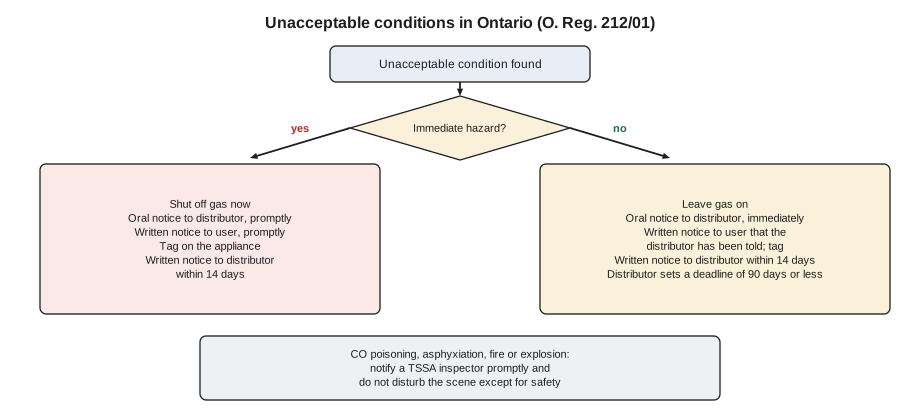
When an Ontario certificate holder finds an immediate hazard, the regulation requires them to do five things. They shut off the gas to the appliance or the work immediately. They give oral notice to the distributor, usually by phoning Enbridge, promptly. They give the user written notice, promptly, that the appliance must not be used until the condition is corrected. They attach a notice to the appliance or work, the tag. And they give the distributor written notice within 14 days of finding the condition, including that the gas was shut off. The owner or user must not use the appliance until the condition is corrected, and once it is corrected they must notify the distributor within 14 days.
Two things apply in every case. First, if anyone has been injured, poisoned, or there has been a fire or explosion, the occurrence is reported at once: in Ontario, a certificate holder or contractor must notify a TSSA inspector promptly, and the scene must not be disturbed except for safety, saving life, continuity of service or preserving property. Second, the technician never leaves an immediately hazardous appliance running because the customer objects. If the customer refuses to allow the shutoff, the technician leaves the building if necessary and calls the distributor, who has the authority to shut off the supply.
The duties when there is no immediate hazard
For an unacceptable condition that is not an immediate hazard, the gas stays on. The certificate holder gives oral notice to the distributor immediately and written notice to the user immediately, stating that the distributor has been told. They attach a notice to the appliance or work, and give the distributor written notice within 14 days. The distributor then writes to the user describing the condition and stating that the gas will be shut off if the contractor does not report it corrected within a set period. The regulation caps that period at 90 days, and distributors often set a shorter one on their notices. If the condition is not corrected in time, the distributor must shut off the gas. Enbridge's own paperwork is commonly described as using an A notice for an immediate hazard and a B notice for one that is not.
Worked problem
When are the notices due?
Rosa found the dryer's rubber hose on Tuesday, February 10, 2026. Suppose she had judged it not an immediate hazard. By what date must her written notice reach the distributor, and if the distributor wrote to the owner on Wednesday, February 11, what is the latest deadline it could set for the correction?
Show solution
- Written notice to the distributor is due within 14 days of finding the condition:
- \[\text{Feb } 10 + 14 \text{ days} = \text{Tue Feb } 24\]
- The distributor's deadline can be no more than 90 days. Counting from February 11 in 2026, when February has 28 days: 28 days takes it to March 11, 31 more to April 11, 30 more to May 11, and 1 more to May 12.
- \[28 + 31 + 30 + 1 = 90 \text{ days} \to \text{Tue May } 12\]
Answer: Rosa's written notice must reach the distributor by February 24, and the distributor could allow the owner until May 12 at the latest, though in practice it may set a shorter period.
What Rosa did at the semi
The water heater was simple to classify. Rosa's analyzer read 280 ppm CO at the draft hood and her monitor 14 ppm in the basement with the water heater firing; the connector had pulled out of the chimney thimble. She shut off the water heater's gas valve, tagged it, and phoned Enbridge, wrote the tenant a notice on the spot and recorded it for her written notice to Enbridge. The dryer was harder. A rubber hose on a gas line is not an approved connector; it can crack, be cut or slip off. It was not leaking when she tested it with solution, but it was lying on the floor where a laundry basket could crush it. She judged it an immediate hazard too, closed the dryer's valve, tagged it and wrote it up in the same notice.
Then she called the landlord. He was unhappy, because the tenants had no hot water and no dryer and he would have to pay for both repairs. Rosa explained each problem plainly, sent him photographs, and offered to do both repairs that afternoon: reconnecting the water heater's vent with a new connector, properly supported and fastened, and replacing the rubber hose with a certified appliance connector and a proper shutoff valve. He agreed. Once both were done and tested, with the water heater passing a spillage test, Rosa removed her tags, endorsed each with her certificate number, name and address, and sent them to Enbridge as the regulation requires. The furnace's blower wheel took the last half hour.
Removing a tag
In Ontario only a person holding the certificate needed for the work may remove a notice, and only after the condition is corrected. That person endorses the notice with their certificate number, name and address and sends it to the distributor by prepaid registered mail or delivers it. Removing or ignoring a tag without correcting the condition is an offence, and so is using an appliance after its deadline has passed. A technician who arrives to find a tag on an appliance reads it, corrects the condition it describes if that is the work, and follows the same steps to clear it.
The customer conversation
Shutting off someone's heat in February is never easy. The conversation goes best when the technician is calm, specific and helpful. They explain what they found in plain words and show it if they can, explain what the law and their certificate require them to do, and make it clear that the decision is about safety, not sales. They give the options: the repair, a quote, the right to get another contractor. They offer what help they can, a portable heater, a time for the repair. And they write it all down, including what the customer said. A customer who later claims they were not told is answered by the written notice they signed or were given.
Writing the notice
The written notice of an unsafe condition is a legal document, and it is written with care. It names the customer and the address, the appliance by make, model and serial number, the date and time, and the technician and their certificate number. It describes the condition in plain words that the customer can understand and a distributor or inspector can act on: not "venting problem" but "vent connector separated from the chimney; flue gas spilling into the basement each time the water heater fires". It says what was done, such as "gas shut off at the appliance valve and tag attached", what the customer must not do, and what must happen before the appliance can be used again. The customer signs it if they will, or the technician notes that it was handed over or left at the premises, and the customer keeps a copy.
A good notice also helps the customer act. It says what kind of contractor can correct the condition, offers the company's own repair if appropriate, and gives a phone number. It avoids language that sounds like a sales pitch, because a notice that reads like an advertisement invites the suspicion that the hazard was invented to sell a furnace. The facts, the readings and the photographs are the notice's authority.
| A written notice includes | Example |
|---|---|
| Customer, address, date and time | Wellington Street North, Feb 10, 2026, 10:40 |
| Appliance and its identification | Water heater, make, model, serial |
| The condition in plain words | Vent connector separated at the chimney; flue gas spilling |
| What was done | Gas shut off at the appliance valve; tag attached |
| What the customer must not do | Do not use or relight the water heater |
| What must happen next | Reconnect the vent; spillage test before use |
| Technician and signature | Name and certificate number; customer signature or note |
Tags left by others
Technicians often arrive to find a tag already on an appliance, left by the distributor, another contractor or a previous Bayline visit. The tag is read before anything else. It says what was found, when and by whom, and often what must be done. If the call is to correct that condition, the technician corrects it, tests the appliance, and clears the tag as the rules require. If the call is about something else, the appliance stays off: a customer who asks the technician to "just get it going" is told why that cannot happen, and offered the repair. A technician who relights a tagged appliance without correcting the condition takes on the responsibility for whatever happens next, and may be committing an offence.
When the customer is not the owner
Many unsafe conditions are found in rented homes, offices and shops, where the person at the door is not the person who owns the equipment. The duties to shut off and tag do not change. The written notice goes to the occupant, who is the user and has to know not to use the appliance, and the technician makes a reasonable effort to reach the owner or landlord the same day, by phone or through the property manager, and records who was told and when. Tenants often worry about the cost and about who will pay; the technician explains that the repair is usually the owner's responsibility and gives them the written notice to pass on. Where an owner cannot be reached and an occupant has no heat in cold weather, Bayline lends heaters and keeps trying, and the office follows up the next morning.
Common mistakes
MistakeLeaving an immediately hazardous appliance on because the customer objects.
InsteadShut it off; if they refuse, leave and call the distributor.
MistakeClassifying a doubtful condition as the less serious kind.
InsteadWhen in doubt, treat it as an immediate hazard.
MistakeTelling the customer verbally and not in writing.
InsteadGive written notice every time, and keep a copy.
MistakeRemoving a tag before the condition is corrected.
InsteadCorrect it first, then clear the tag as the rules require.
MistakeForgetting the distributor.
InsteadGive the oral notice promptly and the written notice within 14 days.
MistakeDisturbing the scene after a CO poisoning or fire.
InsteadMake it safe and leave it for the TSSA inspector.
MistakeFixing the job you were called for and ignoring the rest.
InsteadReport every unsafe condition you find, whatever the call was about.
Summary and key terms
- Ontario's O.
- Reg. 212/01 calls any unsafe use, alteration, deterioration or piping, venting, air or clearance problem an unacceptable condition, and the technician judges whether it is also an immediate hazard.
- For an immediate hazard the technician shuts off the gas, gives the distributor oral notice promptly and the user written notice promptly, tags the appliance and gives the distributor written notice within 14 days; the owner must not use it until corrected and must notify the distributor within 14 days of correction.
- Without an immediate hazard the gas stays on, the distributor is told immediately and in writing within 14 days, and the distributor sets a correction deadline of no more than 90 days.
- CO poisoning, fire or explosion is reported promptly to a TSSA inspector and the scene preserved.
- Tags are removed only by an appropriate certificate holder after correction, endorsed and sent to the distributor.
- Customers get plain explanations, options and written notice.
- Unacceptable condition
- Under O. Reg. 212/01, an unsafe use, alteration, deterioration, or piping, venting, combustion air or clearance problem.
- Immediate hazard
- An unacceptable condition that could cause injury or damage now, requiring the gas to be shut off.
- Distributor
- The gas utility that supplies the building, such as Enbridge.
- Red tag
- The common name for the notice attached to an appliance found unsafe.
- Occurrence
- A CO poisoning, asphyxiation, explosion or fire that appears to result from gas, which must be reported to TSSA.
- Endorsement
- The certificate number, name and address written on a cleared notice before it is sent to the distributor.
Practice problems
Work each problem on paper first, then reveal the answer to check.
Who decides whether an unsafe condition is an immediate hazard?
Show answer
The technician who finds it, judging what they see.
What are the technician's duties for an immediate hazard in Ontario?
Show answer
Shut off the gas, oral notice to the distributor and written notice to the user promptly, tag the appliance, written notice to the distributor within 14 days.
What is the longest correction period a distributor may set for a non-immediate condition?
Show answer
90 days, and it may set a shorter one.
Why did Rosa treat the dryer's rubber hose as an immediate hazard although it was not leaking?
Show answer
It was not an approved connector and could be crushed, cut or slip off without warning.
What should a technician do if a customer refuses to allow a hazardous appliance to be shut off?
Show answer
Leave if necessary and call the distributor, who can shut off the supply.
Lesson quiz · 5 questions
Score 60% or more to complete this lesson.
Create a free account to save your progress, take quizzes and earn a certificate.