
GAS-340 · Lesson 7 of 12 · 22 min
Condensing appliance problems
▶ Video coming soon A video version of this lesson is on the way.
Condensing appliances made up nearly half of Rosa's winter calls, and most of their faults involved water. A condensing furnace or boiler cools its flue gas below its dew point and turns part of the water vapour from combustion back into liquid, which is where its extra efficiency comes from. That water has to go somewhere. When it cannot, it backs up into the heat exchanger and the inducer housing, the pressure switch opens, and the appliance locks out. The call Rosa used to start this topic was a 2019 condensing boiler in a bungalow on Upper Ottawa Street that locked out every few days in January 2026, "always after it had been really cold for a while". The condensate drain ran out through the wall to a gravel bed, and the end of the pipe was a solid plug of ice.
This lesson covers the faults peculiar to condensing furnaces, boilers and water heaters: condensate traps and drains, neutralizers and pumps, freezing, the plastic venting and its terminations, and the combustion and heat exchanger issues that come with acidic condensate. GAS-210 and GAS-230 explained how condensing appliances work and how they are vented; here the subject is what goes wrong and how to fix it properly.
How much water?
It surprises customers, and some technicians, how much water a condensing appliance makes. Burning methane produces two molecules of water for every molecule of methane, so every cubic metre of natural gas burned produces about 1.5 kg of water vapour if all of it were condensed. A condensing appliance condenses only part of it, how much depending on the return water or air temperature, but on a cold day a high-efficiency furnace or boiler can make several litres of acidic water an hour.
Worked problem
How much condensate does the boiler make?
The bungalow's boiler is rated 23.4 kW input and runs at full fire for 10 hours on a very cold day. Natural gas gives 37.5 MJ/m³, and each cubic metre burned can produce up to about 1.5 kg of water. Suppose 70 in 100 of that water condenses at the boiler's return temperatures. How much condensate does it make in the 10 hours?
Show solution
- Gas burned per hour:
- \[23.4 \text{ kW} \times 3.6 = 84.2 \text{ MJ/h}; \quad 84.2 \div 37.5 \approx 2.25 \text{ m}^3\text{/h}\]
- Gas burned in 10 hours:
- \[2.25 \times 10 = 22.5 \text{ m}^3\]
- Water condensed:
- \[22.5 \times 1.5 \times 0.70 \approx 23.6 \text{ kg}\]
- Since a litre of water has a mass of about 1 kg, that is about 24 L.
Answer: About 24 L of acidic water in a cold day, all of which has to drain away. A drain line that freezes stops it, and the water backs up into the boiler.
The 70 in 100 used here is an assumption for the example; the real fraction depends on the appliance and how it is run. A boiler on outdoor reset with low return temperatures condenses more; one with high return temperatures may barely condense at all. The figure that matters on a service call is simply that a lot of water must leave, reliably, every day.
Traps, drains, neutralizers and pumps
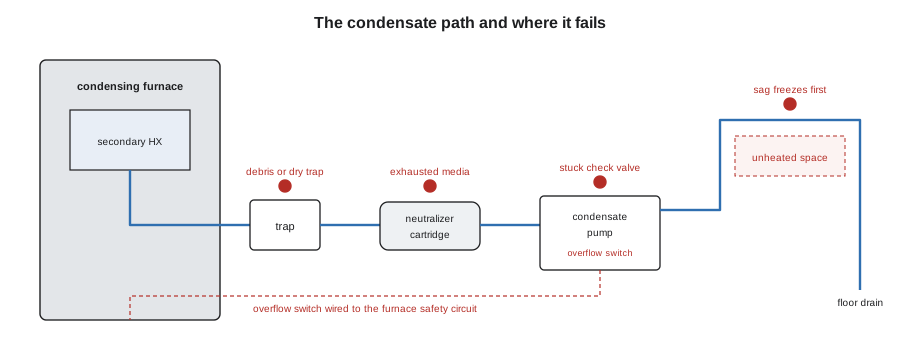
The condensate leaves the appliance through a trap, which holds a column of water that stops flue gas from escaping through the drain while letting condensate out. From the trap it runs to a floor drain, a laundry tub, a condensate pump or, where allowed, outdoors. Many installations include a neutralizer, a cartridge of limestone or similar media that raises the condensate's pH before it reaches drains, because condensate is acidic, often with a pH of about 3 to 4. Some local rules and some appliance makers require one; others recommend it.
Faults in this path account for most condensing lockouts:
- Blocked trap. Debris, rust from a corroding heat exchanger, scale and biological slime collect in the trap. A blocked trap backs water into the collector box, the pressure switch sees the change and opens, and on some furnaces water can reach the inducer. Traps are cleaned at every service and refilled with water before the appliance is restarted.
- Dry trap. A trap that has dried out, often after a summer without heating, lets flue gas out of the drain into the room. It is refilled before start-up.
- Exhausted neutralizer. As the media dissolves the neutralizer stops working, and on some designs the media turns to sludge that blocks the flow. The cartridge or media is replaced as the maker states, often once a year.
- Failed condensate pump. Pumps fail, their check valves stick, and their floats jam. A pump with an overflow safety switch, wired to shut off the appliance if the reservoir overflows, protects the house from flooding but shows up as a no-heat call. The pump's discharge line and check valve are tested, not just the motor.
- Drain lines without slope, or with sags. Condensate drains need a steady fall; a sag holds water, slows the flow and freezes first in a cold space.
- Frozen drains. Lines run outdoors, through unheated garages, crawlspaces or attics, or ending above ground where they ice over, freeze in cold weather. The fix is to reroute the drain inside the heated space, insulate it, or fit heat tracing approved for the purpose, not just to thaw it.
The bungalow boiler
At the bungalow on Upper Ottawa Street, Rosa found the boiler locked out with a code for its flue pressure or blocked drain sensor, depending on how the maker described it. She checked the basics, then followed the condensate. The trap at the boiler was full and the line from it was full too. The line ran 6 m (20 ft) along the basement ceiling with almost no slope, through the rim joist and out to a gravel bed against the foundation, where the last 300 mm (12 in.) of pipe ended above ground in the open air. In a long cold spell the water dribbling out of the end froze into a plug that grew back up the pipe. After a few days the plug reached the rim joist and the boiler backed up.
Rosa thawed the line to get the heat back on, but the repair was a different drain. There was a laundry tub in the basement 4 m (13 ft) from the boiler. She rerouted the condensate to the tub through a new neutralizer, with a steady fall all the way, and capped the old wall penetration. She refilled and tested the trap, ran the boiler through three cycles at full fire and checked the combustion readings, and left the old exterior line in place but disconnected, with a note explaining why it must not be reconnected.
Plastic venting faults
Condensing appliances vent through plastic pipe, certified to ULC S636 in Canada, and the venting itself causes faults:
- Slope. Vent pipe must slope back toward the appliance so that condensate inside it drains back to the trap. A vent that slopes the wrong way, or sags between supports, collects water that partly blocks it, as in the GAS-220 Kowalczyk case.
- Joints. Cemented joints that were not primed and cemented correctly can separate or leak. A leaking exhaust joint inside the house lets flue gas and condensate out; the joints are inspected wherever they can be seen.
- Unlisted materials. Plumbing-grade foam-core pipe, or a mix of materials not in the maker's instructions, is not acceptable vent pipe. Where it is found it is replaced.
- Terminations. Lesson 5 covered snow and ice. Condensing terminations also make a plume of vapour that can frost nearby surfaces, freeze on soffits, stain siding, or be drawn into a nearby window, intake or the appliance's own air intake. The maker's clearances and the code's clearances for terminations apply, and concentric and two-pipe terminations must be the maker's approved kits.
- Recirculation. If the exhaust is drawn back into the intake, the appliance burns its own flue gas, and its oxygen falls and CO rises. The symptom is poor combustion that improves when the terminations are separated.
Corrosion and the heat exchanger
Condensate is acidic, and if the combustion air contains chlorine or fluorine compounds, from laundry chemicals, pool supplies, solvents, refrigerants, paint strippers or a hobby workshop, the condensate becomes much more corrosive. Those compounds can eat through a secondary heat exchanger in a few years. When a technician finds a corroded secondary heat exchanger, white crusting on the inducer, or rust flakes in the trap, they look for the source of contamination in the combustion air and recommend moving the chemicals or, on a direct-vent appliance, making sure it draws air from outdoors as intended. Lesson 8 covers the heat exchanger inspection itself.
| Symptom on a condensing appliance | Look first at |
|---|---|
| Locks out after a long cold spell | Frozen condensate drain or iced termination |
| Locks out after a long run, fine when restarted | Trap or drain backing up slowly; sag in the vent |
| Water on the floor | Pump, check valve, trap seal, leaking vent joint |
| Flue gas smell near the appliance | Dry trap, separated vent joint |
| High CO with low O₂ | Recirculation at the terminations, blocked secondary |
| Rust or white crust in the trap | Corrosion from contaminated combustion air |
Condensing boilers and water heaters
Condensing boilers and water heaters share the furnace's condensate problems and add a few of their own. Many condensing boilers have a built-in condensate trap with a float or a sensor that shuts the burner off if the trap backs up, and a blocked trap shows up as a specific code rather than a pressure switch fault. Their heat exchangers, often stainless steel or aluminum, are sensitive to water quality on the water side: a boiler filled with untreated water, or topped up often because of a leak, can scale or corrode inside and lose heat transfer. The maker's water quality requirements, including limits on hardness and pH and the use of approved inhibitors, are part of servicing them.
Condensing boilers also condense only when their return water is cool enough. A boiler that never condenses is not faulty, but it is not giving the efficiency the owner paid for. Outdoor reset, which lowers the supply temperature in mild weather, keeps return temperatures low; GAS-320's Rymal Medical case showed what happens when the outdoor sensor fails. On a service call, the technician checks that the reset curve is set sensibly and the outdoor sensor reads the real outdoor temperature.
Condensing tank water heaters and tankless heaters often have a condensate neutralizer built in or required by the maker, and their terminations and condensate lines freeze in the same way as a furnace's. Tankless heaters add scale on the water side, which reduces flow and makes the heater cycle or overheat; descaling on the maker's schedule, especially in hard-water areas, is part of their service.
| Condensing boiler or water heater symptom | Check |
|---|---|
| Locks out with a condensate code | Built-in trap, its float or sensor, the drain |
| Needs frequent topping up | Water leak in the system; water quality and inhibitor |
| Never condenses, low efficiency | Reset curve, outdoor sensor, return temperatures |
| Tankless heater cycles or overheats | Scale on the water side, flow, inlet screen |
Start-up of a condensing appliance after summer
The first cold days of autumn bring a wave of condensing appliance calls that a good start-up visit would have prevented. Over the summer, traps dry out, insects nest in terminations, condensate pumps' floats stick, and neutralizer media cakes. Before the heating season, the technician refills and tests the trap, pours water into the condensate path to check that it drains all the way and that the pump and its overflow switch work, inspects both terminations for nests and debris, and checks the vent's slope and supports. On a boiler, the built-in trap is cleaned and refilled as the maker shows. These checks take a few minutes and remove most of the reasons a condensing appliance would lock out on the first cold night.
Explaining condensate to the customer
Customers often do not know that their furnace or boiler makes water, and the drain, pump and neutralizer are easy to forget until something goes wrong. A short explanation at the end of a call helps: where the condensate goes, why it is slightly acidic, what the pump sounds like when it runs, what it looks like when the overflow switch has stopped the furnace, and why the line must not be run outdoors or through a cold garage. Bayline technicians also tell customers never to pour the water from a condensate pump into a garden bed or onto a lawn in quantity, and never to block or remove the drain. A customer who understands the condensate path is the first to spot a problem with it.
Common mistakes
MistakeThawing a frozen condensate line and leaving.
InsteadReroute, insulate or trace it so it cannot freeze again.
MistakeRestarting a furnace or boiler with a dry trap.
InsteadRefill the trap with water before start-up.
MistakeTesting a condensate pump's motor and ignoring its check valve and overflow switch.
InsteadTest the whole pump: float, motor, check valve, discharge line, overflow switch.
MistakeRunning a condensate line with no fall.
InsteadGive it a steady fall to its drain.
MistakeUsing plumbing foam-core pipe for a condensing vent.
InsteadUse only the vent materials the maker and code allow.
MistakeReplacing a corroded secondary heat exchanger without finding the contamination.
InsteadFind and remove the chlorine or fluorine source in the combustion air.
Summary and key terms
- Condensing appliances make a lot of acidic water: up to about 1.5 kg per cubic metre of gas burned if fully condensed, and several litres or gallons on a cold day.
- Most of their faults are in the condensate path: blocked or dry traps, exhausted neutralizers, failed pumps and check valves, sagging drains and frozen lines, which are fixed by rerouting, insulating or tracing, not just thawing.
- Plastic vents must slope back to the appliance, be joined correctly, be of materials the maker and code allow, and end at approved terminations with the required clearances and no recirculation.
- Corroded secondary heat exchangers usually mean chlorine or fluorine compounds in the combustion air.
- Condensate
- Water condensed from flue gas in a condensing appliance, usually acidic.
- Condensate trap
- A water seal that lets condensate drain out while stopping flue gas from escaping through the drain.
- Neutralizer
- A cartridge of limestone or similar media that raises the pH of condensate before it is drained.
- Condensate pump
- A small pump that lifts condensate to a drain, often with an overflow safety switch.
- Recirculation
- Flue gas from an exhaust termination drawn back into the appliance's intake.
- Secondary heat exchanger
- The part of a condensing appliance that cools flue gas below its dew point.
Practice problems
Work each problem on paper first, then reveal the answer to check.
Why does a dry condensate trap matter?
Show answer
It lets flue gas out of the drain into the room.
What caused the bungalow boiler's lockouts?
Show answer
Its condensate line ended outdoors above ground and froze into a plug that grew back up the pipe.
What was the repair?
Show answer
Rerouting the condensate inside to a laundry tub through a neutralizer, with a steady fall.
Why must a condensing vent slope back toward the appliance?
Show answer
So that condensate inside it drains back to the trap instead of collecting in the pipe.
What usually causes rapid corrosion of a secondary heat exchanger?
Show answer
Chlorine or fluorine compounds in the combustion air, which make the condensate far more corrosive.
Lesson quiz · 5 questions
Score 60% or more to complete this lesson.
Create a free account to save your progress, take quizzes and earn a certificate.