
GAS-340 · Lesson 3 of 12 · 24 min
Pressure and flow problems
▶ Video coming soon A video version of this lesson is on the way.
Rosa's third work order came from a bitterly cold week in January 2026. A family on Mohawk Road West had added a gas range and a tankless water heater during a kitchen renovation the summer before. Their furnace, which had been fine for twelve years, now locked out on cold evenings, but only sometimes. The renovation contractor had sent his plumber, who replaced the furnace's igniter. It locked out again the next evening. When Rosa arrived, the furnace was running and the house was warm. She asked the owner to run the hot water in the kitchen and the shower, turn on all four burners on the range and the oven, and then call for heat at the thermostat. Within a minute the furnace's flame was small and lazy, and the analyzer's CO reading was climbing.
Gas pressure and flow are where many faults begin, and where many faults are wrongly blamed. A burner that is short of gas lights roughly or not at all, makes less heat, may produce carbon monoxide and may lose its flame signal; a burner with too much gas overfires, overheats and also produces carbon monoxide. This lesson shows how to read the pressures that matter, what the patterns of readings mean, and how to find the cause: the supply, the regulators, the piping or the appliance's own valve.
The pressures that matter
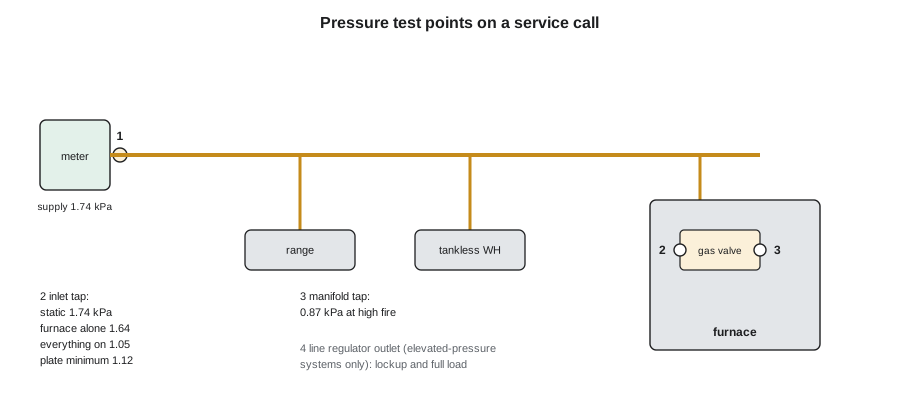
Every gas appliance has a range of inlet pressures it is certified to work with, marked on its rating plate or in its manual, and a manifold pressure set for its burners. GAS-120 and GAS-330 showed how the pressures are set; on a service call they are measured, at four points:
- Supply pressure at the meter outlet, to confirm what the utility is delivering, typically 1.74 kPa (7 in. w.c.) on a low-pressure house service.
- Inlet pressure at the appliance, read at the inlet tap on the combination valve or a test tee upstream, first static with nothing burning and then running with the appliance and every other appliance on the system firing.
- Manifold pressure, read at the valve's outlet tap with the burner firing, compared with the rating plate: typically about 0.87 kPa (3.5 in. w.c.) at high fire on a natural gas furnace.
- Line regulator outlet, on an elevated-pressure system, at lockup and at full load, as GAS-330 described.
The manometer is zeroed with both ports open before each connection, and the tap is closed and leak-tested with solution after the reading. Readings are always written down with the condition they were taken under: static, running alone, running with everything on.
Reading the pattern
One reading tells little. The pattern of readings across the four points, static and running, tells where the problem is:
| What the readings show | Most likely cause | Next test |
|---|---|---|
| Supply low at the meter, static and running | Utility supply or service regulator | Call the utility; do not adjust their regulator |
| Supply good static, drops a lot at the meter when running | Meter or service undersized for the added load, or a regulator problem | Utility to check the meter and regulator size |
| Supply good, appliance inlet good static, drops a lot running | Undersized or restricted piping or connector between meter and appliance | Read pressure at points along the pipe; check sizes against the load |
| Inlet good running, manifold low | Appliance regulator set low, failing or blocked; wrong valve | Check the regulator vent and setting; clock the meter |
| Inlet good, manifold high | Appliance regulator set high or failed | Reset to the plate and clock; replace the valve if it will not hold |
| Inlet swings or creeps up at no flow | Regulator upstream leaking through or vent restricted | Check lockup at the line or service regulator |
Two other measurements confirm what the pressures suggest. Clocking the meter, described in GAS-110, measures the gas the appliance actually burns; an appliance with the right manifold pressure but a much lower clocked input has a restriction such as a partly blocked orifice. And a combustion analysis, described in GAS-230, shows the effect: high CO with low CO₂ and high O₂ can mean underfiring; high CO with low O₂ can mean overfiring or too little air.
Undersized piping after added appliances
The most common pressure problem on service calls is the one at Rosa's January house: appliances added to a system that was sized for less. The pipe from the meter to the furnace was sized years ago for a furnace and a water heater. A range and a tankless water heater were added, the tankless alone at about 58 kW (199,000 Btu/h), more than twice the furnace. With everything firing at once, the flow through the old pipe roughly quadrupled, and the pressure drop through it, which rises roughly with the square of the flow, went up more than ten times.
The symptom is a furnace that works on its own and fails when the other appliances are on, exactly the pattern a customer struggles to describe. The fix is the one GAS-120 taught for new work: add up the connected load, measure the lengths, size the piping from the tables or formulas for the allowed drop, and replace or parallel the sections that are too small. On a service call, the technician's job is to prove the cause with readings and recommend the repair; the repiping is often a separate job.
Worked problem
Is the furnace getting enough gas?
At Rosa's January house the furnace's plate gives a minimum inlet pressure of 1.12 kPa. She read 1.74 kPa static, 1.64 kPa with the furnace running alone and 1.05 kPa with the furnace, range and tankless heater all firing. The meter outlet stayed at 1.70 kPa throughout. How much pressure is lost in the piping in each case, and is the furnace inside its limit?
Show solution
- Furnace alone, from the meter outlet to the furnace inlet:
- \[1.70 - 1.64 = 0.06 \text{ kPa}\]
- Everything firing:
- \[1.70 - 1.05 = 0.65 \text{ kPa}\]
- Compare with the minimum:
- \[1.05 \text{ kPa} < 1.12 \text{ kPa}\]
- House piping is commonly sized for a drop of about 0.125 kPa, so a 0.65 kPa drop is about five times what a correctly sized system would lose.
Answer: With everything firing, the furnace is below its minimum inlet pressure. That explains the lazy flame, the CO and the lockouts on cold evenings when the family cooked and showered at once. A drop that large meant either badly undersized pipe or a restriction, and Rosa went looking for it.
Rosa followed the drop along the pipe. With everything firing, she read the pressure at a tee near the kitchen branch and found most of the loss between the meter and that tee, in a 12 mm (1/2 in.) section that the renovation plumber had used to reroute the main around a new kitchen bulkhead. A half-inch section carrying the whole house load was the restriction. Rosa shut off and tagged nothing, because with the range and tankless off the furnace was safe, but she told the owner not to run all three together, gave him the readings in writing and recommended that the rerouted section be replaced at the original size and the whole system checked against the new load. Bayline replaced the section two days later; with everything firing, the furnace then saw 1.52 kPa.
Regulator problems on service calls
Regulator faults show up as pressures that are wrong, unstable or changing with time. GAS-330 covered how regulators work; on a service call, three patterns come up again and again:
- Droop at full load. The outlet falls well below the set point when every appliance fires. The regulator may be too small for the added load, its spring may be wrong, or a strainer upstream may be clogged. Reading the inlet and outlet at full load separates these.
- Lockup creep. With everything off, the outlet pressure keeps rising slowly instead of settling. The regulator is leaking through, usually because of debris on the seat. On a line regulator that feeds appliance valves rated for a low maximum, this is a hazard, because the lockup pressure can exceed what the valves are built for.
- Hunting and freezing. The outlet swings up and down, or the regulator stops controlling on a cold day. A restricted or blocked vent, often packed with snow, ice or insect nests, is a common cause. Regulators that vent outdoors need their vent openings kept clear, as GAS-330 described.
Appliance regulators inside combination valves can also fail. A valve that will not hold its manifold setting, or whose manifold pressure creeps when the burner shuts off, is replaced; combination valves are not repaired in the field.
Propane systems
On propane, the same patterns apply at different numbers, and two more causes are common in winter. A tank that is nearly empty, or too small for the load on a cold day, cannot vaporize enough gas, and the first-stage pressure falls; GAS-240 explained vaporization. A first-stage or second-stage regulator vent that ices over can make the pressure wander. A service technician on a propane call reads the tank gauge, the first-stage outlet and the second-stage outlet, as well as the appliance inlet and manifold, before blaming the appliance.
| Check | Natural gas house (typical) | Propane house (typical) |
|---|---|---|
| Supply / second-stage outlet | 1.74 kPa (7 in. w.c.) | 2.74 kPa (11 in. w.c.) |
| Furnace manifold, high fire | 0.87 kPa (3.5 in. w.c.) | 2.49 kPa (10 in. w.c.) |
| Furnace manifold, low fire (two-stage) | 0.42 kPa (1.7 in. w.c.) | As the maker states |
| Common cause of low pressure | Undersized piping after added load | Low tank level or vaporization on a cold day |
Confirming the input by clocking
Pressure readings say whether the gas is reaching the burner at the right pressure. They do not say how much gas the burner is actually burning. A partly blocked orifice, a wrong orifice from a botched conversion, a spider web in a burner or a manifold set by someone without a gauge can all leave the manifold pressure looking right while the input is wrong. Clocking the meter, as GAS-110 showed, measures the input directly, and on a service call it is the check that settles an argument about whether an appliance is underfiring or overfiring.
To clock an appliance, every other gas appliance on the meter is turned off, including pilots where practical, and the appliance is run at the firing rate being checked until it is steady. The technician times one or more revolutions of the meter's test dial, converts the time to a flow rate, and multiplies by the heating value of the gas. Most utilities publish their average heating value; Bayline uses 37.5 MJ/m³ for natural gas, the figure used throughout this program, unless the utility gives another.
Worked problem
Clocking the furnace after the repair
After the main was replaced at Rosa's January house, she clocked the furnace at high fire with every other appliance off. The meter's test dial on this meter measures 0.05 m³ per revolution, and one revolution took 72 seconds. The rating plate gives an input of 26 kW. Is the furnace burning its rated input?
Show solution
- Flow rate:
- \[\frac{0.05 \text{ m}^3}{72 \text{ s}} \times 3600 \text{ s/h} = 2.5 \text{ m}^3\text{/h}\]
- Energy per hour:
- \[2.5 \times 37.5 = 93.75 \text{ MJ/h}\]
- Convert to kilowatts, since 1 kW is 3.6 MJ/h:
- \[93.75 \div 3.6 \approx 26.0 \text{ kW}\]
Answer: The furnace is burning its rated input. Before the repair, the same check with everything else firing was impossible, because the meter was measuring the whole house; that is why clocking is always done with the other appliances off.
A clocked input more than a small margin away from the plate, commonly taken as about 5 in 100 either way unless the maker gives a figure, calls for a closer look. Low input with correct manifold pressure points to the orifices or the burner; high input points to the wrong orifices or a manifold set high. At high altitude, or on a gas supply with an unusual heating value, the maker's instructions say how to derate, and the clocked input is compared with the derated figure.
Combination valve checks
When the inlet pressure is right and the manifold pressure is wrong, the combination valve is the suspect. Before condemning it, the technician checks the simple things: that the valve's regulator vent, if it has one, is open; that the manifold adjustment has not simply been turned; that the voltage at the valve's coil terminals during the call is right, about 24 V on most furnaces; and on two-stage valves, that both stages are getting their signal. A valve with the right voltage at its terminals that does not open, will not hold its manifold setting, or lets gas through to the manifold when it is closed is replaced as a unit with the maker's part or an approved replacement, then leak-tested, set to the plate and clocked.
A closed valve that passes gas is tested by reading the manifold tap with the valve closed and the burner off: any pressure that builds up on the manifold side means gas is leaking through. That is a hazard, because gas can collect in the combustion chamber between cycles and light with a bang on the next ignition; the appliance is shut off at its manual valve until the combination valve is replaced.
Common mistakes
MistakeReading the inlet pressure only with the appliance off.
InsteadRead static and running, with every appliance on the system firing.
MistakeBlaming the appliance for low manifold pressure without checking its inlet.
InsteadRead the inlet first; the supply may be the problem.
MistakeTurning up the manifold pressure to make up for a weak supply.
InsteadFind and fix the supply problem; set the manifold to the plate.
MistakeAdjusting the utility's service regulator.
InsteadCall the utility; only they adjust it.
MistakeIgnoring a lockup pressure that keeps creeping up.
InsteadTreat it as a regulator leaking through and fix it.
MistakeLeaving a test tap open or untested.
InsteadClose it and leak-test it with solution after every reading.
Summary and key terms
- Pressure and flow faults cause rough lighting, underfiring or overfiring, CO and flame loss.
- Pressures are read at the meter outlet, the appliance inlet (static and running with everything on), the manifold and any line regulator, and the pattern tells where the fault is: supply, meter, piping, appliance regulator or valve.
- Clocking and combustion analysis confirm it.
- Added appliances on piping sized for less are the most common cause, because pressure drop rises with roughly the square of the flow.
- Regulator faults show as droop, lockup creep, hunting or freezing, often from blocked vents.
- Propane adds low tank level and vaporization to the list.
- Static pressure
- The pressure in the gas piping with no gas flowing.
- Running pressure
- The pressure with the appliance, and usually every other appliance on the system, firing.
- Manifold pressure
- The pressure at the burner manifold, set by the appliance regulator to the rating plate.
- Pressure drop
- The loss of pressure as gas flows through piping, fittings and valves.
- Lockup creep
- A slow rise in regulator outlet pressure at no flow, caused by gas leaking past the seat.
- Underfiring
- Burning less gas than the rated input, from low pressure or a restriction.
Practice problems
Work each problem on paper first, then reveal the answer to check.
Why must the appliance inlet be read with every appliance firing?
Show answer
Because the drop through the piping depends on the total flow; a furnace may be fine alone and short of gas when everything runs.
What pattern points to undersized piping?
Show answer
Good supply at the meter, good inlet static, and a large drop at the appliance when running.
What was the restriction at Rosa's January house?
Show answer
A half-inch section used to reroute the main around a kitchen bulkhead.
What does lockup creep mean?
Show answer
The regulator is leaking through at no flow, often from debris on the seat.
Name two propane-specific causes of low pressure in winter.
Show answer
A nearly empty or undersized tank that cannot vaporize enough, and an iced regulator vent.
Lesson quiz · 5 questions
Score 60% or more to complete this lesson.
Create a free account to save your progress, take quizzes and earn a certificate.